Maintaining accurate books is the foundation of any successful business. However, business owners frequently make common bookkeeping mistakes that can lead to cash flow issues, tax penalties, and poor decision-making. This guide breaks down the most frequent errors and provides actionable advice on how to prevent them — before they cost you money.
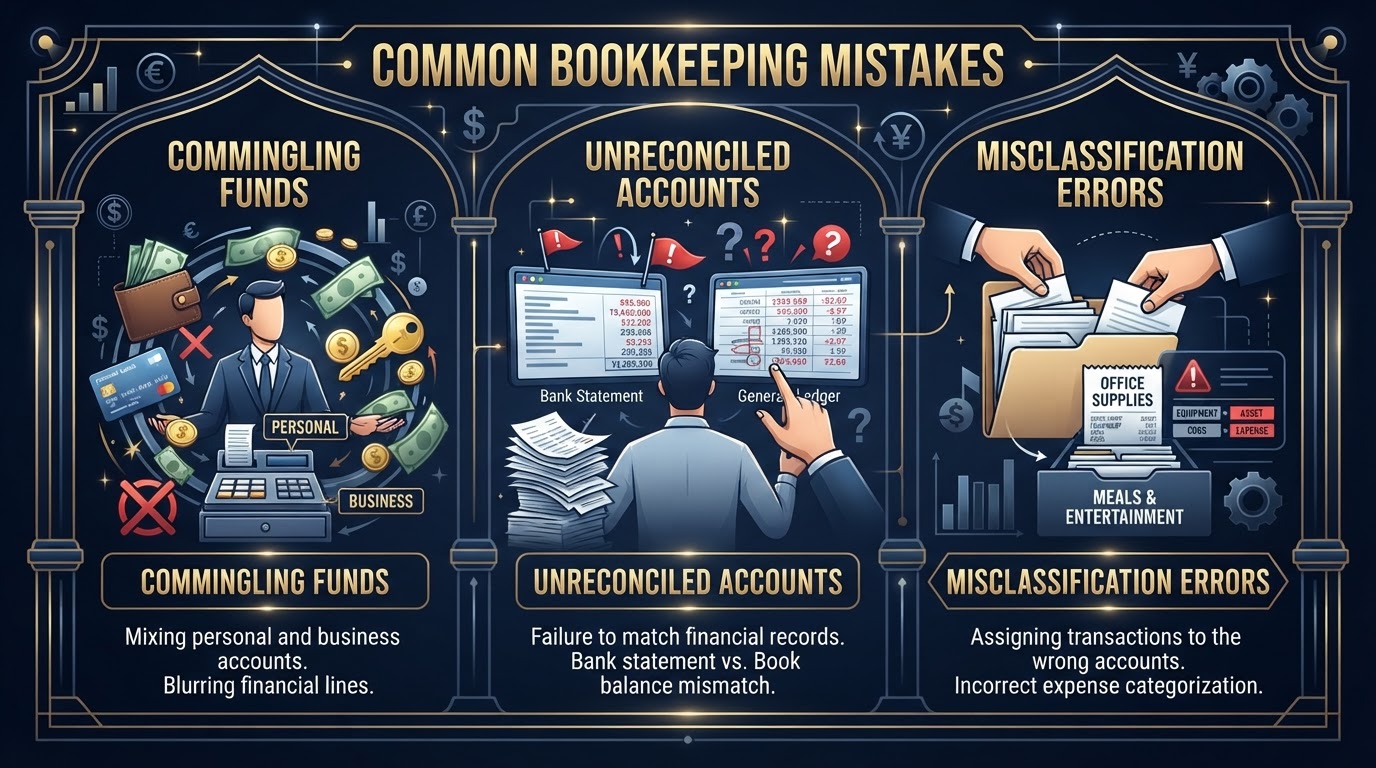
The pattern behind almost every bookkeeping mistake is the same: a shortcut taken for convenience today creates a problem that is far more expensive to fix tomorrow. The good news is that every one of these errors is preventable with the right systems and habits.
Commingling Personal and Business Funds
Commingling — using a personal account for business expenses or vice versa — is the single most damaging bookkeeping mistake a business owner can make. It destroys the corporate veil that protects your personal assets from business liabilities, it makes reconciliation nearly impossible, and it turns tax preparation into a forensic exercise. In an audit, commingled accounts are a red flag that can trigger the IRS to disregard your entity entirely.
The fix is simple in principle: open a dedicated business checking account and a business credit card, and run every business transaction through them. If you need to move money between personal and business, do it as a formal transfer or distribution — not by paying a business expense from a personal account. We help set up the accounts and the transfer discipline that keeps the books clean.

- Commingling pierces the corporate veil and risks your personal assets
- Open dedicated business accounts; run every transaction through them
- Move money as formal transfers or distributions, never ad hoc
Failing to Reconcile Bank Accounts Monthly
Bank reconciliation is the process of matching your books to your bank statement — confirming that every transaction is recorded, every deposit cleared, and every fee captured. When reconciliation is skipped, errors compound: duplicate transactions, missing entries, and unrecorded fees accumulate until the books no longer reflect reality. By the time the discrepancy is discovered, it can take days to untangle.
Monthly reconciliation is the single most important bookkeeping habit. It catches errors while they are still small, confirms that no transactions are missing, and produces a clean set of books for tax preparation. We reconcile every account every month, without exception.
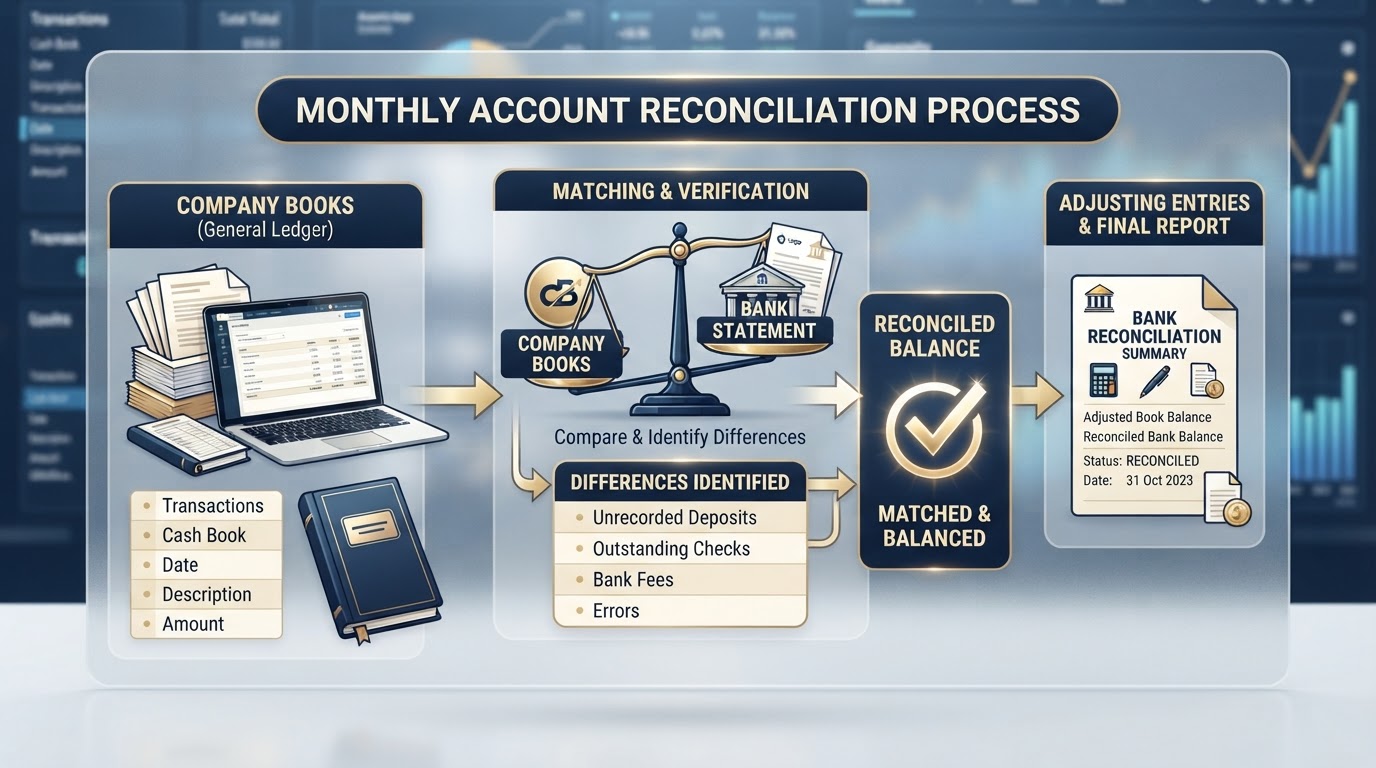
- Reconciliation matches books to bank statements every month
- Skipping it lets errors compound until the books no longer reflect reality
- Monthly reconciliation is the most important bookkeeping habit
Misclassifying Employees as Independent Contractors
Treating an employee as an independent contractor to save on payroll taxes is one of the most expensive mistakes a business can make. The IRS and California apply strict tests (behavioral control, financial control, relationship) to determine worker classification. If the IRS reclassifies a contractor as an employee, you owe back payroll taxes, penalties, and interest — and the liability can be retroactive for years.
The test is not what you call the worker — it is the substance of the relationship. If you control when, where, and how the work is done, the worker is likely an employee. We review your worker classifications against the tests and help restructure relationships that are at risk before a government agency does it for you.
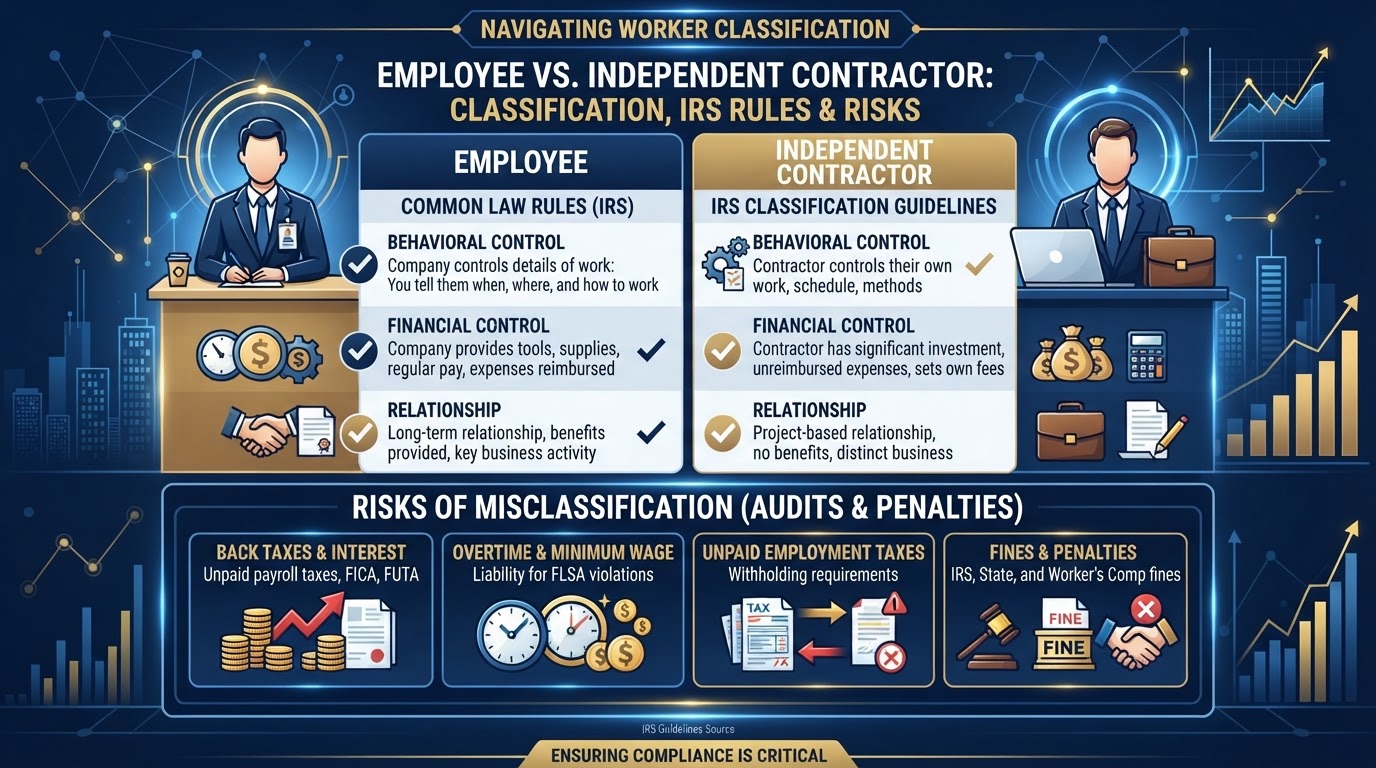
- Classification is based on substance, not the label you use
- Reclassification triggers back payroll taxes, penalties, and interest
- Tests: behavioral control, financial control, type of relationship
Not Keeping Receipts for Expenses under $75
There is a common misconception that receipts under $75 are not required. The IRS requires documentary evidence for any lodging expense regardless of amount, and for any other expense of $75 or more. But even for smaller expenses, you still need a record of the amount, date, place, and business purpose. A bank or credit card statement can serve as evidence for smaller amounts, but the business purpose must still be documented.
The simplest solution is to capture every receipt digitally at the time of purchase — a photo of the receipt with the business purpose noted. We set up a receipt capture workflow that makes this effortless, so the documentation exists before an audit ever begins.
- Lodging receipts required regardless of amount; others $75+
- Business purpose must be documented even for small expenses
- Capture receipts digitally with the business purpose at time of purchase
Improper Categorization of Expenses
When every expense is dumped into "miscellaneous" or "office expense," the books are useless for decision-making and ripe for audit adjustment. Proper categorization — separating cost of goods sold, advertising, vehicle, meals, wages, and professional fees — produces a meaningful profit and loss statement and supports every deduction on the tax return.
We design a chart of accounts tailored to your business so every transaction lands in the right category automatically. The result is books that tell you where your money is going and that survive IRS scrutiny without adjustment.
- Dumping everything into "miscellaneous" makes books useless
- Proper categories produce a meaningful P&L and support deductions
- A tailored chart of accounts categorizes transactions automatically
Trying to Do It All Yourself Without Professional Help
The final mistake is attempting to handle bookkeeping, payroll, and tax without professional support. The owner's time is the most valuable asset in the business, and every hour spent reconciling accounts is an hour not spent selling, delivering, or growing. Beyond the opportunity cost, the tax code changes every year, and a missed deduction or credit can cost far more than the cost of professional help.
Professional bookkeeping is not an expense — it is an investment in accurate financials, defensible tax positions, and the owner's time. Contact us to take the bookkeeping off your plate so you can focus on running the business.
- Owner's time is the most valuable asset — don't spend it on reconciliation
- The tax code changes yearly; missed deductions cost more than help
- Professional bookkeeping is an investment, not an expense
Conclusion
Every bookkeeping mistake in this guide is preventable with the right systems: dedicated accounts, monthly reconciliation, correct worker classification, receipt capture, proper categorization, and professional support. The cost of prevention is always less than the cost of the mistake. Contact us to review your books and put these systems in place before the next tax season.
Quick Tax Savings Estimator
See how much you could potentially save with proactive tax strategy and clean bookkeeping. Most LA businesses overpay by 15-20% simply due to missed deductions.
Free IRS Audit Risk Assessment
Do you mix personal and business expenses in the same bank account?
Frequently Asked Questions
How far back can you catch errors?
I perform a deep forensic review of your history to catch errors and fix them. Whether it's one year or five, my goal is to ensure your historical data is pristine before we move forward.
Will you educate me on how to manage my books?
Yes! My approach is highly educational. I want you to understand the "why" behind the numbers so you can make better business decisions with confidence.

About the Author
Wiyao Awesso
Wiyao Awesso is a leading financial advisor in Los Angeles. With extensive experience in tax strategy, accounting, and fractional CFO services, he helps business owners optimize their finances, minimize tax liabilities, and scale with confidence.