Business Formation & Entity Structuring
Built to Minimize Your Tax Burden.
We form your LLC or S-Corp and structure it the right way from day one — entity selection, filing, EIN, operating agreements, and clean bookkeeping setup. Most business owners overpay in taxes simply because they are in the wrong structure. Your choice of entity determines your liability, your tax burden, and your long-term wealth potential.
Why Entity Selection Matters
In the world of business, your legal structure is more than just a piece of paper filed with the Secretary of State. It is the fundamental architecture of your financial life. It dictates how much you pay the IRS, how much of your personal wealth is at risk in a lawsuit, and how easily you can bring on partners or eventually sell your company.
At Fiscal Integrity Group, we see thousands of business owners operating as Sole Proprietors or standard LLCs long after they should have converted to an S-Corporation. This simple mistake often costs them $10,000 to $50,000 every single year in avoidable self-employment taxes. On the other hand, we see high-growth startups stuck in an S-Corp structure that prevents them from raising venture capital or taking advantage of the massive Section 1202 capital gains exclusion.
Choosing the right entity is a dynamic process. What worked for you when you were making $50,000 a year likely won't work when you're making $500,000. Our goal is to ensure your structure always aligns with your revenue, your risk profile, and your ultimate exit strategy.
Which Entity Is Right for You?
Each structure trades simplicity for protection and tax savings. Here's how they compare.
Sole Proprietorship
Simple, low-risk side businesses just starting out
Pros
- Easiest to set up
- No separate tax return
- Full control
Cons
- Unlimited personal liability
- No credibility with lenders
- Highest self-employment tax
Single-Member LLC
Owners who want liability protection without complexity
Pros
- Personal asset protection
- Flexible taxation
- Simple to maintain
Cons
- Still self-employment tax
- Less favorable than S-Corp at higher income
S-Corporation
Profitable owners ready to cut self-employment tax
Pros
- Save on self-employment tax
- Reasonable salary + distributions
- Credibility & audit-ready structure
Cons
- Payroll requirements
- Stricter recordkeeping
- Reasonable salary rules
Multi-Member LLC / Partnership
Co-owners who need flexibility and protection
Pros
- Liability shield for all owners
- Flexible profit splits
- Pass-through taxation
Cons
- Needs an operating agreement
- Partnership tax return required
The Formation Journey
We don't just file paperwork — we set up your entity, governance, banking, and bookkeeping so your structure is defensible from day one.
Strategy & Entity Selection
We analyze your revenue, goals, and tax exposure to recommend the entity that legally minimizes your tax burden — not just the one that's easiest to file.
Name Reservation & Filing
We confirm name availability and file your Articles of Organization or Incorporation with the California Secretary of State.
EIN & Tax Accounts
We obtain your federal Employer Identification Number and register for any required state tax accounts (sales tax, payroll, franchise tax).
Operating Agreement & Governance
We draft your operating agreement or corporate bylaws, issue ownership stakes, and set up the governance documents that protect your liability shield.
Banking & Bookkeeping Setup
We help you open a separate business bank account and connect it to QuickBooks Online so your books are clean from day one.
Find Your Ideal Structure
Answer 5 quick questions to discover which entity type aligns best with your goals.
Question 1 of 5
What is your estimated annual net profit?
Core Business Structures
The foundation of your business starts here. Choose the structure that aligns with your current operations and future ambitions.
Sole Proprietorship
The Solo Preneur
An unincorporated business owned by a single individual. It is the simplest form of business to start and operate, with no formal legal separation between the owner and the business. While easy to form, it places the owner's personal assets at significant risk.
Strategic Benefits
- Complete Control over all business decisions and operations
- Minimal Startup Costs and simplified registration process
- Simplified Tax Filing (Schedule C on your personal 1040)
- No Corporate Formalities like board meetings or minutes
- Direct access to all business profits without dividend rules
Critical Risks
- Unlimited Personal Liability for all business debts and lawsuits
- Difficult to Raise Capital from outside investors or lenders
- Self-Employment Taxes (15.3%) on 100% of business profits
- Lack of continuity if the owner becomes incapacitated
- Limited fringe benefit deductions compared to corporations
Next Major Deadline: Form 1040 (Schedule C) Deadline
April 15, 2027

"Our team provides a comprehensive structural audit to ensure your Sole Proprietorship is optimized for maximum tax efficiency and asset protection."
General Partnership (GP)
Collaborative Ventures
A simple structure for two or more owners sharing profits and liabilities. Partners share equal responsibility for management and unlimited liability for debts. It's often used for professional services or early-stage collaborations.
Strategic Benefits
- Shared Responsibility for management and daily operations
- Pooled Resources and varied skill sets from multiple partners
- Pass-Through Taxation (profits taxed at individual level)
- Easy to Form with a simple partnership agreement
- Flexible profit-sharing arrangements among partners
Critical Risks
- Joint and Several Liability (responsible for partner's actions)
- Potential for Conflict in decision-making and vision
- Difficult to Transfer Ownership without dissolving the GP
- Profits subject to full Self-Employment tax for active partners
- Personal assets are exposed to business creditors
Next Major Deadline: Form 1065 Deadline
March 15, 2027

"Our team provides a comprehensive structural audit to ensure your General Partnership (GP) is optimized for maximum tax efficiency and asset protection."
Limited Liability Company (LLC)
The Modern Hybrid
A hybrid that combines the liability protection of a corporation with the tax flexibility of a partnership. It is the most popular choice for modern small businesses and real estate holdings due to its simplicity and protection.
Strategic Benefits
- Asset Protection: Shields personal assets from business liabilities
- Flexible Tax Election: Can be taxed as Sole Prop, S-Corp, or C-Corp
- Unlimited Members and flexible management structures
- Minimal Formalities compared to corporations (no mandatory minutes)
- Pass-Through Taxation avoids double taxation on profits
Critical Risks
- Self-Employment Taxes apply to all profits (unless S-Corp elected)
- Varying State Laws and annual franchise fees (e.g., CA $800 min)
- Transfer Restrictions often require consent of other members
- Limited life span in some states if a member leaves
- Complexity increases when electing corporate tax status
Next Major Deadline: Form 1040 Deadline (Single-Member)
April 15, 2027

"Our team provides a comprehensive structural audit to ensure your Limited Liability Company (LLC) is optimized for maximum tax efficiency and asset protection."
S-Corporation (S-Corp)
The Tax Optimizer
A tax designation for corporations (and sometimes LLCs) that allows profits to pass through to owners' personal tax returns, avoiding double taxation while minimizing self-employment taxes through salary/distribution splits.
Strategic Benefits
- Significant Tax Savings by avoiding self-employment tax on distributions
- Asset Protection: Provides a corporate veil for shareholders
- Institutional Credibility and professional standing
- Easy Transfer of Ownership through the sale of stock
- Ability to offer tax-free fringe benefits to employees
Critical Risks
- Strict IRS Compliance and mandatory formal documentation
- Ownership Restrictions: Maximum 100 shareholders (US residents only)
- Reasonable Salary Requirements for officer-shareholders
- Increased payroll administrative costs and filings
- Risk of 'reclassification' if salary is deemed too low by IRS
Next Major Deadline: Form 1120-S Deadline
March 15, 2027

"Our team provides a comprehensive structural audit to ensure your S-Corporation (S-Corp) is optimized for maximum tax efficiency and asset protection."
C-Corporation (Inc.)
The Scalable Powerhouse
A legal entity separate from its owners, subject to corporate income tax. Ideal for businesses planning to scale globally, raise venture capital, or go public. Offers the highest level of structural permanence.
Strategic Benefits
- Unlimited Growth & Scaling potential with multiple stock classes
- Institutional Credibility for large-scale contracts and funding
- Section 1202 QSBS: Potential for 100% tax-free capital gains
- No Ownership Limits: Anyone, anywhere can own shares
- Comprehensive Fringe Benefits and deferred compensation plans
Critical Risks
- Double Taxation on dividends (corporate level + personal level)
- High Administrative Costs and complex annual filings
- Rigid Formalities: Mandatory board meetings, minutes, and bylaws
- Losses do not pass through to shareholders' personal returns
- Extensive regulatory oversight for larger entities
Next Major Deadline: Form 1120 Deadline
April 15, 2027

"Our team provides a comprehensive structural audit to ensure your C-Corporation (Inc.) is optimized for maximum tax efficiency and asset protection."
Specialized & Professional Structures
For licensed professionals and specialized business models, these structures offer targeted protections and advantages that go beyond the basics.
Professional LLC (PLLC) / PC
Designed for licensed professionals like doctors, lawyers, or accountants to limit personal liability for business debts while maintaining professional responsibility for their own malpractice.
Limited Partnership (LP)
Includes at least one general partner with unlimited liability and one or more limited partners whose liability is limited to their investment. Common in real estate and hedge funds.
Limited Liability Limited Partnership (LLLP)
A rare type of limited partnership that provides liability protection for the general partners as well, currently recognized in specific U.S. states.
Benefit Corporation (B Corp)
A for-profit corporation that includes positive social or environmental impact in its legally defined goals, balancing profit with purpose.
Close Corporation
A specialized corporation with a limited number of shareholders and fewer formal requirements, often used for family businesses to maintain tight control.
Non-Profit &
Alternative Structures
Nonprofit Corporation
Formed for charitable, educational, or religious purposes. Typically exempt from federal taxes under Section 501(c)(3) and offers liability protection to its directors while focusing entirely on public benefit.
Cooperative (Co-op)
A business owned and operated by the people who use its services or buy its products. Profits are distributed among user-members, creating a unique democratic business model.

The Master Comparison Matrix
A side-by-side breakdown of the most common legal structures to help you understand the trade-offs between protection, taxation, and compliance.
State-Specific Tax Guide
Where you form your entity matters just as much as what entity you choose. Compare annual fees and franchise taxes by state.
Click a state on the map to view its tax profile.
LLC Tax & Fees
$800 minimum franchise tax
C-Corp Tax & Fees
8.84% flat rate ($800 min)
Strategic Note
High compliance burden, aggressive tax board.
State Tax Comparison Map
Your geographic location can drastically alter your tax burden. See how states stack up across the country.
No Income Tax
Best for high-earning individuals and pass-through entities.
Low/Flat Tax States
Favorable corporate rates or low flat personal income tax.
High Tax States
Aggressive franchise fees and high marginal income tax rates.
* Note: Even if a state has no income tax, they may have high property taxes, sales taxes, or gross receipts taxes (like Texas Margin Tax). Always consult with a professional for a holistic view.
For Foreign Investors
Navigating the U.S. tax system as a non-resident requires specialized knowledge. We help international entrepreneurs find the right balance between tax efficiency and operational simplicity.
The LLC for Foreigners
Often the preferred choice due to its extreme flexibility and limited liability protection. Features pass-through taxation, meaning profits are taxed only at the owner's level, which can help avoid the "double taxation" found in corporations.
- Avoids U.S. corporate level tax entirely
- Simpler administrative and compliance requirements
- Extreme flexibility in management and profit distribution
The C-Corp for Scaling
Highly recommended for startups aiming for high growth or those planning to raise venture capital, as institutional investors often require a corporate structure.
- Acts as a "blocker" for individual U.S. tax filings
- Easier to issue different classes of stock for investors
- Eligible for Section 1202 QSBS tax exclusions
Optimizing Your Foundation
Choosing the entity is just the first step. The real wealth is built through how you leverage that entity using advanced IRS codes and strategies. Our team goes beyond the basics to find every legal advantage.
Which Structure is Right for You?
To provide more precise guidance, our specialists evaluate your business through these four critical strategic lenses:
Revenue & Profit Scaling
What is your estimated annual revenue and profit margin in the first 3-5 years? S-Corp savings typically become mathematically superior once net profit consistently exceeds the $75,000 threshold.
Capital Reinvestment
Do you plan to reinvest profits back into the company for rapid scaling, or distribute them to owners for personal wealth? C-Corps are excellent for reinvestment, while S-Corps favor annual distributions.
Ownership Complexity
How many owners are there, and what are their specific tax residencies? S-Corps are restricted to 100 U.S. resident shareholders, whereas C-Corps and LLCs offer unlimited ownership flexibility.
The Ultimate Exit
Are you building a lifestyle business to pass down, or a high-growth startup to sell? Section 1202 in a C-Corp can provide up to 100% tax-free capital gains on a sale, potentially saving you millions.
Our audits typically identify an average of $18,400 in annual tax savings for new clients.
Deep Dive Resources
Master the nuances of entity structuring through our exclusive playbooks. These guides provide the technical depth you need to make informed decisions.
The S-Corp Salary Playbook
Learn the exact salary/distribution split to minimize your self-employment taxes legally while staying audit-proof.
Read Full Playbook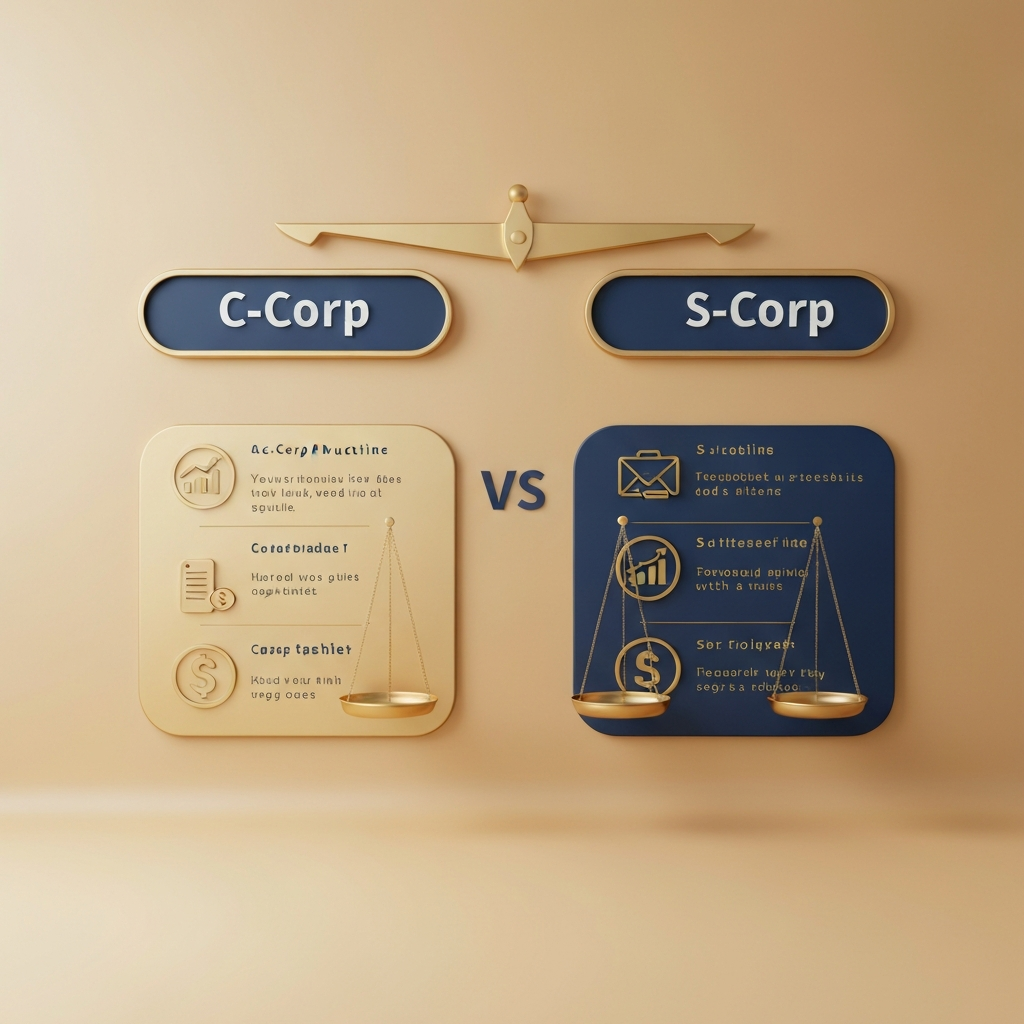
C-Corp vs S-Corp: The Showdown
A side-by-side technical comparison of the two most powerful corporate structures for scaling businesses.
Read Full Playbook
Maximizing the QBI Deduction
Unlock 20% tax-free income through proper entity structuring and navigating the complex SSTB rules.
Read Full PlaybookLLC vs. S-Corp: The Tax Savings Reality
See exactly how much more you pay as a standard LLC compared to an S-Corp at different profit levels. The gap widens dramatically as your income grows.
* Based on 2026 federal income tax brackets and SE tax rates. Assumes a single filer with a 40% reasonable S-Corp salary. State taxes not included. For a personalized analysis, book a structural audit.
$10k+
Annual savings at $100k profit
$30k+
Annual savings at $200k profit
$70k+
Annual savings at $500k profit
LLC to S-Corp Conversion Calculator
Converting to an S-Corp costs money (payroll fees, corporate tax returns). Find out your exact "breakeven point" and see if the tax savings outweigh the admin costs.
Net Annual Savings
+$2,684
Converting to an S-Corp is mathematically favorable.
5-Year Wealth Projection
Assuming 15% annual business growth
Total 5-Year Savings
$28,989
Reasonable Salary Benchmark
The IRS requires S-Corp owners to pay themselves a "reasonable salary" before taking tax-free distributions. Use industry benchmarks to find your defensible split.
IRS Audit Risk
Setting your salary below $45,000 significantly increases your risk of an IRS reclassification audit in the Consulting / Agency sector.
Suggested W-2 Salary
$60,000
Subject to 15.3% payroll tax
Owner Distribution
$90,000
Free from self-employment tax
Estimated FICA Tax Savings
$13,770
Tax Saving Scenarios
Adjust your profit and S-Corp salary percentage to see how different combinations affect your self-employment tax obligations.
Standard LLC SE Tax
$22,950
S-Corp Payroll Tax
$9,180
Annual SE Tax Savings
$13,770
Tax Deduction Finder
Select your industry and discover common write-offs you might be missing. See your estimated total deductions.
Common Deductions
Estimated Deductions
$0
This is a rough estimate. A proper tax strategy can often uncover significantly more.
Unlocking Real Estate Wealth
For our real estate investor clients, the entity is only half the battle. The real magic happens when you combine the right structure with aggressive depreciation strategies like Cost Segregation. Use the tool below to see your potential Year 1 impact.
Cost Segregation ROI Calculator
For real estate investors and Short-Term Rental (STR) owners. See how accelerated depreciation can create massive "paper losses" to offset your active income.
Year 1 Tax Savings
$55,500
Immediate cash flow impact
Net Strategy Benefit
+$47,427
Vs. standard depreciation
Year 1 Deduction Comparison
* Estimates based on typical residential rental cost segregation averages (25% reclass). Actual results require an engineering-based study. Bonus depreciation is 100% for 2025 and 2026 tax years.
The S-Corp Conversion Timeline
Converting from an LLC to an S-Corp is more than just checking a box. It requires strict IRS compliance, payroll setup, and strategic planning. Here is how we execute it flawlessly.
Structural Audit & Feasibility
We analyze your prior year's tax returns and current year-to-date profit to ensure an S-Corp election will actually save you money after admin costs.
File Form 2553 with the IRS
We prepare and file the S-Corp election form. The deadline is March 15th for existing LLCs, but we can often utilize Late Election Relief (Rev. Proc. 2013-30) if you missed it.
Set Reasonable Compensation
The IRS requires S-Corp owners to take a 'reasonable salary'. We run a compensation study based on your industry, location, and role to find the lowest defensible salary to maximize tax savings.
Establish Corporate Payroll
We set up your official payroll system (Gusto, ADP, or QuickBooks), register for state employer tax accounts, and configure your automated tax withholdings.
Run First Payroll & Distribute Profits
You are now an employee of your own company. You receive a regular W-2 paycheck, and any remaining profit can be taken as a tax-advantaged Owner's Distribution.
QSBS Eligibility Checker
Find out if your C-Corp stock qualifies for the Qualified Small Business Stock (QSBS) exemption, potentially giving you 100% tax-free capital gains up to $10 Million.
Is your company a domestic C-Corporation?
S-Corps and LLCs do not qualify for QSBS unless they were converted to a C-Corp before the stock was issued.
Frequently Asked Questions.
Ready to Optimize Your Structure?
Don't wait until tax season to find out you're in the wrong entity. Our structural audits identify immediate savings opportunities and protect your wealth for the long term.
Tax-Loss Harvesting Dashboard
Turn portfolio losses into tax advantages. See how strategically selling losing positions can offset your capital gains and reduce your ordinary income.
Estimated Tax Savings
$20,500
Based on 37% ordinary/ST rate and 20% LT rate
ST Gains Offset
$50,000
Saves $18,500
LT Gains Offset
$10,000
Saves $2,000
Ordinary Offset
$0
Saves $0
The Wash-Sale Rule Warning
If you sell a security at a loss and buy the same or a "substantially identical" security within 30 days before or after the sale, the IRS will disallow the loss deduction. Our advisors help you navigate wash-sale rules to ensure your tax-loss harvesting is fully compliant.
Reach the people in charge
Book a free 1-on-1 call or send us a note — we review your numbers together, no ticket system, no junior staff.