Introduction: The Commingling Trap
It starts innocently enough. You launch your business, land your first client, and they need somewhere to send the money. You have not had time to set up the LLC bank account yet, so you just give them your personal checking details. You tell yourself you will sort it out later. Fast forward two years, and your personal checking account is a chaotic blender of client deposits, software subscriptions, grocery runs, mortgage payments, and payroll.
You are officially commingling funds. And as tax season approaches, the anxiety sets in. Have you ruined your LLC protection? Will the IRS disallow your deductions? Is it too late to fix the mess? I am Wiyao Awesso, and I specialize in the Great Untangling. In this guide, I will explain the severe risks of mixing funds, answer the burning question of whether it is too late to fix, and provide the exact framework my firm uses to restore financial integrity to your business.

What Exactly Is Commingling
Commingling occurs when the financial boundary between you, the individual, and your business, the entity, is erased. It is one of the most common bookkeeping problems we see among business owners across Los Angeles and Southern California, and it almost always begins the same way: with a small, well intentioned shortcut that compounds over months and years until the books become unrecognizable.
The pattern is predictable. A new owner deposits the first client payment into a personal account because the business account is not open yet. Then a second payment follows the same path. Then a software subscription gets charged to the personal card because it was already on file. Within a few quarters, the owner cannot tell which dollars belong to the business and which belong to the household, and every financial decision is being made on guesswork rather than real numbers.
Commingling happens in three common ways:
- 1Depositing Business Income into Personal Accounts
Client checks or Stripe payouts landing directly in your personal checking account instead of a dedicated business account.
- 2Paying Personal Expenses from Business Accounts
Using the business debit card to buy groceries, pay personal rent, or fund family vacations, then leaving the charges in the business books without correction.
- 3Paying Business Expenses from Personal Accounts
Using your personal credit card to buy inventory or pay for software subscriptions without properly reimbursing yourself through an accountable plan.
None of these actions make you a bad business owner. They make you a busy one. But the longer the pattern continues, the harder it becomes to separate the two streams, and the more exposed you become to the risks below.
The Severe Risks of Mixing Funds
If you are currently commingling, you are operating with massive blind spots and severe legal exposure. The danger is not theoretical. It shows up the day a creditor files a lawsuit, the day an auditor requests your bank statements, or the day you try to sell the business and a buyer cannot trust your numbers. Let us break down exactly what is at risk.
Loss of Liability Protection
The main reason you formed an LLC or S Corp was to protect your personal assets, your home and your savings, from business lawsuits. But if you treat the business bank account like your personal piggy bank, a judge will rule that the business is just an alter ego. This leaves you personally liable for business debts.
IRS Audit Nightmares
During an audit, the IRS will demand to see your bank statements. If they see personal groceries mixed with business supplies, they will immediately assume your records are unreliable. They can, and often do, disallow large portions of your legitimate business deductions simply because they are too tangled to verify.

Piercing the Corporate Veil
Let us dive deeper into the legal side. The corporate veil is the legal separation between you and your company. Courts look at several factors to determine if they should pierce this veil, but the absolute most common factor is the commingling of funds. If you do not respect the business as a separate financial entity, the court will not respect it as a separate legal entity.
When the veil is pierced, every asset you intended to protect becomes reachable. The LLC you paid to form, the registered agent fees, the annual statement filings, all of it becomes worthless the moment a judge decides the business and the owner are indistinguishable. And the evidence the court uses to reach that decision is sitting right there in your bank statements.
The Tax Deduction Nightmare
From a tax perspective, commingling makes it nearly impossible to claim all the deductions you are legally entitled to. When you sit down at tax time with a highlighter and a twelve month personal bank statement, trying to remember if that Amazon charge was for office supplies or personal items, you will miss things. You will overpay your taxes simply because of poor organization.
The reverse is also true. When personal and business expenses are mixed, owners sometimes accidentally deduct personal spending as business expense, which is far more dangerous. A single disallowed personal charge inside a business return can trigger a full examination of every other line item, turning a small bookkeeping mistake into a multi year audit. The cleanest defense against both overpaying and overclaiming is the same: a clear, documented separation between the two accounts from the very first transaction.
Is It Too Late to Fix It
Spoiler alert: no. It is never too late.
Whether you have been commingling for two months or ten years, you can stop the bleeding today. The IRS and the courts look at your current behavior and your efforts to rectify past mistakes. Fixing it now is infinitely better than continuing the bad habit out of fear. The historical mess can be reconstructed, reclassified, and documented. What cannot be reconstructed is a clean record you never bothered to create.
The most important step is not perfection. It is momentum. The moment you open a dedicated business account and route every new transaction through it, you have drawn the line. Everything before that line can be untangled with patience and the right process. Everything after it stays clean by design.
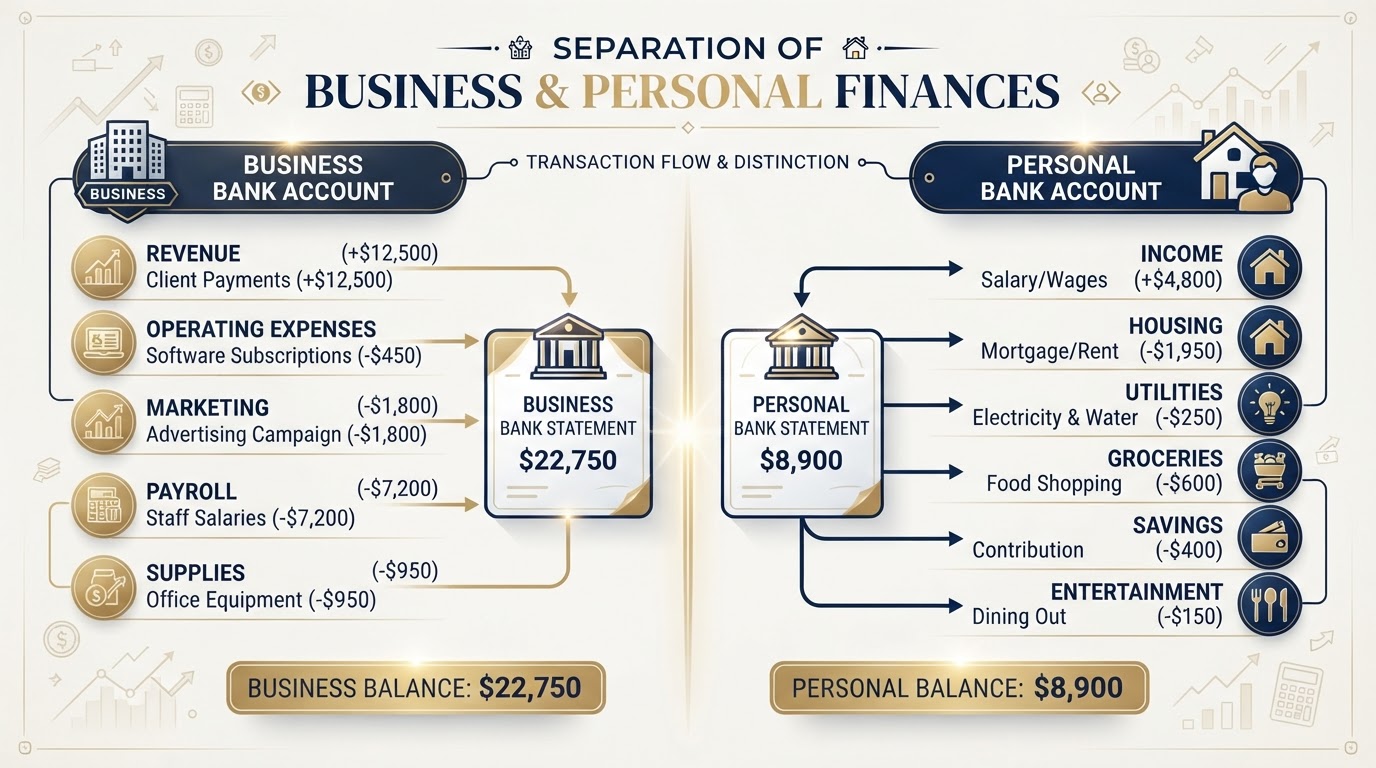
The Process to Untangle Your Finances
Here is the exact framework my firm uses to rescue clients from the commingling trap. Each step builds on the one before it, and none of them require you to have perfect records from the past. They require only that you commit to clean records from this point forward.
Open a Dedicated Business Account Immediately
Stop everything and go to the bank. Open a business checking account in the name of your LLC or corporation. You will need your articles of organization and your EIN. This single action draws the line between old mess and new order.
Reroute All Income and Expenses
Update your payment processors like Stripe, Square, and PayPal to deposit into the new account. Update all business software subscriptions to charge the new business debit or credit card. Every new dollar should flow through the business account only.
Establish a Pay Yourself Routine
Stop using the business card for personal items. Instead, set up a routine, such as the first and fifteenth of the month, to transfer a lump sum from the business account to your personal account as an owner draw or salary.
The Historical Untangling
This is where we come in. We take your messy personal statements, extract only the business transactions, and reconstruct a clean profit and loss statement for the year that will hold up under examination.
Implement an Accountable Plan
If you accidentally use a personal card for a business expense in the future, we set up an IRS compliant reimbursement system so the business pays you back legally and cleanly.

The Clean Slate Methodology
When clients come to me embarrassed about their commingled funds, I stop them immediately. There is no judgment here. My job is not to scold you; my job is to build a firewall between your personal life and your business liability. We perform the forensic extraction, build the new accounting file, and train you on exactly how to move money going forward.
The methodology works because it separates the past from the future. We do not try to relive every transaction you ever made. We reconstruct what we can document, we reclassify what we can support, and we draw a clean starting line the day the new accounts open. From that line forward, every transaction is categorized, reconciled, and reported on a schedule you can rely on. The result is a set of books that tells the true story of your business, and a system that keeps the story honest without you having to think about it every day.

A FIG Client Case Study
A creative agency owner in Los Angeles came to us after operating for three years entirely out of a personal checking account. Client deposits, contractor payments, software subscriptions, and personal living expenses all moved through the same account, and the owner had no idea whether the business was actually profitable. The LLC was in place, but the books told no usable story, and the owner was anxious about an upcoming tax filing with nothing clean to hand a preparer.
We opened a dedicated business checking account the first week and rerouted every payment processor to it. Then we pulled three years of personal statements and performed the historical untangling, extracting only the business transactions and reconstructing a clean profit and loss statement for each year. Personal spending was removed, business deductions were documented, and an accountable plan was put in place for the occasional personal card charge going forward.
The outcome was a business with a real financial story for the first time. The owner could see true profitability, capture every legitimate deduction, and hand a clean file to the tax preparer without scrambling. More importantly, the corporate veil was restored, because the business now behaved like a business on paper and in practice. The strategy worked because the separation was established before the next filing, not assembled after a notice arrived.
Reclaiming Your Financial Integrity
Commingling is a dangerous habit, but it is entirely fixable. By drawing a hard line in the sand today, opening the proper accounts, and bringing in a professional to untangle the history, you protect your assets and ensure you capture every tax deduction you deserve.
If you are currently running your business out of your personal checking account, do not wait for an audit to fix it. Book a strategy call with me today. We will execute the Great Untangling and give you the clean slate your business needs to scale safely.

Frequently Asked Questions
Can I deduct expenses I paid from my personal account?
Yes, but they must be properly documented and reimbursed to you by the business through an accountable plan, or recorded as an owner contribution. You cannot just leave them mixed in your personal account.
What if I am a sole proprietor with no LLC?
Even without an LLC, you must separate funds. It is the only way to accurately track business profitability and survive an IRS audit without them scrutinizing your personal living expenses.
How do I pay myself legally?
If you are an LLC or sole proprietor, you simply transfer money from the business account to the personal account and categorize it as an owner draw. If you are an S Corp, you must run it through formal W-2 payroll.
Quick Tax Savings Estimator
See how much you could potentially save with proactive tax strategy and clean bookkeeping. Most LA businesses overpay by 15-20% simply due to missed deductions.
Free IRS Audit Risk Assessment
Do you mix personal and business expenses in the same bank account?
Frequently Asked Questions
How far back can you catch errors?
I perform a deep forensic review of your history to catch errors and fix them. Whether it's one year or five, my goal is to ensure your historical data is pristine before we move forward.
Will you educate me on how to manage my books?
Yes! My approach is highly educational. I want you to understand the "why" behind the numbers so you can make better business decisions with confidence.

About the Author
Fiscal Integrity Group
Fiscal Integrity Group is a leading financial advisory firm in Los Angeles. With extensive experience in tax strategy, accounting, and fractional CFO services, we help business owners optimize their finances, minimize tax liabilities, and scale with confidence.


