When the Person You Hired to Fix Your Books Made Them Worse
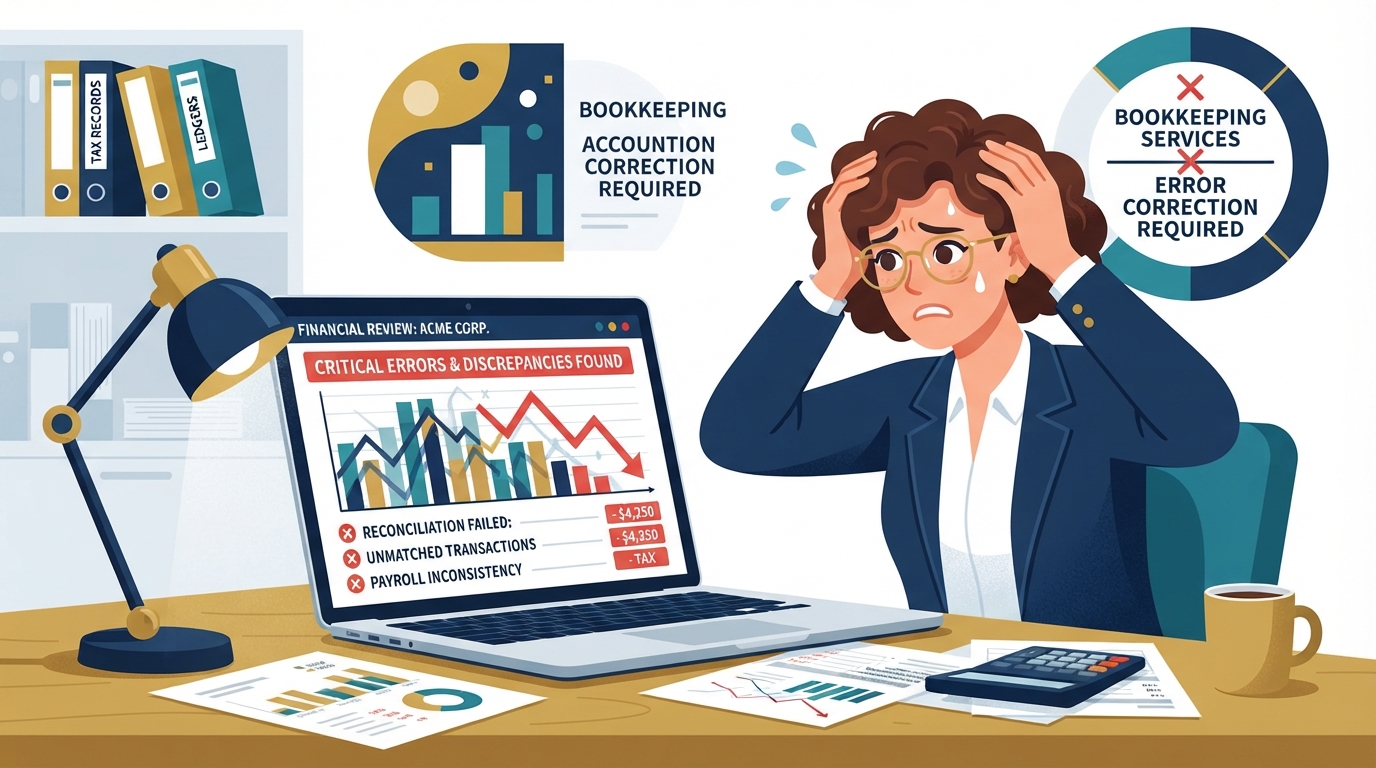
You did the right thing. You recognized that your books were a mess, you acknowledged that bookkeeping was not your strength, and you hired someone to take it off your plate. You handed over access to your bank accounts, your credit cards, your accounting software, and you trusted them to do the job you were paying them to do. For a few months, everything seemed fine. Reports came in. Numbers appeared on a schedule. You felt relief. Then something started to feel wrong. A number did not match. A category looked strange. Your accountant asked a question you could not answer, and when you opened the books to investigate, you discovered that the person you hired to fix your books had made them worse.
This is one of the most demoralizing moments a business owner can experience, and we see it constantly across Los Angeles, Orange County, the Inland Empire, and San Diego. A contractor in Riverside hired a bookkeeper who categorized every single expense as "office supplies" for eight months. A landscaper in Temecula discovered her bookkeeper had been reconciling to the wrong bank account for an entire year. A real estate investor in Pasadena found that his bookkeeper had deleted transactions instead of categorizing them, quietly erasing thousands of dollars of deductible expenses. The pain is not just the mistakes themselves. The pain is the betrayal of trust, the wasted money, and the realization that you now have to fix the very thing you paid someone to fix. The question is not whether the mistakes can be undone. They can. The question is how to recover, how to rebuild trust in your numbers, and how to make sure this never happens again.
Why Bookkeeper Mistakes Happen So Often
The bookkeeping industry has a dirty secret that no one talks about: the barrier to calling yourself a bookkeeper is essentially zero. There is no license required in most states. There is no exam. There is no oversight body that reviews the quality of a bookkeeper's work. Anyone can put up a website, claim expertise, and start taking on clients. Some of these people are excellent. Many are not. The result is a market where business owners have no reliable way to distinguish between a skilled professional and someone who watched a few tutorial videos and decided to start charging for bookkeeping. When you hire a bookkeeper, you are not just hiring a person. You are hiring a process, a standard, and a system of accountability, and if those things are absent, mistakes are not a possibility. They are an inevitability.
The mistakes happen for a few predictable reasons. First, many bookkeepers are generalists who do not understand the specific accounting needs of your industry. A bookkeeper who has only worked with retail stores will not know how to handle job costing for a construction company, and a bookkeeper who has only worked with service businesses will not understand inventory and cost of goods sold for a restaurant. Second, many bookkeepers work in isolation, with no review process and no second set of eyes on their work. A single person categorizing transactions with no oversight will make errors, and those errors will compound month after month because no one is catching them. Third, many bookkeepers do not reconcile. Reconciliation is the single most important quality-control step in bookkeeping, and it is also the step that requires the most discipline. A bookkeeper who skips reconciliation is essentially working without a safety net, and the numbers they produce are guesses dressed up as facts.
The Most Common Mistakes Bookkeepers Make
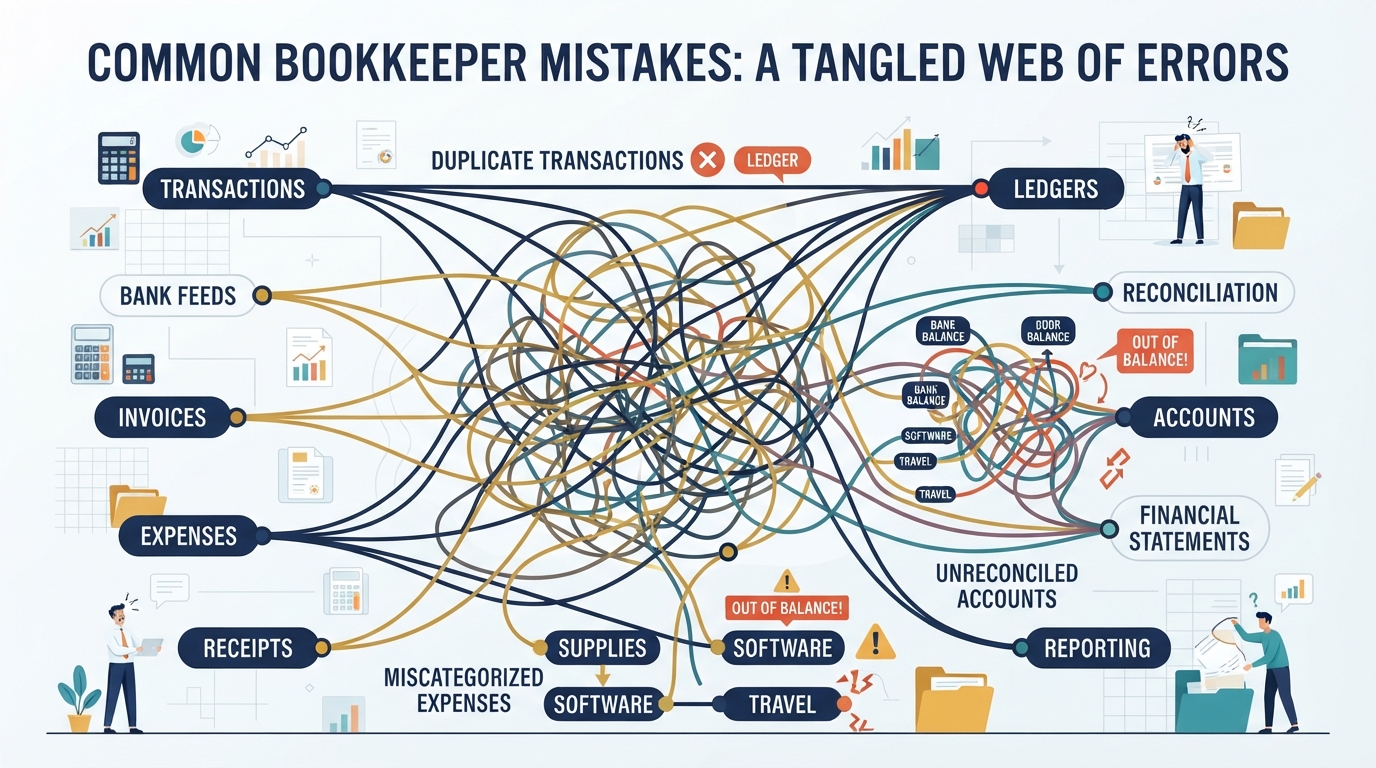
When we inherit books from a previous bookkeeper, we see the same patterns repeat themselves across every industry and every city in Southern California. The first and most common mistake is miscategorization. A bookkeeper who does not understand your business will default to broad, generic categories. Everything becomes "office expenses" or "miscellaneous." The problem is that these generic categories destroy your ability to see where your money is actually going, and they create tax exposure because legitimate deductions get buried in categories that do not survive scrutiny. We have opened books where a contractor's entire materials spend was categorized as "office supplies," which would have been a red flag in any audit and would have cost the owner thousands in lost deductions if it had not been caught.
The second common mistake is duplicate transactions. This happens when a bookkeeper manually enters a transaction that the bank feed has already imported, or when they import a statement twice without realizing it. The result is that your expenses appear twice, your profit looks lower than it is, and your bank reconciliation will not tie out. The third mistake is failing to reconcile at all. We have seen books that went two and three years without a single reconciliation, which means no one ever confirmed that the numbers in the software matched the numbers at the bank. The fourth mistake is deleting transactions instead of fixing them. A lazy bookkeeper who cannot figure out how to categorize a transaction will sometimes just delete it, which removes it from your books entirely and erases a real expense or a real deposit. The fifth mistake, and the one that causes the most damage, is commingling. A bookkeeper who does not understand the boundary between business and personal will record personal transactions in the business books, which corrupts your profit and loss, inflates your expenses, and creates serious tax problems if the IRS ever looks closely.
How to Spot the Damage Before It Spreads
The earlier you catch bookkeeper mistakes, the easier and cheaper they are to fix. The problem is that most business owners do not know what to look for, and a bad bookkeeper is not going to volunteer that they are making errors. You have to be willing to look at your own books, even if bookkeeping is not your strength, and you have to know the warning signs. The first sign is a reconciliation that never completes. If your bookkeeper tells you the books are done but the reconciliation shows a discrepancy every month, something is wrong and it is being papered over rather than fixed. The second sign is categories that do not make sense for your business. If you run a landscaping company and you see a category called "office supplies" with a balance larger than your equipment expenses, the categorization is broken.
The third sign is a profit and loss statement that swings wildly from month to month for no apparent reason. If your revenue and expenses are relatively stable but your P&L shows huge swings, it usually means transactions are being recorded in the wrong month or being missed entirely. The fourth sign is a balance sheet that does not balance or that shows negative numbers in accounts that should never be negative, like a bank account showing a negative balance or a loan balance that grows instead of shrinks. The fifth sign, and the one we hear most often, is your gut. If something feels off, if the numbers do not match your sense of how the business is actually performing, trust that instinct. Business owners know their businesses. When the books contradict what you know to be true, the books are usually wrong, not your intuition.
The Forensic Audit We Run on Every Inherited Set of Books
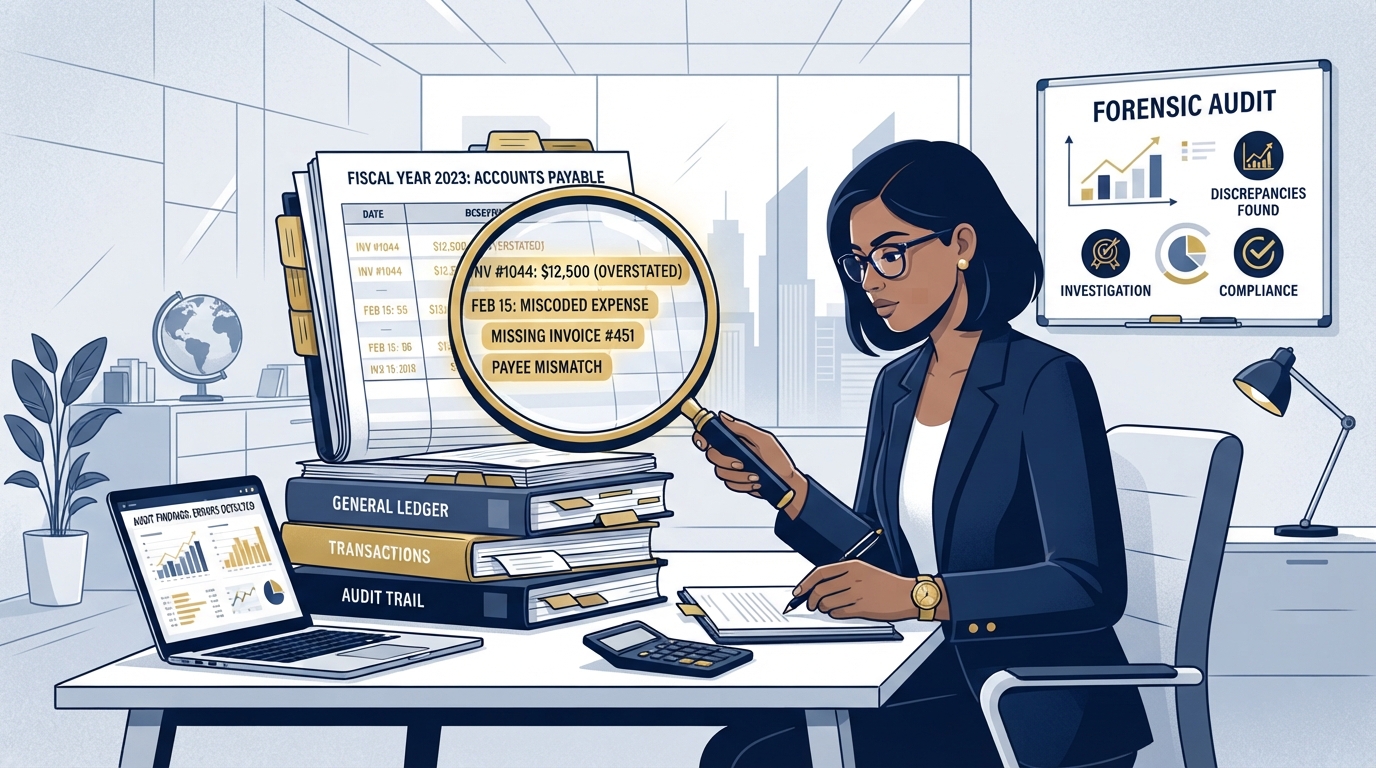
When a business owner comes to us after a bad bookkeeping experience, the first thing we do is not start fixing. The first thing we do is assess. We run a forensic audit of the books we inherited, and the goal of that audit is to understand the full scope of the damage before we touch a single transaction. This is critical because fixing mistakes without understanding them first usually creates new mistakes. We begin by reconciling every bank and credit card account, month by month, from the earliest period the previous bookkeeper touched. Reconciliation is the truth serum of bookkeeping. It does not care about excuses or explanations. Either the numbers match the bank or they do not, and when they do not, the discrepancy tells us exactly where to look.
Once the reconciliations are done, we review the categorization. We pull a transaction list for every account and scan for the patterns we know indicate trouble: generic categories, duplicate entries, deleted transactions, personal expenses mixed into business accounts. We compare the chart of accounts against the actual business to see whether the structure makes sense for the industry, and we look for orphaned transactions sitting in clearing accounts like undeposited funds or accounts receivable that should have been cleared months ago. The audit produces a report, and that report tells you exactly what was wrong, how bad it is, and what it will take to fix it. This is the transparency that was missing from your previous bookkeeping relationship. You will know the truth about your books, probably for the first time, and from that truth we can build a plan.
How We Fix the Mistakes Without Starting Over
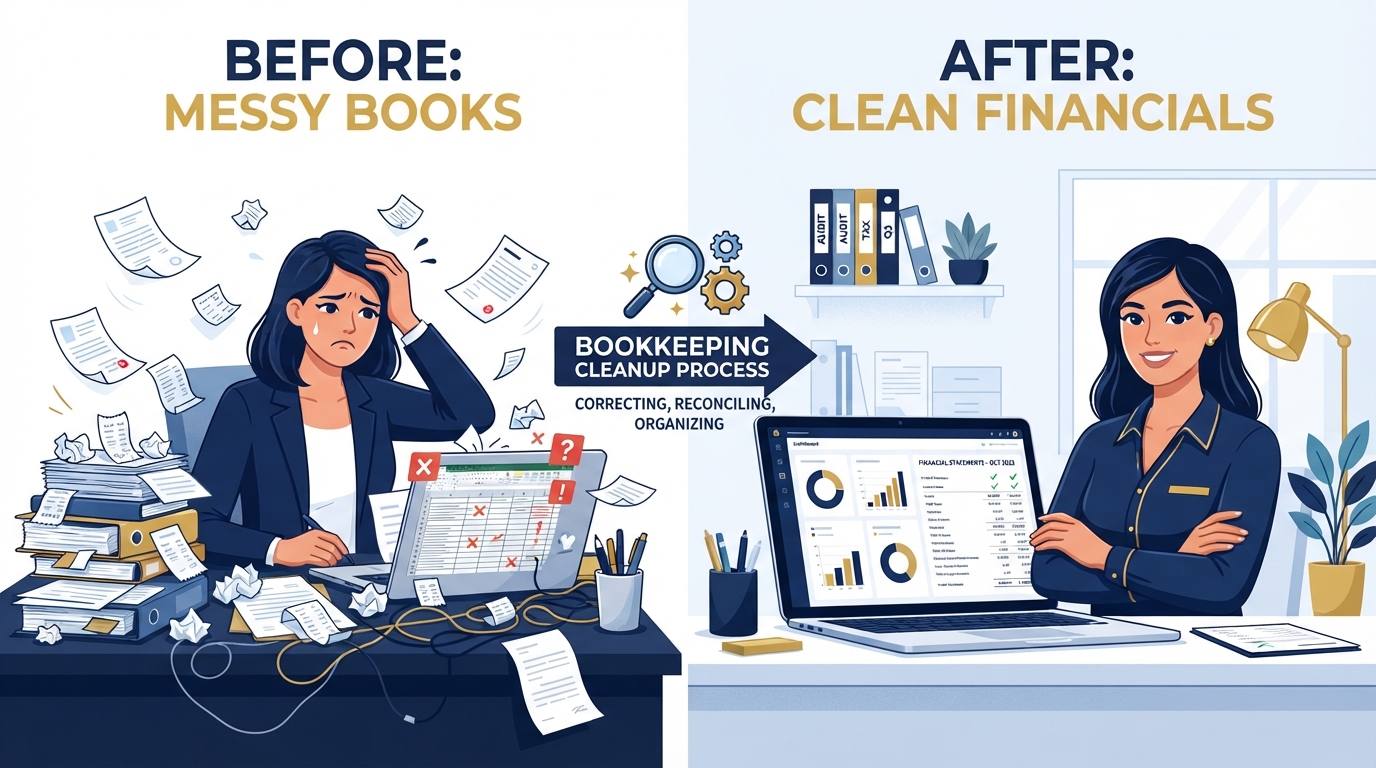
The fear that most business owners have at this stage is that fixing the mistakes means throwing away all the work that was done and starting from scratch. That is almost never necessary. The previous bookkeeper's work is a starting point, not a waste. Most of the transactions are probably recorded correctly. The mistakes are usually concentrated in specific areas: a category that was used wrong, a period that was not reconciled, a type of transaction that was handled incorrectly. Our job is to identify those areas and fix them surgically rather than demolishing the entire structure. We re-categorize the transactions that were miscategorized, we remove the duplicates, we restore the deleted transactions from the audit trail, and we separate the personal transactions from the business transactions.
For the reconciliation errors, we go back to the bank statements and we reconcile forward until every account ties to the penny. For the chart of accounts problems, we restructure the categories so they reflect the actual business, and we re-map the historical transactions into the new structure so your trend data is preserved. The result is not a blank slate. It is your business history, corrected and trustworthy, with every mistake addressed and every account reconciled. By the time the cleanup is done, you have books you can actually rely on, and you have the documentation to prove that the work was done correctly, which is something your previous bookkeeper almost certainly never provided.
Building Accountability Into Your Bookkeeping Relationship
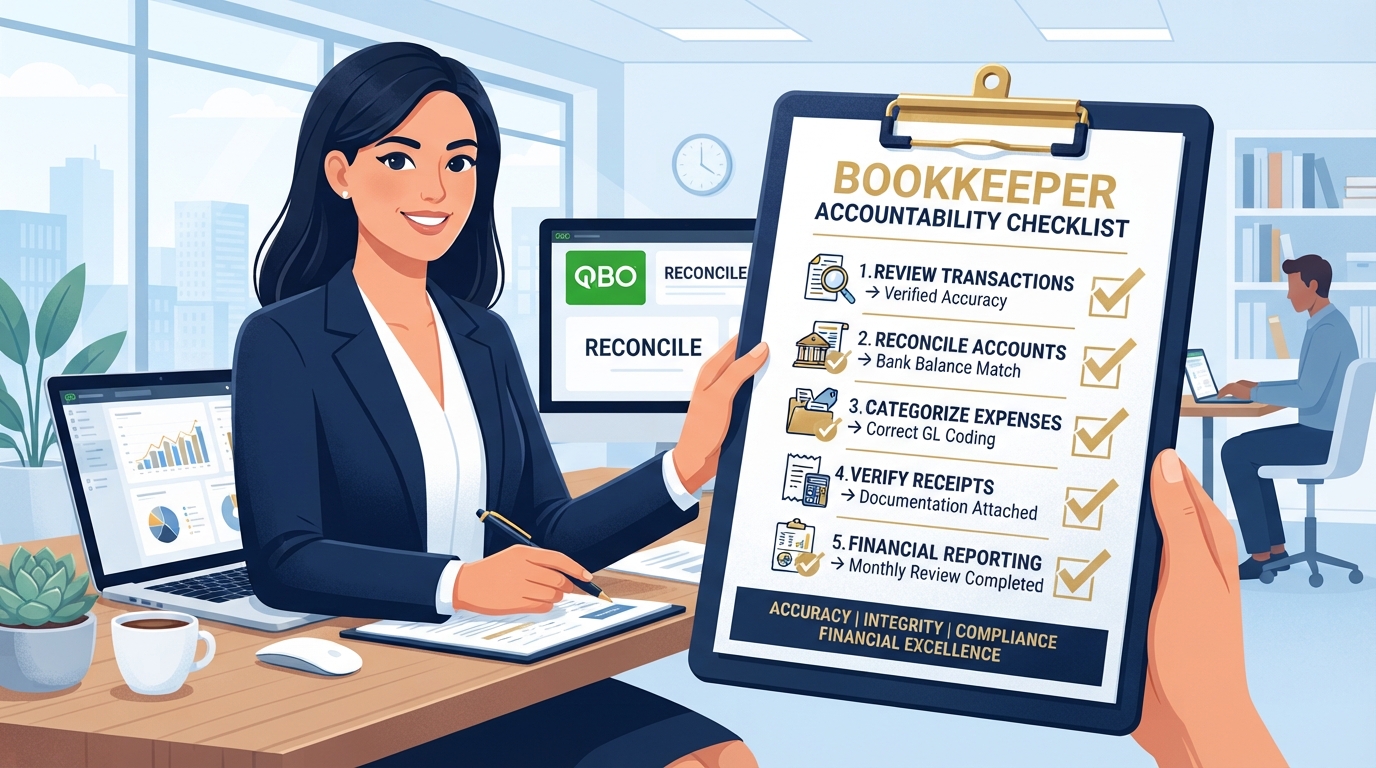
The reason your previous bookkeeper was able to make mistakes for months without anyone noticing is that there was no accountability built into the relationship. No one was reviewing their work. No one was checking the reconciliations. No one was asking questions. The bookkeeper operated in a vacuum, and in a vacuum, mistakes thrive. The fix is not just to hire a better bookkeeper. The fix is to build a system where the bookkeeper's work is reviewed, verified, and held to a standard. This is the model we use for every client. No single person does the bookkeeping and then walks away. Every set of books goes through a review process where a second professional checks the reconciliation, reviews the categorization, and confirms that the reports are accurate before they ever reach the client.
Accountability also means transparency. You should always be able to see what was done, when it was done, and who did it. Your accounting software keeps an audit log of every change, and we make sure you know how to access it. You should receive a monthly package that includes the reconciled reports and a short narrative explaining what happened in your books that month, not just a pile of numbers. And you should have a point of contact who can answer your questions in plain language rather than hiding behind jargon. When these elements are in place, a bookkeeper cannot quietly make mistakes for months because the system catches them immediately. Accountability is not about distrust. It is about making sure the work is right, and a good bookkeeper welcomes it because it protects them as much as it protects you.
Real Stories From Southern California Business Owners
The bad bookkeeper story is not rare, and hearing how other business owners recovered can help you understand that you are not alone and that the situation is fixable. A construction company in the Inland Empire came to us after their bookkeeper had been categorizing all subcontractor payments as "contract labor" without tracking which job each payment belonged to. The result was that they had no idea which projects were profitable and which were losing money. We restructured their books to tag every transaction to a project, went back through a year of history to assign the old payments to the right jobs, and produced job-cost reports that finally showed them the truth about their margins. They discovered that their largest project had been bleeding money for months, a fact that was completely invisible in the books their previous bookkeeper had produced.
A restaurant owner in Santa Monica came to us after her bookkeeper had been reconciling to the wrong credit card account for an entire year. Every reconciliation showed a perfect match, which should have been a red flag, because real books almost never reconcile perfectly when someone is doing them wrong. The bookkeeper was matching the software to a different card, so the reconciliation was meaningless. We reconciled to the correct accounts, found over forty thousand dollars in uncategorized transactions that had been sitting in limbo, and rebuilt her cost of goods sold tracking so she could finally see her true food costs. A real estate investor in Pasadena discovered that his bookkeeper had been recording mortgage payments as expenses rather than splitting them between interest and loan principal, which meant his balance sheet was wrong and his equity position was understated. We corrected the split, rebuilt the loan amortization, and gave him an accurate picture of his net worth for the first time. In every case, the damage was significant but recoverable, and the recovery started with a willingness to look honestly at what had gone wrong.
The Prevention System We Install for Every Client
Recovering from a bad bookkeeping experience is only half the work. The other half is making sure it never happens again, and that requires a system, not just a person. The first layer of our prevention system is the review process. No bookkeeping is ever delivered to a client without a second professional reviewing it. The reviewer checks the reconciliation, samples the categorization, and confirms the reports are accurate. This single step eliminates the vast majority of mistakes because it means no one person is ever the sole check on their own work. The second layer is the monthly close. Every month, by the 15th, your books are reconciled, categorized, reviewed, and locked. The close prevents errors from compounding because each month is finalized before the next one begins.
The third layer is transparency. You receive a monthly package with your reports and a narrative explanation, and you have ongoing access to your books so you can look whenever you want. The fourth layer is education. We do not just hand you numbers. We explain what they mean, what we noticed, and what decisions they should inform. A client who understands their books is a client who can spot a problem early, which is the best prevention there is. The fifth layer is industry expertise. We do not assign a generalist to your books. We match you with a bookkeeper who understands your industry, whether that is construction, landscaping, real estate, restaurants, or e-commerce, because industry knowledge is what prevents the categorization errors that bad bookkeepers make. Together, these layers create a system where mistakes are caught, not hidden, and where trust is built on verification, not assumption.
How We Help You Recover From a Bad Bookkeeping Experience
If you are reading this and recognizing your own situation, the most important thing to understand is that the mistakes are not your fault. You hired someone to do a job, and the system failed you. The damage is real, but it is fixable, and the fix does not require you to become a bookkeeping expert yourself. We help business owners across Los Angeles and Southern California recover from bad bookkeeping experiences every week. The process begins with a conversation and a forensic audit. We look at what you have, we assess the scope of the damage, and we give you a clear plan with a clear timeline. There is no judgment about the state of your books, because we have seen every kind of mess and we have fixed every kind of mess.
What we will not do is let you keep carrying the weight of books you cannot trust. The recovery is not just about fixing transactions. It is about restoring your confidence in your own numbers so you can make decisions without doubt. We handle the cleanup, we rebuild the structure, we install the accountability system, and we stay with you month after month so the books never drift again. The first step is a conversation, and the conversation is free. You have already been burned once. The way forward is to work with people who have nothing to hide and a system to prove it.

Conclusion: Trust Is Earned, Not Assumed
Hiring a bookkeeper should have been the moment your financial stress decreased. When it instead becomes the source of new stress, the temptation is to give up on bookkeeping altogether and go back to doing it yourself. That would be a mistake. The problem was not the decision to delegate. The problem was delegating to a system that had no accountability. The right bookkeeping relationship is not built on blind trust. It is built on a process that verifies the work, a structure that catches errors, and a team that explains the numbers. That is what we provide, and it is what every business owner deserves. Your books should be a source of clarity and confidence, not anxiety and doubt. If your previous bookkeeper took that from you, we can help you get it back. The way forward is not another leap of faith. It is a conversation, an audit, and a system you can see and understand. We are ready when you are.
Bookkeeper Red Flags Checklist
Check every statement that applies to your current bookkeeping situation. The more boxes you check, the higher the risk that mistakes are quietly costing you money.
Your bookkeeping setup looks relatively healthy. A few areas may still benefit from a professional review to catch anything slipping through the cracks.
No obligation. We'll look at your books and tell you exactly what we find — including any mistakes your current bookkeeper may be making.
Quick Tax Savings Estimator
See how much you could potentially save with proactive tax strategy and clean bookkeeping. Most LA businesses overpay by 15-20% simply due to missed deductions.
Free IRS Audit Risk Assessment
Do you mix personal and business expenses in the same bank account?
Frequently Asked Questions
How far back can you catch errors?
I perform a deep forensic review of your history to catch errors and fix them. Whether it's one year or five, my goal is to ensure your historical data is pristine before we move forward.
Will you educate me on how to manage my books?
Yes! My approach is highly educational. I want you to understand the "why" behind the numbers so you can make better business decisions with confidence.

About the Author
Wiyao Awesso
Wiyao Awesso is a leading financial advisor in Los Angeles. With extensive experience in tax strategy, accounting, and fractional CFO services, he helps business owners optimize their finances, minimize tax liabilities, and scale with confidence.