When Your Chart of Accounts Is Quietly Sabotaging Your Business
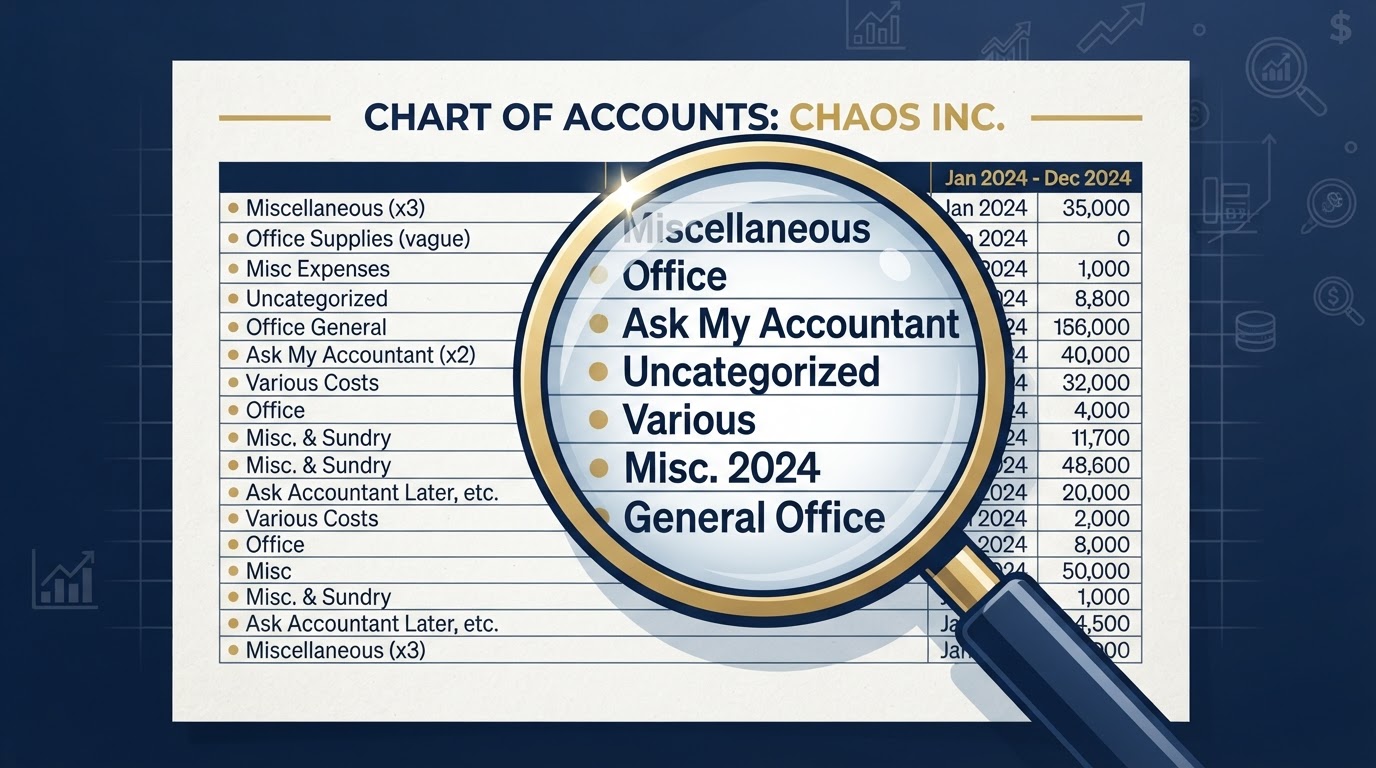
You opened your bookkeeping software to check on a number. Maybe your accountant asked what you spent on marketing last quarter. Maybe a lender wanted to see your cost of goods sold. Maybe you just wanted to know whether you were actually making money. You pulled up your chart of accounts and stared at it. There were forty-seven accounts. Maybe sixty. Some had names like "Office," "Miscellaneous," and "Ask My Accountant." There were three different accounts that all seemed to mean the same thing. One was called "Supplies," another "Office Supplies," and a third "Materials and Supplies." You had no idea which one was right, and you had no idea what would happen if you picked the wrong one.
This is the moment most business owners realize that their chart of accounts is not just a boring back-office detail. It is the skeleton of your entire financial system. Every transaction you record, every report you generate, every tax deduction you claim, and every decision you make is built on top of that skeleton. When the skeleton is broken, everything built on top of it is unreliable. We see this constantly across Southern California. A contractor in Los Angeles could not tell his bonding company what his gross margin was because his job costs were lumped into a single account called "Construction Expenses." A restaurant owner in Irvine had no idea whether food costs were rising because her chart of accounts had one account for "Purchases" that mixed food, liquor, paper goods, and cleaning supplies together. A real estate investor in Pasadena could not separate property-level income and expenses because every property fed into the same six accounts. The chart of accounts is not the problem. The chart of accounts that was never designed for your business is the problem.

What a Chart of Accounts Actually Is (and Why It Matters More Than You Think)
A chart of accounts is the complete list of every account used to record transactions in your business. Every dollar that enters or leaves your business gets sorted into one of these accounts. They are grouped into five main categories: assets, liabilities, equity, income, and expenses. When you run a profit and loss statement, the software is simply pulling the balances of your income and expense accounts. When you run a balance sheet, it is pulling your asset, liability, and equity accounts. The chart of accounts is the foundation. Everything you see in your financial reports is just a reflection of how transactions were categorized into these accounts.
The reason this matters so much is that your chart of accounts determines what you can and cannot see. If you have one expense account called "Vehicle," you can see total vehicle spending. If you split it into "Fuel," "Repairs and Maintenance," "Insurance," and "Registration," you can see exactly where the money goes and where to cut costs. If you have one income account called "Sales," you can see total revenue. If you split it by service line or product category, you can see which part of your business is actually profitable and which one is quietly losing money. The level of detail in your chart of accounts directly determines the level of insight in your reporting. A chart of accounts that is too vague hides problems. A chart of accounts that is too detailed creates noise. The goal is a structure that is clean enough to read in thirty seconds and detailed enough to answer real business questions.
Signs Your Chart of Accounts Is Quietly Costing You Money
Most business owners do not realize their chart of accounts is broken until something goes wrong. The damage is usually invisible until you need a real answer and your books cannot give it to you. Here are the signs we look for when we inherit a new set of books.
- Duplicate accounts. You have "Office Supplies," "Supplies," and "Office Expense" all doing the same job. Nobody knows which one to use, so transactions land in all three and your reports understate the true number.
- Vague catch-all accounts. Accounts like "Miscellaneous," "Ask My Accountant," or "General Expenses" become dumping grounds. Once a transaction lands there, it is effectively invisible to you and to your tax preparer.
- No cost of goods sold structure. If you sell a product or deliver a service with direct costs, you need a clear cost of goods sold section. Without it, you cannot calculate gross margin, and you cannot tell whether your pricing is actually working.
- Personal and business mixed together. Owner draws, personal expenses, and shareholder loans scattered across the chart of accounts make it impossible to see true business performance and create tax reporting headaches.
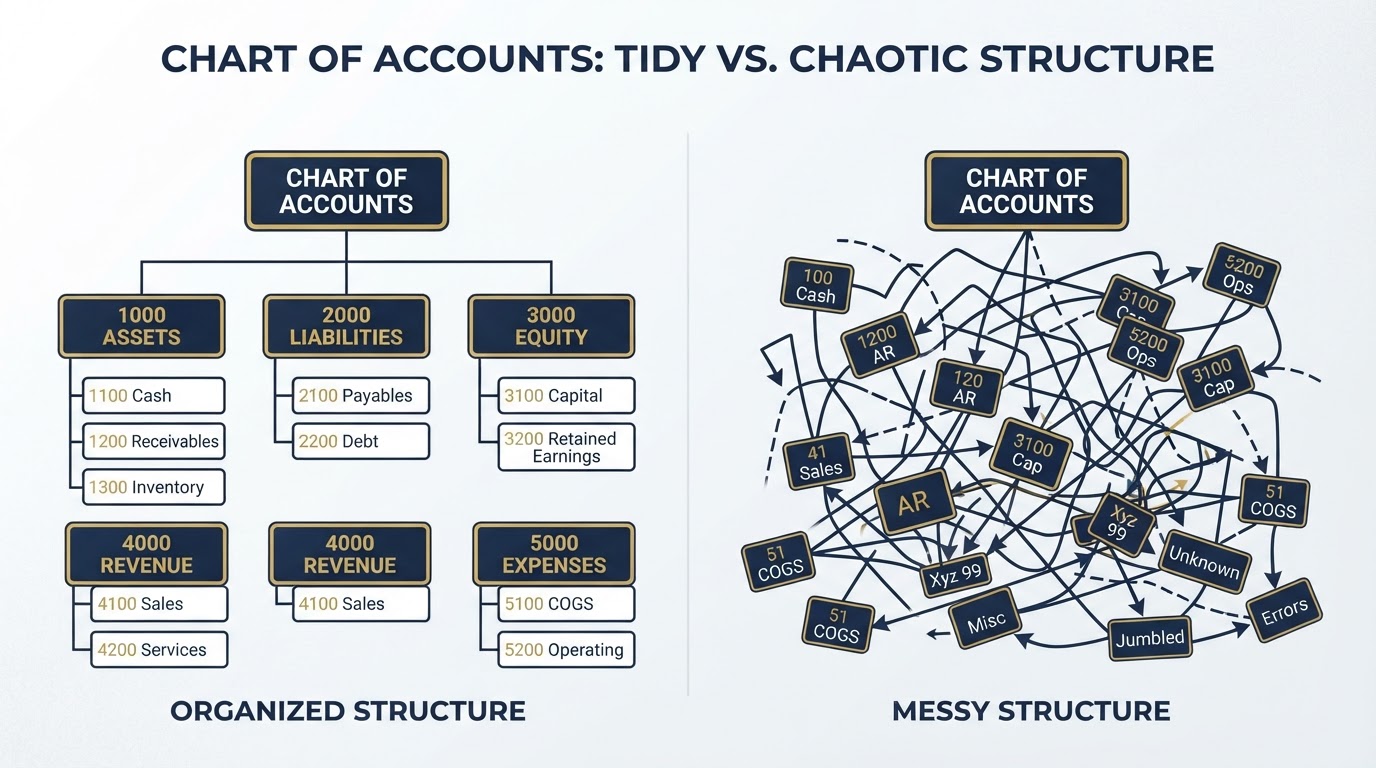
- Too many accounts. We have seen charts of accounts with over a hundred line items. When the list is that long, nobody uses it correctly, and every report becomes a wall of numbers nobody reads.
- Accounts that no longer match your business. You stopped offering a service two years ago, but the account is still there. You added a new revenue stream, but there is no account for it, so it gets dumped into "Sales."
The Real Cost of a Messy Chart of Accounts
A broken chart of accounts is not just an annoyance. It costs you money in ways that are hard to see until you add them up. The first cost is missed deductions. When transactions get dumped into vague accounts, your tax preparer has to guess what they were. Some of those guesses are conservative, which means you lose deductions you were entitled to. Some are wrong, which means you claim deductions you cannot defend in an audit. Either way, you pay for the mess.
The second cost is bad decisions. When you cannot separate your revenue streams, you cannot tell which one is profitable. When you cannot separate your direct costs from your overhead, you cannot tell whether your pricing is working. We worked with a landscaping company that thought its maintenance division was its most profitable line. After we restructured the chart of accounts and split maintenance, installation, and irrigation into separate income and cost accounts, the truth came out. The installation division was carrying the business. The maintenance division was barely breaking even once labor and fuel were properly allocated. That single insight changed how the owner bid jobs and where he deployed his crews.
The third cost is time. Every month, you or your bookkeeper spend extra hours trying to figure out which account a transaction belongs in. Every quarter, your accountant spends extra hours cleaning up the mess before they can do anything useful. Every year, your tax preparer charges you more because your books are harder to work with. A clean chart of accounts pays for itself in the hours it saves alone.
How We Clean Up a Chart of Accounts Without Destroying Your History
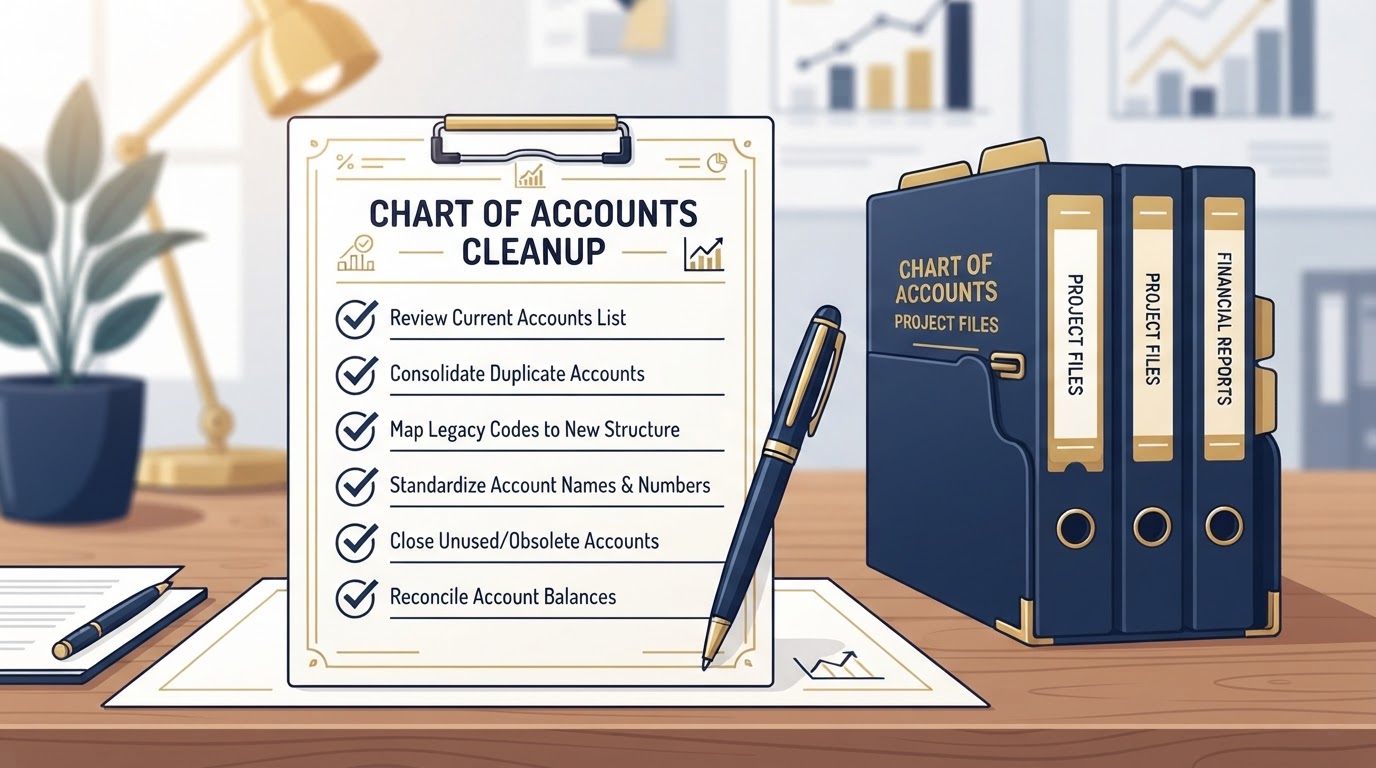
The biggest fear business owners have about restructuring their chart of accounts is losing their history. They worry that if we merge or rename accounts, years of data will disappear. It will not. Modern accounting software preserves the full transaction history of every account even after it is merged or renamed. The cleanup is surgical, not destructive. Here is how we approach it.
First, we map your existing chart of accounts. We pull every account, its balance, and the transaction volume flowing through it. We look for duplicates, catch-alls, dead accounts, and accounts that do not match how your business actually operates. We identify which accounts are doing real work and which ones are just noise.
Second, we design a new structure built around your business. We create a chart of accounts that reflects your actual revenue streams, your actual cost structure, and the decisions you need to make. We keep it lean. We use parent accounts and sub-accounts so your reports stay readable while still giving you the detail you need. We make sure every account has a clear purpose and a clear name so nobody has to guess where a transaction belongs.
Third, we migrate carefully. We merge duplicate accounts, reclassify misclassified transactions, and inactivate dead accounts rather than deleting them. We preserve your history. We document every change so you and your tax preparer can trace any number back to its origin. We do this in a way that keeps your prior-period reports intact and your year-to-date comparisons meaningful.
Why a Generic Chart of Accounts Fails Most Businesses
When you set up QuickBooks or any accounting software, it hands you a default chart of accounts. That default is built for a generic small business that does not really exist. It has no idea whether you are a contractor, a restaurant, a real estate investor, an e-commerce company, or a medical practice. So it gives you a little of everything and not enough of anything. Most business owners accept the default, add a few accounts over the years whenever they are unsure where something goes, and end up with a chart of accounts that reflects confusion rather than strategy.
Every industry needs a different structure. A contractor needs job costing with separate accounts for materials, subcontractors, labor, equipment rental, and permits, all mapped to individual projects. A restaurant needs separate accounts for food cost, liquor cost, paper goods, and labor, broken out by location if there is more than one. A real estate investor needs property-level income and expense accounts so each property can be evaluated on its own. An e-commerce business needs clean separation between platform fees, shipping, returns, cost of goods sold, and advertising by channel. A medical practice needs to separate patient revenue by service type and track overhead separately from clinical costs. The default chart of accounts gives you none of this. You have to build it deliberately, and that is exactly what we do.
What a Clean Chart of Accounts Looks Like in Practice
A clean chart of accounts is short, logical, and readable. It uses consistent naming. It groups related accounts under parent accounts so reports collapse into a readable summary when you need the big picture and expand into detail when you need to dig in. It has no duplicates, no catch-alls, and no dead accounts. Every account earns its place because it answers a real question.
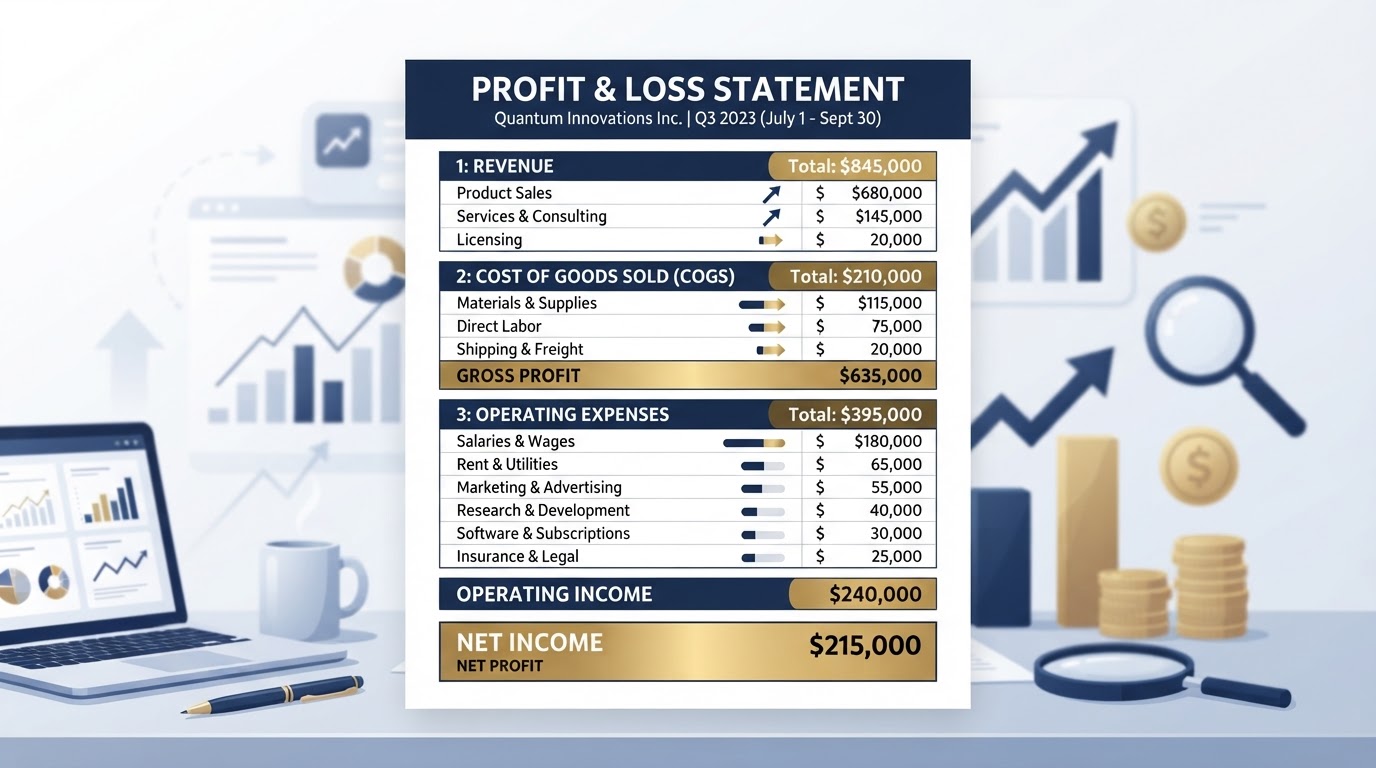
On the income side, you should be able to see your revenue broken down by the major streams that matter to your business. For a contractor, that might be new construction, remodels, and service calls. For a real estate investor, that might be rental income, application fees, and other property income, separated by property. On the cost side, you should be able to see your direct costs separated from your overhead so you can calculate gross margin. On the expense side, you should be able to see your major spending categories without scrolling through a hundred line items. When you pull up your profit and loss statement, you should be able to read it in under a minute and understand exactly where your money came from and where it went.
The Reclassification Problem Nobody Warns You About
Cleaning up a chart of accounts is not just about renaming and merging accounts. It is about reclassifying the transactions that landed in the wrong place. This is the part that takes real care. When we restructure a chart of accounts, we do not just move the account balances. We look at the actual transactions inside those accounts and decide where each one truly belongs.
This matters because account balances can be misleading. An account called "Repairs and Maintenance" might contain a vehicle repair, a building repair, and a software subscription that was misclassified. If we just merge the account into a new one, we carry the mistake forward. Instead, we review the transactions, reclassify each one correctly, and then merge the accounts. The result is a chart of accounts where the balances actually mean what they say they mean.
We also handle the timing question carefully. If we are cleaning up books mid-year, we make sure the reclassification does not distort your year-to-date comparisons in a way that confuses you or your tax preparer. We document every reclassification so the audit trail is clear. The goal is a chart of accounts you can trust, not just one that looks cleaner on the surface.
How to Keep Your Chart of Accounts Clean Going Forward
A chart of accounts is not a set-it-and-forget-it document. It needs to evolve with your business. The most common reason charts of accounts become messy is that nobody owns the structure. Every time someone is unsure where a transaction goes, they create a new account instead of asking. Over time, the list grows, duplicates appear, and the structure decays.
The fix is simple in principle and disciplined in practice. First, lock the chart of accounts so nobody can add or rename accounts without approval. Second, establish a rule that every new account must have a clear purpose and a clear name. Third, review the chart of accounts at least once a year as part of your year-end close. Ask whether every account is still earning its place. Ask whether your business has changed in a way that demands new accounts. Ask whether any accounts have become catch-alls that need to be split. This annual review takes an hour and prevents the slow decay that ruins most charts of accounts.
How We Help You Rebuild a Chart of Accounts That Actually Works
At Fiscal Integrity Group, we do not hand you a generic template and call it a day. We build your chart of accounts around your actual business. We start by understanding how you make money, what your cost structure looks like, and what decisions you need your reports to support. Then we design a structure that gives you clear, readable, decision-grade financials.
We handle the migration carefully, preserving your history and documenting every change. We reclassify misclassified transactions so your balances mean what they say. We set up the parent and sub-account structure that keeps your reports readable. And we put a maintenance process in place so the structure stays clean as your business grows. The result is a chart of accounts that serves your business instead of confusing it.

Your Chart of Accounts Is the Foundation of Every Financial Decision
You cannot build a reliable financial system on a broken chart of accounts. Every report you run, every decision you make, and every tax return you file is only as trustworthy as the structure underneath it. If your chart of accounts is full of duplicates, catch-alls, and accounts that no longer match your business, your numbers are lying to you even if the math is correct.
The good news is that this is fixable. A chart of accounts cleanup is one of the highest-leverage projects you can undertake because it improves every report you will run for years to come. It saves time every month, sharpens every decision, and strengthens every tax position. If your chart of accounts has become a source of confusion rather than clarity, it is time to rebuild it the right way. We would be glad to show you what a clean, purpose-built chart of accounts can do for your business.
Quick Tax Savings Estimator
See how much you could potentially save with proactive tax strategy and clean bookkeeping. Most LA businesses overpay by 15-20% simply due to missed deductions.
Free IRS Audit Risk Assessment
Do you mix personal and business expenses in the same bank account?
Frequently Asked Questions
How far back can you catch errors?
I perform a deep forensic review of your history to catch errors and fix them. Whether it's one year or five, my goal is to ensure your historical data is pristine before we move forward.
Will you educate me on how to manage my books?
Yes! My approach is highly educational. I want you to understand the "why" behind the numbers so you can make better business decisions with confidence.

About the Author
Wiyao Awesso
Wiyao Awesso is a leading financial advisor in Los Angeles. With extensive experience in tax strategy, accounting, and fractional CFO services, he helps business owners optimize their finances, minimize tax liabilities, and scale with confidence.