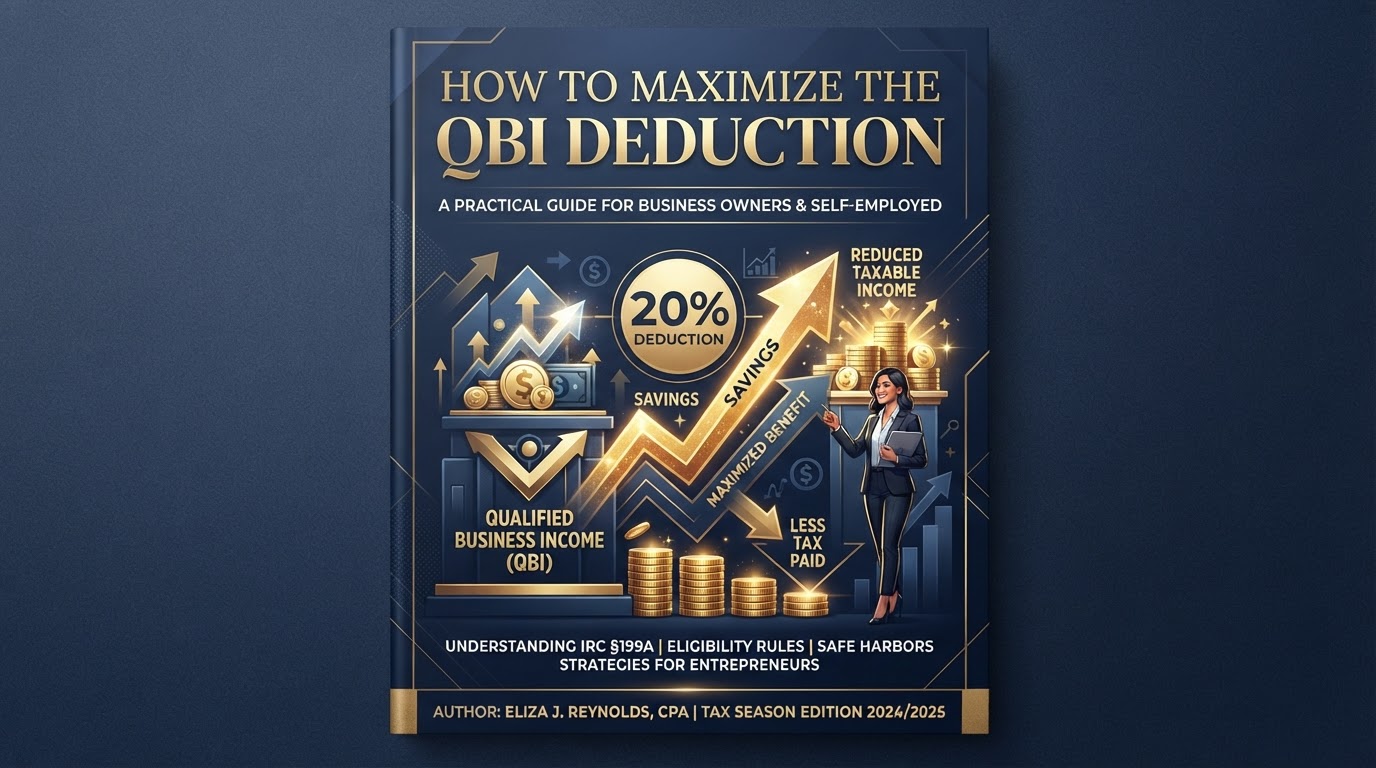
The Qualified Business Income (QBI) deduction, created by the 2017 Tax Cuts and Jobs Act, allows eligible self-employed individuals and small business owners to deduct up to 20% of their qualified business income from their federal income taxes. This is a deduction that can significantly lower your effective tax rate — and for many owners, it is the single largest tax benefit available. This guide explains how it works and how we maximize it for our clients.
What the 20% Deduction Actually Means
The QBI deduction, codified under Section 199A, lets you deduct up to 20% of your qualified business income from a pass-through entity — a sole proprietorship, partnership, LLC, or S-Corporation. Qualified business income is the net amount of income, gain, deduction, and loss from your business, excluding capital gains, qualified dividend income, and reasonable compensation paid to an S-Corp owner.
For a business generating $300,000 in qualified business income, a full 20% deduction shelters $60,000 from federal income tax. At a 24% marginal rate, that is over $14,000 in federal tax savings from a single deduction. The deduction is taken below the line, meaning it is available whether or not you itemize, and it reduces taxable income but not self-employment tax.

Specified Service Trades or Businesses (SSTB)
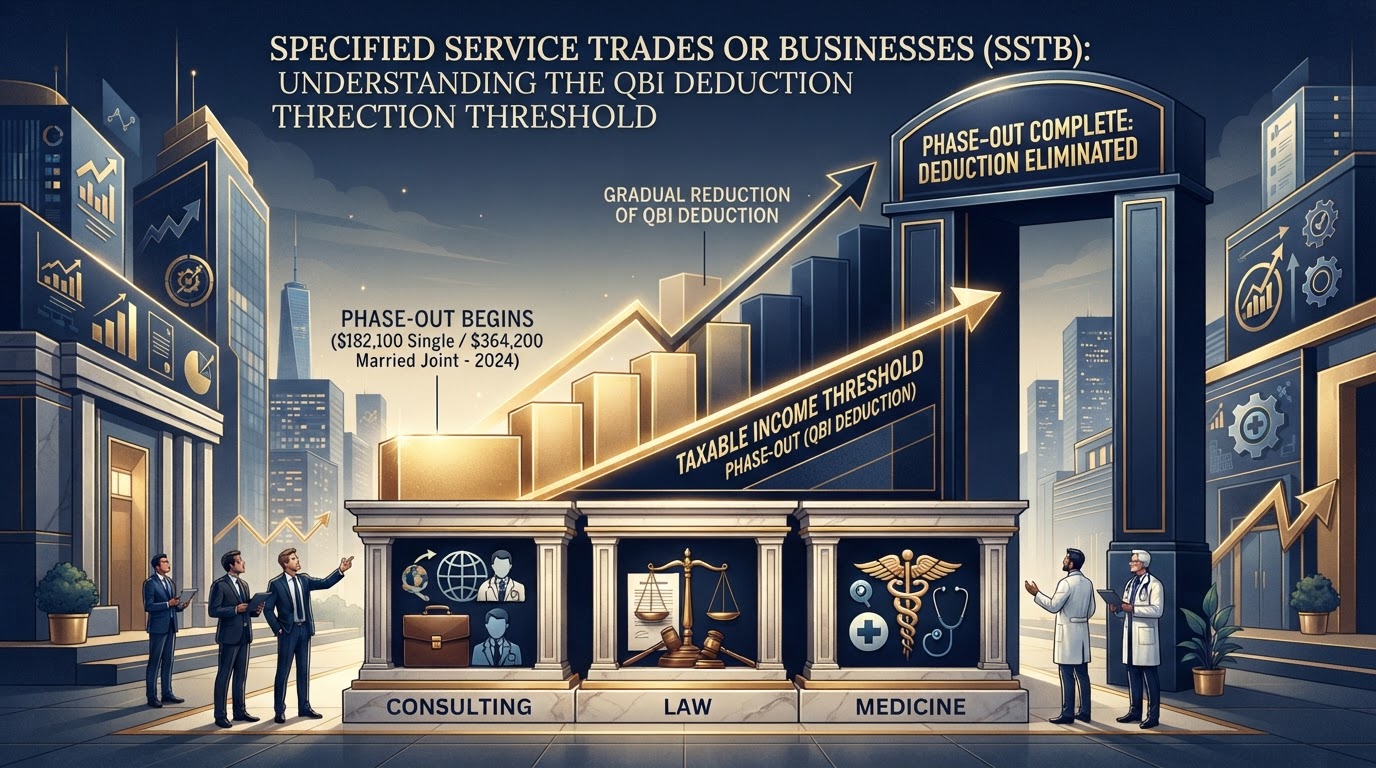
The biggest limitation on the QBI deduction is the SSTB rule. If your business involves the performance of services in the fields of health, law, accounting, financial services, consulting, engineering, or any trade where the principal asset is the reputation or skill of its employees, it is an SSTB — and the QBI deduction begins to phase out once your taxable income crosses a threshold.
For 2026, the phase-out range begins around $241,950 for single filers and $483,900 for married filing jointly, with the deduction eliminated entirely above the top of the range. Architects and engineers are explicitly excluded from the SSTB definition, which is a meaningful advantage. We help clients in service industries understand whether they are an SSTB and, where possible, restructure their activities to separate SSTB income from non-SSTB income.
The W-2 Wage & Property Limit
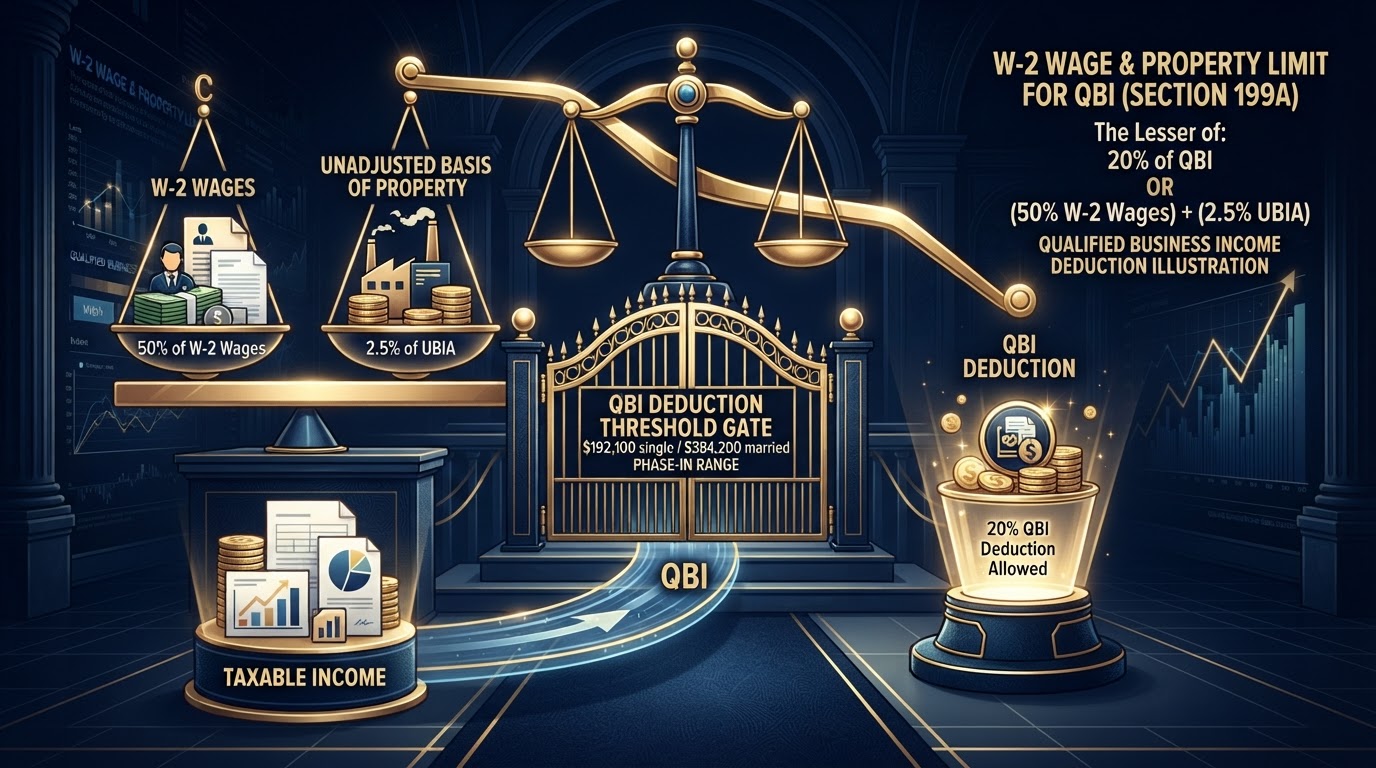
For non-SSTB businesses, the QBI deduction is limited once taxable income exceeds the threshold. Above the threshold, the deduction is the lesser of 20% of QBI or the greater of: 50% of W-2 wages paid by the business, or 25% of W-2 wages plus 2.5% of the unadjusted basis of qualified property. This is the wage and property limit, and it is where most of the planning happens for higher-income owners.
A business with no employees and no depreciable property can see its QBI deduction reduced to zero once income crosses the threshold. We model this for every client and, where it makes sense, consider strategies like increasing W-2 wages, purchasing depreciable property, or restructuring to separate qualified income. The wage limit rewards businesses that employ people and invest in equipment, which is why construction and manufacturing clients often fare better than pure consulting businesses.
Rental Real Estate & QBI
Rental real estate was historically uncertain territory for QBI, but the IRS issued a safe harbor under Notice 2019-07 that allows rental real estate to qualify as a trade or business for QBI purposes if certain requirements are met. The safe harbor requires separate books and records, 250 hours of rental services per year, and contemporaneous records including a time log.
For real estate investors, qualifying rental income for QBI can add a significant deduction on top of depreciation and cost segregation benefits. We help clients track their hours, maintain the required logs, and make the annual safe harbor election so their rental income qualifies. Without the election and the documentation, the deduction is lost.

Aggregation of Multiple Businesses
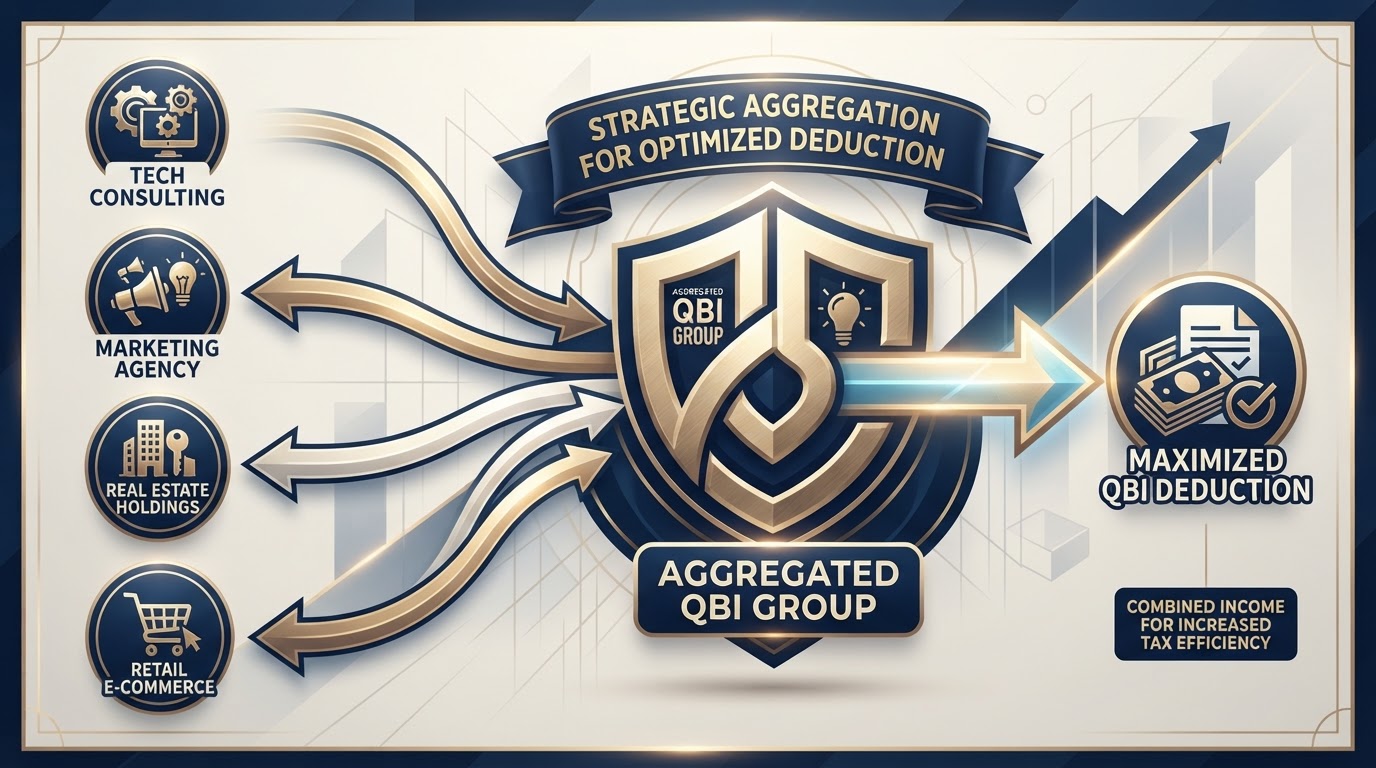
If you own multiple pass-through entities, you may be able to aggregate them for QBI purposes. Aggregation lets you combine the income, W-2 wages, and qualified property of multiple businesses, which can help overcome the wage and property limit. A business with high income but low wages can aggregate with a business that has high wages and property, producing a larger combined deduction than either would alone.
To aggregate, the businesses must share common ownership, and the activities must be coordinated, combined, or integrated — for example, sharing back-office functions, accounting, or employees. We analyze every multi-entity owner's structure to determine whether aggregation produces a better result, and we make the annual election on the tax return where it applies.
Reasonable Compensation Impact
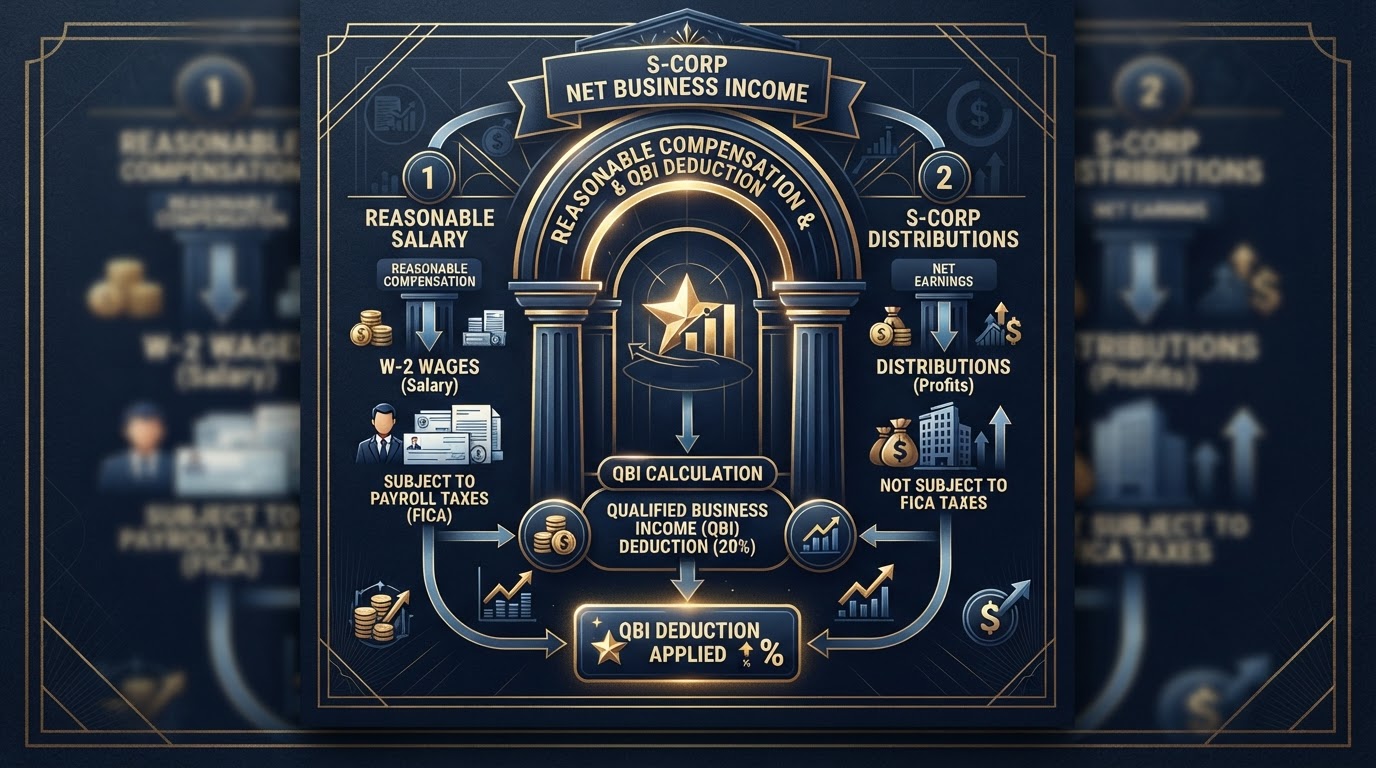
For S-Corporation owners, reasonable compensation directly affects QBI. Your W-2 salary is not qualified business income, so the more you pay yourself in salary, the lower your QBI — but the salary itself is subject to payroll tax. The art is finding the salary level that minimizes total tax: low enough to maximize QBI and reduce payroll tax, but high enough to satisfy the IRS's reasonable compensation standard.
We model the interaction between reasonable salary, distributions, QBI, and the wage limit for every S-Corp client. The optimal salary is not a guess — it is the output of a calculation that balances self-employment tax, income tax, and the QBI deduction. Retirement contributions also factor in, because they reduce QBI while providing their own deduction, so the full picture must be modeled together.
Conclusion
The QBI deduction is one of the most valuable tax benefits available to pass-through business owners, but it is also one of the most complex. SSTB status, the wage and property limit, rental safe harbors, aggregation, and reasonable compensation all interact to determine your final deduction. Maximizing it requires proactive modeling, not just ticking a box at filing time. If you want to know whether you are capturing the full QBI benefit your business is entitled to, we can help.
Quick Tax Savings Estimator
See how much you could potentially save with proactive tax strategy and clean bookkeeping. Most LA businesses overpay by 15-20% simply due to missed deductions.
Free IRS Audit Risk Assessment
Do you mix personal and business expenses in the same bank account?
Frequently Asked Questions
How far back can you catch errors?
I perform a deep forensic review of your history to catch errors and fix them. Whether it's one year or five, my goal is to ensure your historical data is pristine before we move forward.
Will you educate me on how to manage my books?
Yes! My approach is highly educational. I want you to understand the "why" behind the numbers so you can make better business decisions with confidence.

About the Author
Wiyao Awesso
Wiyao Awesso is a leading financial advisor in Los Angeles. With extensive experience in tax strategy, accounting, and fractional CFO services, he helps business owners optimize their finances, minimize tax liabilities, and scale with confidence.