Real estate remains one of the most powerful wealth-building tools in the United States, largely due to the favorable tax treatment it receives from the IRS. For high-net-worth investors, the goal is not just to generate rental income, but to use that real estate to shelter other forms of income, such as W-2 salary or business profits. This guide explores the advanced strategies used by top-tier investors to minimize or even eliminate their tax obligations — strategies we implement for real estate investors across Southern California every single day.

Real Estate Professional Status (REPS)
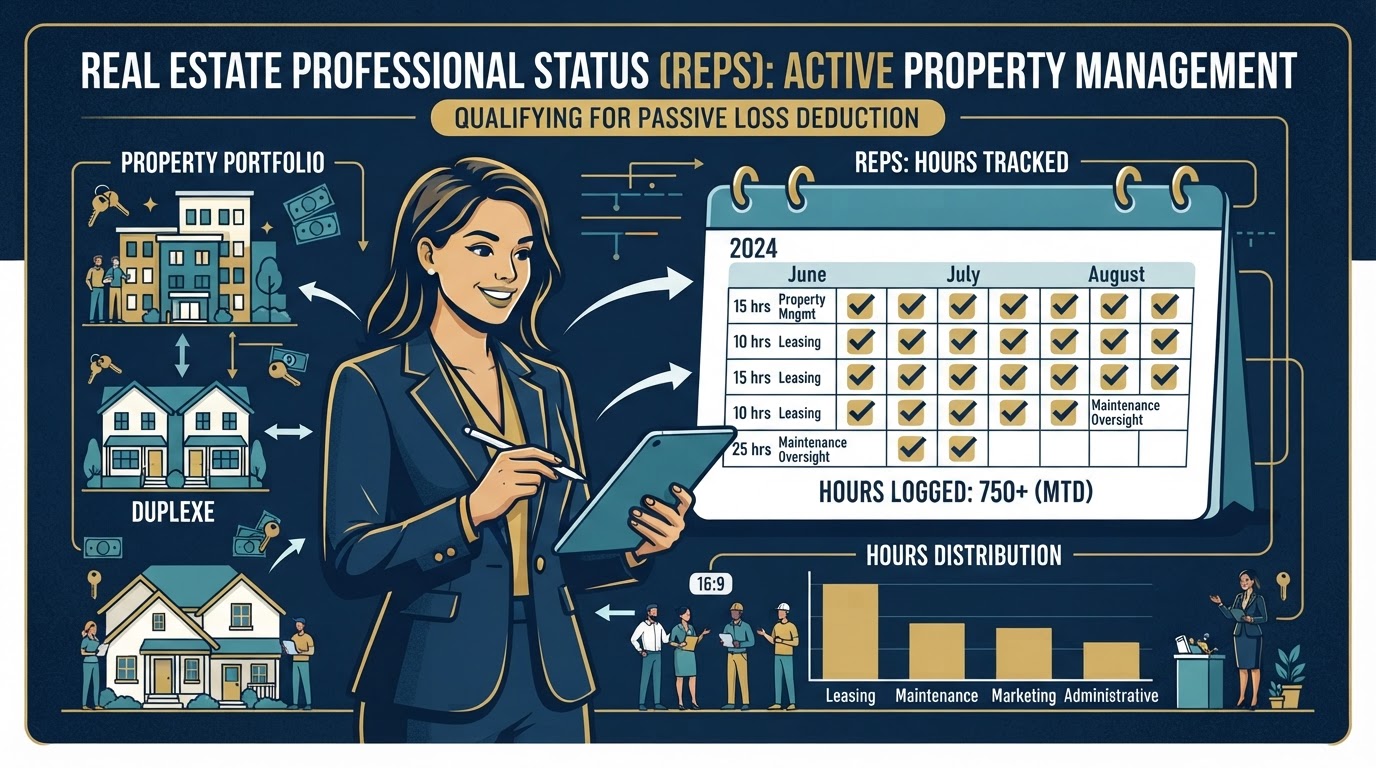
The single most powerful tax status a real estate investor can achieve is Real Estate Professional Status (REPS). Under IRC Section 469(c)(7), if you qualify as a real estate professional, your rental activities are no longer considered "passive" — meaning your rental losses can directly offset your W-2 wages, business income, and other non-passive income. For a high-earning professional with a $300,000 salary, this can wipe out your entire tax liability in a single year.
To qualify, you must meet two tests. First, more than half of your personal services during the year must be performed in real property trades or businesses. Second, you must perform more than 750 hours of service in those real property trades or businesses. The 750-hour requirement is where most investors fail — not because they don't work the hours, but because they don't document them. We help our clients build contemporaneous time logs that hold up under IRS scrutiny.
Material Participation & Aggregation
Even if you qualify for REPS, you must still demonstrate "material participation" in each rental property to deduct its losses against non-passive income. The IRS provides seven tests for material participation, and meeting any one of them for a given property is sufficient. The most common tests involve working 500+ hours on the property during the year or doing substantially all of the work involved.
This is where the aggregation election becomes critical. Under IRC Section 469, you can elect to treat all of your rental real estate interests as a single activity. Instead of proving 500 hours on each individual property — nearly impossible for an investor with five or more doors — you combine the hours across your entire portfolio. An investor spending 100 hours per year on each of six properties can aggregate to 600 total hours and potentially meet the material participation threshold for the entire portfolio at once.
Accelerated Depreciation & Cost Segregation
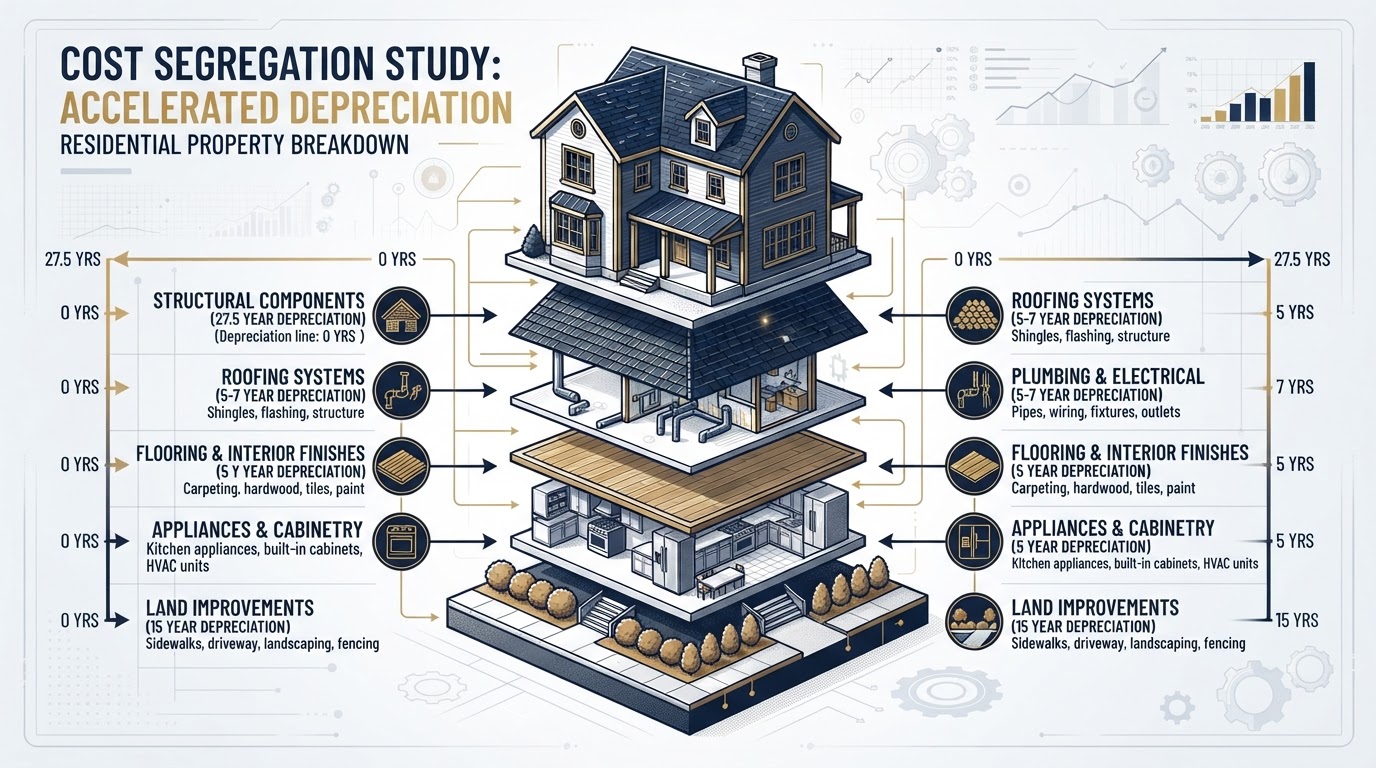
Cost segregation is the engine that makes real estate tax strategy work. When you buy a residential rental property, the IRS lets you depreciate the building over 27.5 years. But not every component of that building is a building. The carpet, appliances, cabinetry, lighting fixtures, and landscaping all have shorter useful lives — typically 5, 7, or 15 years.
A cost segregation study reclassifies these components into shorter depreciation categories, front-loading massive deductions into the early years of ownership. On a $1,000,000 property, a cost seg study might reclassify $200,000 of the purchase price into 5-year property, generating $40,000 or more in deductions in year one alone. Combined with bonus depreciation, the numbers become extraordinary.
100% Bonus Depreciation
Bonus depreciation allows you to deduct the entire cost of qualifying property in the year it is placed in service, rather than spreading the deduction over multiple years. Under the Tax Cuts and Jobs Act, property placed in service after September 27, 2017 was eligible for 100% bonus depreciation — meaning every dollar reclassified by a cost segregation study became an immediate, full deduction.
The percentage is phasing down: 80% for property placed in service in 2023, 60% in 2024, 40% in 2025, and 20% in 2026. Even at reduced percentages, the impact is significant. A $300,000 cost segregation reclassification at 40% bonus depreciation still generates $120,000 in immediate deductions. Timing your property acquisitions and improvements around these thresholds is a core part of the planning we do for investors.

Interest Tracing & Debt Optimization
How you finance your real estate matters as much as what you buy. The IRS applies "interest tracing" rules under IRC Section 163 to determine whether interest is deductible, and against which income it can be deducted. Interest on debt secured by a rental property and used to improve that property is generally deductible against rental income. But interest on a HELOC drawn against your personal residence and used as a down payment on a rental? That traces to the rental activity.
Sophisticated investors use debt optimization to ensure every dollar of interest traces to the right activity. This includes restructuring loans, using cash-out refinances strategically, and avoiding the common mistake of mixing acquisition debt with home equity debt on a personal residence. We review the debt structure on every property in a client's portfolio and restructure where the tracing rules are being applied incorrectly.
1031 Exchanges
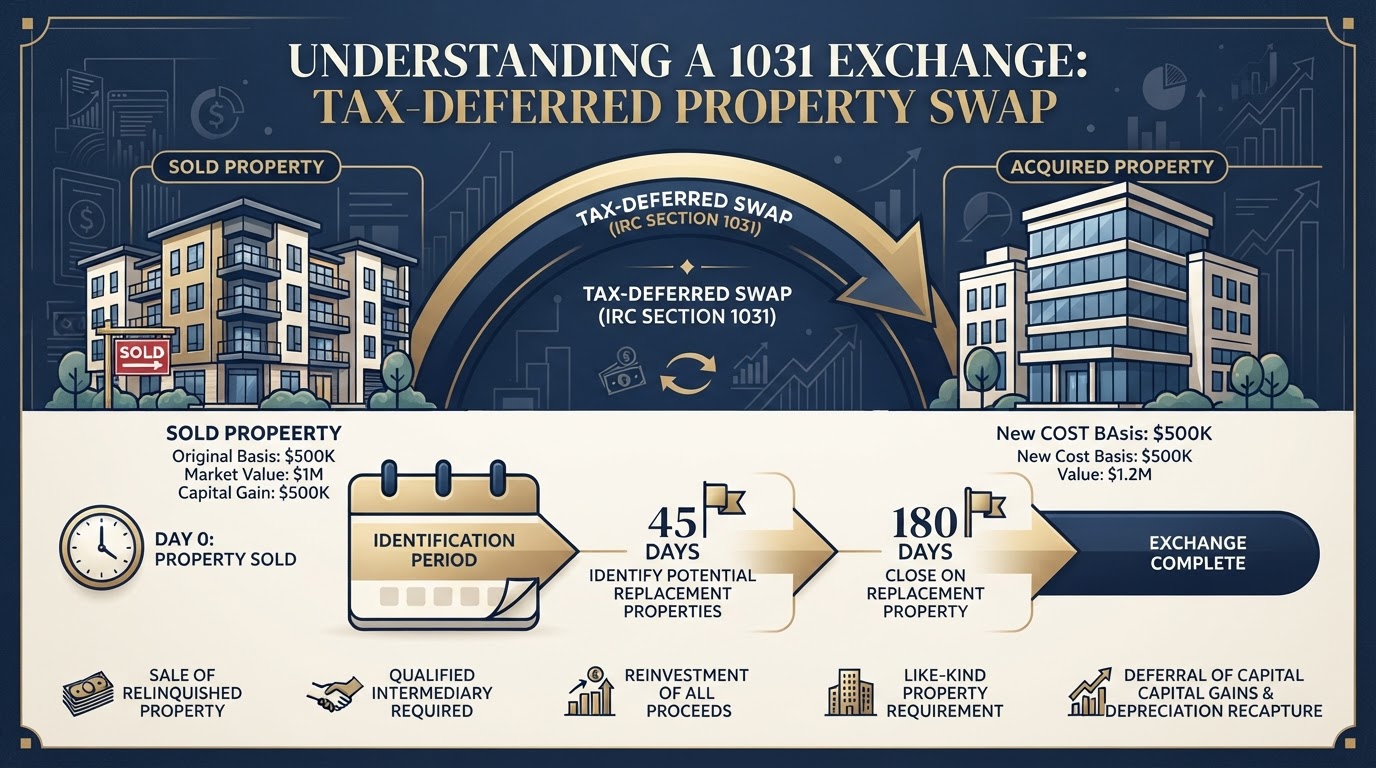
A 1031 exchange, named after Section 1031 of the Internal Revenue Code, allows you to defer all capital gains taxes when you sell an investment property and reinvest the proceeds into a like-kind property. This is how investors build generational wealth without paying tax on each sale — you keep rolling the gain forward into larger and larger properties until you eventually pass the assets to your heirs, who receive a stepped-up basis and wipe out the deferred gain entirely.
The rules are strict. You have 45 days from the sale of your property to identify potential replacement properties (up to three, or more under the 95% and 200% rules), and 180 days to close on the replacement. You must use a Qualified Intermediary to hold the funds — you cannot touch the cash. Any cash you receive ("boot") is taxable. We coordinate with Qualified Intermediaries and ensure your books properly track the exchange so the deferral is clean and defensible.
Passive Activity Loss Carryforwards
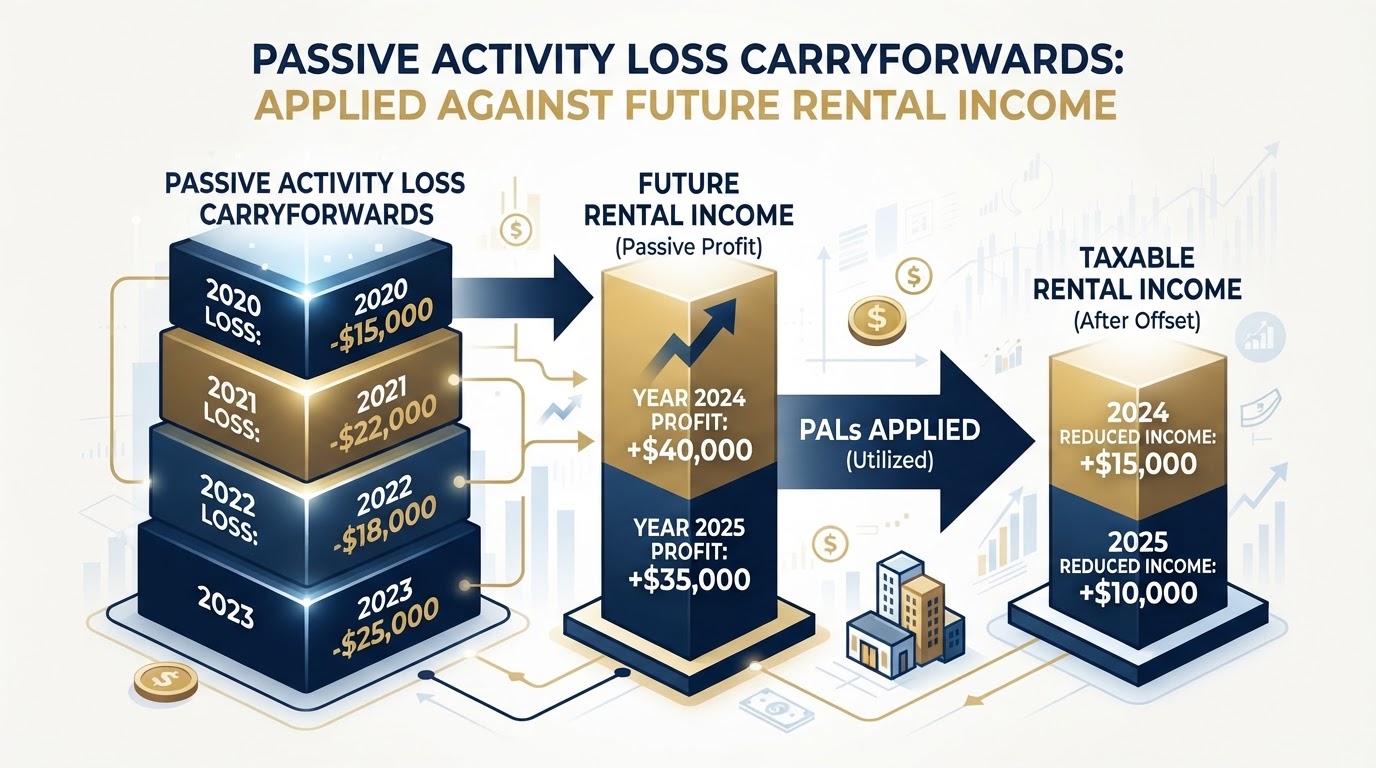
When your rental property generates a tax loss (common after a cost segregation study creates large depreciation deductions) but you don't have enough passive income to absorb it, that loss doesn't disappear. It becomes a passive activity loss carryforward — a suspended loss that sits on your return until you either generate passive income or dispose of the property in a taxable transaction.
These carryforwards are a hidden asset. When you sell the property, all suspended passive losses are released and can offset any type of income — including the gain on the sale itself. We track every client's suspended loss balances year over year so that when a disposition event occurs, the full benefit is captured and nothing is left on the table.
Implementation Steps
- Conduct a thorough review of current financial statements and property-level performance.
- Identify qualifying properties for cost segregation studies and order the studies.
- Track and document hours to establish REPS and material participation.
- Make the aggregation election where it benefits the portfolio.
- Restructure debt to optimize interest tracing and deductibility.
- Establish a contemporaneous documentation system for every property.
- Monitor changes in tax legislation that may impact future viability of each strategy.
Conclusion
Implementing these advanced strategies requires a coordinated effort between you and your advisory team. By taking proactive steps today, you can secure significant tax savings and build long-term wealth through your real estate portfolio. The investors who benefit most are the ones who plan before they buy, document before they deduct, and review their entire portfolio holistically each year rather than property by property. If you own rental real estate in Southern California and want to know which of these strategies apply to your portfolio, we can help.
Quick Tax Savings Estimator
See how much you could potentially save with proactive tax strategy and clean bookkeeping. Most LA businesses overpay by 15-20% simply due to missed deductions.
Free IRS Audit Risk Assessment
Do you mix personal and business expenses in the same bank account?
Frequently Asked Questions
How far back can you catch errors?
I perform a deep forensic review of your history to catch errors and fix them. Whether it's one year or five, my goal is to ensure your historical data is pristine before we move forward.
Will you educate me on how to manage my books?
Yes! My approach is highly educational. I want you to understand the "why" behind the numbers so you can make better business decisions with confidence.

About the Author
Wiyao Awesso
Wiyao Awesso is a leading financial advisor in Los Angeles. With extensive experience in tax strategy, accounting, and fractional CFO services, he helps business owners optimize their finances, minimize tax liabilities, and scale with confidence.