The Allure of the Short-Term Rental
In the last few years, the short-term rental boom has captured the imagination of thousands of investors across Los Angeles and Southern California. The pitch is seductive and simple: cash flow that runs two or three times higher than a traditional long-term rental, the freedom to use the property yourself on off weeks, and tax benefits that can shelter a significant portion of your W-2 or business income. For a high-earning professional watching a third of their salary disappear to taxes every April, the combination sounds almost too good to be true.
And in some ways, it is. As the market matures, regulations tighten, and platforms saturate with generic listings, many new investors are discovering that the reality behind the spreadsheet is far more demanding than a simple "buy, list, and collect" strategy. This guide breaks down everything our team sees behind the scenes — the real numbers, the tax mechanics, and the operational traps that most weekend seminars never mention. The goal is not to talk you out of short-term rentals. Done correctly, they remain one of the most powerful wealth-building and tax-mitigation tools available to a high-income earner. The goal is to make sure you walk in with your eyes open, so the property builds your net worth instead of draining it.

The Hidden Reality: It Is a Business, Not an Investment
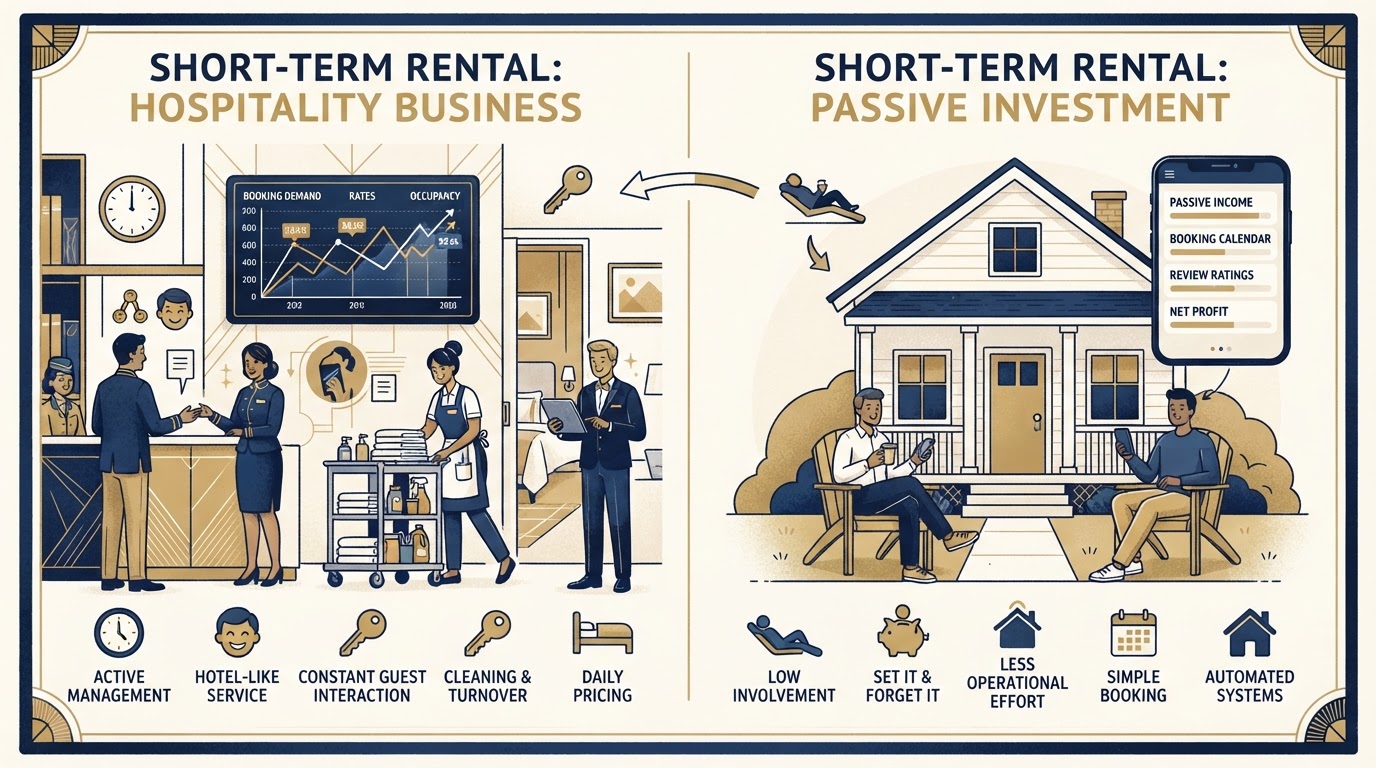
The first thing we tell every prospective short-term rental investor is the thing the marketing materials leave out: a short-term rental is a hospitality business, not a passive real estate investment. Unlike a long-term rental where you might hear from a tenant once every six months, an STR demands constant, active management. You are effectively running a decentralized hotel, and the guests are your customers in the most literal sense. They expect hotel-level service, hotel-level cleanliness, and hotel-level responsiveness — and the platform algorithms reward or punish you based on how well you deliver it.
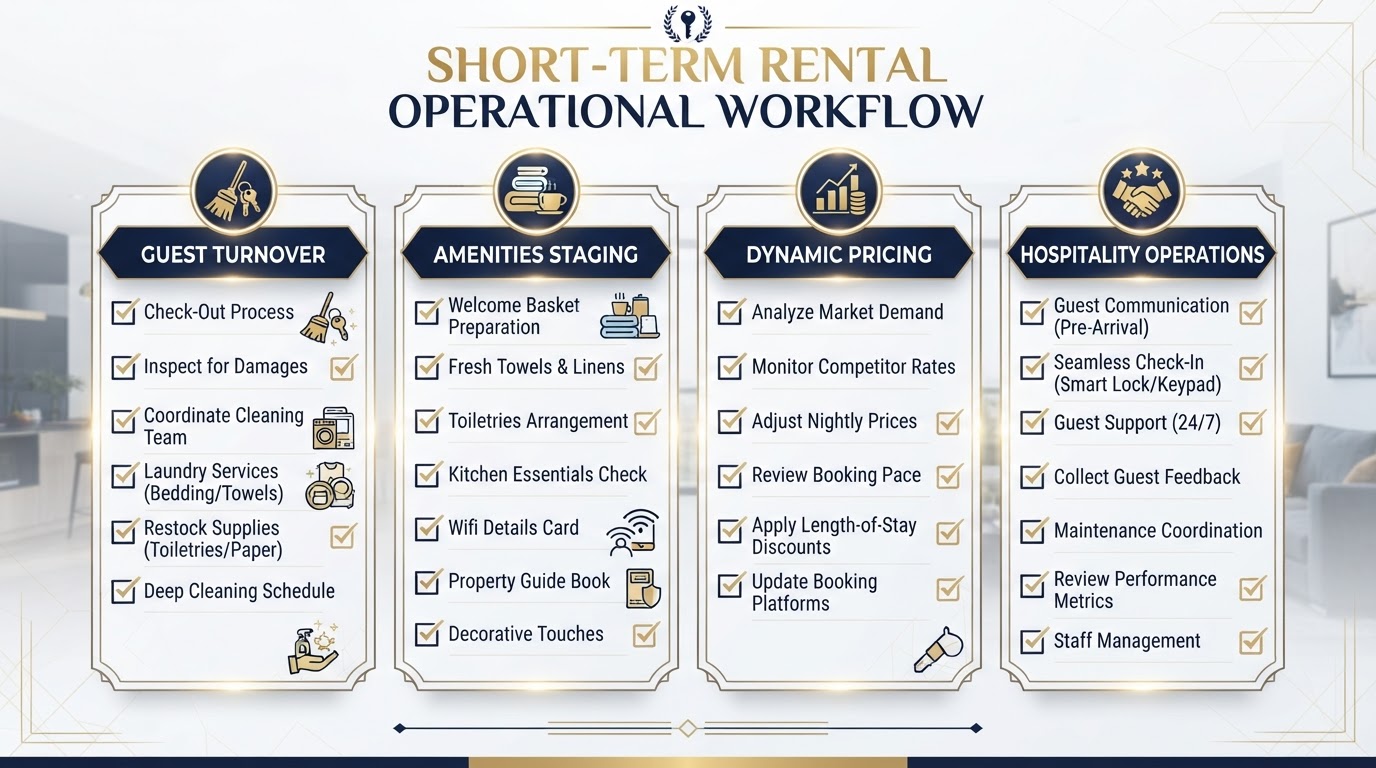
Consider what a single property actually requires on a weekly basis. Dynamic pricing must be reviewed and adjusted constantly, because a static nightly rate leaves money on the table during peak demand and leaves the calendar empty during slow weeks. Cleanings must be coordinated within tight four-hour turnover windows between guests, which means a reliable cleaning crew, backup coverage, and a system for quality checks. Guest communications run around the clock — a late-night lockout, a plumbing emergency, or a noise complaint does not wait for business hours. And the property itself must be refreshed continually to maintain five-star ratings and compete with newer, more polished listings entering the market every week.
If you are not prepared for that operational intensity, one of two things happens. You burn out, or the guest experience suffers. When the guest experience suffers, the reviews drop, and when the reviews drop, the algorithm buries your listing. A property that once commanded premium nightly rates can see its occupancy and revenue fall by half within a single season of declining ratings. This is the feedback loop that catches new investors by surprise, because it is invisible on any pro forma.
The Financials: ROI Versus Operational Intensity
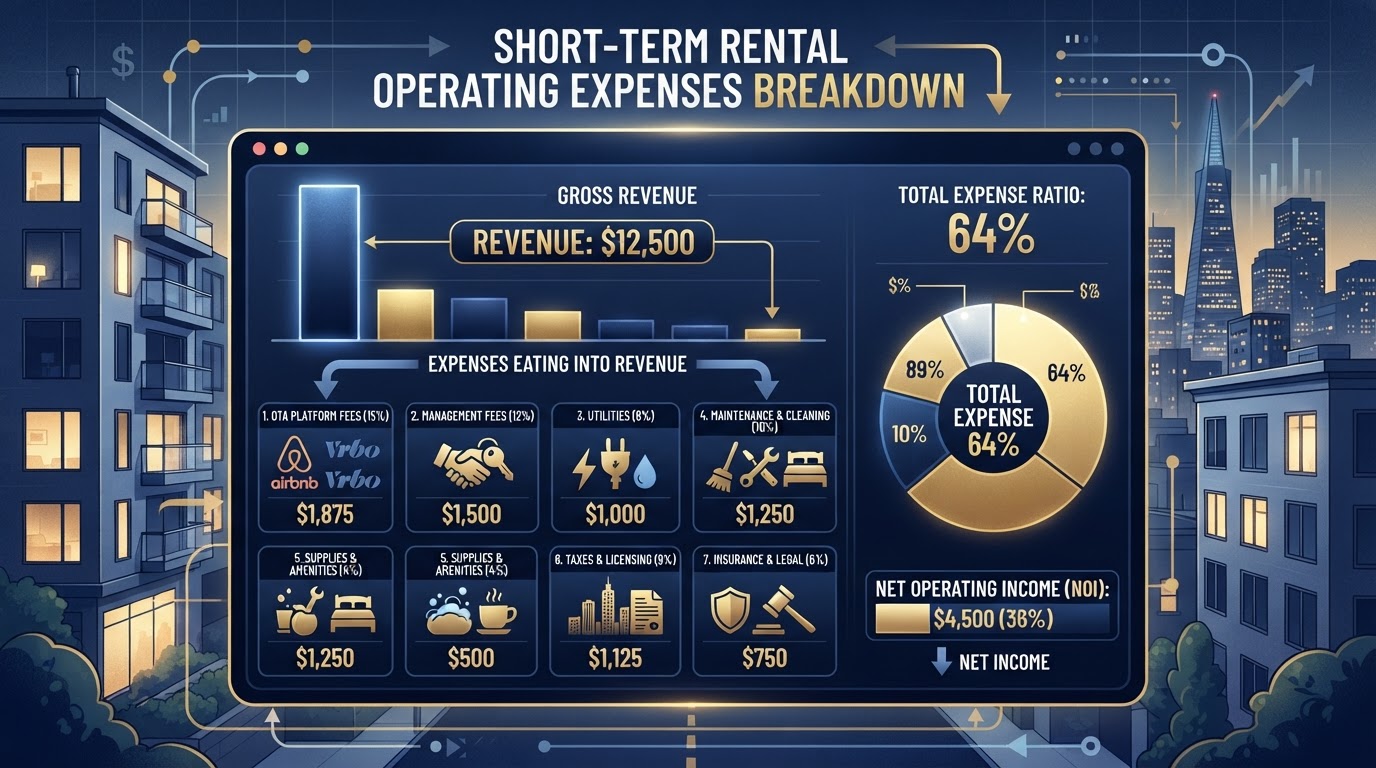
On paper, short-term rentals often show a two- or three-times gross revenue increase over long-term rentals in the same market. That headline number is what sells the strategy. But gross revenue is not what lands in your bank account. When we analyze these deals for clients, we look past the top line and dig into the operating expenses that quietly eat away at profitability — the costs that the listing sites and the gurus tend to understate.
Management fees for a professional short-term rental manager run significantly higher than a long-term rental manager, often fifteen to thirty percent of gross revenue, because the workload is far greater. The owner pays all utilities, including premium internet, streaming services, and often pool or hot tub heating. Maintenance and supplies — linens, coffee, toiletries, and the frequent wear-and-tear repairs that come with guests who treat a rental like a hotel — consume another meaningful slice. And the platform fees themselves, whether Airbnb or VRBO, take three to fifteen percent depending on the fee structure you choose.
After those expenses, the spread between a short-term and a long-term rental is often narrower than the marketing suggests. The true value, and the reason so many high-net-worth individuals are drawn to this asset class, usually lies not in the cash flow but in the tax advantages. That is where the strategy becomes genuinely powerful — and where it also becomes genuinely complex.
The Short-Term Rental Loophole: How the Tax Strategy Works
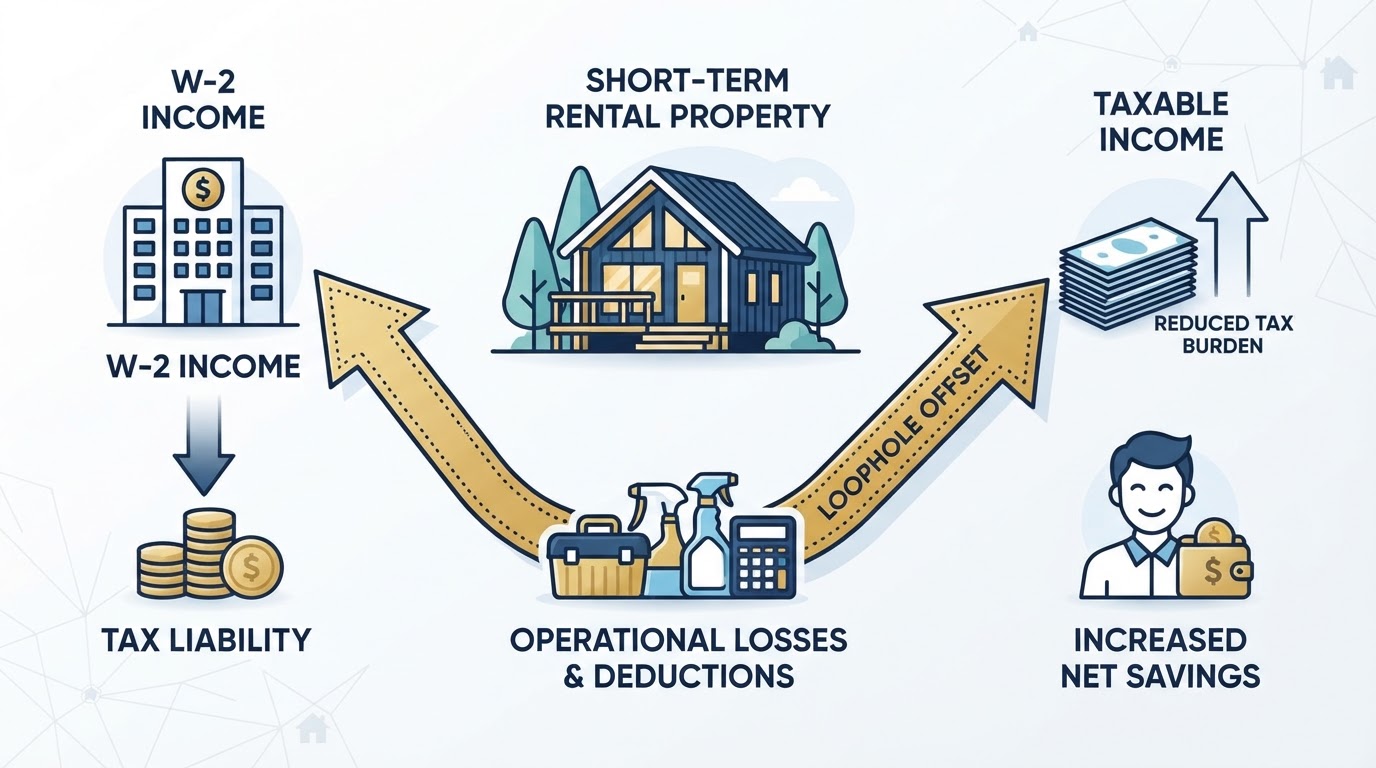
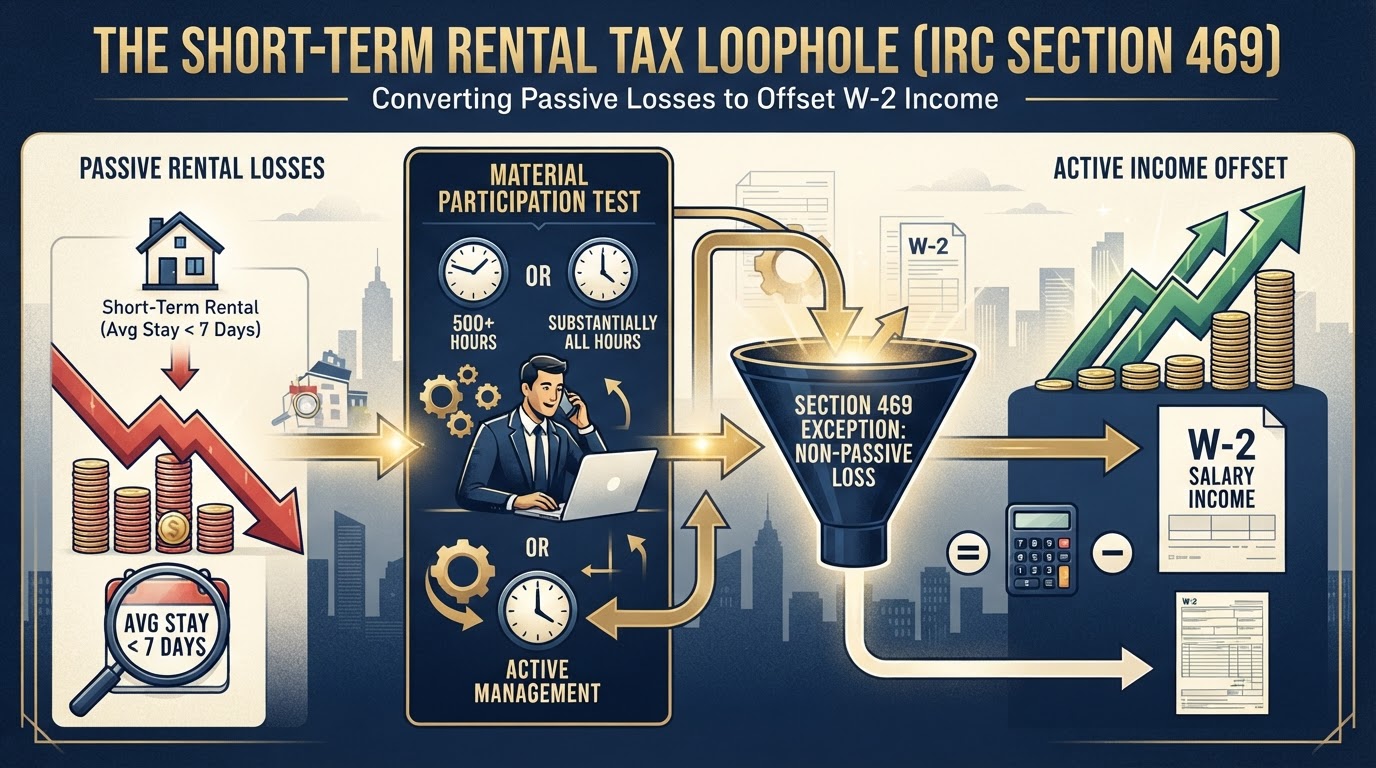
This is where most of our clients get genuinely interested. Under IRC Section 469, rental activities are generally classified as passive. That classification matters enormously, because passive losses generally cannot offset non-passive income like your W-2 salary or your active business profits. For a full-time doctor, attorney, or technology executive, that limitation usually blocks real estate losses from doing any good against their largest tax bill — unless they qualify as a Real Estate Professional, which is a demanding test few high earners can satisfy.
There is, however, a specific exception built into the rules. When a rental activity meets two criteria, it is not treated as a rental activity for passive-loss purposes at all. First, the average period of customer use is seven days or fewer — the so-called seven-day rule. Second, the owner materially participates in the activity. The most common material participation test we rely on is the 500-hour test, though the substantially-all test can also apply for a hands-on owner. When both conditions are met, the losses from the property are treated as non-passive, which means they can flow through to the owner's personal return and offset W-2 wages and other active income.
The documentation is what makes or breaks this strategy. The seven-day rule is measured by the average rental period, not the maximum, and it must be provable from the platform's booking records. We pull those reports for every client and keep them in the tax file, because that single document is the foundation of the entire position. Material participation must be documented with a contemporaneous time log — one reconstructed after an IRS notice carries far less weight than one maintained in real time. We provide clients with a structured tracking template and review the logs quarterly to ensure they are on pace and properly categorized.
Cost Segregation and Bonus Depreciation
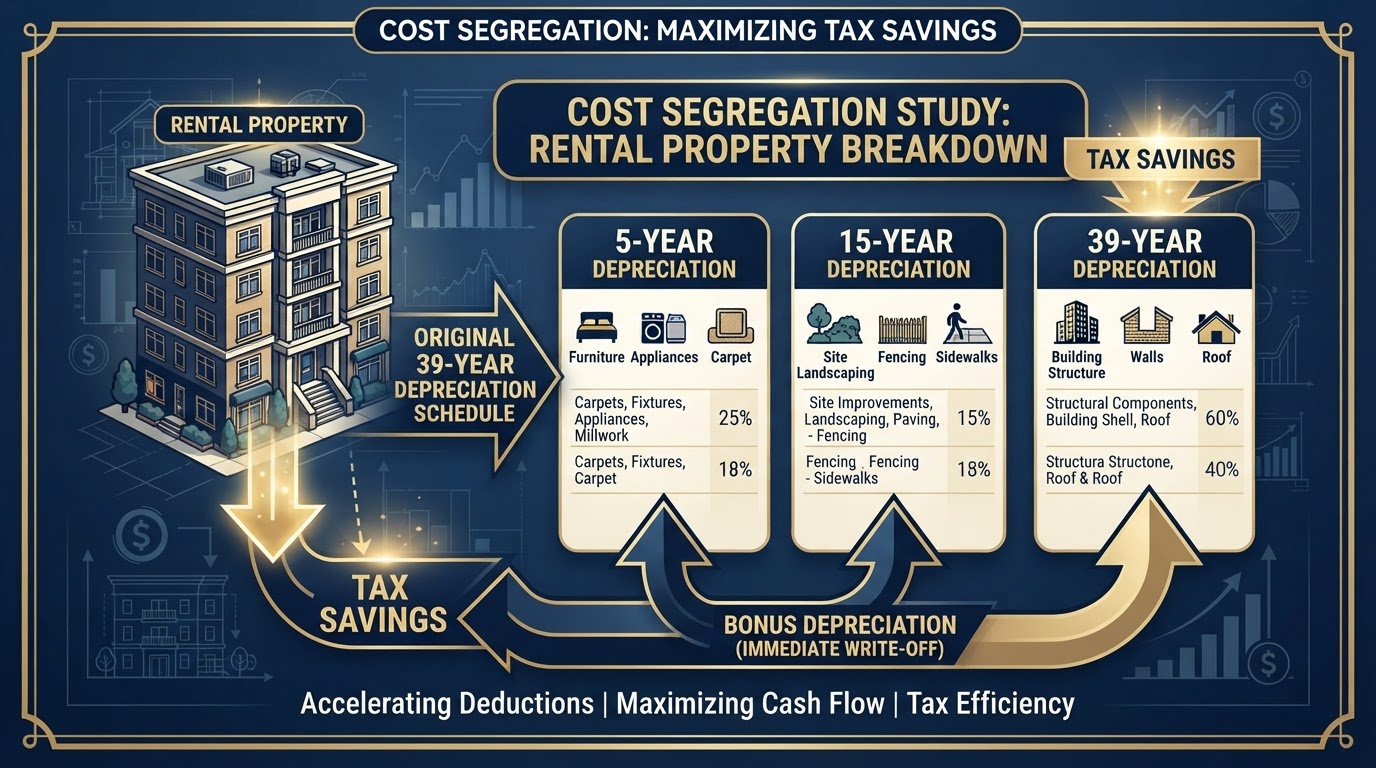
The loophole only matters if the property actually generates a loss for tax purposes. A property that throws off positive cash flow but produces a tax loss is the ideal outcome, and the tool that creates that result is a cost segregation study. Instead of depreciating the entire building over 27.5 years for residential property or 39 years for commercial, an engineering-based study reclassifies components of the structure into shorter recovery periods.
Five-year property captures furniture, appliances, electronics, specialty lighting, and decor. Fifteen-year property captures landscaping, driveways, fencing, patios, and swimming pools. Only the core structure, roof, and fundamental plumbing and electrical remain on the long schedule. When combined with bonus depreciation, the reclassified five- and fifteen-year components can be expensed at a high percentage in the very first year, generating a large paper loss even when the property is cash-flow positive.
On a million-dollar property, a cost segregation study might reclassify a meaningful portion of the basis into five- and fifteen-year property, and at current bonus depreciation rates that can produce a first-year deduction large enough to shelter a significant slice of W-2 income. That is how a high-earning professional can legally reduce their taxable income in the year of acquisition while owning an appreciating asset. But the study, the bonus election, and the participation documentation must be coordinated as a single integrated strategy — a disconnected set of moves will not hold up under examination.
Five Pitfalls New Investors Miss
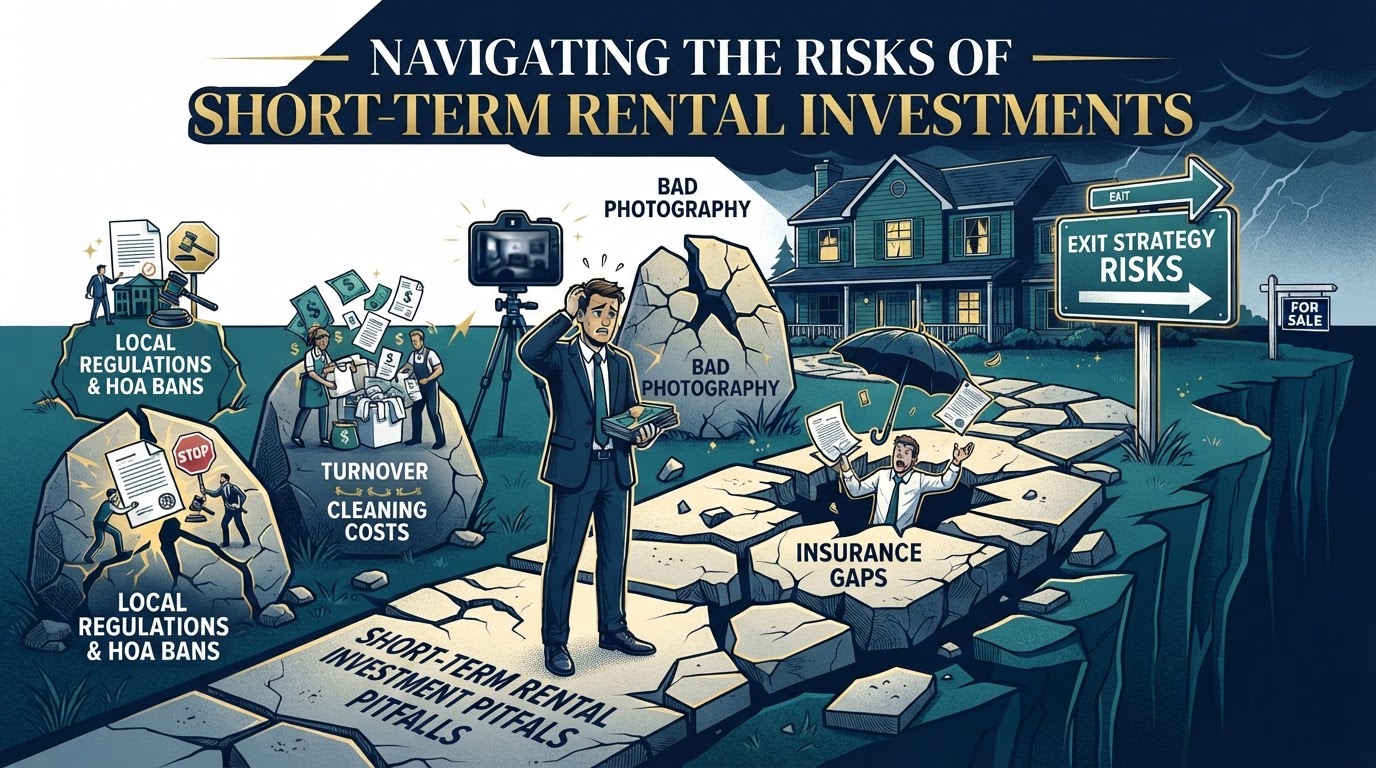
The tax benefits are real, but they do not insulate you from the operational and legal risks that sink inexperienced operators. These are the five mistakes we see most often in the Southern California market.
Ignoring local regulations and HOA rules. Cities like Santa Monica and Los Angeles, along with many coastal towns, enforce strict primary-residence requirements or outright bans on short-term rentals. If you do not live in the property, you may not be allowed to host legally. Always verify the specific city ordinances and the HOA bylaws before you close. An illegal STR is a significant liability, not a technicality.
Underestimating turnover costs. Cleaning a short-term rental is not like cleaning your own home. It requires professional-grade speed and consistency, often within a four-hour window between check-out and check-in. If your cleaning fees are not properly calculated and passed through to the guest, they will consume your margin entirely.
Neglecting photography and staging. The market is highly visual and competitive. Without professional staging, interior design, and high-end photography, your listing will be buried by the algorithm. Guests book on aesthetics first, and a mediocre listing underperforms even when the property itself is excellent.
Carrying the wrong insurance. Standard homeowner's or landlord insurance does not cover short-term rental business activity. You need a specialized commercial policy to protect against guest liability, loss of income, and property damage. A single serious claim can wipe out years of profit if you are uninsured properly.
Having no exit strategy. Always underwrite the deal as a long-term rental first. If the city bans short-term rentals tomorrow, or if travel demand drops, can the property still cover its debt service as a long-term rental or medium-term corporate housing? If the answer is no, the deal is a high-risk gamble rather than a resilient investment.
Scaling: DIY Versus Professional Management
Once you have one successful property, the temptation is to buy five more. But remember the framing: five properties means five small hospitality businesses. You will eventually hit a wall where you can no longer manage the guest experience, the cleanings, and the pricing yourself while maintaining your primary career. That wall arrives faster than most owners expect.
Hiring a full-service manager — who typically takes twenty to thirty percent of gross revenue — makes the investment more passive, but it introduces a tax tension that is easy to overlook. If your manager puts in more hours on the property than you do, you may fail the material participation test, and the entire tax strategy collapses. The non-passive treatment that lets your losses offset W-2 income depends on your own involvement, not a third party's. This is a decision we help clients navigate based on their total financial picture, and often a hybrid approach — software automation paired with a dedicated local cleaner and the owner handling pricing and guest communication — is the sweet spot that preserves both the cash flow and the tax position.
A FIG Client: From Spreadsheet Projection to Real Numbers
A client came to us after purchasing a short-term rental in a Southern California beach community. The seller's pro forma showed strong gross revenue and a healthy margin. Eight months in, the owner's actual cash flow was far below projection, the books were a tangle of uncategorized platform payouts and personal card charges, and no one had documented the hours needed to support the tax strategy the owner was counting on.
We started by reconstructing the books from the bank and platform records, separating the business transactions from personal spending that had been commingled on the same cards. We categorized every payout, fee, and refund correctly, reconciled the merchant processor to the bank deposits, and produced a clean profit-and-loss statement that reflected the real operating margin — which was materially lower than the pro forma but still positive. We then set up a contemporaneous time-tracking log so the owner's material participation was documented in real time rather than reconstructed later, and we coordinated a cost segregation study on the property.
The result was a property that was both operationally honest and tax-optimized. The owner could see the true cash flow and make informed decisions about pricing, cleaning costs, and whether to add a second unit. And the documented participation, combined with the cost segregation study and the bonus depreciation election, supported a first-year loss that flowed through to offset a meaningful portion of the owner's W-2 income. The strategy worked because every piece — the books, the time log, the study, and the election — was in place before the return was filed, not assembled after a notice arrived.
Is the Short-Term Rental Path Right for You?
Short-term rentals remain one of the most powerful wealth-building and tax-mitigation tools available to a high-earning individual, but they reward a sophisticated, business-first approach and punish a passive, set-and-forget mindset. You need a team that understands not just the bookkeeping and the hospitality metrics, but the engineering of the tax strategy behind them — the seven-day rule, the participation documentation, the cost segregation study, and the bonus election, all coordinated and all supported before the return is filed.
If you are considering a short-term rental investment, or you already own one and want to confirm you are capturing the tax savings and running the operation on real numbers, we can help. We specialize in untangling the complex intersection of real estate tax law and operational bookkeeping so you can focus on finding the next great property and building generational wealth.
Quick Tax Savings Estimator
See how much you could potentially save with proactive tax strategy and clean bookkeeping. Most LA businesses overpay by 15-20% simply due to missed deductions.
Free IRS Audit Risk Assessment
Do you mix personal and business expenses in the same bank account?
Frequently Asked Questions
How far back can you catch errors?
I perform a deep forensic review of your history to catch errors and fix them. Whether it's one year or five, my goal is to ensure your historical data is pristine before we move forward.
Will you educate me on how to manage my books?
Yes! My approach is highly educational. I want you to understand the "why" behind the numbers so you can make better business decisions with confidence.

About the Author
Fiscal Integrity Group
Fiscal Integrity Group is a leading financial advisory firm in Los Angeles. With extensive experience in tax strategy, accounting, and fractional CFO services, we help business owners optimize their finances, minimize tax liabilities, and scale with confidence.