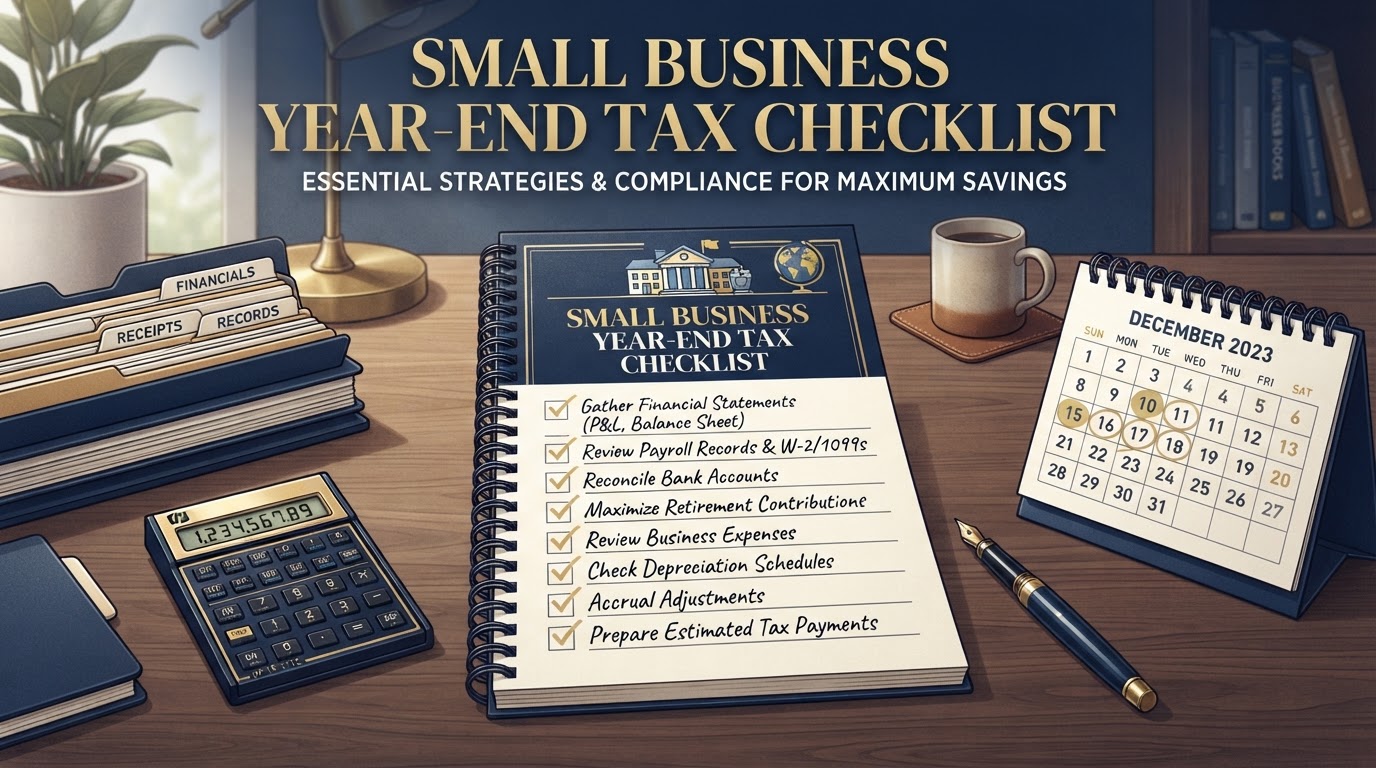
For small business owners, the months of November and December are critical for tax optimization. Once the clock strikes midnight on December 31st, many of the most powerful tax-saving opportunities for that year vanish. Proactive planning allows you to shift income, accelerate expenses, and ensure your books are audit-ready before the filing deadline. This checklist walks through every move we make for our Southern California clients before the year closes.
Reconciling Every Account
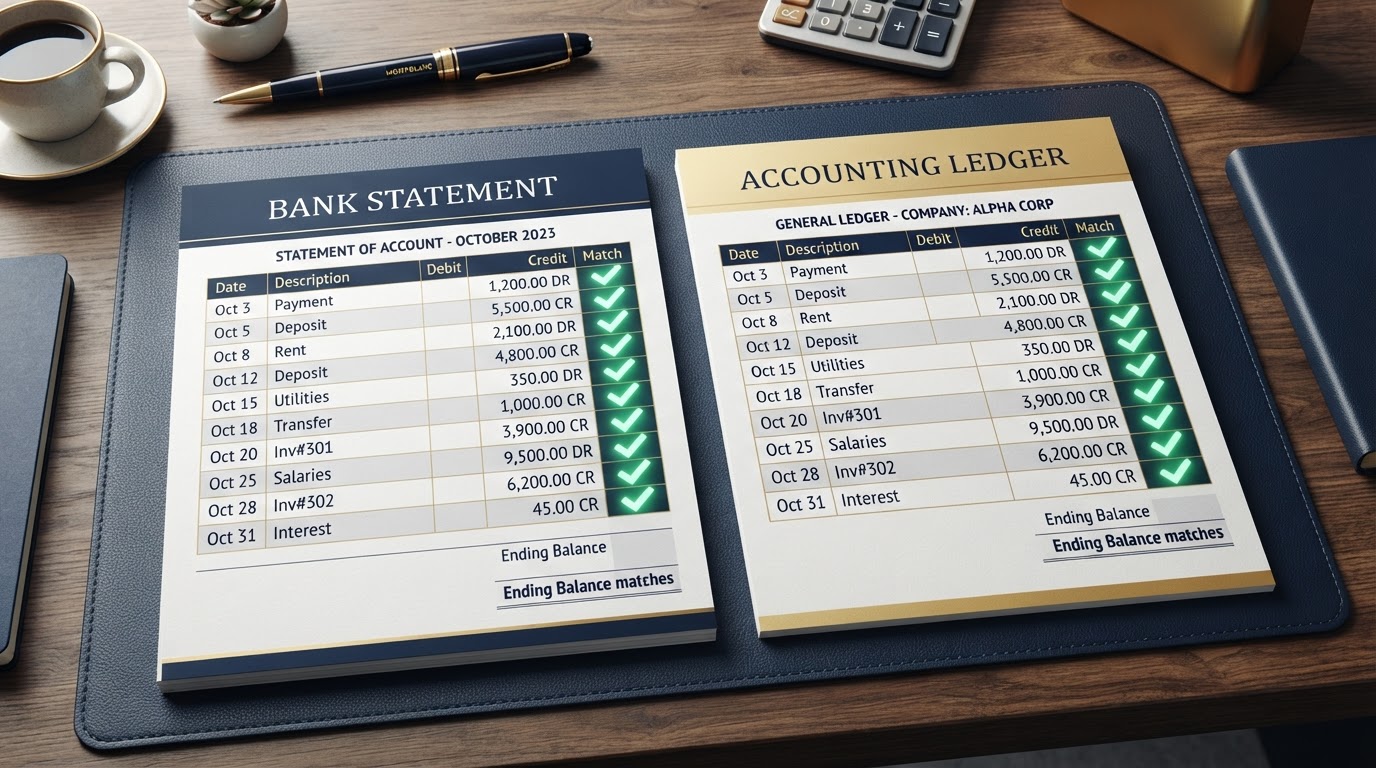
The first step in any year-end close is reconciling every bank account, credit card, loan, and merchant processor to the penny. Reconciliation is not just a bookkeeping formality — it is the process that proves your financial statements match the external source of truth. If your QuickBooks balance does not match your bank statement on December 31, every downstream report, from your Profit and Loss to your tax return, is built on a broken foundation.
We reconcile every account for our clients before any tax decision is made. This includes checking accounts, savings accounts, business credit cards, vehicle loans, lines of credit, PayPal, Stripe, Square, and any payroll clearing accounts. Any transaction that has not cleared the bank by year-end is flagged as outstanding and either chased down or written off as a stale item. A clean reconciliation is the single best audit defense you can build.
Accounts Receivable & Bad Debt
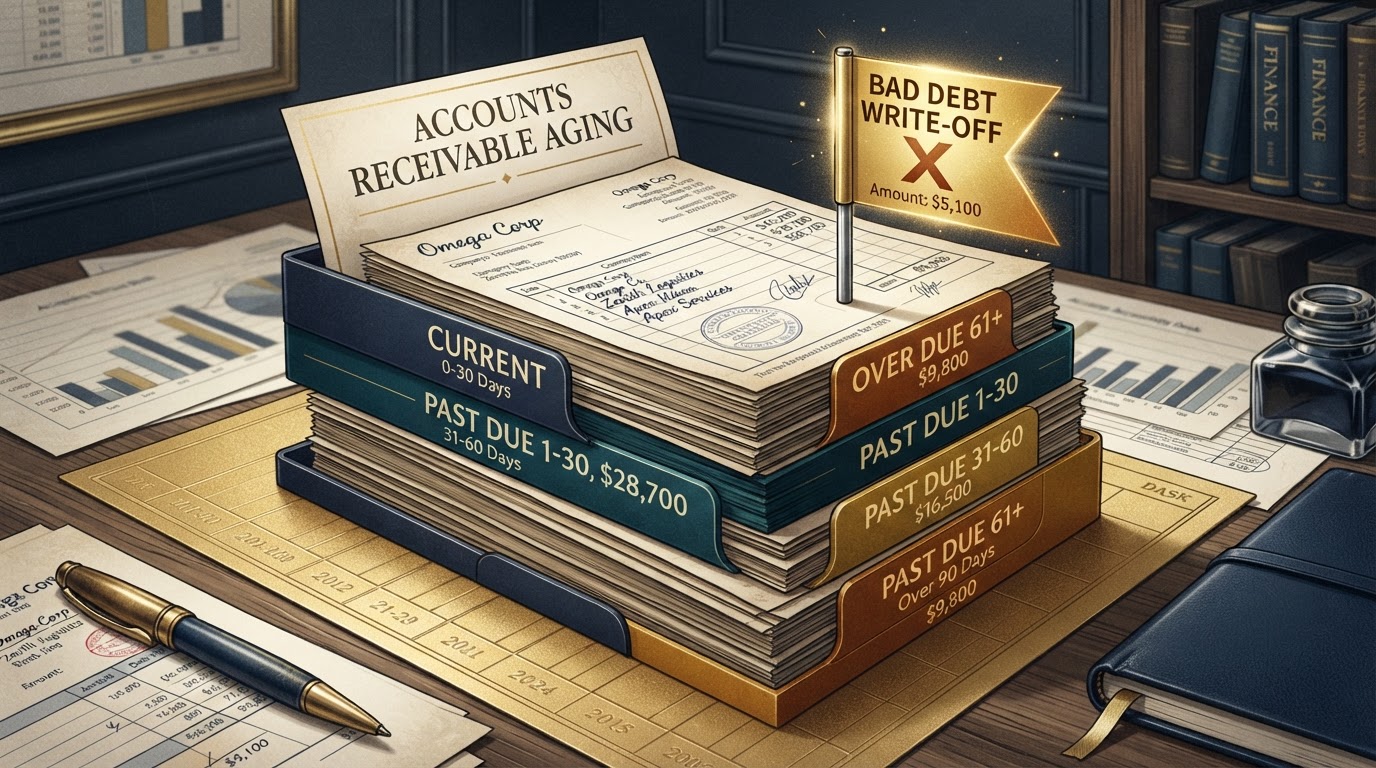
At year-end, we review every outstanding invoice in your Accounts Receivable aging report. Invoices that are 90, 120, or 180 days past due need a decision: are you going to collect them, or are they gone? An invoice you will never collect is not income — it is bad debt, and under the accrual method of accounting, you can write it off to reduce your taxable income.
For cash-basis taxpayers, bad debt write-offs work differently because you never recognized the income in the first place. But reviewing your AR aging at year-end still matters: it tells you which clients are consistently slow payers, which invoices need to go to collections, and whether your credit policy is too loose. We help clients clean up their AR aging every December so the new year starts with an accurate picture of what is actually owed to the business.
Accelerating Deductible Expenses
One of the simplest year-end strategies is accelerating deductible expenses into the current tax year. If you know you will need office supplies, software subscriptions, insurance premiums, or professional services in the first quarter of next year, prepaying them before December 31 lets you take the deduction now, when it may offset a higher tax bracket. The IRS allows you to deduct prepaid expenses that benefit a period of 12 months or less, as long as the benefit does not extend beyond the end of the tax year following the year of payment.
This strategy is especially powerful for profitable businesses staring down a large tax bill. By pulling expenses forward, you reduce current year taxable income and smooth out your tax liability across years. We review every client's projected income and expenses in November so there is time to execute before the deadline.
Section 179 & Bonus Depreciation
If you purchased equipment, machinery, vehicles, or furniture during the year, Section 179 allows you to deduct the full purchase price in the year the asset is placed in service rather than depreciating it over several years. For 2026, the Section 179 deduction limit is over $1.2 million, with a phase-out threshold that begins around $3 million in equipment purchases. This is one of the most aggressive deductions available to small businesses.
Bonus depreciation is the companion strategy. While Section 179 requires you to specify which assets get the full deduction, bonus depreciation applies automatically to all qualifying property. The bonus percentage has been phasing down — 80% in 2023, 60% in 2024, 40% in 2025, and 20% in 2026. Even at reduced rates, front-loading depreciation into the year of purchase creates a significant tax shield. We help clients time equipment purchases around these thresholds and document the placed-in- service date carefully, because the IRS is strict about when an asset is actually ready for use.

Retirement Plan Contributions
Retirement contributions are one of the few year-end tax strategies that can still be executed after December 31. A SEP-IRA can be funded up until the filing deadline, including extensions, and still count as a deduction for the prior year. A Solo 401(k) is even more powerful, allowing both employee deferrals and employer profit-sharing contributions, but it generally must be established by December 31 to count for that tax year — even if the actual funding happens later.
For a self-employed individual earning $200,000, maxing out a Solo 401(k) can shelter over $60,000 from taxes in a single year. We model the exact contribution limit for each client based on their net self-employment income, then coordinate the contribution with their overall tax strategy so it works alongside the QBI deduction and S-Corp salary structure rather than against them.

Employee Bonuses & Benefits
Year-end bonuses paid to employees and to owner-employees are deductible in the year they are paid, as long as they are reasonable compensation for services rendered. For accrual-basis taxpayers, bonuses can be accrued and deducted in the current year even if paid within the first 2½ months of the following year, under the recurring-item exception. For cash-basis taxpayers, the bonus must actually be paid by December 31 to get the deduction this year.
Beyond bonuses, year-end is the time to review benefit programs. Contributions to qualified retirement plans, health reimbursement arrangements, and dependent care assistance programs all create deductions while providing value to your team. We help clients structure these so they maximize the owner's tax benefit while staying within nondiscrimination rules.
Home Office & Vehicle Logs
The home office deduction is available to self-employed individuals and partners who use a portion of their home exclusively and regularly for business. The simplified method gives a flat $5 per square foot, up to 300 square feet, for a maximum deduction of $1,500. The regular method requires calculating the actual percentage of your home used for business and allocating mortgage interest, utilities, insurance, and depreciation accordingly — which often produces a much larger deduction.
Vehicle deductions require a contemporaneous mileage log to survive IRS scrutiny. The standard mileage rate is simpler, but the actual expense method — which includes gas, repairs, insurance, registration, and depreciation — can produce a larger deduction for heavy vehicles. We help clients reconstruct logs when they are missing and choose the method that yields the best result. The key is documentation: a mileage app that tracks every trip in real time is the gold standard.

The December 31 Deadline
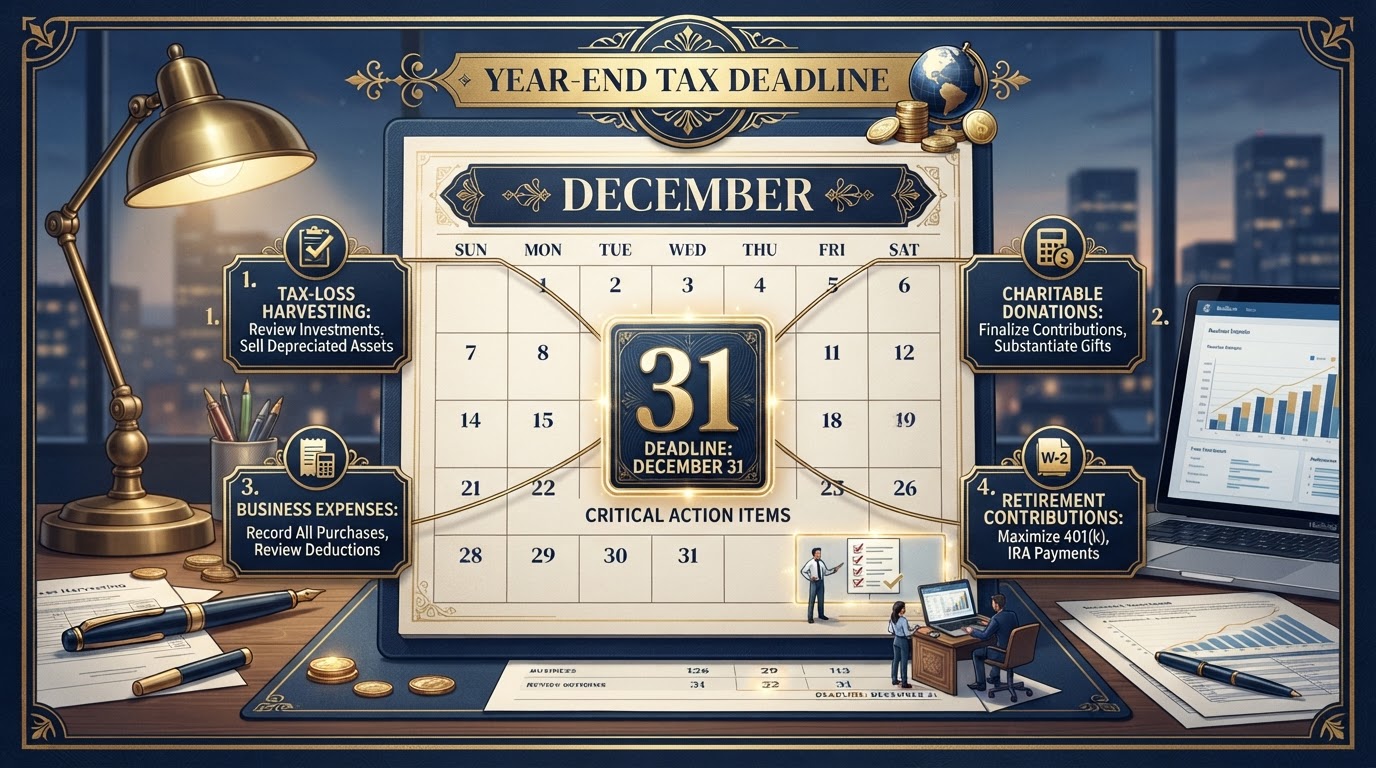
The unifying theme of every strategy above is the December 31 deadline. Once the year closes, your ability to shift income, accelerate expenses, or place assets in service is gone. The business owners who save the most are the ones who start planning in October and November, not in April. We run a year-end tax projection for every client in the fall so there is time to execute every available strategy before the window closes.
Conclusion
A year-end tax checklist is not a list of chores — it is a sequence of decisions that, made in the right order and at the right time, can legally reduce your tax bill by thousands of dollars. Reconcile first, review your receivables, accelerate expenses, maximize depreciation, fund retirement, and document everything. If you want a team to run this checklist for your business before December 31, we can help.
Quick Tax Savings Estimator
See how much you could potentially save with proactive tax strategy and clean bookkeeping. Most LA businesses overpay by 15-20% simply due to missed deductions.
Free IRS Audit Risk Assessment
Do you mix personal and business expenses in the same bank account?
Frequently Asked Questions
How far back can you catch errors?
I perform a deep forensic review of your history to catch errors and fix them. Whether it's one year or five, my goal is to ensure your historical data is pristine before we move forward.
Will you educate me on how to manage my books?
Yes! My approach is highly educational. I want you to understand the "why" behind the numbers so you can make better business decisions with confidence.

About the Author
Wiyao Awesso
Wiyao Awesso is a leading financial advisor in Los Angeles. With extensive experience in tax strategy, accounting, and fractional CFO services, he helps business owners optimize their finances, minimize tax liabilities, and scale with confidence.