Named after the famous golf tournament in Georgia, the Augusta Rule (officially Section 280A of the tax code) allows homeowners to rent out their primary residence for up to 14 days per year without having to report any of that rental income on their personal tax return. While originally intended for residents near major events, it has become a powerful strategy for small business owners across the country. This playbook walks through exactly how we implement it for our clients.

Establishing a Fair Market Rate
The Augusta Rule only works if the rent your business pays to use your home is at fair market value. The IRS will disallow the deduction — and potentially reclassify the payment as a disguised dividend or distribution — if the rate is inflated. Fair market rate means the amount a third party would pay to rent a comparable property for a comparable event in your area.
We help clients document fair market rate by pulling comparable rental listings for similar homes in the same zip code, considering square footage, amenities, and the type of event. A board meeting for a day commands a different rate than a multi-day corporate retreat. We save screenshots of comparable listings and a short written justification so the rate is defensible if the IRS ever questions it.

Legitimate Business Purpose
The business must have a real, legitimate reason to rent your home. The most common qualifying events are corporate retreats, board meetings, strategic planning sessions, annual shareholder meetings, and employee training events. The key is that actual business is conducted — there must be an agenda, attendees, minutes, and a purpose that benefits the business.
A vague claim that you "worked from home" does not qualify. The Augusta Rule requires a specific rental arrangement for a specific event. We help clients structure these events properly: a written rental agreement, a meeting agenda, a sign-in sheet, and minutes that document what was discussed and decided. This paper trail is what separates a legitimate deduction from an audit trigger.

The 14-Day Limit & Strict Rules
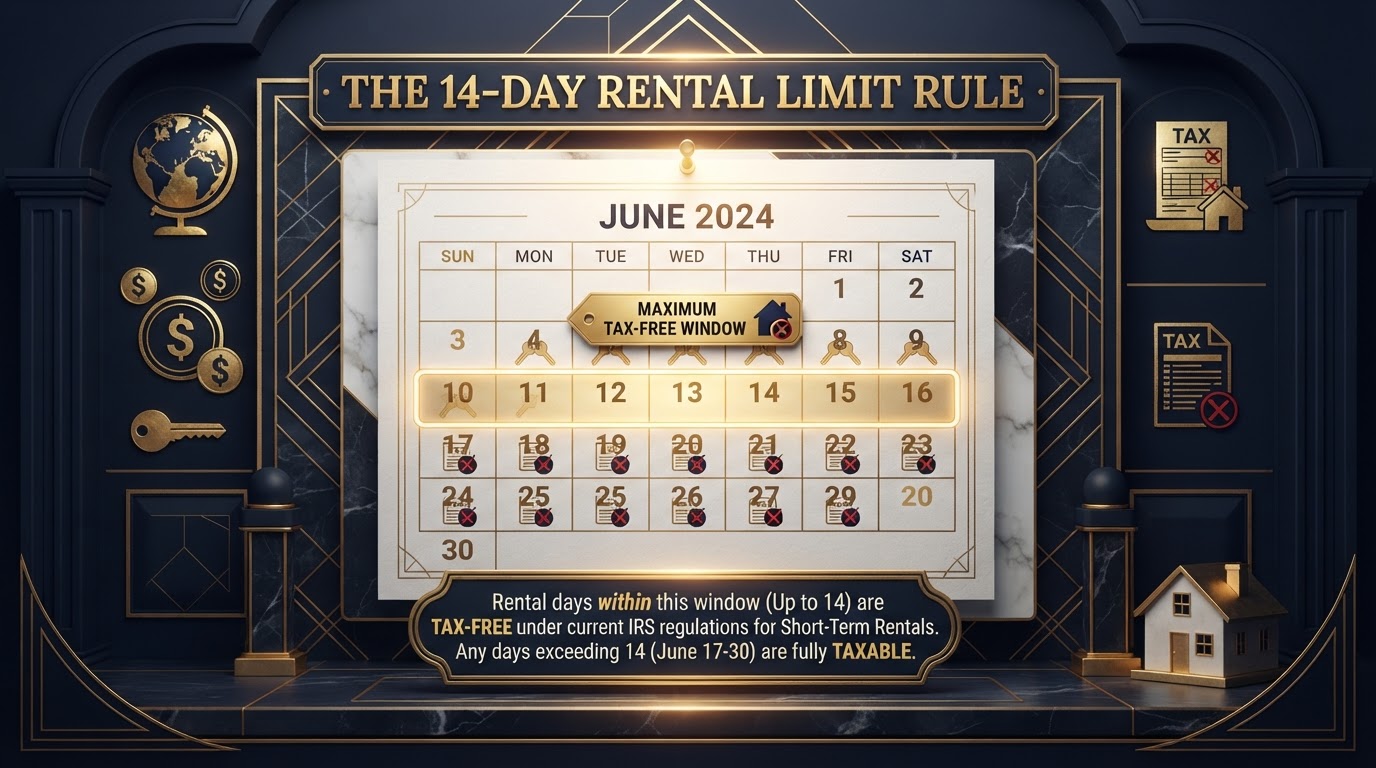
Section 280A allows you to rent your home tax-free for up to 14 days per year. The 14 days do not have to be consecutive, but once you exceed 14 days of rental use, all rental income becomes taxable and you enter the full Schedule E rental reporting regime. This cliff is absolute — there is no partial exclusion for 15 days.
Personal use of the home during the rental period also matters. If you personally use the home for more than the greater of 14 days or 10% of the days it is rented, the home is considered a personal residence, which is actually what you want for the Augusta Rule — but you must track both numbers carefully. We maintain a rental-use log for every client so the 14-day limit is never accidentally exceeded.
Documentation Requirements
The Augusta Rule lives or dies on documentation. To survive an audit, you need a written rental agreement between the business and the homeowner, proof of payment (a check or transfer from the business account), comparable rental rate evidence, a meeting agenda, signed minutes, and an attendance log. Each of these documents tells the IRS that a real transaction occurred for a real business purpose.
We build a complete documentation file for every client who uses this strategy. The file is assembled at the time of the event, not reconstructed years later. Contemporaneous documentation is the standard the IRS applies, and a file created after an audit notice starts is far less credible than one created when the rental actually occurred.
Corporate Minutes & Compliance
For the Augusta Rule to work cleanly, the business must formally approve the rental arrangement. This means the board of directors or managing members must pass a resolution authorizing the rental, documenting the business purpose, the fair market rate, and the dates. This resolution goes into the corporate minute book.
Without this step, the payment from the business to the homeowner looks like a disguised distribution or a personal expense paid by the business. The corporate minutes are what establish that the payment was a legitimate, deductible business expense rather than a transfer of profits. We provide clients with template resolutions and help them maintain a clean minute book.

Combining With Other Strategies
The Augusta Rule does not exist in isolation. It stacks naturally with an S-Corp salary strategy, the QBI deduction, and a home office deduction — as long as each is structured correctly and the purposes do not overlap improperly. For example, the home office deduction covers the ongoing business use of a portion of your home, while the Augusta Rule covers specific short-term rental events. These are distinct benefits under distinct code sections.
We model the combined effect of all strategies for each client so the total tax reduction is clear and so no single strategy undermines another. The goal is a coordinated plan, not a collection of isolated tricks.

Audit-Proofing the Strategy
The Augusta Rule is legitimate, but it is also a known IRS focus area because it is easy to abuse. The business owners who get into trouble are the ones who rent their home to their business with no real meeting, no minutes, and no comparable rate analysis. The defense is simple: do it for real. Hold the meeting. Keep the minutes. Pay fair market rent. Document everything at the time.

Conclusion
The Augusta Rule lets a business owner convert personal residence value into a tax-deductible business expense while the rental income stays tax-free. Done correctly, with fair market rate, a real business purpose, proper corporate minutes, and complete documentation, it is one of the cleanest dual-benefit strategies in the tax code. If you own a home and a business and want to know whether this strategy fits your situation, we can help.
Quick Tax Savings Estimator
See how much you could potentially save with proactive tax strategy and clean bookkeeping. Most LA businesses overpay by 15-20% simply due to missed deductions.
Free IRS Audit Risk Assessment
Do you mix personal and business expenses in the same bank account?
Frequently Asked Questions
How far back can you catch errors?
I perform a deep forensic review of your history to catch errors and fix them. Whether it's one year or five, my goal is to ensure your historical data is pristine before we move forward.
Will you educate me on how to manage my books?
Yes! My approach is highly educational. I want you to understand the "why" behind the numbers so you can make better business decisions with confidence.

About the Author
Wiyao Awesso
Wiyao Awesso is a leading financial advisor in Los Angeles. With extensive experience in tax strategy, accounting, and fractional CFO services, he helps business owners optimize their finances, minimize tax liabilities, and scale with confidence.