For commercial contractors and large-scale residential builders, submitting a standard invoice often isn't enough. General Contractors, Architects, and Lenders require standardized billing formats — specifically the AIA G702 (Application and Certificate for Payment) and G703 (Continuation Sheet). These forms are the industry standard for requesting payment on a construction project, and getting them wrong means delayed payment, disputes, and cash flow problems.

This guide walks through the components of the AIA billing package, how to calculate the values correctly, and the common errors that cause applications to be rejected. Whether you are a subcontractor submitting to a GC or a GC submitting to an owner, mastering AIA billing is essential to getting paid on time.
Understanding the Original Contract Sum
The G702 begins with the original contract sum — the agreed total value of the work before any change orders. This is the baseline against which all progress is measured. Every subsequent application references this original sum, adjusted by approved change orders, to arrive at the contract sum to date. An error in the original contract sum propagates through every pay application for the life of the project.
We verify the original contract sum against the executed contract before the first application is ever submitted, and we reconcile it whenever a change order is approved so the running total is always accurate.
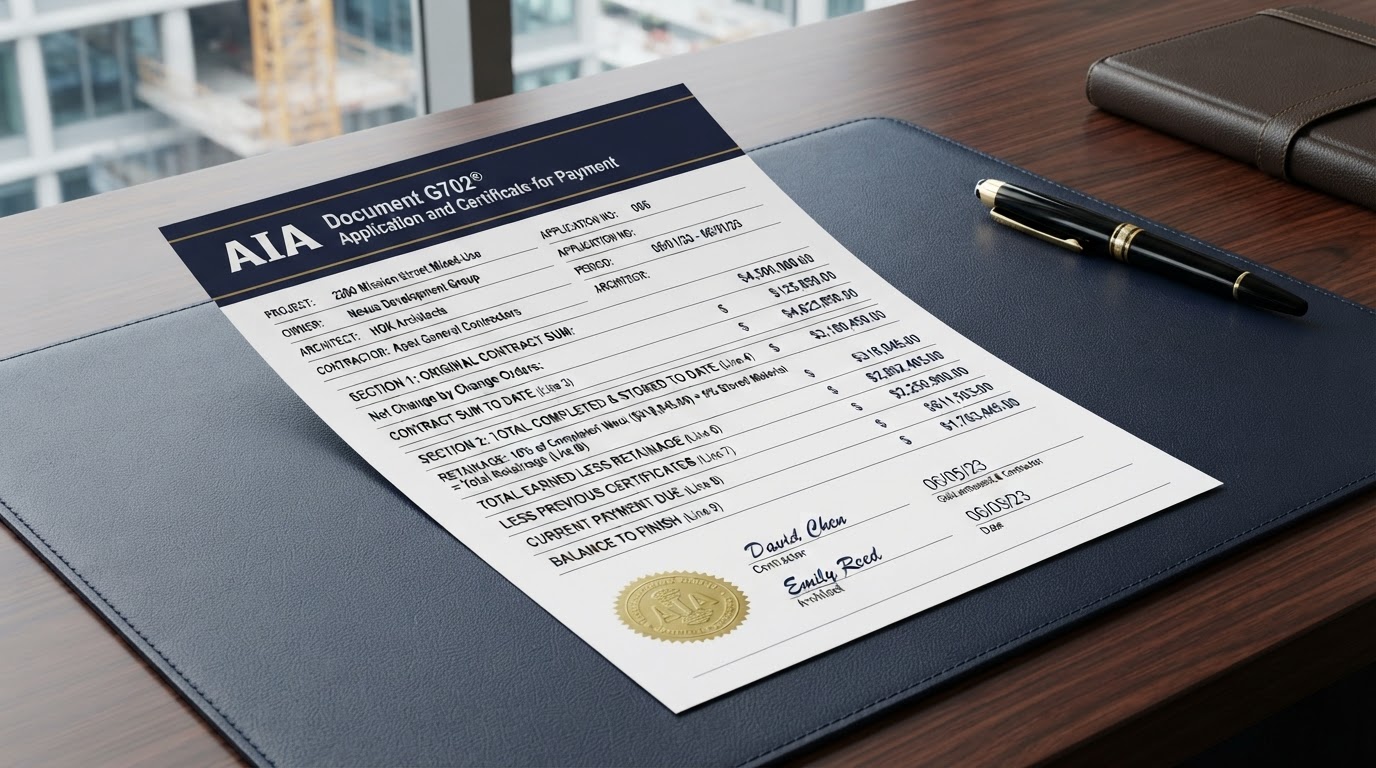
- Original contract sum is the baseline before change orders
- Every application references and adjusts this figure
- An error here propagates through every pay application
Tracking Net Change by Change Orders
Change orders modify the original contract sum — either increasing it (additive work) or decreasing it (deductive work). The G702 captures the net change from approved change orders, which is added to (or subtracted from) the original contract sum to produce the contract sum to date. Only approved change orders should appear; unapproved change orders are a common reason applications are rejected or reduced.
We maintain a change order log that tracks the status of every change order — submitted, approved, or pending — so only approved amounts flow into the pay application. This prevents the rejection that comes from including work the owner has not yet authorized.
- Net change = sum of approved additive minus deductive change orders
- Only approved change orders should appear on the application
- Maintain a change order log tracking approval status
Managing Retainage Percentages
Retainage is the percentage of each payment withheld by the owner or GC until the project is complete — typically 10%. The G702 calculates retainage on both the completed work and the stored materials. The retainage is released at the end of the project (or at an agreed milestone), and tracking it accurately is essential to knowing what you are owed and when.
We track retainage by line item and by project, so at any moment you know the total retainage held and the schedule for its release. This is also critical for the year-end balance sheet — retainage receivable is an asset that must be recorded correctly.
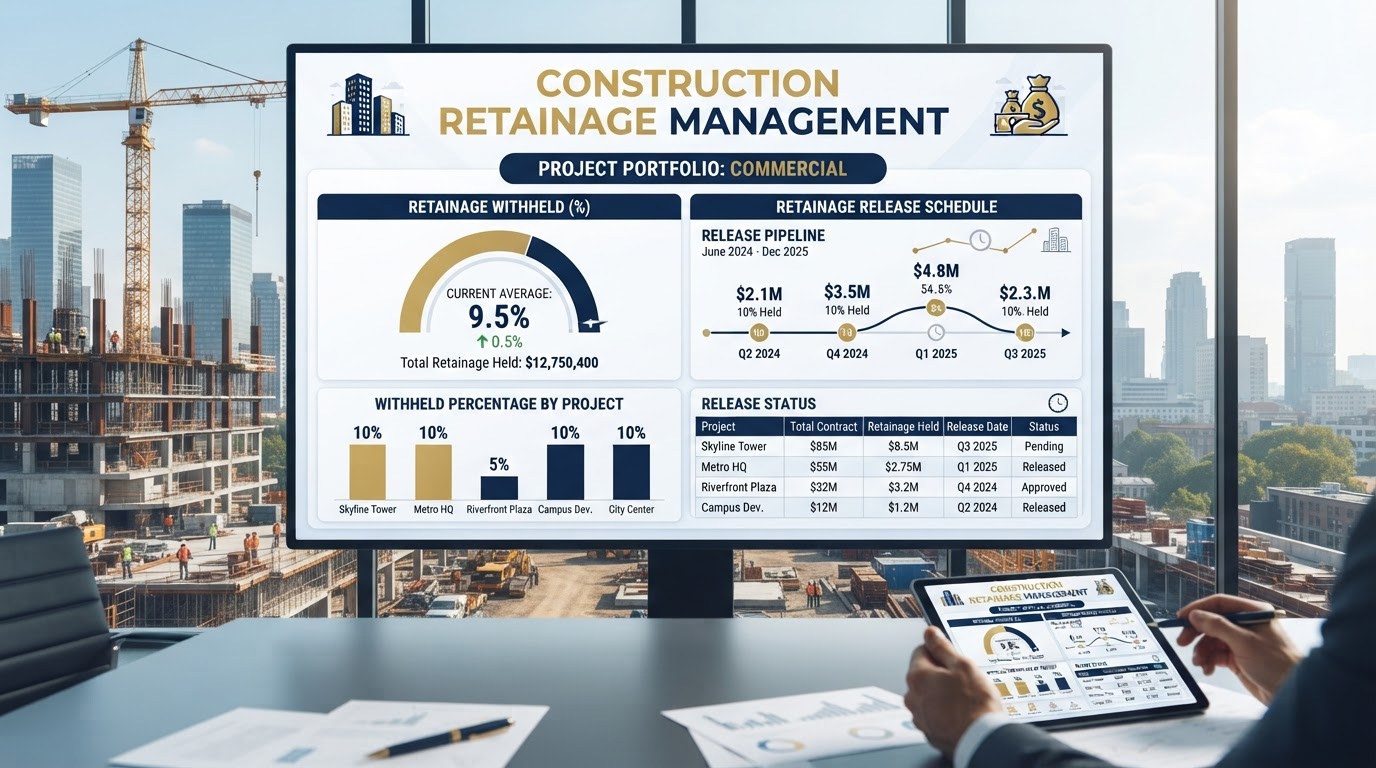
- Retainage is typically 10% withheld until project completion
- Calculated on both completed work and stored materials
- Track retainage receivable as an asset on the balance sheet
Itemized Breakdown by Trade or Phase
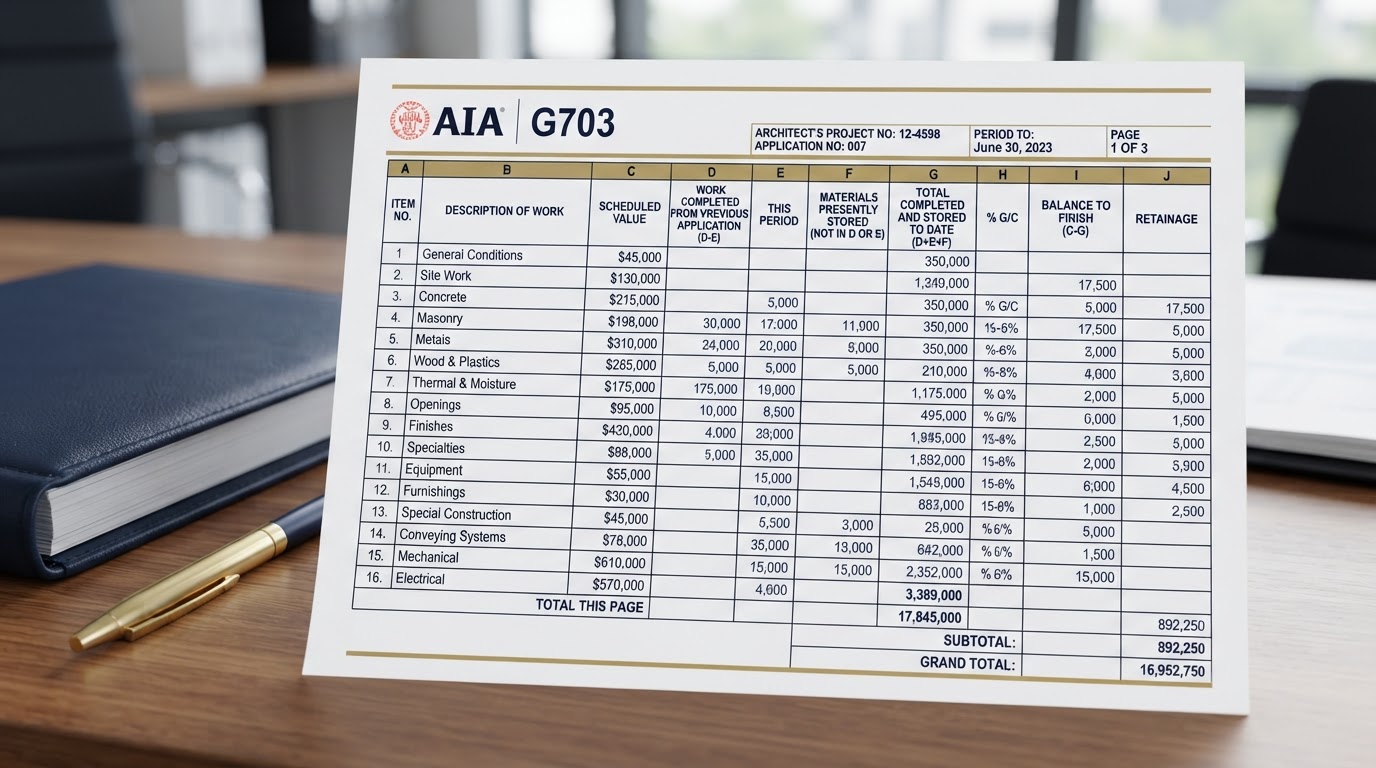
The G703 continuation sheet provides the line-item detail that supports the G702. Each line represents a scheduled value — a portion of the contract allocated to a specific trade, phase, or work item. For each line, you report the scheduled value, work completed to date (previous plus current), and stored materials. The sum of all lines must tie exactly to the G702 totals.
The scheduled values are typically established at the start of the project in the schedule of values. Getting this schedule right at the outset prevents disputes later, because it defines what each portion of the work is worth before the work begins.
- G703 provides line-item detail supporting the G702 totals
- Each line: scheduled value, completed to date, stored materials
- Schedule of values established at project start prevents disputes
Claiming Materials Presently Stored
Materials that have been purchased and stored on site (or in an approved warehouse) but not yet installed can be included in the pay application as stored materials. This is a powerful cash flow tool — it lets you get paid for materials you have paid for before they are installed. The catch is documentation: you must be able to prove the materials exist, are stored properly, and are titled to the project.
We help contractors document stored materials with paid invoices, photos, and a stored materials list so the claim is accepted without dispute. Without this documentation, owners and GCs routinely reject the stored materials portion of the application.
- Stored materials can be billed before installation
- Requires documentation: paid invoices, photos, stored materials list
- Without documentation, the stored materials claim is routinely rejected
Avoiding Common Math Errors and Rejections
The most common reasons AIA applications are rejected are math errors (the G703 lines do not foot to the G702 totals), including unapproved change orders, incorrect retainage calculations, and missing signatures or notarization. Each of these delays payment by weeks while the application is revised and resubmitted.
We use a templated, formula-driven billing system that prevents math errors, flags unapproved change orders before they are included, and ensures every signature and notarization is in place before submission. The result is applications that are accepted on the first submission.
- Math errors: G703 lines must foot exactly to G702 totals
- Unapproved change orders and incorrect retainage cause rejections
- Missing signatures or notarization delays payment for weeks
Conclusion
AIA billing is a discipline. The contractors who get paid on time are the ones whose applications are accurate, complete, and submitted on schedule. We set up the templates, the schedule of values, and the review process that produces clean applications every month. Contact us to streamline your AIA billing before the next pay application is due.
Quick Tax Savings Estimator
See how much you could potentially save with proactive tax strategy and clean bookkeeping. Most LA businesses overpay by 15-20% simply due to missed deductions.
Free IRS Audit Risk Assessment
Do you mix personal and business expenses in the same bank account?
Frequently Asked Questions
How far back can you catch errors?
I perform a deep forensic review of your history to catch errors and fix them. Whether it's one year or five, my goal is to ensure your historical data is pristine before we move forward.
Will you educate me on how to manage my books?
Yes! My approach is highly educational. I want you to understand the "why" behind the numbers so you can make better business decisions with confidence.

About the Author
Wiyao Awesso
Wiyao Awesso is a leading financial advisor in Los Angeles. With extensive experience in tax strategy, accounting, and fractional CFO services, he helps business owners optimize their finances, minimize tax liabilities, and scale with confidence.