Cash flow is the lifeblood of any business. More companies fail due to cash flow problems than due to lack of profitability — meaning you can be running a "profitable" business on paper while simultaneously being unable to make payroll or pay your vendors. This paradox is what destroys otherwise great businesses. This guide introduces the CFO-level frameworks that large corporations use to manage their liquidity, and shows you how to apply those same principles as a small or mid-sized business owner.
From building a 13-week cash flow forecast to implementing the Profit First methodology to managing receivables and payables cycles, this playbook provides you with actionable tools you can implement immediately. Beyond day-to-day management, we also cover how to use your cash flow data to negotiate better terms with lenders, position your business for acquisition, and make strategic investment decisions with confidence.
The 13-Week Cash Flow Forecast
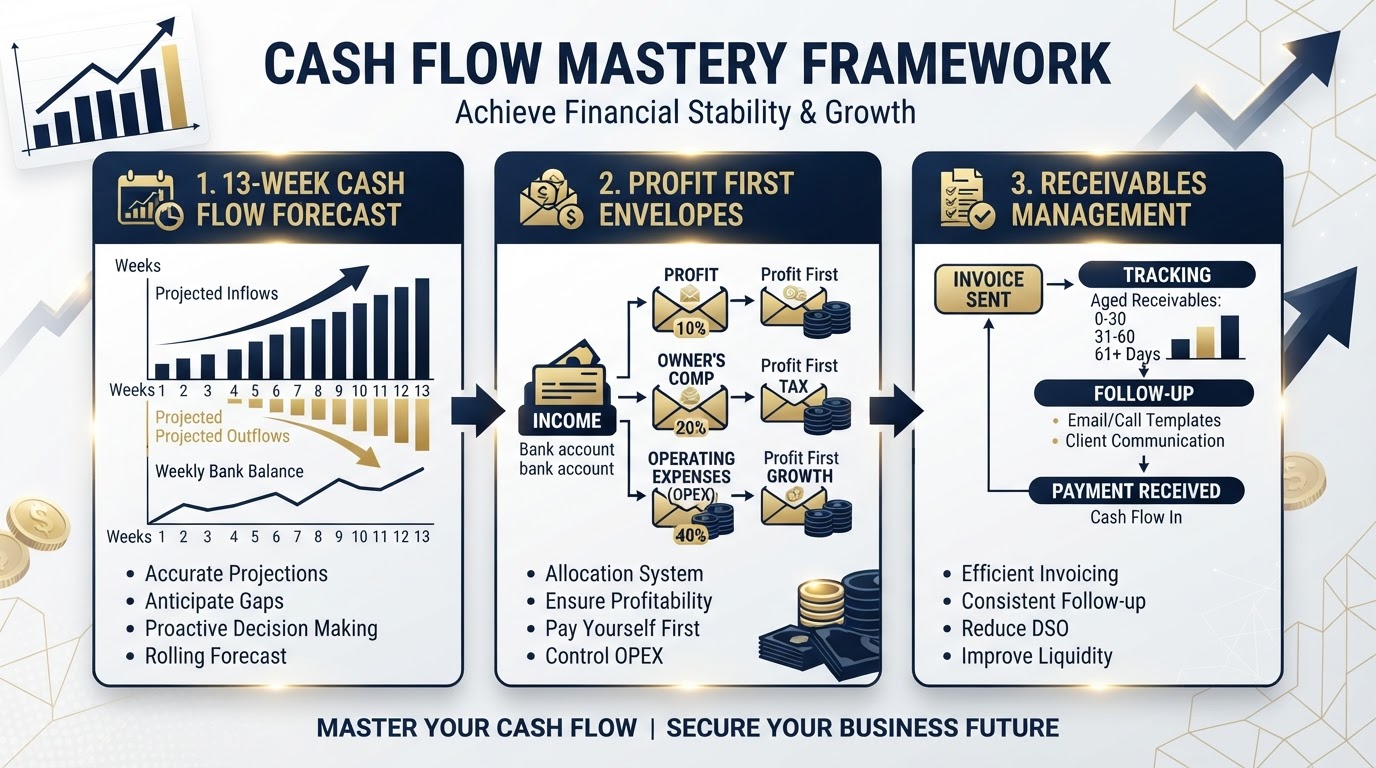
The 13-week cash flow forecast is the standard liquidity management tool used by CFOs at companies of every size. It projects your cash balance week by week for the next quarter, based on expected receipts and disbursements. The goal is to identify cash shortfalls weeks before they happen — when you still have time to arrange a line of credit, delay a discretionary payment, or accelerate a receivable.
The forecast starts with your current cash balance, adds projected customer payments based on your receivables aging, and subtracts scheduled payables, payroll, and debt service. The output is a weekly cash position that tells you exactly when you will need capital and how much. We build this forecast for clients and update it weekly so the picture is always current.
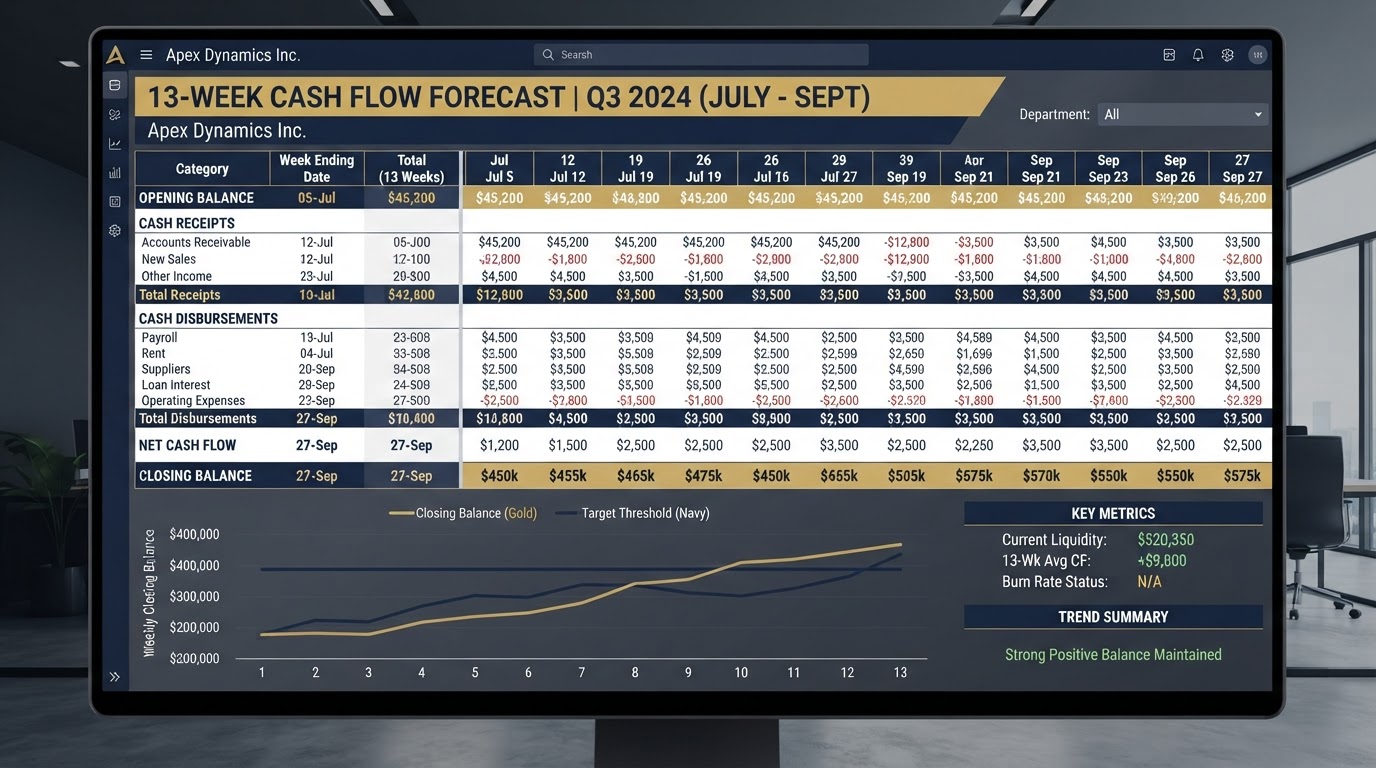
- Project cash balance week by week for the next quarter
- Identify shortfalls weeks before they happen — while you can act
- Update weekly so the forecast reflects current reality
Profit First: The Envelope System for Businesses
Profit First is a cash management methodology that flips the traditional accounting formula on its head. Instead of Revenue minus Expenses equals Profit, Profit First says Revenue minus Profit equals Expenses. You allocate a predetermined percentage of every deposit into separate accounts for profit, owner's pay, taxes, and operating expenses — and you run the business on what remains.
The power of the system is that it forces profitability by removing the option to spend the profit. When the operating expense account is low, you are forced to find efficiencies rather than dip into profit. We help clients set up the allocation percentages, open the right accounts, and build the rhythm of transfers that makes the system work.
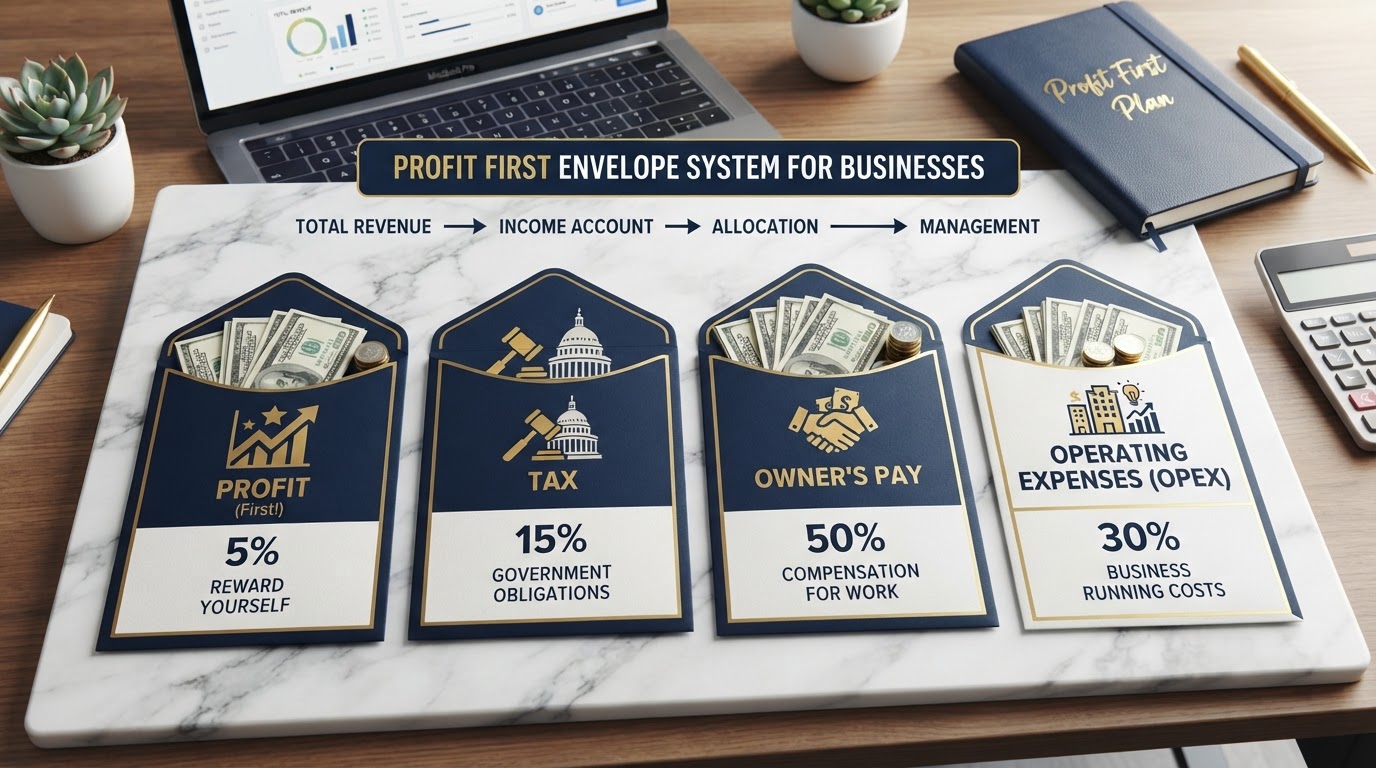
- Allocate every deposit into profit, owner's pay, tax, and operating accounts
- Run the business on the operating account — force efficiency
- Profit is taken first, not whatever is left over
Accounts Receivable Acceleration & Payable Optimization
The gap between when you deliver a product or service and when you get paid is the single largest drain on cash flow for most businesses. Accelerating receivables means invoicing immediately, offering early payment discounts, requiring deposits on large jobs, and following up on overdue accounts the day they age past terms. Every day a receivable sits unpaid is a day you are financing your customer's business.
On the payable side, the goal is the opposite: take the full payment term your vendors offer without damaging the relationship. Negotiate longer terms with key vendors, schedule payments to optimize your cash position, and never pay early unless there is a discount that justifies it. The combination of faster receivables and slower payables widens the cash cushion without changing your profitability.
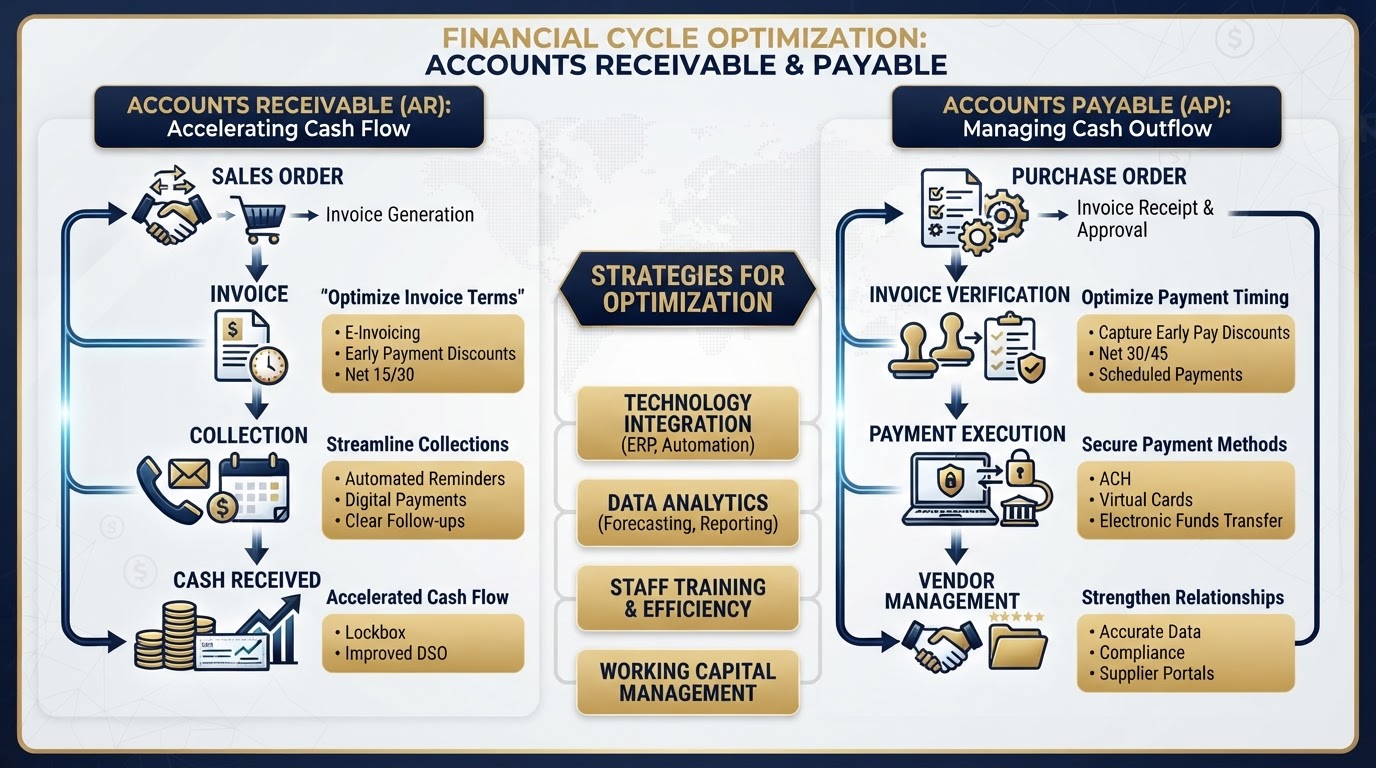
- Invoice immediately and follow up the day an invoice ages past terms
- Require deposits on large jobs to fund the work before it starts
- Take full vendor payment terms — never pay early without a discount
Cash Flow KPIs Every Owner Must Track
You cannot manage what you do not measure. The cash flow KPIs that matter most are days sales outstanding (DSO), days payable outstanding (DPO), the cash conversion cycle, and operating cash flow margin. DSO tells you how long it takes to collect receivables; DPO tells you how long you take to pay vendors; the cash conversion cycle is the difference — the number of days your cash is tied up in operations.
Tracking these metrics monthly reveals trends before they become crises. A rising DSO means your customers are paying slower; a shrinking operating cash flow margin means your profitability is eroding even if the income statement looks fine. We build a dashboard that surfaces these numbers so you can act on them.
- Days Sales Outstanding (DSO): how fast you collect receivables
- Days Payable Outstanding (DPO): how long you take to pay vendors
- Cash conversion cycle: the number of days cash is tied up in operations
Line of Credit vs. Working Capital Loan
A line of credit is a revolving facility you draw on when you need it and pay down when cash comes in — you only pay interest on the outstanding balance. A working capital loan is a lump sum you receive upfront and repay on a fixed schedule. For seasonal businesses or those with predictable cash cycles, a line of credit is almost always the better tool because it flexes with your actual need.
The mistake most owners make is waiting until they are out of cash to apply for financing — when they are in the weakest negotiating position. We help clients secure a line of credit while cash is healthy, so it is available on the terms you want when you actually need it.
- Line of credit: revolving, interest only on the balance drawn
- Working capital loan: lump sum with fixed repayment schedule
- Secure financing while cash is healthy — not when you are desperate
Conclusion
Cash flow mastery is not about one tactic — it is the combination of a rolling forecast, a profit-first allocation discipline, aggressive receivables management, disciplined payables, and the right financing in place before you need it. Together, these turn cash flow from a source of stress into a strategic advantage. Contact us to build your cash flow management system before the next slow season.
Quick Tax Savings Estimator
See how much you could potentially save with proactive tax strategy and clean bookkeeping. Most LA businesses overpay by 15-20% simply due to missed deductions.
Free IRS Audit Risk Assessment
Do you mix personal and business expenses in the same bank account?
Frequently Asked Questions
How far back can you catch errors?
I perform a deep forensic review of your history to catch errors and fix them. Whether it's one year or five, my goal is to ensure your historical data is pristine before we move forward.
Will you educate me on how to manage my books?
Yes! My approach is highly educational. I want you to understand the "why" behind the numbers so you can make better business decisions with confidence.

About the Author
Wiyao Awesso
Wiyao Awesso is a leading financial advisor in Los Angeles. With extensive experience in tax strategy, accounting, and fractional CFO services, he helps business owners optimize their finances, minimize tax liabilities, and scale with confidence.