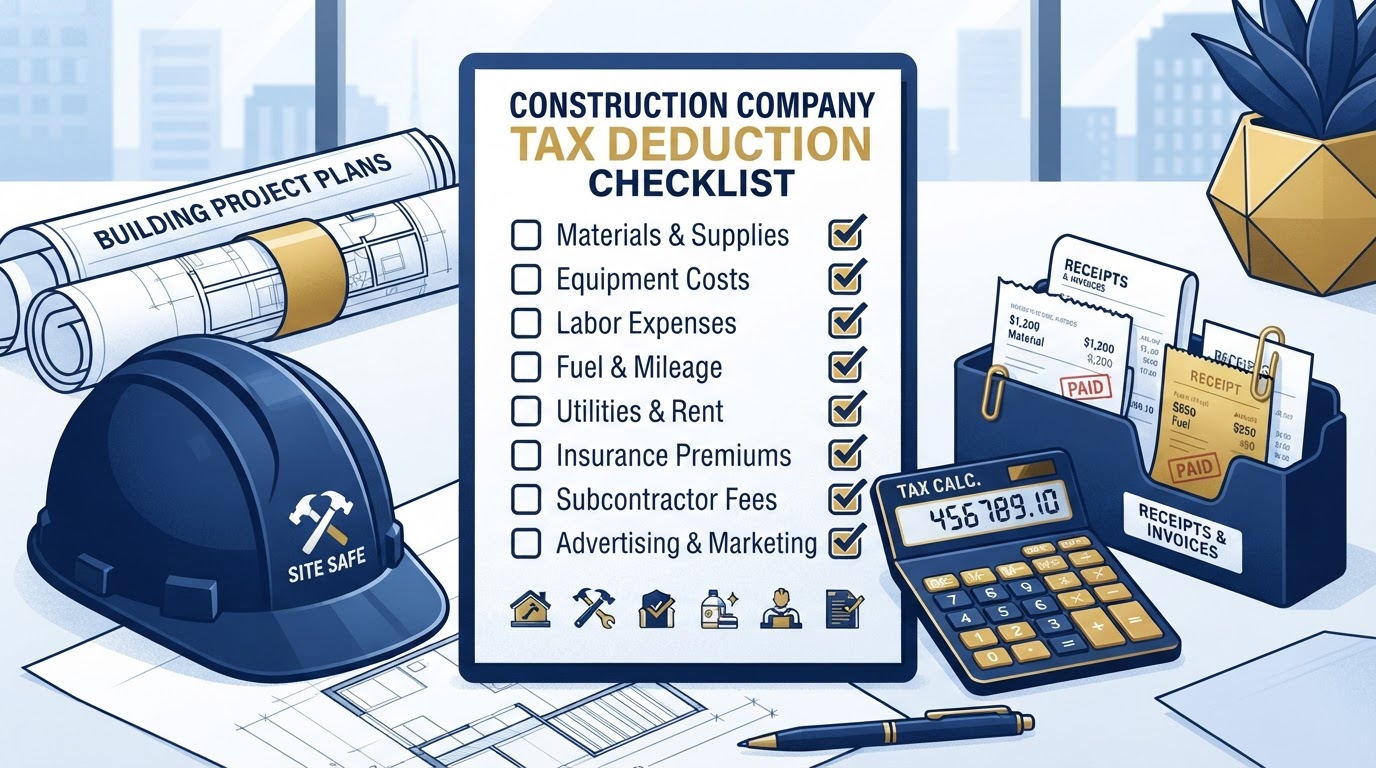
Construction companies often miss out on significant tax savings because they fail to properly categorize their expenses or overlook industry-specific deductions. The nature of a contracting business — heavy equipment, vehicles, subcontractor labor, materials, job sites spread across multiple cities, and project-based revenue recognition — creates a web of tax opportunities that generic bookkeeping simply cannot capture. This checklist is designed to help contractors, builders, and tradesmen across Southern California maximize their tax benefits by providing a deep dive into every allowable deduction. We use this exact framework when we clean up and optimize the books for construction clients at Fiscal Integrity Group.
Heavy Machinery & Equipment Depreciation
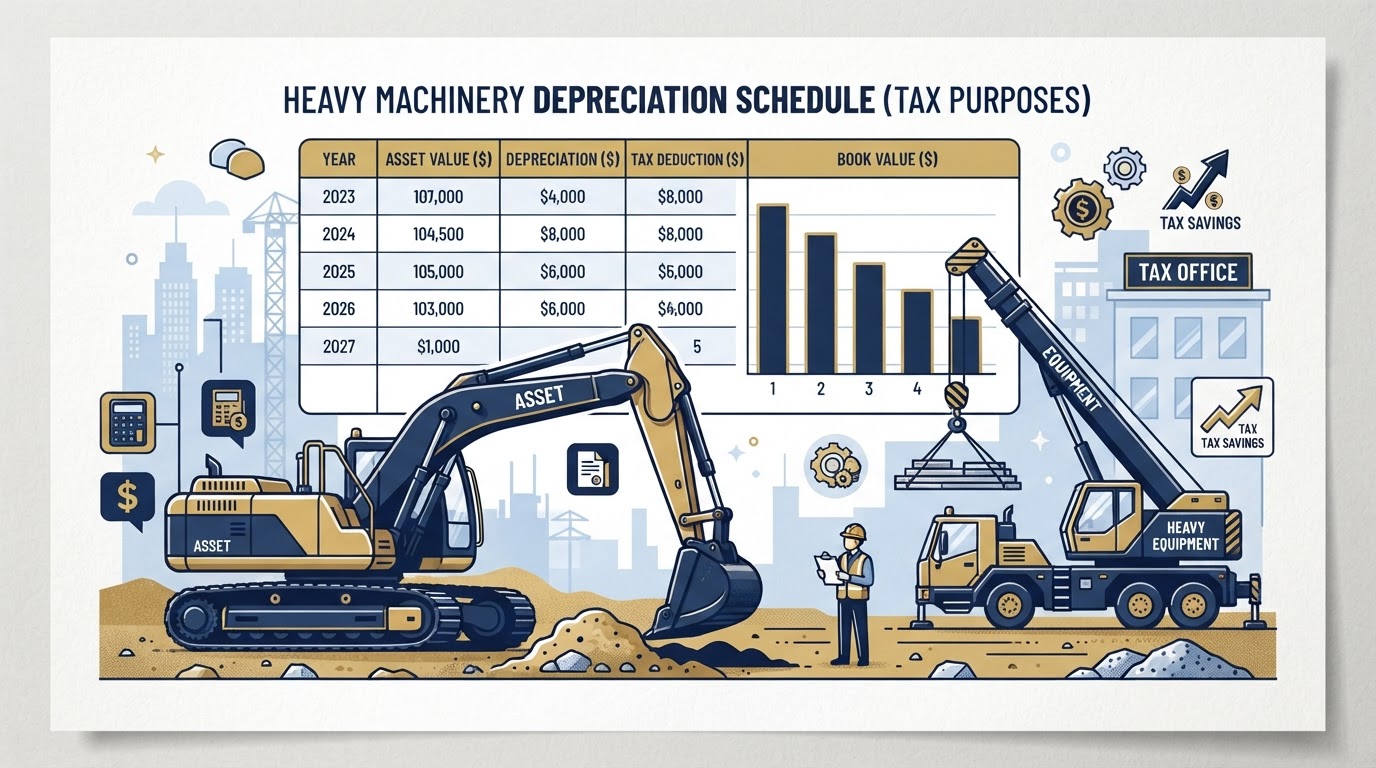
For most construction companies, heavy machinery and equipment represent the single largest capital investment outside of real estate. Excavators, skid steers, cranes, forklifts, generators, compressors, and concrete mixers all have useful lives that the IRS allows you to recover through depreciation. The default method is the Modified Accelerated Cost Recovery System (MACRS), which lets you front-load a larger portion of the deduction in the early years of an asset's life. For a $120,000 excavator placed in service this year, MACRS depreciation can generate a first-year deduction of roughly $17,000 to $24,000 depending on the recovery period and applicable convention.
The mistake we see most often is contractors either failing to capitalize these assets at all — leaving the deduction on the table entirely — or lumping multiple pieces of equipment into a single vague "tools" line item that the IRS will challenge in an audit. Each piece of equipment must be tracked individually with its own cost basis, date placed in service, and depreciation schedule. We build a fixed asset register for every construction client that captures every item over the IRS's $2,500 safe-harbor threshold, with supporting invoices and delivery documentation.
Section 179 and Bonus Depreciation for Contractors
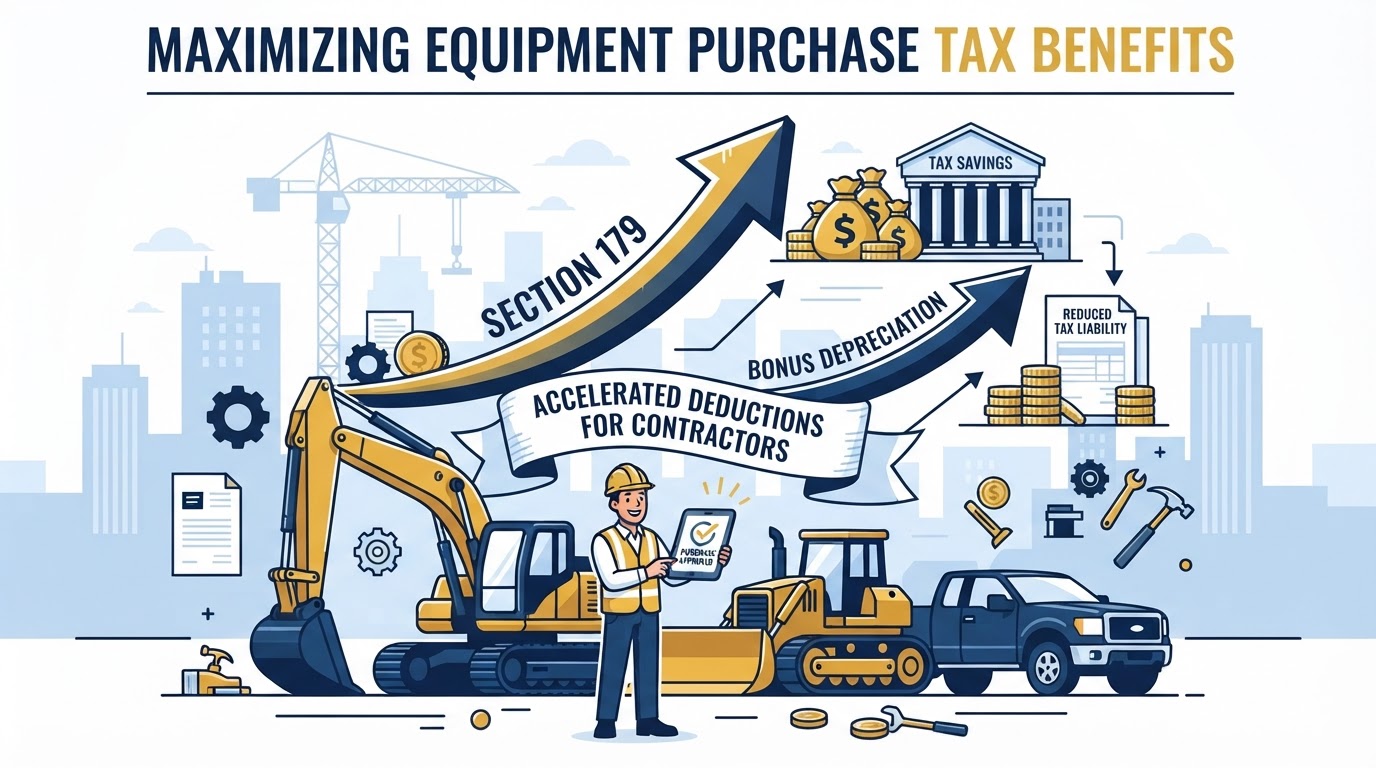
Section 179 and bonus depreciation are the two most powerful first-year expensing provisions available to contractors, and understanding the difference between them is critical. Section 179 allows you to expense the full purchase price of qualifying equipment in the year it is placed in service, up to an annual dollar limit. For 2026, the Section 179 deduction limit is approximately $1.22 million with a phase-out threshold that begins around $3.05 million of equipment purchases. The key advantage of Section 179 is that you choose exactly which assets to expense, giving you precise control over your taxable income.
Bonus depreciation, by contrast, is applied automatically to all qualifying property unless you elect out of it. The Tax Cuts and Jobs Act set bonus depreciation at 100% for property placed in service through 2022, and it has been phasing down — 80% in 2023, 60% in 2024, 40% in 2025, and 20% in 2026 before dropping to zero in 2027. This means that for equipment purchased and placed in service in 2026, you can still take a 20% bonus depreciation deduction in the first year, with the remainder depreciated under MACRS. We model both options for every equipment purchase to determine which produces the better after-tax result, because the right answer depends on your current and projected future income, your entity structure, and whether you have W-2 wages that affect your QBI deduction.
Vehicle and Fleet Mileage vs. Actual Expenses
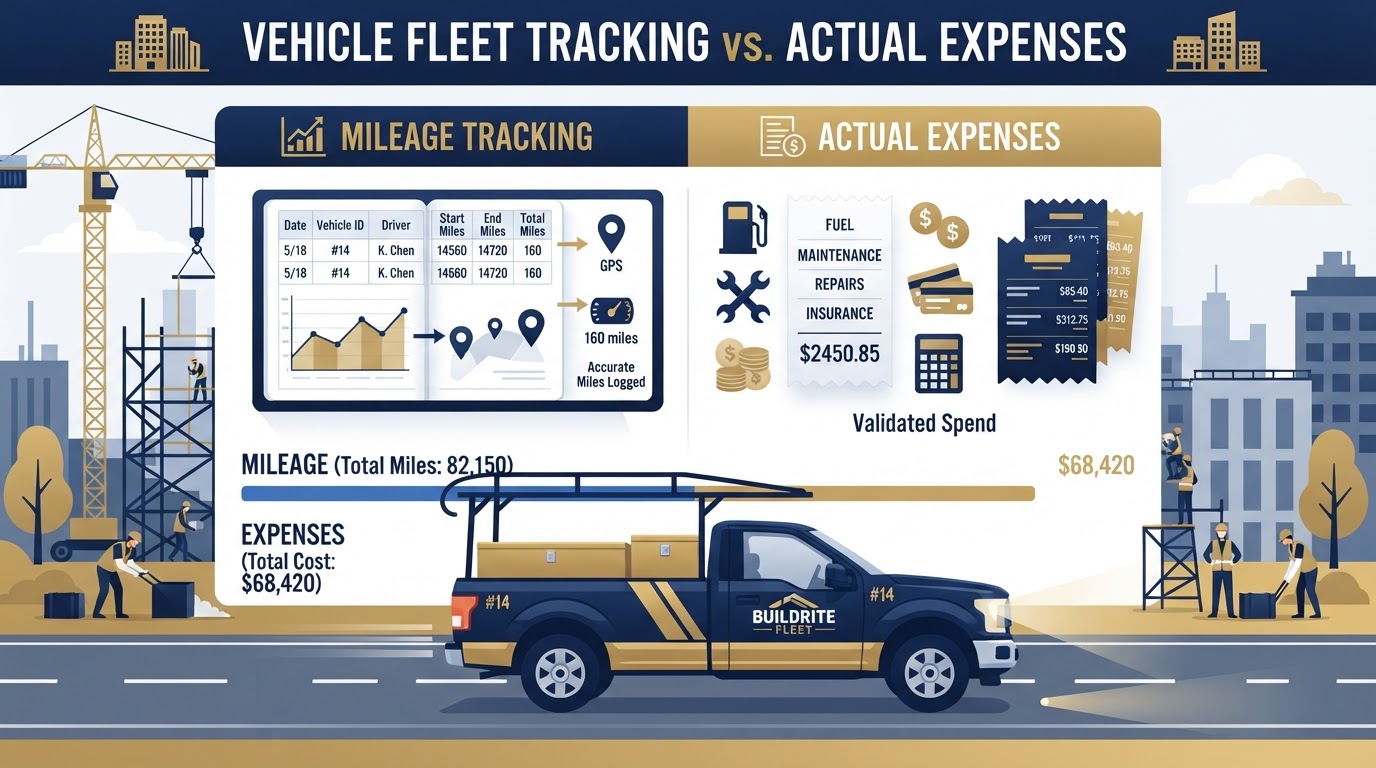
Construction businesses almost always have a fleet — work trucks, vans, and sometimes heavy haulers. The IRS gives you two methods for deducting vehicle expenses: the standard mileage rate or the actual expense method. For the 2026 tax year, the standard mileage rate is approximately 70 cents per business mile. For a truck driven 18,000 business miles, that is a deduction of $12,600 with minimal recordkeeping — just a mileage log.
The actual expense method allows you to deduct the real costs of operating the vehicle: gas, oil, repairs, insurance, registration, and depreciation. For heavy vehicles — those with a gross vehicle weight rating over 6,000 pounds, which includes most full-size work trucks and vans — bonus depreciation and Section 179 can generate massive first-year deductions. A $65,000 heavy SUV or truck can qualify for a first-year deduction of tens of thousands of dollars under the combined provisions. The catch is that you must maintain contemporaneous mileage logs that separate business from personal use, and you must track every actual expense with receipts. We help clients choose the method that produces the larger deduction and build the documentation system that survives an audit.
W-2 Wages vs. 1099 Subcontractor Payments
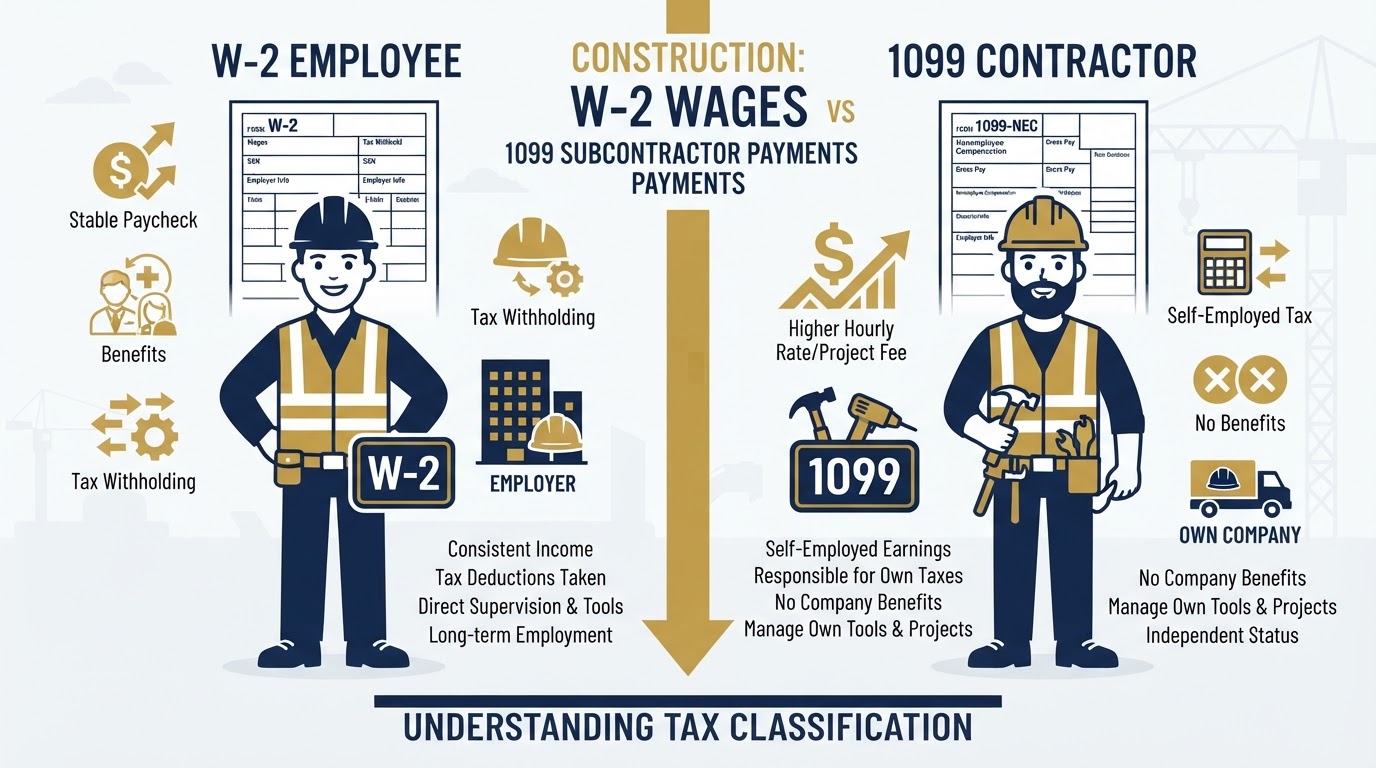
The construction industry relies heavily on subcontractors, and the line between a W-2 employee and a 1099 independent contractor is one of the most audited areas in the entire tax code. Misclassifying an employee as a contractor can trigger back payroll taxes, penalties, and interest that can cripple a business. The IRS applies a multi-factor test focused on behavioral control, financial control, and the relationship between the parties. A subcontractor who uses your tools, follows your schedule, and works exclusively for you is very likely an employee in the eyes of the IRS.
When the classification is correct, 1099 subcontractor payments are fully deductible as a business expense, and you have no payroll tax obligation. But you must collect a Form W-9 from every subcontractor before you pay them, and you must file Form 1099-NEC for any subcontractor paid $600 or more in a year. Failure to file 1099s can result in penalties of up to $310 per form, and the IRS can disallow the deduction entirely if you cannot prove you attempted to comply. We maintain a subcontractor compliance file for every construction client, ensuring that W-9s are collected, 1099s are filed on time, and the classification itself is defensible.
Job Materials and Small Tools Deductions
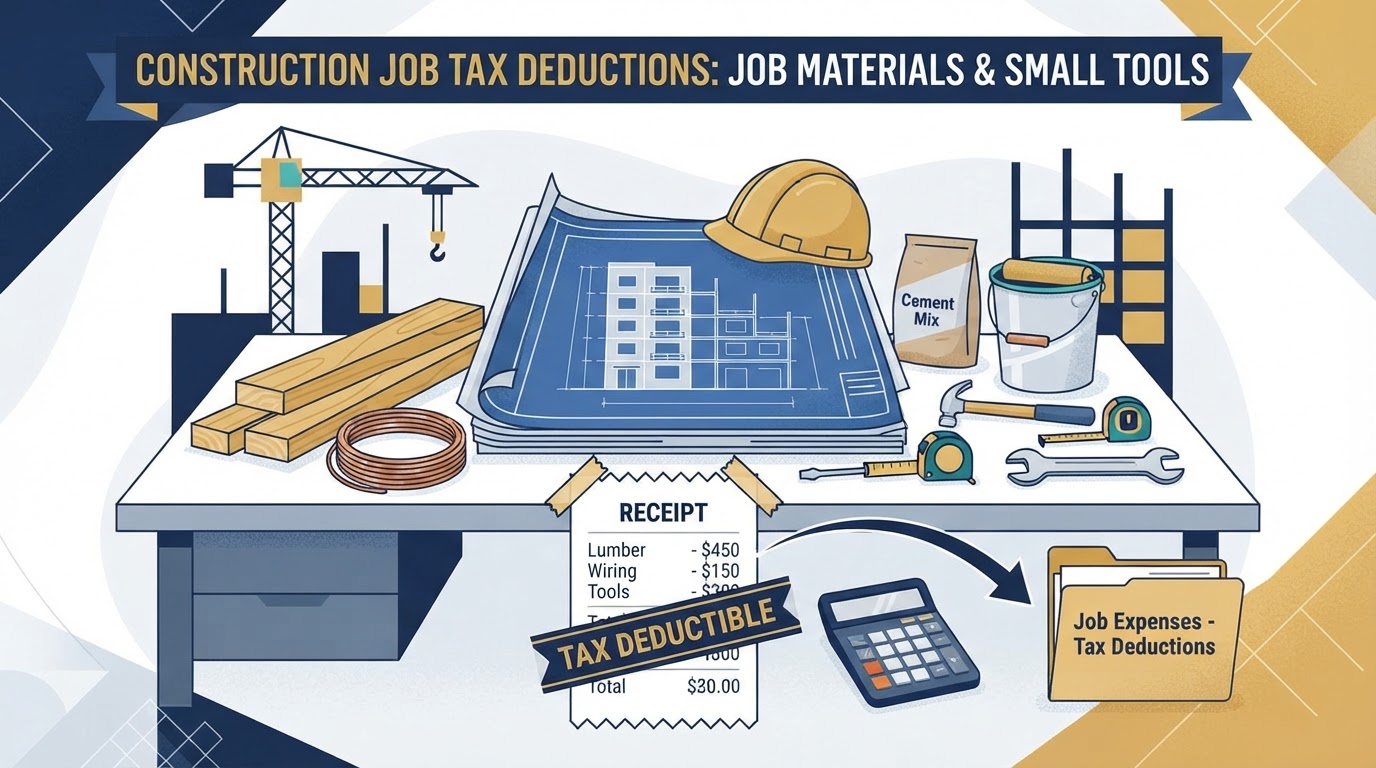
Job materials — lumber, concrete, drywall, electrical, plumbing fixtures, paint, fasteners — are deducted as cost of goods sold or materials and supplies, depending on how your accounting system is structured. The key is that these costs must be matched to the specific job that generated the revenue, which is the entire purpose of job costing. Without proper job costing, you cannot prove which materials belong to which project, and you lose the ability to measure project profitability — a critical metric for any contractor.
Small tools — hand tools, power tools, and consumable equipment under the $2,500 safe-harbor threshold — can be expensed immediately under the IRS's de minimis safe harbor election. This is a significant benefit because it eliminates the need to track and depreciate hundreds of small items individually. But you must make the election on your tax return, and your bookkeeping must have a clear written accounting policy supporting the threshold. We set up the safe harbor election and the supporting capitalization policy for every construction client so that small tools are expensed efficiently while larger assets are properly capitalized and depreciated.
Safety Gear and Required Uniforms
OSHA-required safety gear — hard hats, safety glasses, steel-toe boots, high-visibility vests, harnesses, and respiratory protection — is fully deductible as an ordinary and necessary business expense. The same is true for uniforms that are required as a condition of employment and that are not suitable for everyday wear. A branded work shirt with your company logo that an employee would not wear off the job site qualifies; a plain polo shirt does not. We help clients categorize these expenses correctly so they are captured in full and not mistakenly lumped into a vague "miscellaneous" account that invites IRS scrutiny.
Insurance Premiums and Builder's Risk
Construction businesses carry a heavy insurance load: general liability, workers' compensation, commercial auto, builder's risk, surety bonds, and professional liability. Every one of these premiums is deductible. Builder's risk insurance, which covers a project during construction, should be allocated to the specific job as part of job costing rather than treated as a general overhead expense. Workers' compensation premiums are often based on a payroll classification system, and misclassifying your workers into the wrong code can result in overpaying premiums. We review the classification codes for every construction client to ensure premiums are accurate and that every dollar of insurance is captured as a deduction in the correct period.
Licenses, Permits, and Municipal Fees
Contractor licenses, city business licenses, building permits, and municipal impact fees are all deductible business expenses. The California Contractors State License Board (CSLB) renewal fee, local city business license fees, and pull fees for permits on individual jobs should all be tracked and deducted. Permit fees specifically tied to a job should be allocated to that job's cost structure. Many contractors pay these fees out of pocket or from a personal account and never record them in the business books — which means the deduction is lost. We reconcile these accounts to ensure every license and permit fee is captured.
Advertising, Job Site Signs, and Marketing
All advertising and marketing expenses are fully deductible. This includes job site signs, vehicle wraps, website costs, online ads, sponsorships, and printed materials. Job site signs serve a dual purpose — they market your business and they identify the active contractor on the site, which is often a legal requirement. Vehicle wraps on work trucks are deductible as both advertising and as part of the vehicle expense. We ensure these costs are categorized under advertising rather than buried in general overhead, which keeps your financial statements clean and your deductions clearly supported.
Job Costing Software and Office Overhead
Construction-specific software — like Procore, BuilderTrend, QuickBooks with job costing, or estimating software — is fully deductible under IRC Section 179 as off-the-shelf software, or it can be deducted as a recurring subscription expense. Office overhead, including rent, utilities, phone, internet, and office supplies, is also deductible. For contractors with a home office used exclusively for business, the home office deduction may apply. The key is that overhead must be allocated across jobs using a consistent method — typically based on direct labor hours or revenue — so that each job carries its fair share of the indirect costs. Without this allocation, your job profitability reports are fiction, and you cannot make informed decisions about which types of projects to pursue.
Conclusion
The construction industry has more tax deduction opportunities than almost any other sector, but capturing them requires disciplined bookkeeping, proper job costing, a fixed asset register, and a subcontractor compliance system. The contractors who lose money to taxes are not the ones who spend less — they are the ones whose books fail to capture and categorize what they spend. If you want a bookkeeping team that understands construction accounting and maximizes every deduction available to your business, we can help.
Quick Tax Savings Estimator
See how much you could potentially save with proactive tax strategy and clean bookkeeping. Most LA businesses overpay by 15-20% simply due to missed deductions.
Free IRS Audit Risk Assessment
Do you mix personal and business expenses in the same bank account?
Frequently Asked Questions
How far back can you catch errors?
I perform a deep forensic review of your history to catch errors and fix them. Whether it's one year or five, my goal is to ensure your historical data is pristine before we move forward.
Will you educate me on how to manage my books?
Yes! My approach is highly educational. I want you to understand the "why" behind the numbers so you can make better business decisions with confidence.

About the Author
Wiyao Awesso
Wiyao Awesso is a leading financial advisor in Los Angeles. With extensive experience in tax strategy, accounting, and fractional CFO services, he helps business owners optimize their finances, minimize tax liabilities, and scale with confidence.