Choosing the right legal and tax structure for your business is one of the most important decisions you will make. The structure you choose impacts your personal liability, your ability to raise capital, and most importantly, how much you pay in taxes. This guide compares the two most common corporate structures — the C-Corporation and the S-Corporation — and explains how we help business owners across Southern California select and maintain the structure that minimizes their total tax burden while supporting their long-term growth plans.
The S-Corporation Advantage
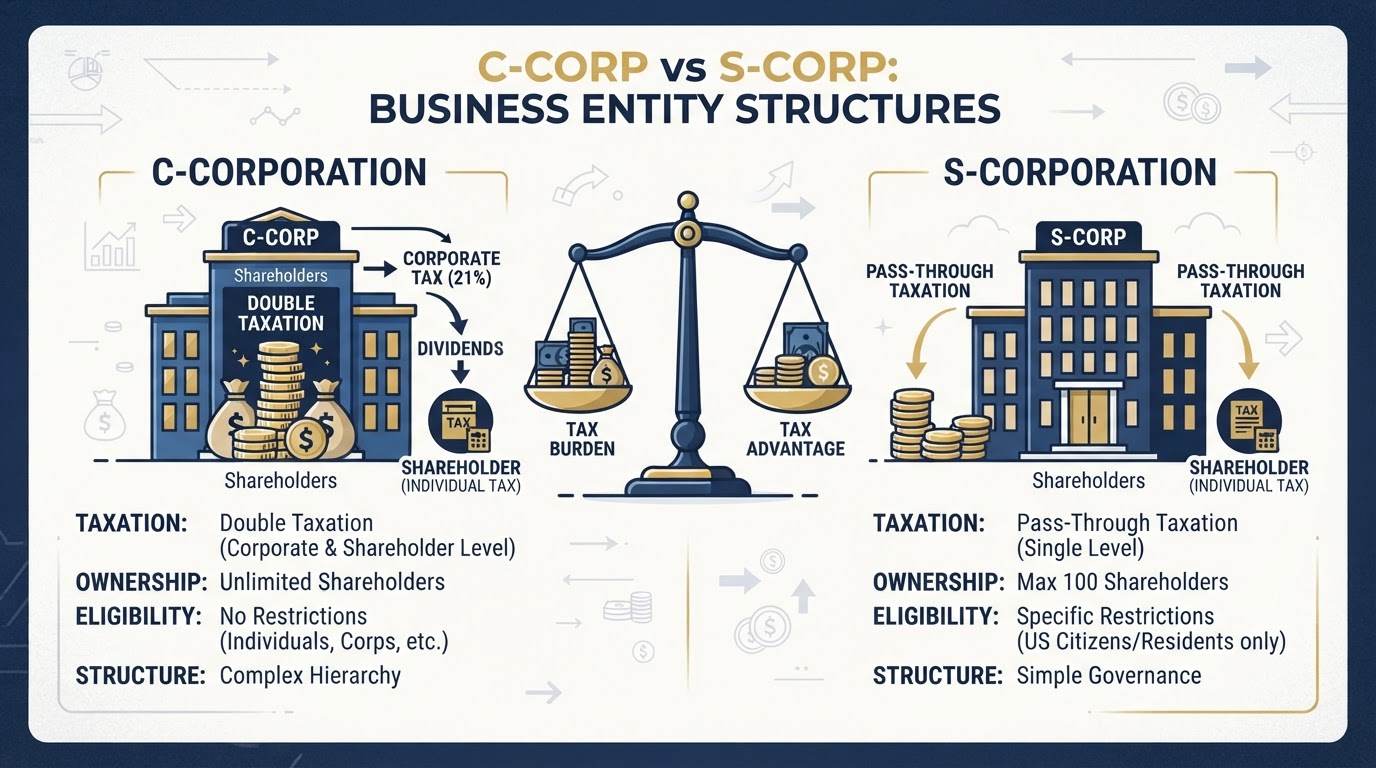
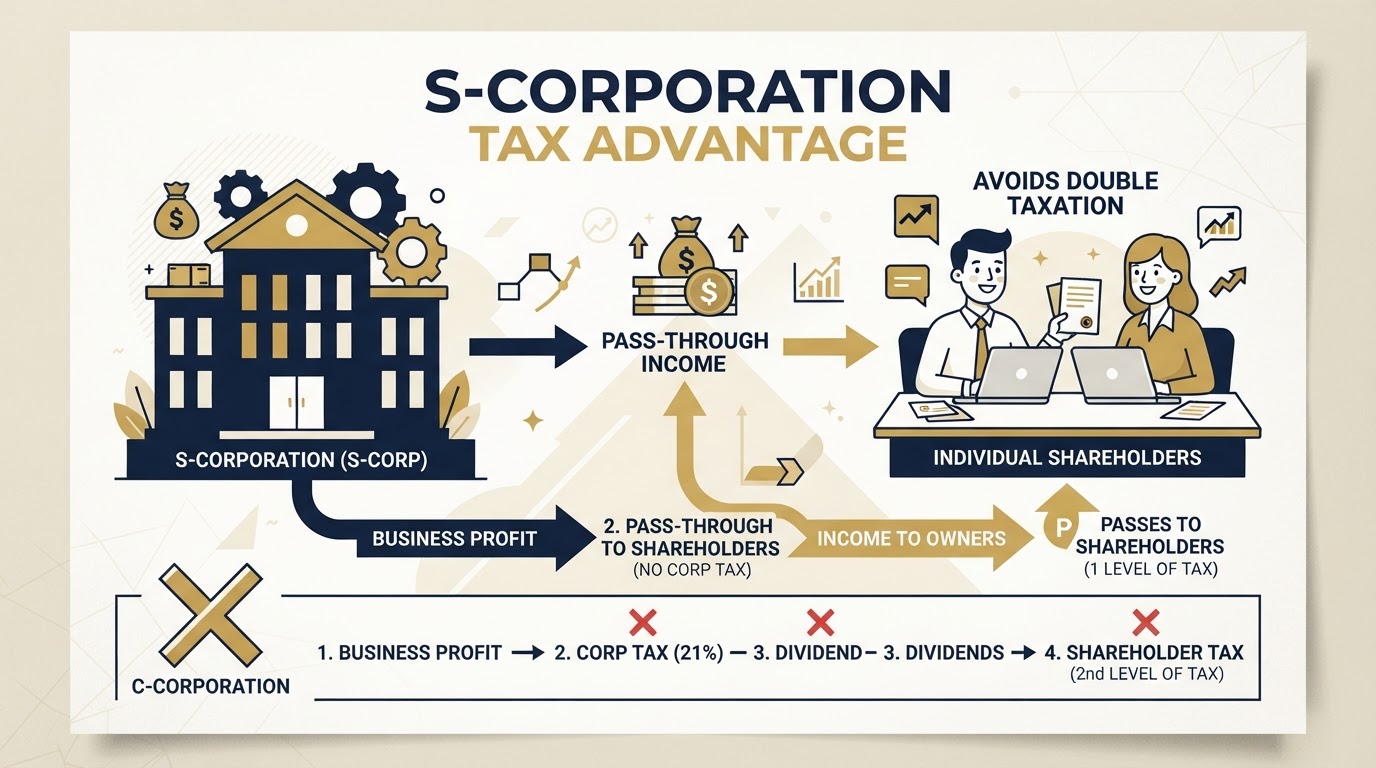
The S-Corporation is a pass-through entity, meaning the corporation itself generally does not pay federal income tax. Instead, the business's profits, losses, deductions, and credits flow through to the shareholders' personal tax returns, where they are taxed at the individual's marginal rate. This avoids the double taxation that plagues C-Corporations, where the corporation pays tax on its earnings and then shareholders pay tax again on dividends distributed from those already-taxed earnings.
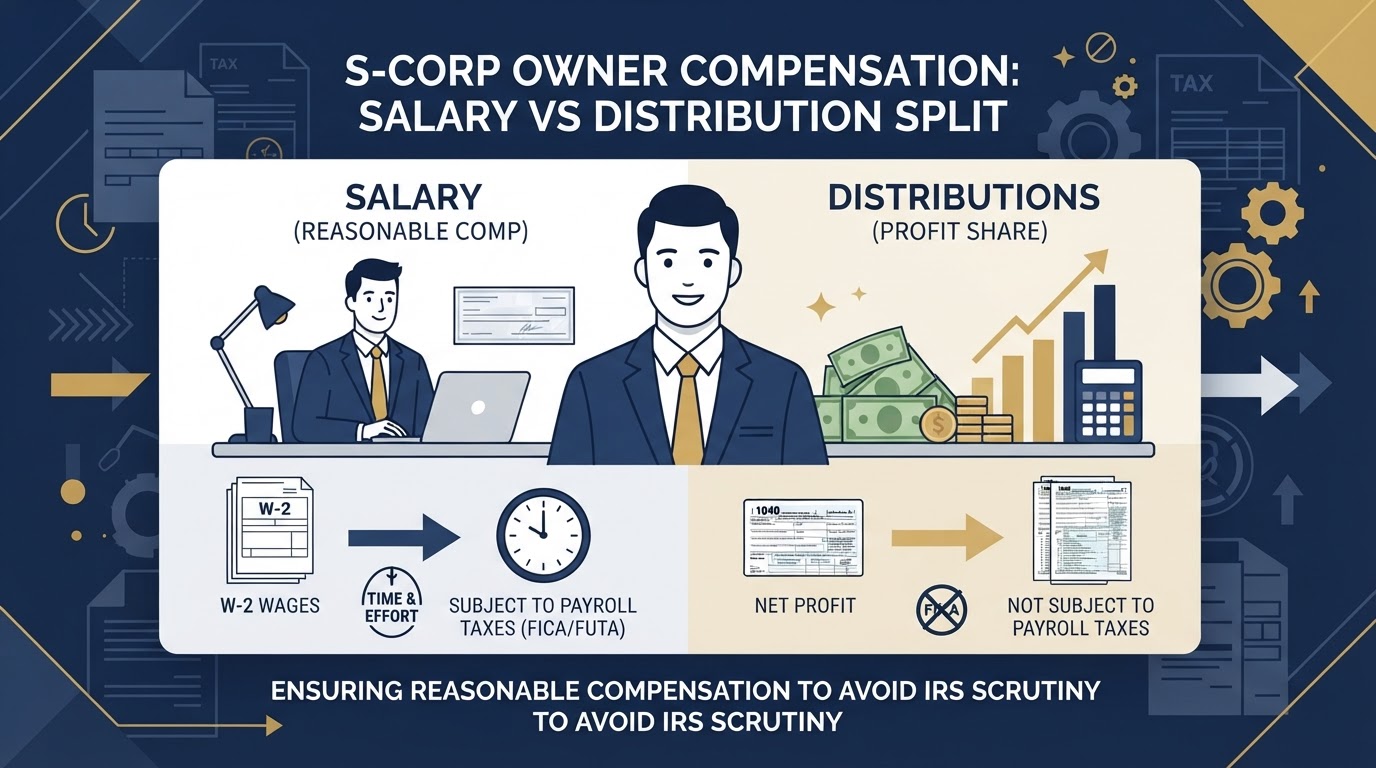
The defining tax advantage of an S-Corp is the split between reasonable compensation and distributions. An S-Corp owner who works in the business must be paid a reasonable W-2 salary, which is subject to payroll taxes — Social Security and Medicare, totaling 15.3% split between employer and employee. But the remaining profit can be taken as distributions, which are free from payroll tax. For a business generating $300,000 in net profit, paying a reasonable salary of $120,000 and taking $180,000 as distributions can save roughly $13,700 in self-employment tax compared to operating as a sole proprietorship or single-member LLC. Over a decade, that compounds into well over $150,000 in tax savings from a single structural choice.
The C-Corporation and Scaling
The C-Corporation is a separate taxable entity. It pays its own corporate income tax at the flat 21% federal rate established by the Tax Cuts and Jobs Act, plus any applicable state corporate tax. The C-Corp structure is often the right choice for businesses that intend to raise significant outside capital, issue multiple classes of stock, or eventually go public or be acquired by a larger corporation. Venture capital and private equity investors almost always require a C-Corp structure because of the predictability of governance and the favorable treatment of preferred stock.
The C-Corp's flat 21% rate can actually be advantageous for businesses that retain earnings to reinvest in growth rather than distributing them to owners. If your business earns $500,000 and you reinvest all of it, the C-Corp pays 21% — potentially lower than the owner's personal marginal rate of 32% or 37%. The trade-off is that when you eventually distribute those earnings as dividends, they are taxed again at the qualified dividend rate. The decision hinges on your time horizon: if you are reinvesting for years before distributing, the deferral can outweigh the double tax. We model this for every client considering a C-Corp election.

Section 1202 Qualified Small Business Stock (QSBS)
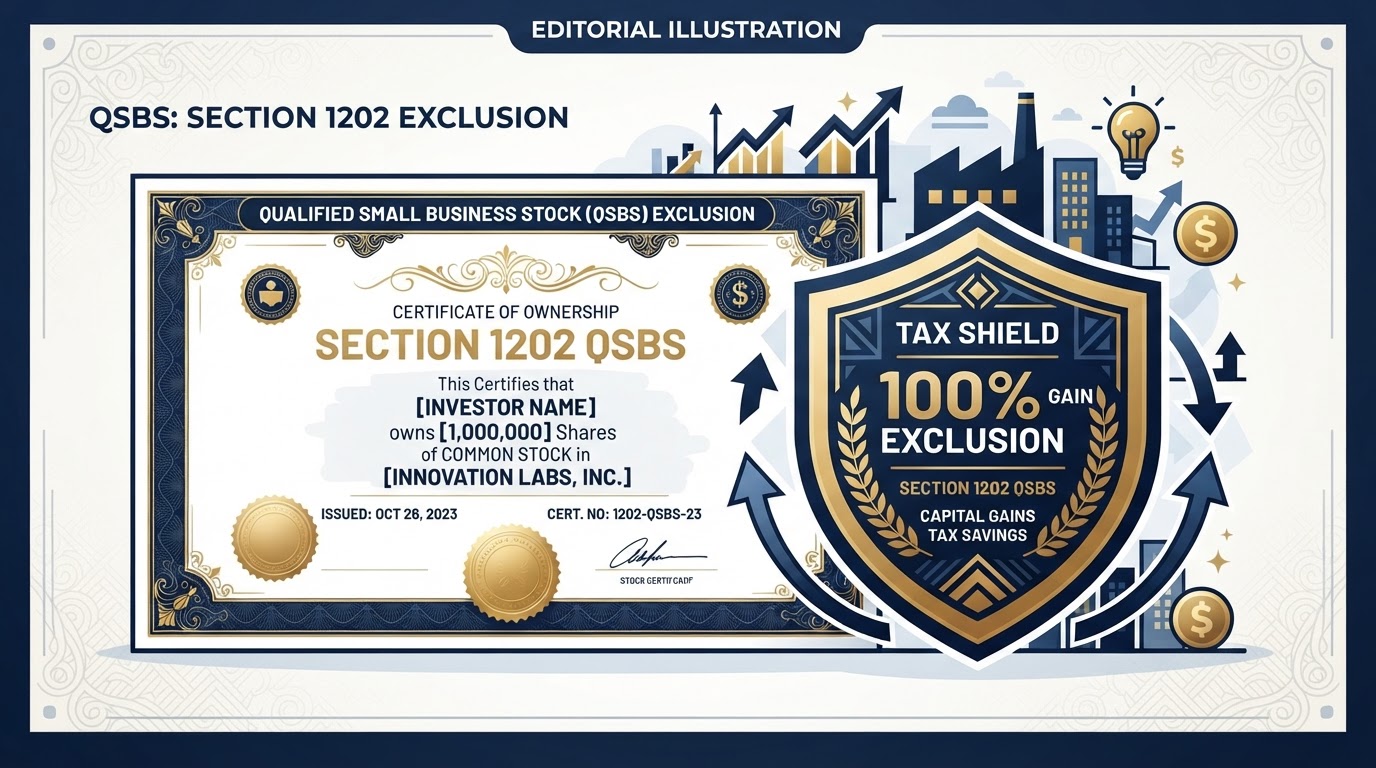
One of the most powerful — and most overlooked — reasons to operate as a C-Corporation is Section 1202, the Qualified Small Business Stock exclusion. If you form a C-Corporation from scratch and hold the stock for more than five years, you may be able to exclude from federal income tax the greater of $10 million or 10 times your basis in the stock when you sell. For a founder who builds a C-Corp worth $30 million and sells it after the five-year holding period, the entire $30 million can be federal income tax-free.
This is an extraordinary benefit, but it comes with strict requirements. The business must be a qualified small business — a domestic C-Corp with gross assets under $50 million at the time of stock issuance — and it cannot be in certain excluded service industries (health, law, accounting, consulting, banking, farming, or hospitality where the principal asset is reputation). The business must also be an active trade or business, not a passive investment vehicle. We help clients evaluate whether their business qualifies for QSBS treatment and, where it does, structure the entity from day one to preserve the exclusion. This single provision can be worth more than a decade of ordinary tax planning combined.
Reasonable Compensation
For S-Corporation owners, reasonable compensation is the single most audited issue. The IRS requires that any S-Corp owner who provides services to the business be paid a reasonable W-2 salary before any distributions are taken. The salary must reflect what a comparable business would pay an unrelated individual for the same services. Paying yourself zero salary and taking everything as distributions is the fastest way to trigger an IRS reclassification, back payroll taxes, penalties, and interest.
We determine reasonable compensation for every S-Corp client using a multi-factor analysis: industry compensation benchmarks, the owner's time commitment, the role and responsibilities, comparable market data, and the ratio of salary to distributions. There is no single magic percentage, but a common guideline is that salary should represent roughly 40% to 60% of total owner compensation, with the balance as distributions. We document the analysis in a compensation memo that we keep in the client's file, so that if the IRS ever questions the salary, we have a defensible, contemporaneous justification rather than a guess made after the fact.
Tax Rates & Double Taxation
The C-Corporation's double taxation is the most cited reason to avoid the structure, but it is not always the disadvantage it appears to be. The corporate rate is a flat 21% federally. When the corporation distributes after-tax earnings as qualified dividends, the shareholder pays a top federal rate of 20% (plus the 3.8% Net Investment Income Tax for higher earners). The combined effective rate on distributed C-Corp earnings is therefore roughly 21% plus 23.8% on the remaining 79% — an effective rate of around 39.8%. For an S-Corp owner in the top 37% bracket plus 3.8% NII on distributions, the comparable rate is around 40.8%. The difference is narrow, and for businesses that retain earnings rather than distribute them, the C-Corp can actually be cheaper.
California adds its own layer. The state imposes an 8.84% corporate tax on C-Corp income (with a minimum franchise tax of $800), and it does not conform to the federal dividend rate reduction, taxing dividends as ordinary income. S-Corps in California pay a flat 1.5% franchise tax on net income (also subject to the $800 minimum), making the S-Corp generally more favorable at the state level. We model both the federal and California state tax impact for every entity decision, because the right answer in Texas is often the wrong answer in California.
State-Level Tax Considerations
Beyond California's franchise tax, several states impose additional taxes or fees on S-Corporations that can erode the pass-through advantage. New York, Illinois, and Massachusetts all have their own variations. For multi-state businesses, the apportionment of income across states becomes a significant factor — a C-Corp may be able to use its separate taxable status to manage state-level income more flexibly than a pass-through entity. We analyze the state nexus and apportionment for any client operating across state lines.
Fringe Benefits & Deductions
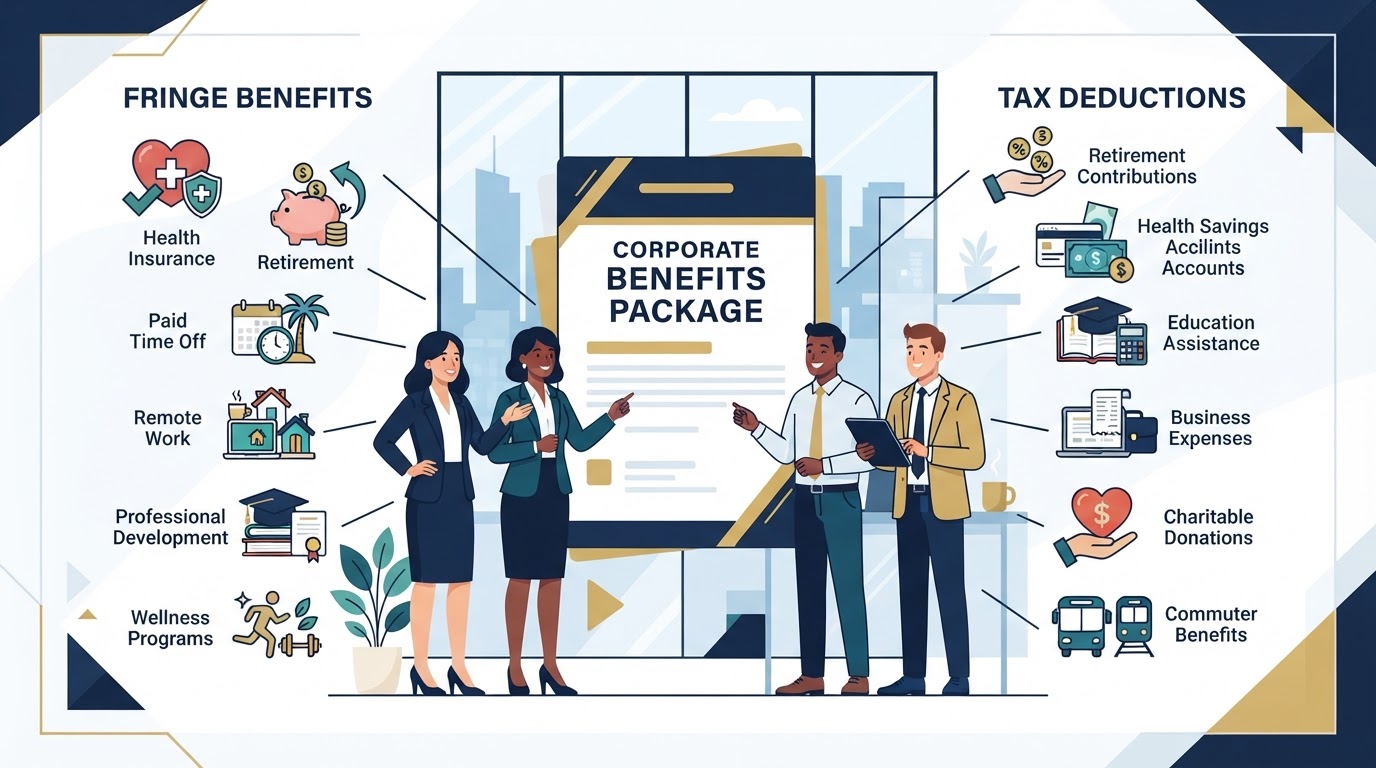
The C-Corporation offers one advantage that the S-Corp cannot match: fully deductible fringe benefits for owner-employees. In a C-Corp, health insurance, disability insurance, medical reimbursement plans, and even certain life insurance premiums can be deducted by the corporation and are not taxable to the owner-employee. In an S-Corp, health insurance for a more-than-2% shareholder is reported as wages on the W-2, and while it is deductible, it does not enjoy the same clean treatment as a C-Corp's medical reimbursement plan. For owners with significant health costs, the C-Corp's fringe benefit advantage can offset some of the double-taxation cost.
Conclusion
The choice between a C-Corporation and an S-Corporation is not a simple one-size-fits-all answer. It depends on your income level, your growth plans, whether you intend to raise outside capital, whether your business qualifies for QSBS, your state of operation, and your personal health and benefit needs. The S-Corp's pass-through structure and payroll tax savings make it the right choice for most small to mid-sized service businesses, while the C-Corp's flat rate, QSBS exclusion, and fringe benefit deductibility make it compelling for businesses built for scale and eventual sale. If you want a structured analysis of which entity minimizes your total tax burden, we can help.
Quick Tax Savings Estimator
See how much you could potentially save with proactive tax strategy and clean bookkeeping. Most LA businesses overpay by 15-20% simply due to missed deductions.
Free IRS Audit Risk Assessment
Do you mix personal and business expenses in the same bank account?
Frequently Asked Questions
How far back can you catch errors?
I perform a deep forensic review of your history to catch errors and fix them. Whether it's one year or five, my goal is to ensure your historical data is pristine before we move forward.
Will you educate me on how to manage my books?
Yes! My approach is highly educational. I want you to understand the "why" behind the numbers so you can make better business decisions with confidence.

About the Author
Wiyao Awesso
Wiyao Awesso is a leading financial advisor in Los Angeles. With extensive experience in tax strategy, accounting, and fractional CFO services, he helps business owners optimize their finances, minimize tax liabilities, and scale with confidence.