When the Bank Asks for Your Books, Will They Hold Up?
You found the perfect opportunity. Maybe it is a new location, a bigger warehouse, a fleet expansion, or the equipment that finally lets you take on the contracts you have been turning down. You sit down with a lender, and the first thing they ask for is three years of financial statements and the last six months of bank reconciliations. That is the moment most business owners discover their books are not ready for the scrutiny a loan application demands. The numbers are there, sort of, but they are not clean, not reconciled, and not organized in a way that tells a lender anything except that the owner has been flying by the seat of their pants.
A loan application is not just about whether you have enough revenue to qualify. It is about whether your financial records prove, beyond reasonable doubt, that your business is stable, profitable, and capable of servicing new debt. Lenders do not take your word for it. They look at the documents, and if the documents are messy, inconsistent, or unreconciled, the loan dies before it ever reaches a credit committee. This guide explains exactly what lenders look for, why clean books are the difference between approval and denial, and how to get your financial records loan ready before you ever walk into a bank.

What a Lender Actually Sees When They Open Your Books
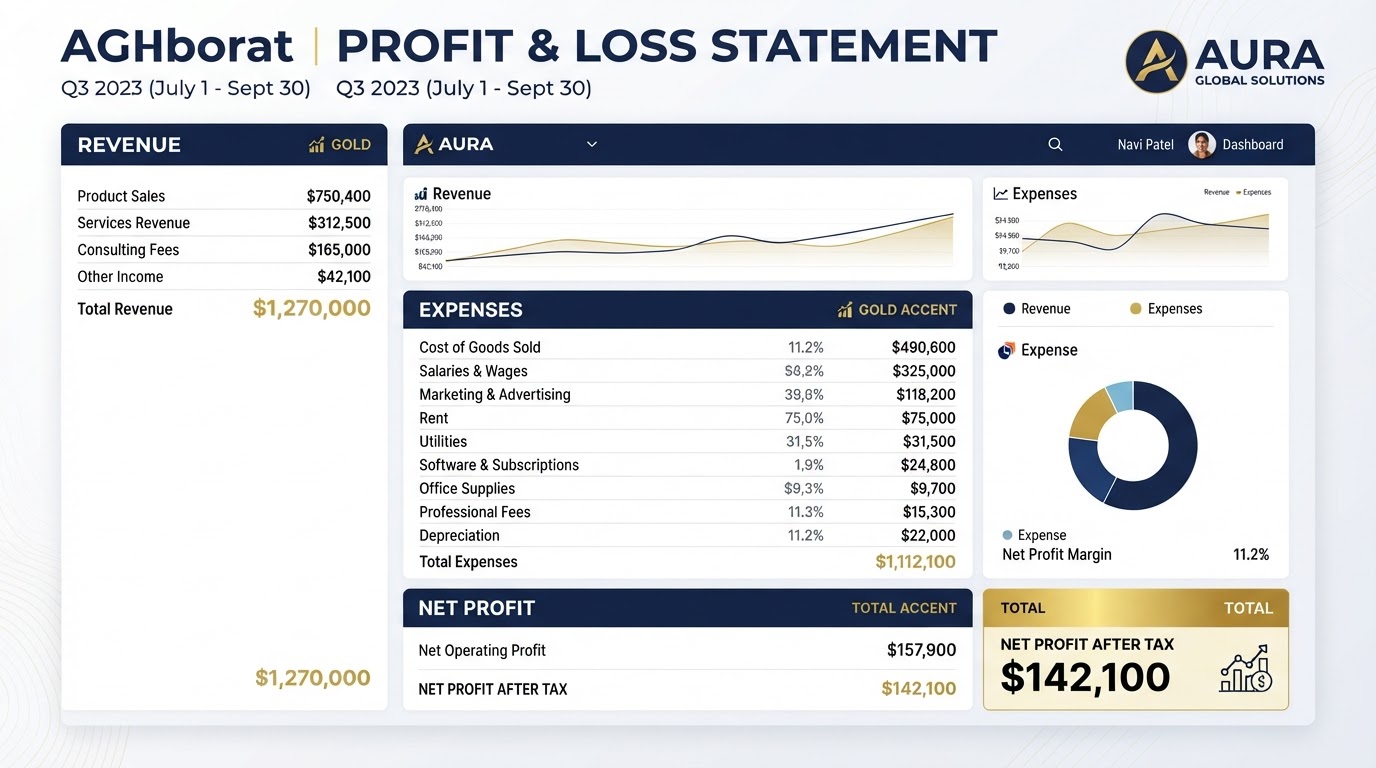
When a lender reviews your financial statements, they are not just glancing at the bottom line. They are running a structured analysis that touches every part of your books. They look at your Profit and Loss statement to see whether revenue is growing, stable, or declining. They look at your Balance Sheet to see whether you have assets to pledge and whether your liabilities are manageable. They look at your cash flow to see whether the business actually generates the cash needed to make loan payments. And they look at the consistency and cleanliness of the records themselves, because sloppy books signal sloppy management, and sloppy management means risk.
The lender is also comparing your books to your tax returns. If your financial statements show one picture and your tax return shows another, the lender has a problem. They do not know which set of numbers to believe. This happens more often than you might think, because many business owners manage their books loosely all year and then hand everything to a tax preparer who makes adjustments at year end without updating the books. The result is a mismatch that makes a lender question the integrity of every number you have provided.

Reconciliation: The Nonnegotiable Foundation
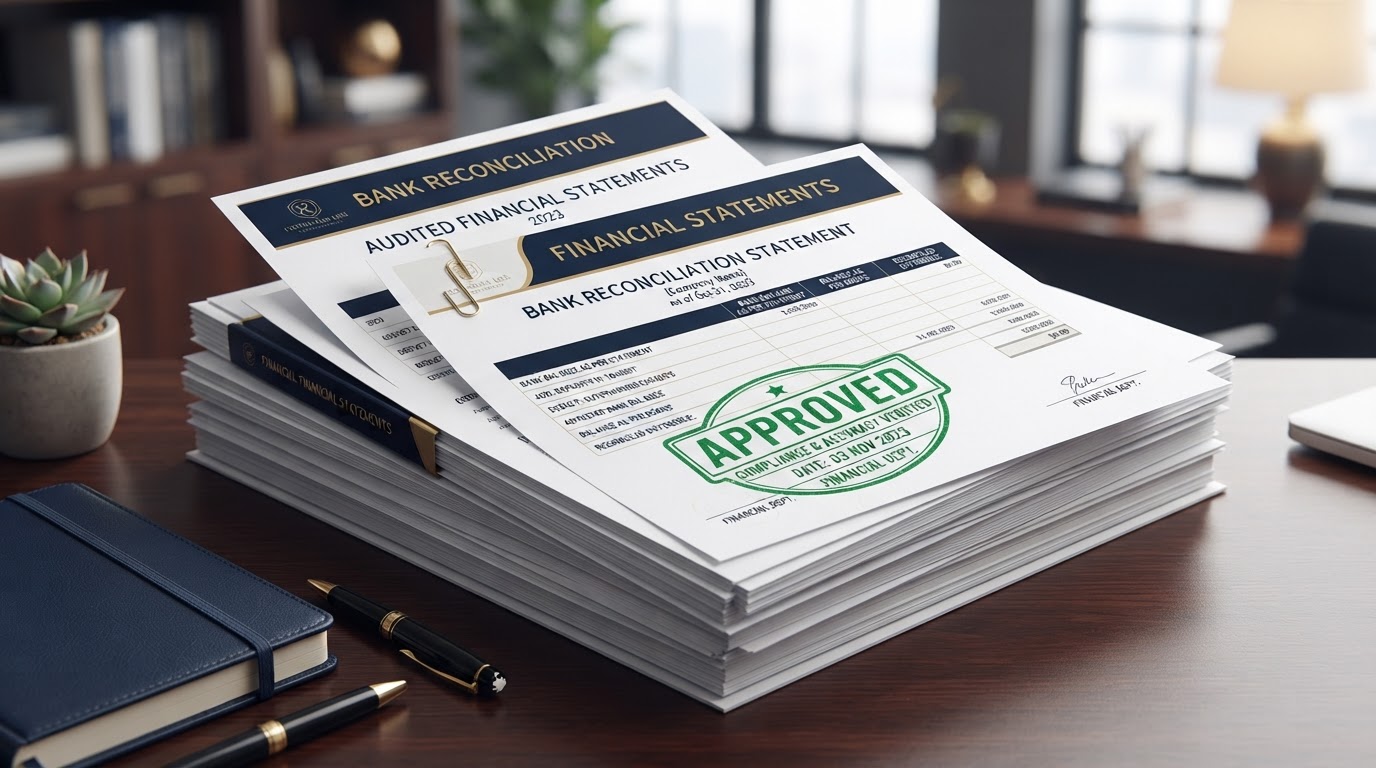
If there is one thing a lender will check before anything else, it is whether your bank accounts are reconciled. Reconciliation means that every transaction in your accounting software has been matched to the corresponding transaction on your bank statement, and the ending balance in your books matches the ending balance on the bank statement exactly. If your books show a checking balance of forty two thousand dollars but the bank statement shows thirty eight thousand, the lender stops reading. An unreconciled account means the numbers cannot be trusted, and if the numbers cannot be trusted, the loan cannot be underwritten.
Reconciliation is also the process that catches the errors that accumulate in every set of books. Duplicate transactions, missing transactions, transactions recorded for the wrong amount, transactions in the wrong account, and personal expenses mixed into the business account all surface during reconciliation. A lender who sees twelve consecutive months of clean reconciliations knows the books have been maintained with discipline. A lender who sees gaps, forced balances, or a reconciliation history that starts the month before the loan application knows the books were thrown together for the occasion. That distinction can be the difference between an approval and a denial.
The Three Statements a Lender Will Scrutinize
The Profit and Loss Statement
Your Profit and Loss statement, also called the income statement, shows your revenue, cost of goods sold, gross profit, operating expenses, and net income over a specific period. A lender will typically ask for three years of P&L statements plus a year to date statement. They are looking for revenue stability or growth, reasonable gross margins for your industry, operating expenses that are proportional to revenue, and net income that demonstrates the business can generate profit. They are also looking for consistency in how revenue and expenses are categorized from year to year, because inconsistent categorization makes it impossible to compare one period to the next.
The Balance Sheet
The Balance Sheet shows what your business owns and what it owes at a specific point in time. A lender uses it to assess your liquidity, your leverage, and your available collateral. They will calculate your current ratio, which is current assets divided by current liabilities, to see whether you can cover short term obligations. They will look at your debt to equity ratio to see how leveraged the business is. They will examine your accounts receivable to see if the money customers owe you is collectible. And they will look at your fixed assets to see what collateral is available to secure the loan. A Balance Sheet with negative equity, a current ratio below one, or accounts receivable that are obviously stale and uncollectible will kill a loan application before the P&L is even reviewed.
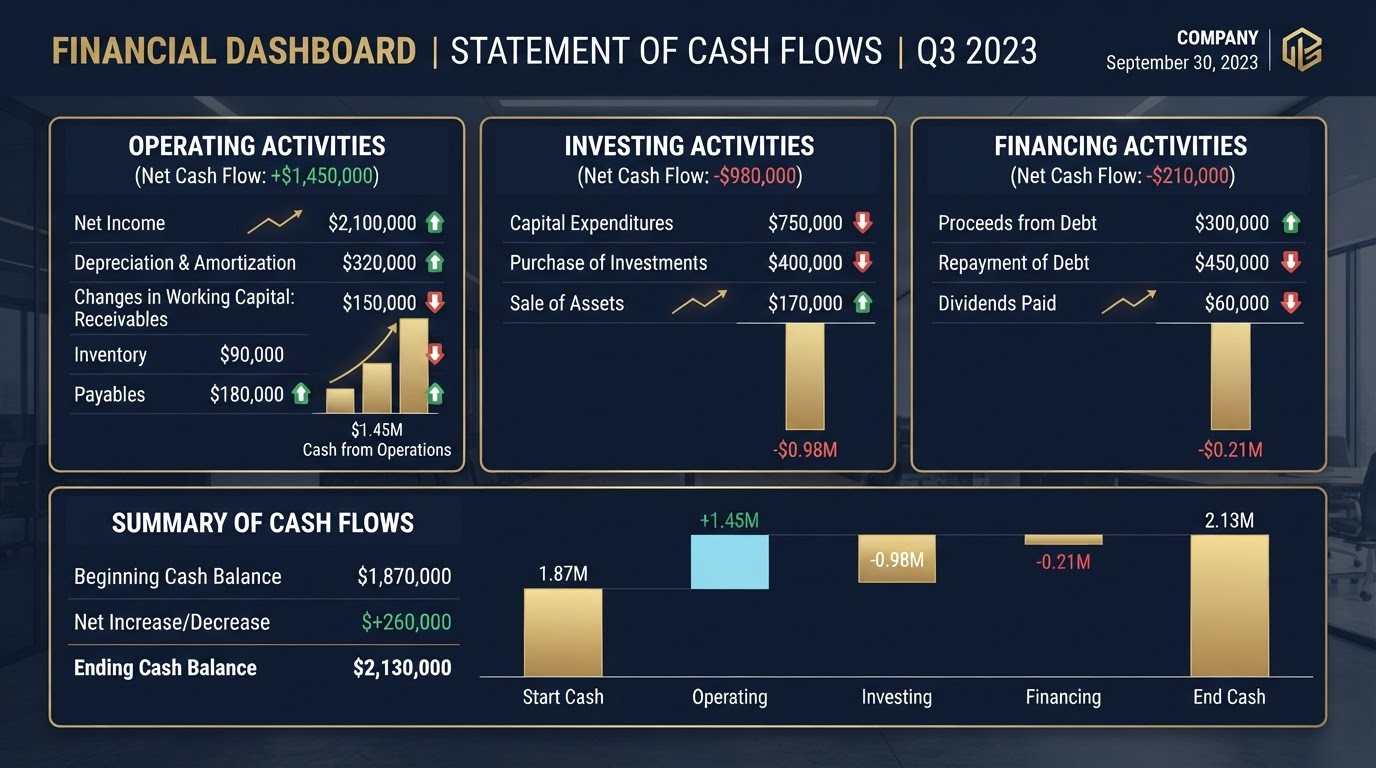
The Statement of Cash Flows
The Statement of Cash Flows shows how cash moves through your business across operating, investing, and financing activities. This is the statement that separates profitable businesses from businesses that actually generate cash. A business can show a profit on the P&L and still be cash starved if its money is tied up in accounts receivable and inventory. The lender wants to see that operating activities generate positive cash flow, because that is the cash that will service the loan. If your cash flow statement shows operating cash losses papered over by owner contributions or new debt, the lender knows the business is not self sustaining, and adding more debt on top of that is a recipe for default.
The Five Ratios Every Lender Calculates
Lenders do not just read your statements. They run calculations on them. These ratios are the mathematical backbone of every credit decision, and understanding them before you apply lets you see your business the way the bank sees it.
1. Debt Service Coverage Ratio
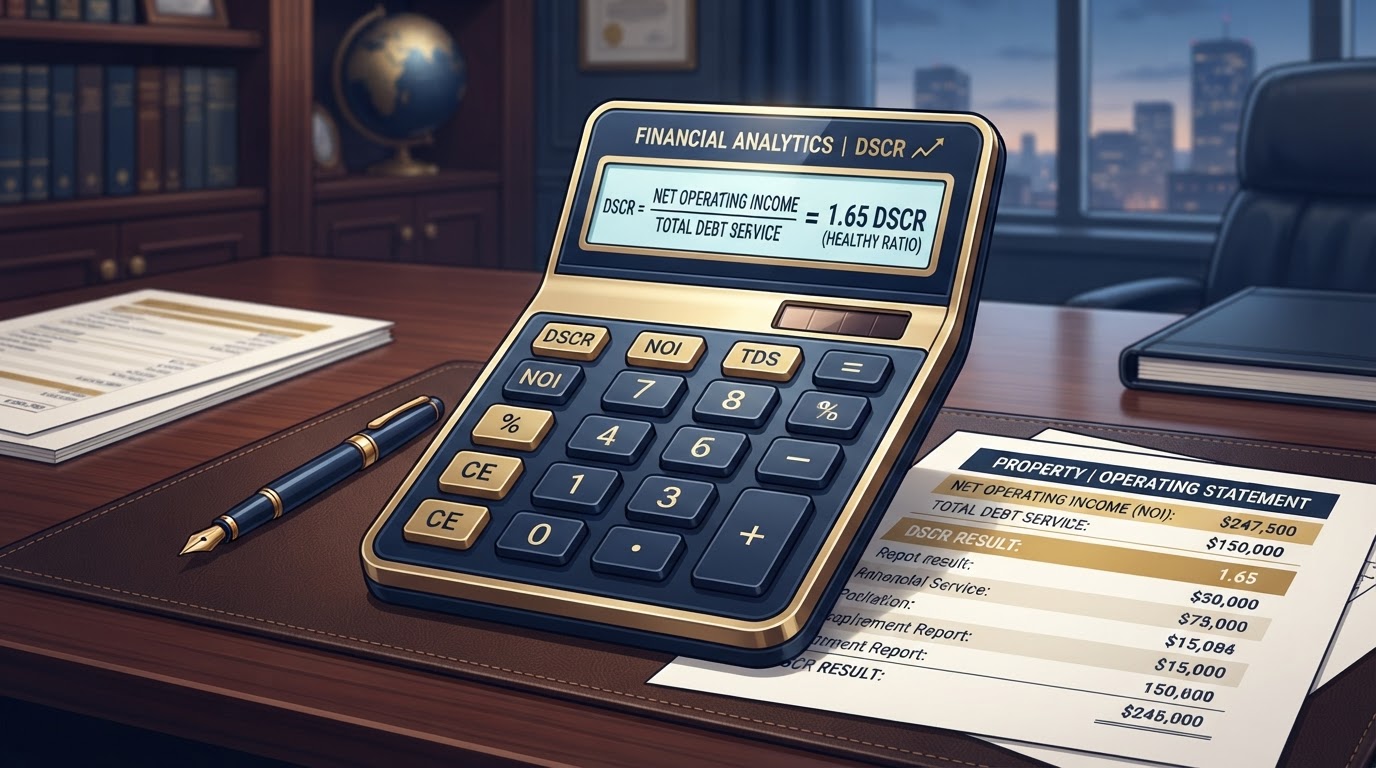
The Debt Service Coverage Ratio, or DSCR, is the single most important number in commercial lending. It measures whether your business generates enough operating income to cover its debt payments. The formula is net operating income divided by total debt service. A DSCR of 1.0 means your business generates exactly enough to cover its debt payments, with nothing left over. Most lenders want to see a DSCR of at least 1.25, meaning your business generates twenty five percent more income than it needs to service its debt. A DSCR below 1.0 means the business cannot cover its current debt, let alone take on more, and the loan is almost always denied.
2. Current Ratio
The current ratio measures short term liquidity. It is current assets divided by current liabilities. A current ratio of 2.0 means you have two dollars in current assets for every dollar in current liabilities. Lenders generally want to see a current ratio above 1.5, though the threshold varies by industry. A current ratio below 1.0 is a red flag that the business may not be able to meet its short term obligations, which makes adding a new loan payment especially risky.
3. Debt to Equity Ratio
The debt to equity ratio measures leverage. It is total liabilities divided by total equity. A ratio of 2.0 means the business has two dollars of debt for every dollar of owner equity. Lenders want to see that the owners have skin in the game and that the business is not propped up entirely by borrowed money. A debt to equity ratio above 3.0 makes most lenders nervous, though asset heavy industries like real estate and manufacturing can sustain higher ratios.
4. Gross Profit Margin
Gross profit margin is gross profit divided by revenue, expressed as a percentage. It shows how efficiently the business produces its goods or services. Lenders compare your gross margin to industry benchmarks. If your gross margin is significantly below the industry average, it signals that your pricing, costs, or both are out of line with the market, which raises questions about long term sustainability.
5. Accounts Receivable Turnover
This ratio measures how quickly you collect the money customers owe you. A slow accounts receivable turnover means your cash is trapped in unpaid invoices, which means the business is less liquid than its revenue suggests. Lenders will often request an accounts receivable aging report to see exactly how old each invoice is. If a significant portion of your receivables are over ninety days old, the lender may discount or exclude them from the collateral calculation, which reduces the loan amount you qualify for.
Why Your Books and Your Tax Return Must Match
One of the most common reasons loan applications get delayed or denied is a mismatch between the financial statements and the business tax return. The lender will request both, and they will compare them. If the net income on your P&L does not match the net income on your tax return, the lender will ask why. The most common explanation is that the tax preparer made adjustments at year end, such as depreciation, meals and entertainment limitations, or owner compensation adjustments, without recording those same adjustments in the books. This creates two different versions of the truth, and the lender cannot underwrite a loan on numbers they cannot verify.
The fix is to reconcile the books to the tax return after the return is filed. This means recording the same year end adjustments in your accounting software so that the books and the tax return tell the same story. When the lender pulls both documents and the numbers tie out exactly, it signals that the books are maintained professionally and can be trusted. When they do not tie out, it signals that the books are approximate at best, and approximate is not good enough when someone is lending you hundreds of thousands of dollars.

The Loan Ready Checklist
Before you submit a loan application, every item on this checklist should be complete. If any item is missing, the lender will either request it, which delays the application, or they will deny the loan outright.
What to Have Ready Before You Apply
- 1.Three years of reconciled Profit and Loss statements, plus year to date.
- 2.Three years of reconciled Balance Sheets, plus current period.
- 3.Three years of business tax returns, signed and filed.
- 4.Twelve months of bank statements for every business account.
- 5.Accounts receivable aging report, current within thirty days.
- 6.Accounts payable aging report, current within thirty days.
- 7.Fixed asset register with cost, date, and accumulated depreciation.
- 8.Debt schedule showing every loan, payment, and balance.
- 9.Business debt service coverage ratio calculation.
- 10.Personal financial statement for each owner guarantor.
- 11.Business licenses, formation documents, and operating agreement.
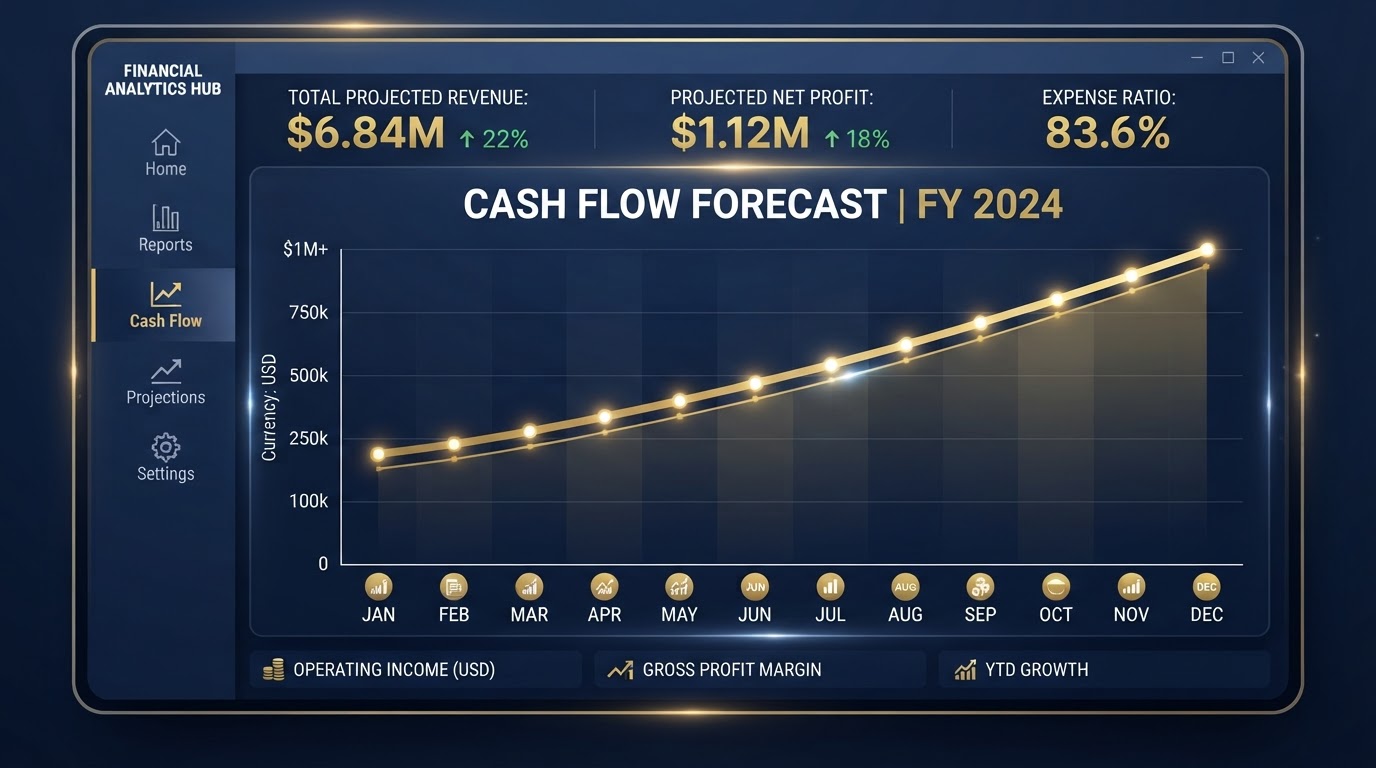
- 12.A cash flow projection for the next twelve months.
FIG Case Study: A Contractor Who Nearly Lost a Seven Hundred Thousand Dollar Equipment Loan
A commercial roofing contractor in Southern California came to us after being denied a seven hundred thousand dollar equipment loan. The contractor had the revenue to qualify. His top line was over three million dollars, and his profit margins were healthy. But when the lender reviewed his books, they found a checking account that had not been reconciled in eight months, an Undeposited Funds balance of forty one thousand dollars, a Balance Sheet with negative equity caused by an incorrect opening balance entry, and a P&L that did not match his tax return by over sixty thousand dollars. The lender denied the loan and told him to come back when his books were clean.
Our team performed a full cleanup engagement. We reconciled every bank and credit card account for the prior twelve months, oldest to newest. We cleared the Undeposited Funds balance by matching each payment to the actual bank deposit. We corrected the opening balance entry and restructured the equity accounts to eliminate the negative equity. We recorded the year end tax adjustments in the books so the P&L and the tax return matched exactly. We built a fixed asset register, an accounts receivable aging report, a debt schedule, and a twelve month cash flow projection. We calculated his DSCR at 1.68, well above the lender threshold.
The contractor resubmitted the application with the cleaned books and the complete document package. The loan was approved in three weeks. The contractor used the funds to purchase two new roofing rigs, which let him take on three additional commercial contracts that year. The increase in revenue from those contracts was more than ten times the cost of the cleanup engagement. The lesson is simple. The books were never the problem. The problem was that the books had never been maintained to the standard a lender requires, and by the time the lender asked for them, there was not enough time to fix them properly.

When to Start Preparing Your Books for a Loan
The biggest mistake business owners make is waiting until they need a loan to get their books in order. By the time you are sitting across from a lender, it is too late to reconcile eight months of transactions, clean up a broken Balance Sheet, and align your books with your tax return. That work takes weeks, and lenders do not wait. They move on to the next applicant whose books are already clean.
The right approach is to maintain loan ready books all year, every year. That means a monthly close process with full reconciliation of every account, a quarterly review to catch any drift, and an annual process that ties the books to the tax return. When your books are always clean, a loan application becomes a matter of pulling reports, not scrambling to reconstruct history. You can walk into a lender with a complete package on day one, and that speed and professionalism signals to the lender that your business is run the way a business should be run.
How Fiscal Integrity Group Gets Your Books Loan Ready
At Fiscal Integrity Group, we specialize in preparing business books for the scrutiny of lenders, investors, and auditors. Our process starts with a diagnostic review of your current books. We identify every unreconciled account, every mismatch between your books and your tax return, every stale receivable, and every structural error on your Balance Sheet. We then execute a cleanup that restores integrity from the balance sheet up, reconciling every account oldest to newest, correcting every error, and documenting every adjustment.
Once the books are clean, we implement a monthly close process that keeps them that way. Every month, we reconcile every account, clear the review queue, review the aging reports, and produce clean financial statements. Every quarter, we review the ratios a lender will eventually calculate, so you know where you stand before you ever apply. And when you are ready to apply for financing, we assemble the complete document package, calculate the ratios, and help you present your business in the strongest possible light. If your books are not loan ready and you are thinking about financing, the time to start is now, not when the lender asks.
"A lender is not lending to your business. They are lending to your books. If the books tell a clean, consistent, reconciled story, the loan gets approved. If the books tell a messy, inconsistent, unreconciled story, no amount of revenue will save the application."— Wiyao Awesso, Fiscal Integrity Group
Quick Tax Savings Estimator
See how much you could potentially save with proactive tax strategy and clean bookkeeping. Most LA businesses overpay by 15-20% simply due to missed deductions.
Free IRS Audit Risk Assessment
Do you mix personal and business expenses in the same bank account?
Frequently Asked Questions
How far back can you catch errors?
I perform a deep forensic review of your history to catch errors and fix them. Whether it's one year or five, my goal is to ensure your historical data is pristine before we move forward.
Will you educate me on how to manage my books?
Yes! My approach is highly educational. I want you to understand the "why" behind the numbers so you can make better business decisions with confidence.

About the Author
Fiscal Integrity Group
Fiscal Integrity Group is a leading financial advisory firm in Los Angeles. With extensive experience in tax strategy, accounting, and fractional CFO services, we help business owners optimize their finances, minimize tax liabilities, and scale with confidence.