Construction companies in Southern California operate in one of the most financially complex industries in the country. Between multi year projects, fluctuating material costs, heavy equipment investments, prevailing wage compliance, and a cash flow cycle that can stretch ninety days or more, the margin for error is razor thin. Yet most contractors treat tax strategy as something that happens once a year in April, when the real work of tax preparation and planning should be happening every single month. This guide breaks down the tax strategies and preparation practices that successful construction companies use to keep more of what they earn, stay compliant with California regulators, and avoid the surprise tax bills that sink so many growing firms. We use this exact framework with every construction client at Fiscal Integrity Group.
Why Construction Taxes Are Different
Most businesses buy a product, sell it, and recognize the revenue in the same tax year. Construction does not work that way. A single commercial project can span two or three tax years, which means the IRS has developed an entirely separate set of rules for how contractors recognize revenue, deduct costs, and handle long term contracts. If your bookkeeper or tax preparer does not specialize in construction, they are almost certainly applying generic rules that either overstate your income, trigger premature tax liability, or cause you to miss deductions that are specific to the industry.
The three biggest differences are long term contract accounting, heavy equipment depreciation, and the interplay between job costing and tax deductions. Each of these areas has its own set of IRS rules, elections, and timing considerations. Getting them right requires a bookkeeping system that is built around job costing from day one, not a generic chart of accounts that lumps everything into vague categories like materials or labor. When your books are structured properly, tax preparation becomes a straightforward exercise. When they are not, tax season becomes a scramble of estimates, reclassifications, and missed opportunities.
Choosing the Right Entity Structure for Tax Efficiency
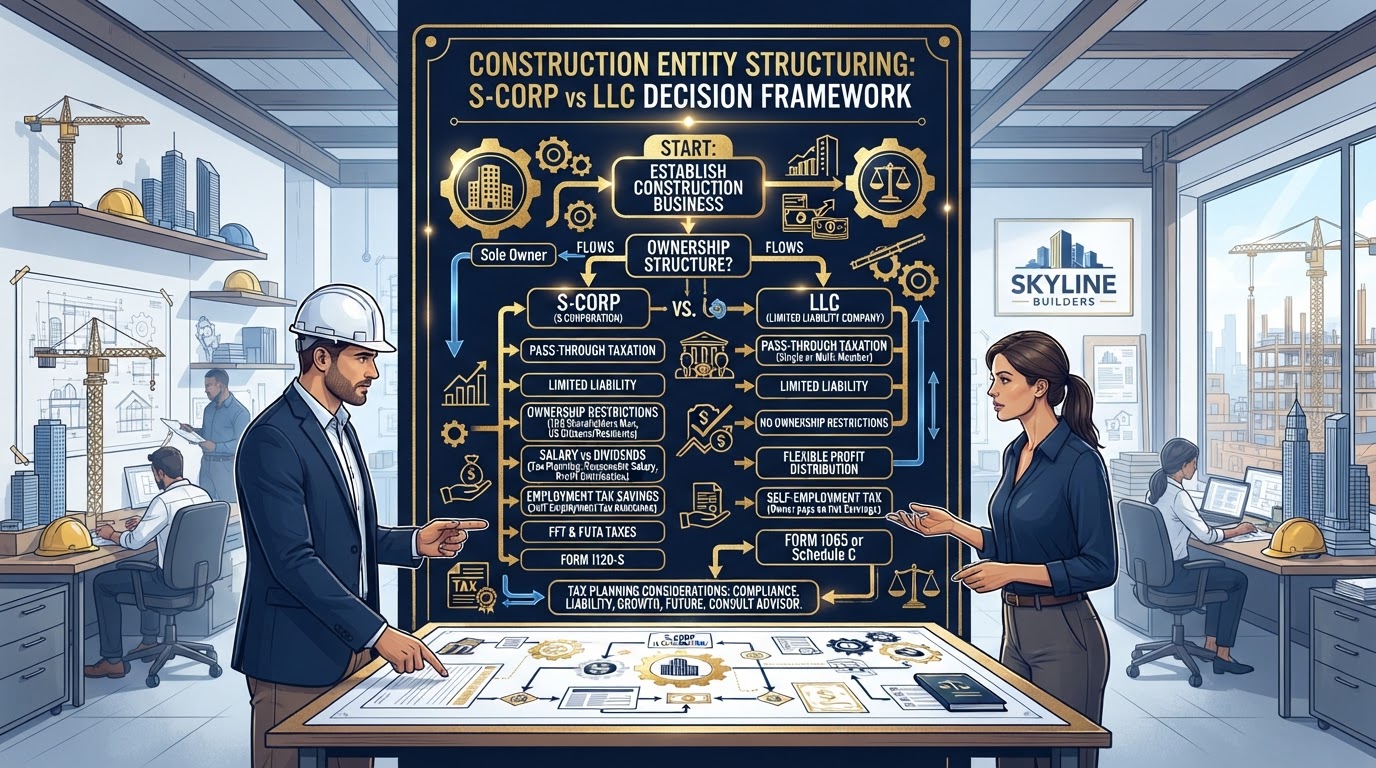
The entity structure you choose for your construction company has a massive impact on your tax liability, your personal liability, and your ability to reinvest in the business. Many contractors start as sole proprietorships or single member LLCs because the paperwork is simple, but they never revisit that decision as the business grows. A construction company generating five hundred thousand dollars in net profit as a sole proprietorship is paying self employment tax on every dollar of that profit, which is an enormous and unnecessary cost.
An S Corporation election allows a profitable construction company to split income between a reasonable salary and distributions, significantly reducing self employment tax. For a contractor with three hundred thousand dollars in profit, the savings can be ten thousand dollars or more per year. The key is setting a reasonable salary that the IRS will accept, which in construction is typically based on industry benchmarks for your role and region. We analyze each client individually, modeling the tax impact of S Corp election versus LLC versus C Corporation, and we factor in the Qualified Business Income deduction under Section 199A, which can reduce your taxable income by up to twenty percent.
For larger contractors, a C Corporation may make sense in specific situations, particularly when the goal is to retain earnings inside the business for equipment purchases or real estate acquisition. The C Corp structure has its own tax implications, including the potential for double taxation, but it also offers benefits like deductible medical reimbursement plans and lower tax rates on retained earnings. The right answer depends on your revenue, your growth plans, and your exit strategy. We model every scenario before recommending a structure.
Long Term Contract Accounting: PCM, CCM, and the Small Contractor Exception
The IRS requires contractors to use specific accounting methods for long term contracts, which are defined as any project that spans more than one tax year. The two primary methods are the Percentage of Completion Method and the Completed Contract Method. Large contractors, defined as those with average annual gross receipts exceeding thirty million dollars over the prior three years, are generally required to use the Percentage of Completion Method for tax purposes.
Under the Percentage of Completion Method, you recognize revenue and expenses based on the portion of the contract that is complete at the end of the tax year. If you have a two million dollar contract and you have completed forty percent of the work by December 31, you report eight hundred thousand dollars in revenue for that year, regardless of how much you have actually billed or collected. This method aligns your tax liability with your actual economic performance, but it can create cash flow pressure when you owe taxes on revenue you have not yet collected.
The Completed Contract Method allows you to defer all revenue and expenses for a project until it is fully complete. This is available to small contractors under the thirty million dollar threshold and for certain types of residential construction. The tax deferral benefit can be significant, allowing you to keep cash inside the business for months or years before recognizing the income. We review every construction client contract to determine which method applies, which elections are available, and which approach produces the best tax outcome. This is not a decision you can make in April. It must be documented and reflected in your books throughout the year.
Cash Versus Accrual Accounting for Contractors
Most small construction companies use cash basis accounting because it is simple and intuitive. You recognize income when you receive payment and deduct expenses when you pay them. For very small contractors, this works fine. But once your revenue exceeds certain thresholds or you begin carrying significant inventory, work in progress, or accounts receivable, cash basis accounting can distort your financial picture and limit your tax planning options.
The accrual method matches revenue to the expenses that generated it, giving you a more accurate picture of project profitability. It is also required for certain contractors under IRS rules. The Tax Cuts and Jobs Act raised the gross receipts threshold for cash basis eligibility, allowing more small businesses to use the cash method, but construction companies with long term contracts are still subject to the specialized rules described above. We help each client determine which method is permitted and which produces the most accurate financial reporting and the most favorable tax outcome.
Equipment Depreciation: Section 179 and Bonus Depreciation Strategy
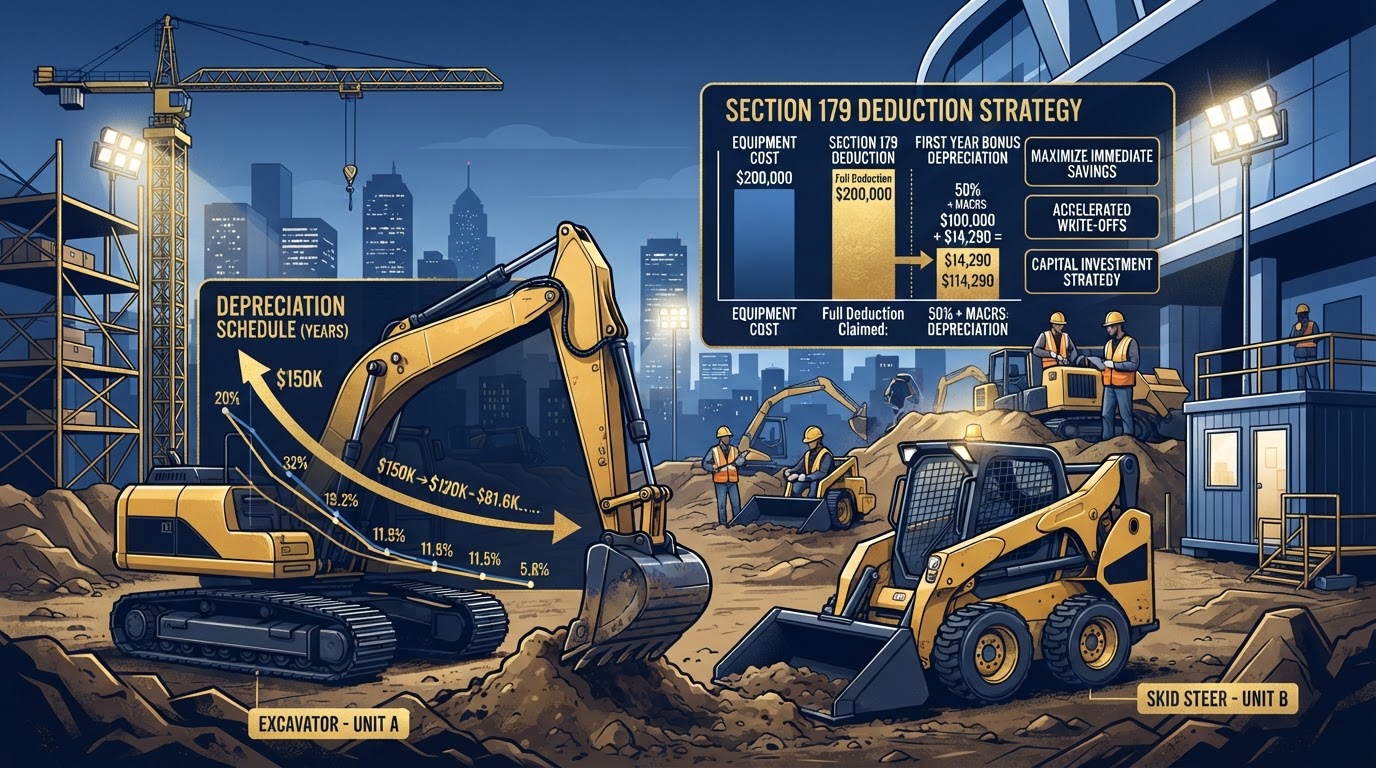
Heavy equipment is one of the largest investments a construction company makes, and it is also one of the most powerful tax planning tools available. The IRS allows you to recover the cost of equipment through depreciation, and two provisions in particular let you accelerate that deduction into the year of purchase. Section 179 allows you to expense the full purchase price of qualifying equipment in the year it is placed in service, up to a limit of approximately one point two two million dollars for 2026, with a phase out that begins around three point zero five million in total equipment purchases.
Bonus depreciation is the second tool, and it applies automatically to qualifying property unless you elect out. Under the One Big Beautiful Bill Act, bonus depreciation has been restored to one hundred percent for property placed in service after January 19, 2025. This means that for equipment purchased and placed in service in 2026, you can deduct the entire cost in the first year. This is a significant change from the phase down schedule that was in effect from 2023 through 2025, and it makes equipment purchasing one of the most impactful tax strategies available to contractors right now.
The strategic question is not whether to use these provisions, but how much equipment to buy and when to place it in service. If your projected net income for the year is four hundred thousand dollars and you buy a three hundred thousand dollar excavator, you can reduce your taxable income to one hundred thousand dollars. But if you overbuy and create a net operating loss, you may be carrying that loss forward rather than getting an immediate refund. We model each equipment purchase against projected income, entity structure, QBI deduction impact, and state tax considerations before recommending a purchase timing strategy. The goal is to drive your tax liability to your target number without unnecessarily depleting your cash reserves.
Vehicle and Fleet Tax Strategy
Construction companies almost always maintain a fleet of work trucks and vans. The IRS gives you two methods for deducting vehicle expenses: the standard mileage rate and the actual expense method. For 2026, the standard mileage rate is approximately seventy cents per business mile. For a truck driven eighteen thousand business miles, that is a deduction of twelve thousand six hundred dollars with minimal recordkeeping.
For heavy vehicles with a gross vehicle weight rating over six thousand pounds, which includes most full size work trucks and vans, the actual expense method combined with Section 179 and bonus depreciation can generate first year deductions of tens of thousands of dollars on a single vehicle. A sixty five thousand dollar heavy SUV placed in service in 2026 can qualify for a first year deduction of nearly the full purchase price under the combined provisions. The requirement is contemporaneous mileage documentation separating business from personal use, and we build the mileage tracking system for every client so the deduction survives an audit.
Cash Flow Management and Retainage Strategy
Construction cash flow is brutal. You pay your crews every week, your material suppliers in thirty days, and your subcontractors as work progresses. But your clients may not pay you for sixty to ninety days after you submit a pay application, and they typically hold back ten percent as retainage until the project is fully complete. This means you are financing your clients projects with your own cash, and the longer the project, the deeper the hole.
Tax strategy must account for this reality. If you are recognizing revenue under the Percentage of Completion Method but have not yet collected the cash, you can owe taxes on money you do not have. We help clients manage this by aligning their accounting method elections, their billing schedules, and their estimated tax payments so that tax liability tracks closely with cash collection. We also track retainage receivable on the balance sheet so it is visible and collectible, rather than buried in accounts receivable where it gets forgotten.

Prevailing Wage and Certified Payroll Compliance
If you bid on public works projects in California, you enter the heavily regulated world of prevailing wage and certified payroll. The California Department of Industrial Relations requires contractors to pay workers a specific hourly rate based on their trade and the geographic location of the project, plus fringe benefits and training fund contributions. You must submit Certified Payroll Reports on a weekly basis, documenting every worker, their classification, their hours, and their pay.
From a tax strategy perspective, prevailing wage work offers unique opportunities. Fringe benefit contributions to approved plans can be deductible and may reduce your taxable income. The key is ensuring that your bookkeeping system tracks prevailing wage work separately from private work, allocates fringe benefit costs correctly, and generates the certified payroll reports automatically. We integrate specialized construction payroll software with QuickBooks for our public works clients, ensuring compliance and capturing every deductible benefit.

Subcontractor Compliance: W-9s, 1099s, and Classification Risk
Construction companies rely heavily on subcontractors, and the line between a W-2 employee and a 1099 independent contractor is one of the most audited areas in the tax code. Misclassifying an employee as a contractor can trigger back payroll taxes, penalties, and interest that can cripple a business. The IRS applies a multi factor test focused on behavioral control, financial control, and the relationship between the parties. A subcontractor who uses your tools, follows your schedule, and works exclusively for you is very likely an employee in the eyes of the IRS.
When classification is correct, 1099 subcontractor payments are fully deductible, and you have no payroll tax obligation. But you must collect a Form W-9 from every subcontractor before you pay them, and you must file Form 1099-NEC for any subcontractor paid six hundred dollars or more in a year. For 2026, the reporting threshold is two thousand dollars. Failure to file 1099s can result in penalties of up to three hundred ten dollars per form, and the IRS can disallow the deduction entirely if you cannot prove you attempted to comply. We maintain a subcontractor compliance file for every construction client, ensuring W-9s are collected, 1099s are filed on time, and the classification itself is defensible.
California Sales and Use Tax on Construction Materials
California sales tax rules for construction contractors are uniquely complex. The California Department of Tax and Fee Administration generally considers contractors to be the consumers of the materials they install, meaning you pay sales tax when you purchase materials and do not charge sales tax to your client on the final invoice. But the rules change if you are acting as a retailer, if the contract is lump sum versus time and materials, or if you purchase materials from an out of state vendor that does not charge California sales tax.
In that last case, you are legally required to self assess and pay use tax directly to the CDTFA. The CDTFA aggressively audits construction companies for unreported use tax, scouring expense ledgers for out of state equipment and material purchases. We implement use tax tracking systems for every construction client so that every taxable purchase is captured, reported, and remitted correctly, eliminating the risk of a surprise audit assessment.
The Qualified Business Income Deduction for Contractors
The Qualified Business Income deduction under Section 199A allows eligible pass through businesses, including S Corporations and partnerships, to deduct up to twenty percent of their qualified business income from their taxable income. The One Big Beautiful Bill Act made this deduction permanent, which is a significant win for construction company owners. For a contractor with three hundred thousand dollars in qualified business income, the QBI deduction reduces taxable income by sixty thousand dollars.
The calculation is not automatic. It is limited by your taxable income, the W-2 wages paid by the business, and the unadjusted basis of qualified property, which includes equipment. Construction companies with significant equipment and payroll are well positioned to maximize the deduction, but only if the books are structured to capture the correct wage and property figures. We model the QBI deduction for every client throughout the year, adjusting salary and equipment strategies to maximize the benefit.
Construction Tax Deductions: Every Write-Off Contractors Miss
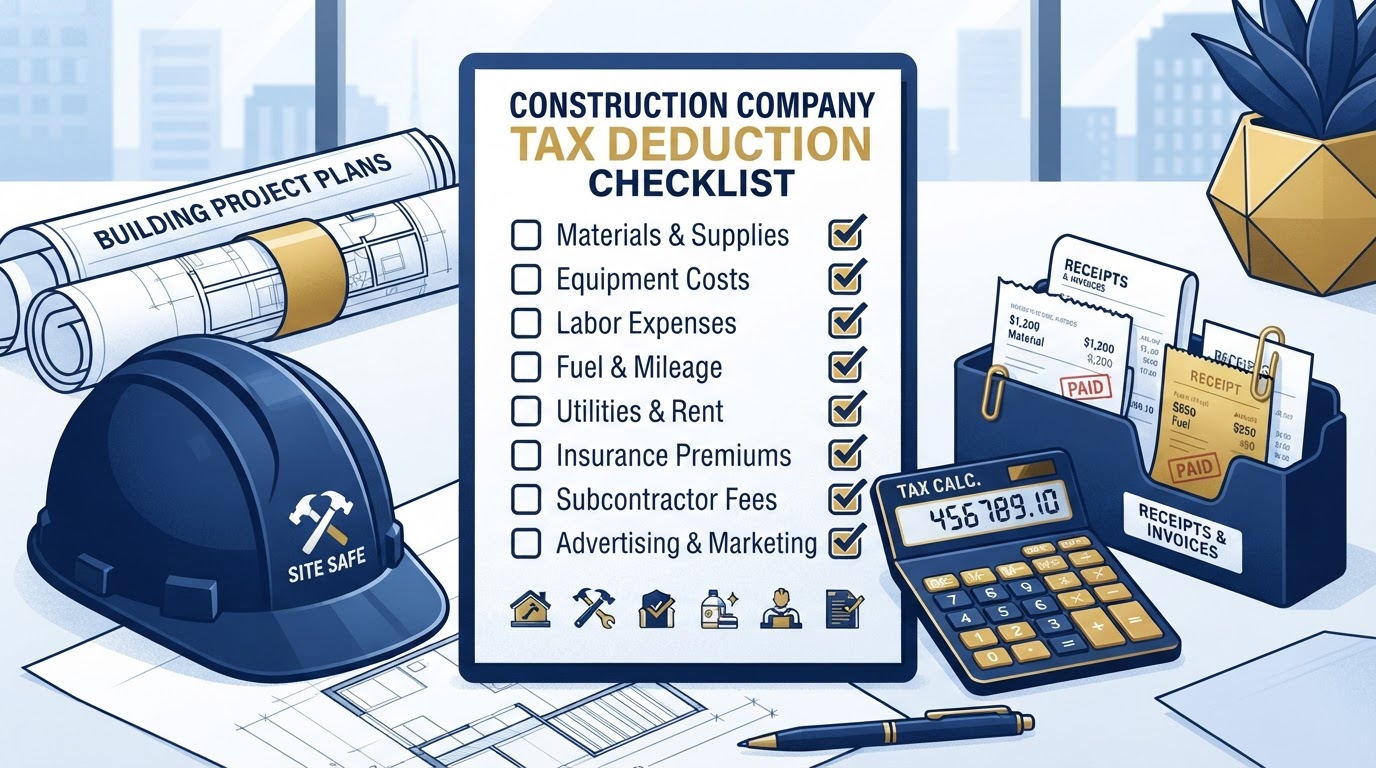
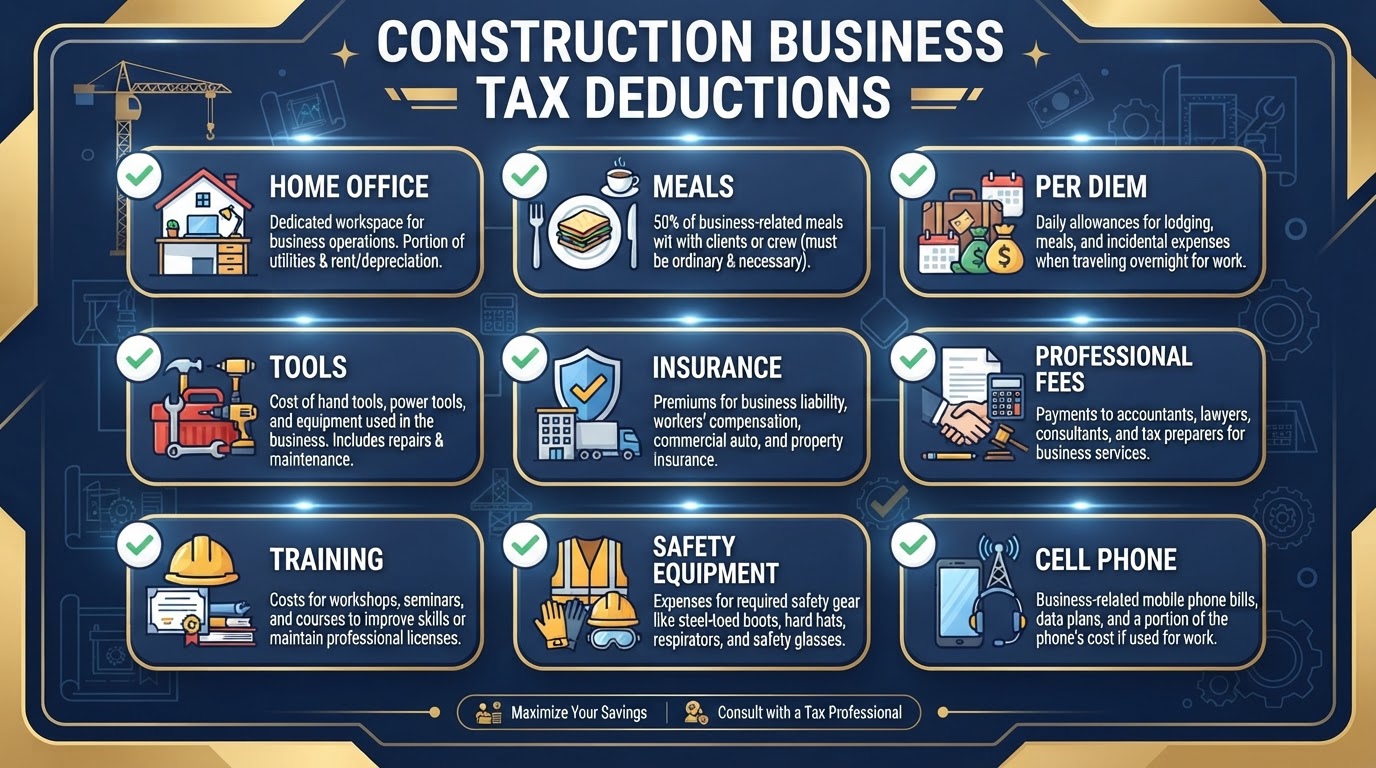
Beyond equipment and vehicles, construction companies have dozens of everyday deductions that slip through the cracks when the books are not structured around job costing. The rule is simple: if an expense is ordinary and necessary for your trade, it is deductible. The problem is never whether the expense qualifies. It is whether the expense actually makes it into the books, properly categorized, before the tax return is filed. Here are the deductions most contractors miss.
Home Office Deduction
If you run your construction business from a dedicated home office, you can deduct a portion of your housing costs. The simplified method allows five dollars per square foot up to three hundred square feet, for a maximum deduction of one thousand five hundred dollars. The regular method allocates actual expenses, including rent, utilities, insurance, and depreciation, based on the percentage of your home used exclusively for business. For a contractor with a dedicated two hundred square foot office in a three thousand dollar per month rental, the regular method almost always produces a larger deduction. The key requirement is exclusive and regular business use. A kitchen table does not qualify.
Per Diem and Travel Expenses
When your crews travel to job sites outside their normal area, per diem deductions can add up quickly. The IRS per diem rates cover lodging, meals, and incidentals without requiring you to save every receipt. For 2026, the standard CONUS rate is approximately one hundred seventy eight dollars per day, with higher rates in high cost areas. For overnight travel, you can deduct airfare, lodging, ground transportation, parking, tolls, and fifty percent of meal costs. The most common mistake is failing to document the business purpose of the trip and the dates of travel. We set up a per diem tracking system that captures every eligible trip.
Meals and Entertainment
Business meals are fifty percent deductible when you eat with a client, subcontractor, or supplier and the meal has a business purpose. The documentation must include the date, location, amount, attendees, and the business discussed. Entertainment expenses, such as sporting event tickets, are no longer deductible, but food and beverages purchased separately at such an event may still qualify for the fifty percent meals deduction. Construction companies frequently miss meals because they are paid in cash or on a personal card and never make it into the books.
Tools, Small Equipment, and Supplies
Hand tools, power tools, ladders, scaffolding, fasteners, adhesives, and consumable supplies are fully deductible in the year purchased, provided they fall under your capitalization threshold. The IRS de minimis safe harbor allows you to expense items costing up to two thousand five hundred dollars each without capitalizing them. This means a contractor who buys three thousand dollars worth of power tools throughout the year can deduct every dollar, rather than depreciating them over five or seven years. The catch is that these purchases must be categorized correctly in the books, not buried in a generic materials account.
Insurance Premiums
General liability insurance, workers compensation, commercial auto, equipment insurance, and surety bonds are all fully deductible business expenses. Many contractors pay these premiums annually and forget to record them, or they pay them on a personal account and never reimburse themselves properly. We ensure every insurance premium is captured, categorized, and allocated to the correct job or overhead account.
Professional Fees and Software
Legal fees for contract review, accounting and bookkeeping fees, engineering and architectural consulting, permit fees, and software subscriptions like QuickBooks, project management tools, and estimating software are all deductible. These recurring expenses are frequently missed because they auto charge to a card that is not reconciled. We capture every subscription and professional fee so nothing is left on the table.
Safety Gear, Uniforms, and Training
Hard hats, safety glasses, steel toe boots, high visibility vests, gloves, and branded uniforms are deductible business expenses. Training and certification courses, including OSHA certifications, first aid training, and trade specific continuing education, are also fully deductible. Contractor license renewal fees and bond premiums fall in this category as well. These smaller expenses add up to thousands of dollars per year and are among the most commonly missed deductions in construction.
Cell Phone and Internet
If you use your personal cell phone and home internet for business, you can deduct the business use percentage. For a contractor whose phone is used eighty percent for business, that is a meaningful deduction on a one hundred fifty dollar monthly bill. The requirement is a reasonable, documented allocation method. We help clients establish and document the business use percentage so the deduction holds up under review.
Interest and Financing Costs
Interest paid on business loans, equipment financing, lines of credit, and credit cards is fully deductible. The principal portion of loan payments is not deductible, which is why your bookkeeping system must split each loan payment into interest and principal. Many contractors record the entire payment as an expense, which overstates the deduction and creates a mess on the balance sheet. We set up loan amortization schedules for every client so interest is captured correctly.
Bad Debt and Write-Offs
If a client fails to pay for completed work and the debt is determined uncollectible, you may be able to write off the bad debt. For accrual basis contractors, this means removing the receivable from your books and claiming a deduction. For cash basis contractors, since you never recognized the income, there is no deduction to claim. Knowing which method applies to your business is essential, and we ensure the treatment is correct.
- Home office: simplified method up to one thousand five hundred dollars, or regular method with actual expense allocation
- Per diem and travel: standard CONUS rate of approximately one hundred seventy eight dollars per day for out of area job sites
- Meals: fifty percent deductible with date, attendees, and business purpose documented
- Tools and supplies: expense up to two thousand five hundred dollars per item under the de minimis safe harbor
- Insurance: general liability, workers comp, auto, equipment, and surety bonds
- Professional fees and software: legal, accounting, permits, and all subscriptions
- Safety gear, uniforms, training, certifications, and license renewals
- Cell phone and internet: business use percentage of personal plans
- Interest on loans, equipment financing, and credit cards, with principal separated
- Bad debt write-offs, treated correctly based on your accounting method
Year End Tax Planning for Construction Companies
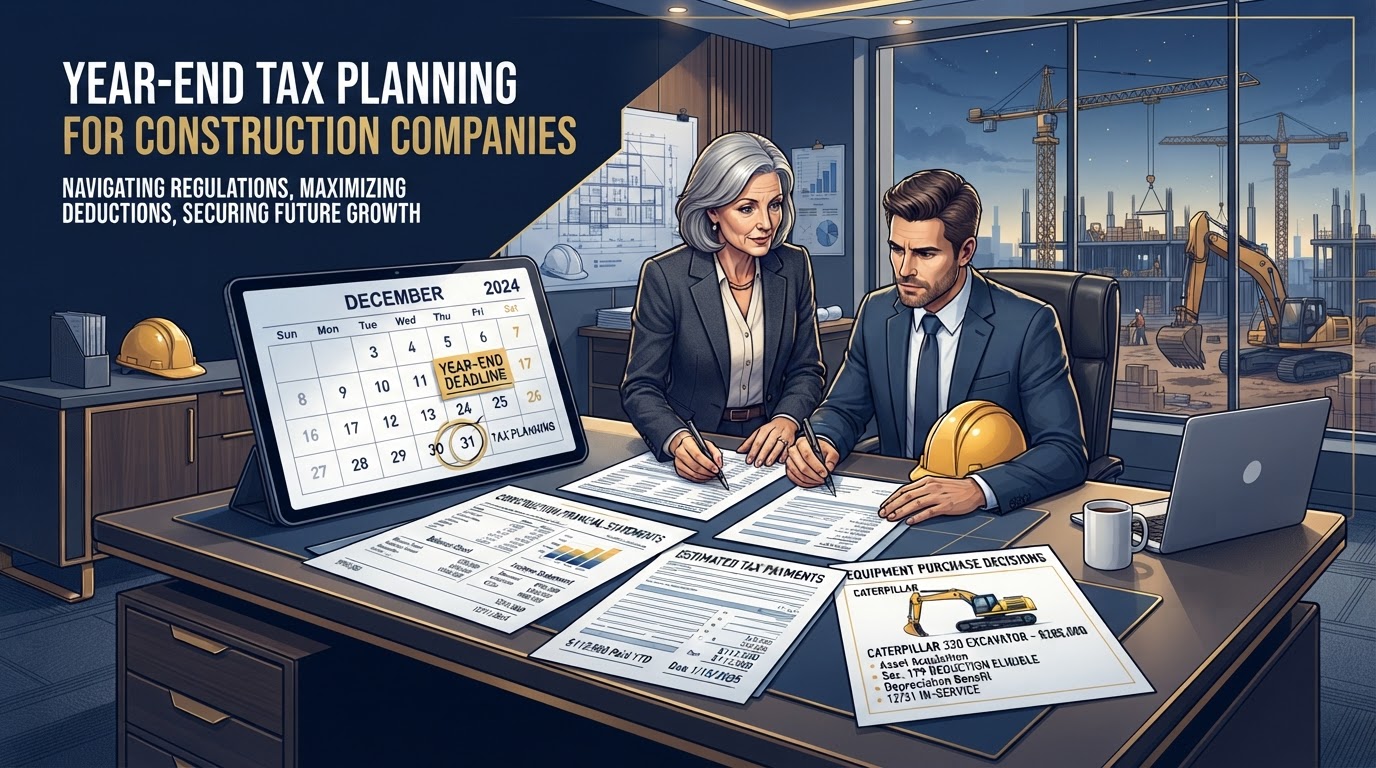
The most expensive mistake a construction company can make is waiting until January to think about taxes. By then, the window for strategic action has closed. Effective tax planning begins in October, when we project your full year income based on your books through the third quarter. From that projection, we model your estimated tax liability and identify the specific actions that will reduce it before December 31.
Those actions may include purchasing and placing equipment in service before year end to capture Section 179 or bonus depreciation, adjusting your reasonable salary to optimize QBI, making retirement contributions through a Solo 401(k) or SEP IRA, prepaying certain expenses, or deferring billing to push revenue into the following year. Each action has a specific tax consequence and a specific deadline. We present a written year end plan to every construction client in November, with dollar amounts and deadlines, so there are no surprises in April.
How FIG Helped a Southern California General Contractor Restructure for Tax Efficiency
A general contractor in the Inland Empire came to Fiscal Integrity Group operating as a single member LLC with approximately one point eight million dollars in annual revenue. Their books were maintained on a cash basis with no job costing, no fixed asset register, and no formal tax planning. The owner was paying self employment tax on the full net profit, had never taken a QBI deduction, and was hit with a surprise tax bill every spring that drained the operating account.
We began with a full bookkeeping cleanup, reconstructing the chart of accounts around job costing and reconciling twelve months of bank and credit card statements. We then analyzed the entity structure and recommended an S Corporation election, establishing a reasonable salary based on industry benchmarks and routing the remaining profit as distributions. We built a fixed asset register for the existing equipment and identified two additional equipment purchases that qualified for one hundred percent bonus depreciation under the One Big Beautiful Bill Act. Finally, we modeled the QBI deduction and implemented a year end planning meeting in November.
The result was a significant reduction in self employment tax, a meaningful QBI deduction, and first year depreciation that brought the taxable income to the target level. More importantly, the owner now receives monthly financial reports with job level profitability, a projected tax liability updated each quarter, and a year end plan delivered in November. The surprise tax bills are gone, replaced by a predictable, managed tax strategy that runs all year.
Construction Tax Preparation Checklist
When tax season arrives, your preparation should be a matter of pulling clean numbers from a well maintained bookkeeping system, not a scramble to reconstruct the year. Here is what a complete construction tax preparation file should include:
- Reconciled profit and loss statement and balance sheet for all twelve months
- Job cost reports showing revenue and expenses by project
- Fixed asset register with cost, date placed in service, and depreciation method
- Section 179 and bonus depreciation election worksheet
- Vehicle mileage logs and actual expense records for each fleet vehicle
- Subcontractor compliance file with W-9s and 1099 summaries
- Prevailing wage and certified payroll reports for public works projects
- Sales and use tax returns reconciled to the books
- Retainage schedule showing amounts held and expected collection dates
- QBI calculation worksheet with W-2 wages and qualified property
- Estimated tax payment records for all four quarters
- Prior year tax return and depreciation schedules
Conclusion
Construction companies have more tax planning opportunities than almost any other industry, but capturing them requires a bookkeeping system built around job costing, a fixed asset register, subcontractor compliance, and proactive year end planning. The contractors who lose money to taxes are not the ones who spend less. They are the ones whose books fail to capture and categorize what they spend, and whose tax strategy is an afterthought rather than a year round discipline. If you want a firm that understands construction accounting and builds a tax strategy into your books every month, Fiscal Integrity Group can help.
Quick Tax Savings Estimator
See how much you could potentially save with proactive tax strategy and clean bookkeeping. Most LA businesses overpay by 15-20% simply due to missed deductions.
Free IRS Audit Risk Assessment
Do you mix personal and business expenses in the same bank account?
Frequently Asked Questions
How far back can you catch errors?
I perform a deep forensic review of your history to catch errors and fix them. Whether it's one year or five, my goal is to ensure your historical data is pristine before we move forward.
Will you educate me on how to manage my books?
Yes! My approach is highly educational. I want you to understand the "why" behind the numbers so you can make better business decisions with confidence.

About the Author
Wiyao Awesso
Wiyao Awesso is a leading financial advisor in Los Angeles. With extensive experience in tax strategy, accounting, and fractional CFO services, he helps business owners optimize their finances, minimize tax liabilities, and scale with confidence.