The One Big Beautiful Bill Act: What It Actually Means for Your Business and Your Taxes
On July 4, 2025, the One Big Beautiful Bill Act (OBBBA) was signed into law. It is one of the most sweeping tax packages in a decade, and it touches almost every part of the tax code that matters to a small business owner in Southern California — the pass-through deduction, bonus depreciation, Section 179 expensing, the SALT cap, estate planning, and a handful of brand-new deductions for tipped workers, overtime, and seniors. If you own a business, employ people, or hold real estate, this law changes the math on decisions you were already planning to make.
The challenge with a bill this large is that the headlines do not match the fine print. The news tells you that tips and overtime are now tax-free, that the SALT cap went up, and that bonus depreciation is back. What the news does not tell you is that several of these provisions are temporary, that most phase out above certain income levels, and that the rules for claiming them are technical enough that a wrong entry on a return can cost you the benefit entirely. This guide walks through every provision that matters to business owners, with real numbers, worked examples, side-by-side comparisons, and a case study showing how we apply these changes for clients at Fiscal Integrity Group.
This is a long guide, and deliberately so. The OBBBA is not a single change — it is a package of roughly a dozen interlocking provisions, and the way they interact with each other is where the real money is won or lost. A contractor who buys equipment, has employees who work overtime, and operates through an S-Corporation is touched by at least five separate parts of this law in a single year. Reading only the section that applies to your situation means you miss the stacking opportunities that come from understanding how the pieces fit together. We recommend reading the whole guide once, then returning to the sections that apply to your business.

The Background: How We Got Here
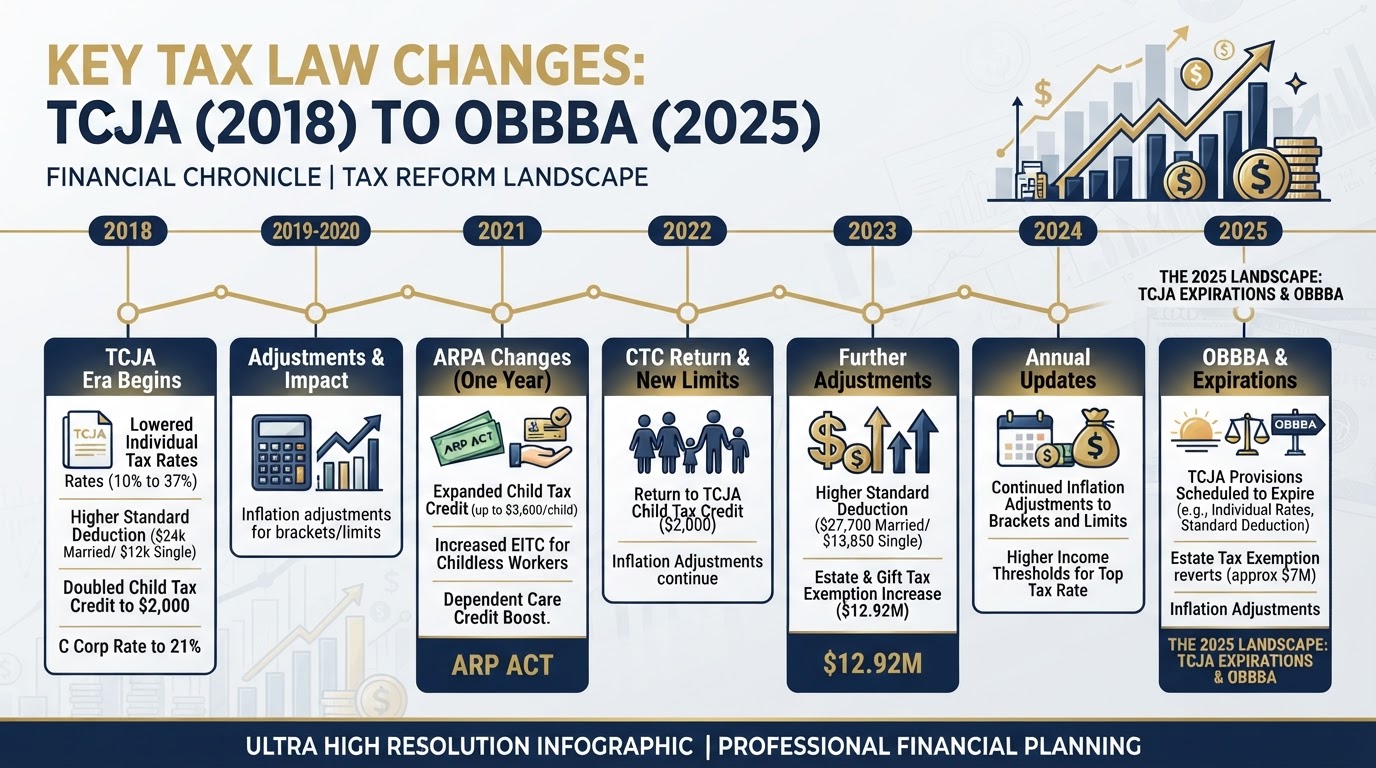
To understand what the OBBBA changed, you have to understand what it was built on. The Tax Cuts and Jobs Act (TCJA), passed in late 2017, restructured the tax code in ways that benefited pass-through business owners, real estate investors, and corporations. It introduced the 20% Qualified Business Income deduction, doubled the estate exemption, capped the SALT deduction at $10,000, and set bonus depreciation on a declining schedule. Many of those provisions were temporary — scheduled to sunset on December 31, 2025. Had Congress done nothing, the QBI deduction would have disappeared, the estate exemption would have roughly halved, and bonus depreciation would have continued its decline toward zero.
The OBBBA did not just extend those provisions — it made several of them permanent, raised the dollar amounts, and added entirely new deductions on top. The result is a tax code that, for at least the next several years, is more generous to business owners than at any point since the TCJA was enacted. But the generosity comes with complexity. Each provision has its own eligibility rules, income thresholds, phase-out ranges, and documentation requirements. A business owner who understands the structure can capture benefits worth tens of thousands of dollars per year. One who does not may leave that money on the table without realizing it.
What Actually Changed: The Provisions That Matter Most
The OBBBA is built on top of the TCJA. Many of the TCJA provisions were scheduled to sunset on December 31, 2025. The OBBBA made several of them permanent, raised the dollar amounts, and added new deductions on top. Below are the changes that most directly affect a small or mid-sized business and its owners, in the order we find most impactful in practice.
1. The Section 199A QBI Deduction Is Now Permanent (and Bigger for Small Owners)
The 20% Qualified Business Income (QBI) deduction under Section 199A was set to expire at the end of 2025. The OBBBA made it permanent. For pass-through owners — sole proprietors, partnerships, LLCs, and S-Corporations — this means up to 20% of qualified business income continues to be excluded from federal income tax indefinitely. This is the single most valuable provision in the law for the typical small business owner, and its permanence means you can build long-term financial plans around it rather than treating it as a temporary windfall.
The law also expanded access to the full deduction. The phase-in thresholds for the W-2 wage and property limitations were raised to $75,000 for single filers and $150,000 for joint filers (indexed for inflation). Beginning in 2026, there is a new guaranteed minimum deduction of $400 for owners who materially participate in the business and have at least $1,000 of QBI. In plain English: more small owners now qualify for the full 20%, and even very small side-businesses get a floor under their deduction.
The mechanics matter. QBI is the net amount of qualified items of income, gain, deduction, and loss from any qualified trade or business. It does not include W-2 wages paid to the owner, guaranteed payments to partners, capital gains, interest income, or dividend income. For S-Corporation owners, this means the deduction applies to the business profit that flows through to the personal return — not the reasonable salary the owner takes. This is one reason S-Corp owners often capture more QBI benefit than sole proprietors with the same revenue: a portion of their income is classified as salary (not QBI), but the remaining profit is fully eligible, and the wage/property limitation is easier to manage.

Worked example. A single-member LLC in Los Angeles with $200,000 of net business income and no W-2 employees would, under the new thresholds, qualify for the full 20% deduction with no wage/property limitation. That is a $40,000 deduction against taxable income — roughly $8,800 to $11,000 in federal tax saved depending on the marginal bracket, every year, permanently.
Worked example — S-Corp comparison. That same business operated as an S-Corporation, where the owner takes a $60,000 reasonable salary and the remaining $140,000 passes through as profit, would have $140,000 of QBI (the salary is excluded). The 20% deduction is $28,000. The salary is subject to payroll tax, but the QBI deduction still applies to the profit portion. The total tax picture depends on payroll tax cost versus the QBI benefit, which is exactly the kind of analysis we run for every client considering an S-Corp election.
There is also a trap. Certain businesses — known as Specified Service Trades or Businesses (SSTBs) — face stricter limits. Doctors, lawyers, accountants, consultants, and financial advisors are SSTBs. If an SSTB owner's taxable income exceeds the threshold range, the QBI deduction phases out entirely. The OBBBA raised the thresholds, which helps, but the SSTB classification itself did not change. If you run a professional service business, you need to know where the phase-out starts and plan around it.
2. 100% Bonus Depreciation Is Back — and Permanent
Under the TCJA schedule, bonus depreciation was already declining — it was 60% in 2024 and scheduled to drop to 40% in 2025. The OBBBA restored 100% bonus depreciation for qualified property acquired after January 19, 2025, and made the 100% rate permanent. This means a business that buys a truck, equipment, or fixtures and places it in service can write off the entire purchase price in the first year rather than depreciating it over five or seven years.
The phrase "placed in service" is doing a lot of work in that sentence. It does not mean "ordered" or "paid for." It means the asset is ready and available for use in the business. A truck that is delivered in December but not registered or insured until January is generally not placed in service until January. This distinction determines which tax year the deduction lands in, and it is one of the most common errors we see when reviewing prior-year returns.
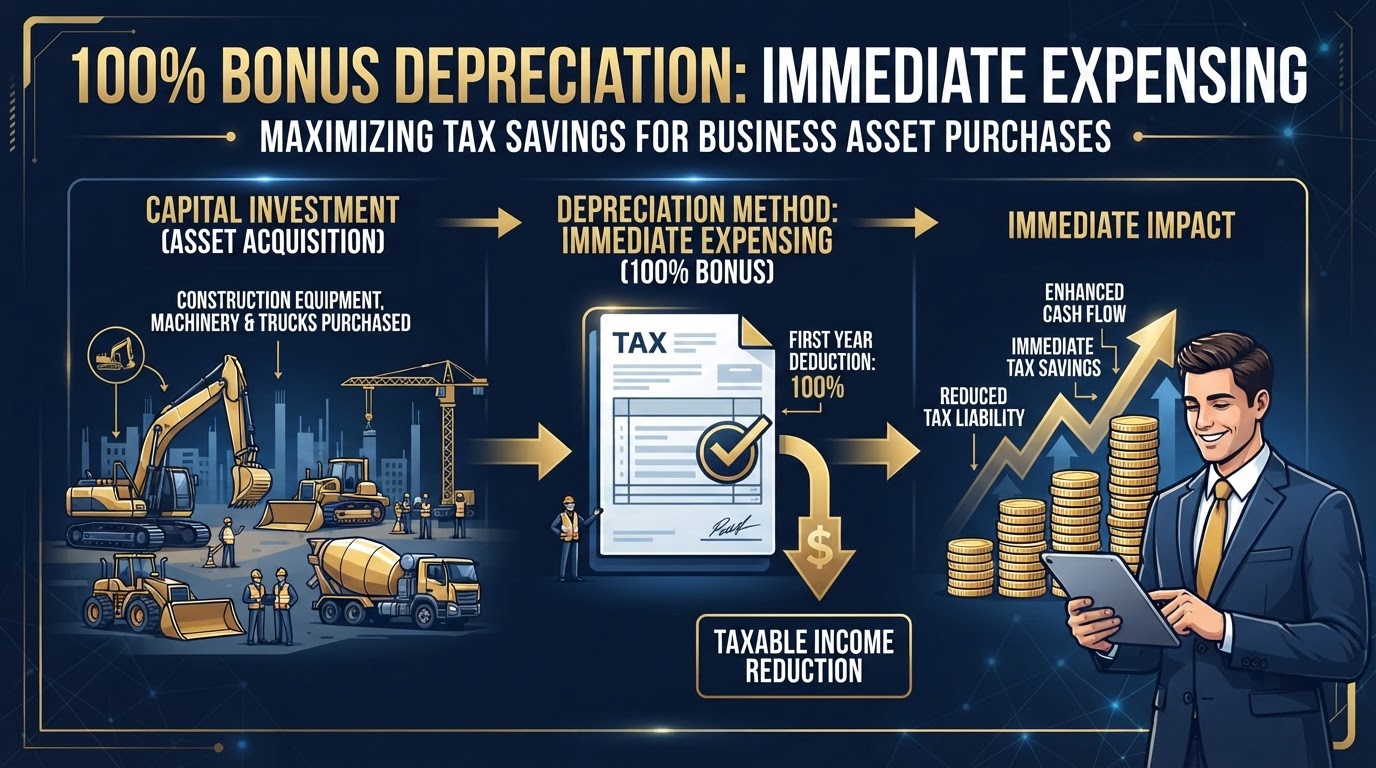
Worked example. A landscaping company buys a $80,000 skid-steer loader in October 2025 and places it in service before year-end. With permanent 100% bonus depreciation, the entire $80,000 is deductible in 2025. At a 24% effective federal rate, that is roughly $19,200 in federal tax reduced in the year of purchase — cash that stays in the business instead of going to the IRS in installments over the next several years.
Worked example — real estate. A real estate investor performing a cost segregation study on a newly acquired $1.2 million rental property may identify $300,000 of assets that qualify as 5-, 7-, or 15-year property (fixtures, flooring, appliances, land improvements). With 100% bonus depreciation restored, that entire $300,000 can be deducted in the year the property is placed in service, creating a large passive loss that may be deductible against other passive income depending on the investor's participation status. When bonus was at 60%, only $180,000 of that would have been immediately deductible. The restoration to 100% roughly doubles the first-year benefit of a cost segregation study.
3. Section 179 Expensing Doubled to $2.5 Million
Section 179 lets a business immediately expense the cost of qualifying property instead of depreciating it. The OBBBA doubled the maximum Section 179 deduction from $1.22 million to $2.5 million for 2025, and the phase-out threshold (the point at which the deduction begins to reduce) rose to $4 million. This is especially valuable for businesses that want to target the deduction to specific assets rather than applying bonus depreciation across all eligible property.
The key difference between Section 179 and bonus depreciation: Section 179 cannot create a net operating loss — it is capped at taxable income — and it can be elected asset-by-asset. Bonus depreciation applies automatically to all qualifying property and can create or increase a loss. For profitable businesses that want precision, Section 179 is often the better lever; for businesses with losses or large purchases, bonus depreciation is the broader tool. In practice, many businesses use both in the same year — Section 179 on selected assets to fine-tune taxable income to a target, and bonus depreciation on the remainder.
Worked example. A manufacturing company with $1.8 million of taxable income purchases $2.2 million of equipment in 2025. It elects Section 179 on $1.8 million (capped at taxable income so no loss is created), then applies 100% bonus depreciation to the remaining $400,000. The full $2.2 million is deducted in year one, with the Section 179 portion keeping the business at roughly break-even and the bonus portion creating a modest loss that can carry forward. This kind of layered election is routine in tax planning and impossible to execute well without clean, current books.
4. The SALT Cap Rose to $40,000 (Temporarily)
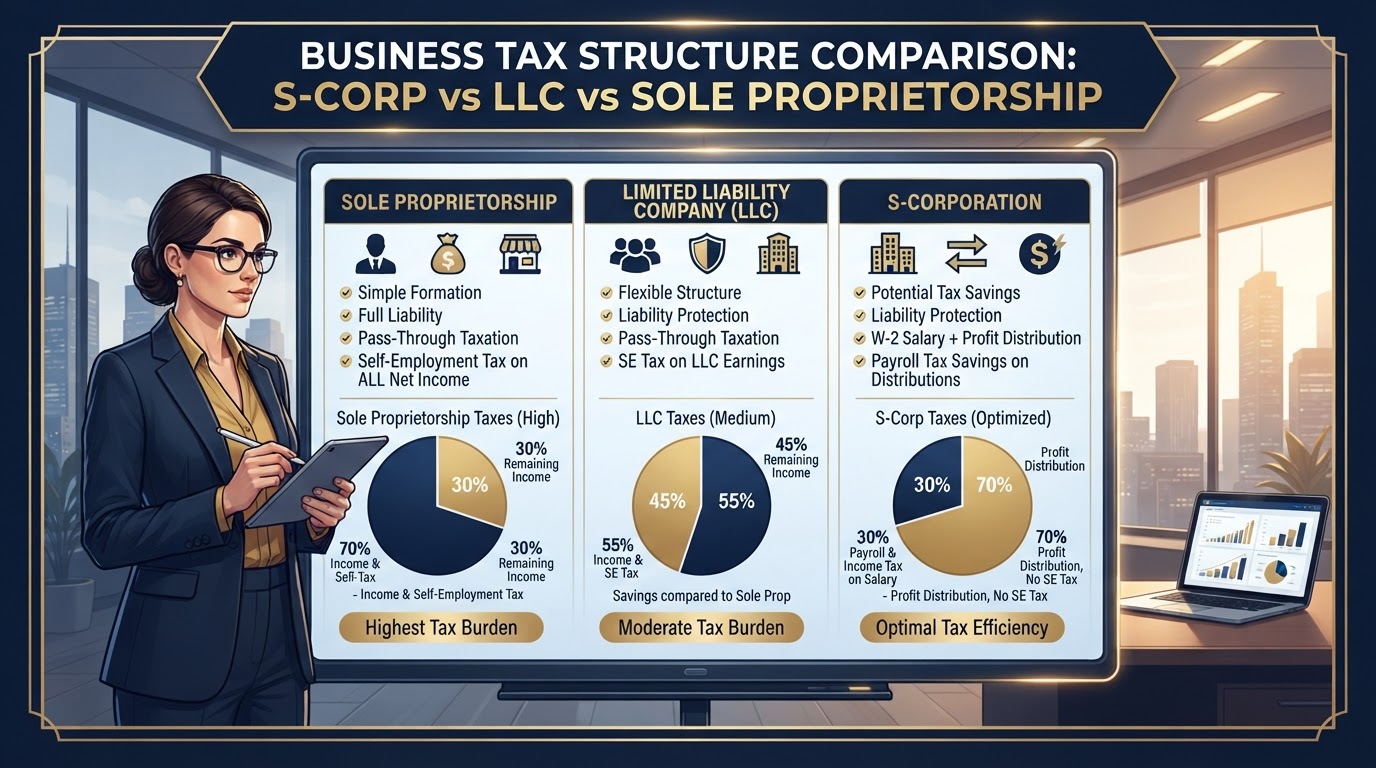
The state and local tax (SALT) deduction cap, which had been fixed at $10,000 since 2018, increased to $40,000 for 2025 and 2026. The cap then grows by 1% per year through 2029 before reverting to $10,000 in 2030. The benefit phases out for high earners: the $40,000 is reduced by 30 cents for every dollar of modified AGI above $500,000 (single) or $600,000 (joint) in 2025.
For business owners in California — a high-tax state — this is meaningful. A pass-through entity owner with $40,000 of property and state income taxes can now deduct the full amount (subject to the income phase-out), where previously $30,000 of that was lost. The pass-through entity tax (PTET) workaround that many states, including California, adopted to bypass the old $10,000 cap is preserved under the OBBBA, so electing entities can still deduct entity-level state taxes in full.
The interaction between the higher SALT cap and the PTET election is worth understanding. For a California S-Corp or partnership owner, the PTET election allows the entity to pay state tax at the entity level, which is fully deductible for federal purposes with no SALT cap. The owner then receives a credit on their California return for their share of the entity-level tax. With the SALT cap raised to $40,000, some owners may find that a portion of their personal state taxes now fits under the cap, while the PTET still handles the overflow. The optimal structure depends on the owner's total tax picture, and it is one of the decisions we model for California clients every year.

Worked example. A married California business owner with $450,000 of modified AGI pays $28,000 in state income tax and $12,000 in property tax — $40,000 total. Under the old $10,000 cap, $30,000 of that deduction was lost. Under the new $40,000 cap (and assuming the owner is below the $600,000 joint phase-out), the full $40,000 is deductible. At a 32% marginal rate, that is roughly $9,600 in additional federal tax saved compared to the old cap — every year the higher cap is in effect.
5. No Tax on Tips and No Tax on Overtime (2025–2028)
Two of the most publicized provisions are temporary deductions running from 2025 through 2028. Workers in occupations that customarily and regularly received tips before 2025 can deduct up to $25,000 of qualified tip income per return. Workers who receive FLSA-required overtime can deduct up to $12,500 of overtime compensation ($25,000 for joint filers). Both phase out beginning at $150,000 modified AGI ($300,000 joint).

For business owners, the operational impact is real. Employers and payors must file new information returns and furnish statements showing cash tips and qualified overtime paid during the year. The IRS is publishing the list of tip-eligible occupations and providing transition relief for 2025. If you run a restaurant, a salon, a valet operation, or any business with tipped or overtime-heavy staff, your payroll reporting workflow needs to be updated to capture and report these amounts correctly — otherwise your employees lose the deduction and you face reporting exposure.
There are subtleties that the headlines skip. The tip deduction applies only to tips received in occupations that customarily and regularly received tips before 2025 — meaning a business that newly adds tipping in 2026 does not qualify its workers. The overtime deduction applies only to FLSA-required overtime, not to premium pay offered voluntarily by the employer outside of FLSA rules. Both deductions are above-the-line, meaning they reduce adjusted gross income, which can have downstream effects on other tax benefits that are tied to AGI thresholds.

Worked example. A restaurant server earning $35,000 in base wages and $18,000 in reported tips would, under the new provision, be able to deduct the full $18,000 of tip income (below the $25,000 cap). At a 12% marginal rate, that is roughly $2,160 in federal tax saved. For the employer, the key action is ensuring the payroll system separately tracks and reports cash tips so the employee can substantiate the deduction. A payroll system that lumps tips into general wages makes this impossible.
6. The Estate and Gift Tax Exemption Rose to $15 Million
Beginning in 2026, the estate and lifetime gift tax exemption increases to $15 million per individual and $30 million per married couple, indexed for inflation, and the increase is permanent. The 2025 exemption remains $13.99 million per person. This prevents the roughly halving of the exemption that was scheduled to occur and gives business owners and real estate investors more room to transfer wealth to heirs free of estate tax.
For most small business owners, the estate tax itself will never apply — their estates will be well under the exemption. But the permanence of the higher exemption matters for planning. It means that strategies like gifting ownership interests in a business, setting up trusts, or using valuation discounts can be pursued without the urgency of a sunset. It also means that business owners who were holding off on succession planning because of the scheduled drop can now plan with confidence.


Worked example. A married couple owning a construction business valued at $22 million can now pass the entire business to their children free of estate tax using their combined $30 million exemption, with no need for life insurance funding to cover an estate tax liability. Under the scheduled sunset, the exemption would have dropped to roughly $7 million per person ($14 million combined), exposing $8 million of the business value to a 40% estate tax — a potential $3.2 million liability that is now eliminated.
7. Other Provisions Worth Knowing
- Child Tax Credit — permanently increased to $2,200 per qualifying child under 17, with the $1,400 refundable portion made permanent and inflation-adjusted.
- Senior deduction — a temporary additional $6,000 deduction for taxpayers 65 and older, phasing out at $75,000 (single) and $150,000 (joint).
- Standard deduction — the near-doubling from the TCJA is made permanent.
- Business interest limitation (Section 163(j)) — adjusted to allow more interest deductibility for businesses with high depreciation or amortization.
- QSBS exclusion — the Section 1202 qualified small business stock exclusion is preserved and enhanced.
- Manufacturing deductions (Section 199) — retained in modified form for certain domestic production activities.
How the Provisions Stack: The Real Opportunity
The single most important concept in this guide is that the OBBBA provisions are not independent — they stack. A business owner who qualifies for the QBI deduction, buys equipment eligible for bonus depreciation or Section 179, operates in a high-tax state with the raised SALT cap, and has employees who work overtime can capture all of these benefits in the same tax year. The combined effect is often far larger than any single provision in isolation.
But stacking is also where the planning gets hard. Each provision has its own rules about what income qualifies, what documentation is required, and how the benefit is calculated. Bonus depreciation reduces QBI (because it reduces business income), which can reduce the QBI deduction — meaning an aggressive equipment purchase can partially offset itself through the QBI interaction. The SALT cap interacts with the PTET election. The tip and overtime deductions affect AGI, which can affect other phase-outs. Understanding these interactions is the difference between capturing the full benefit and accidentally undermining it.
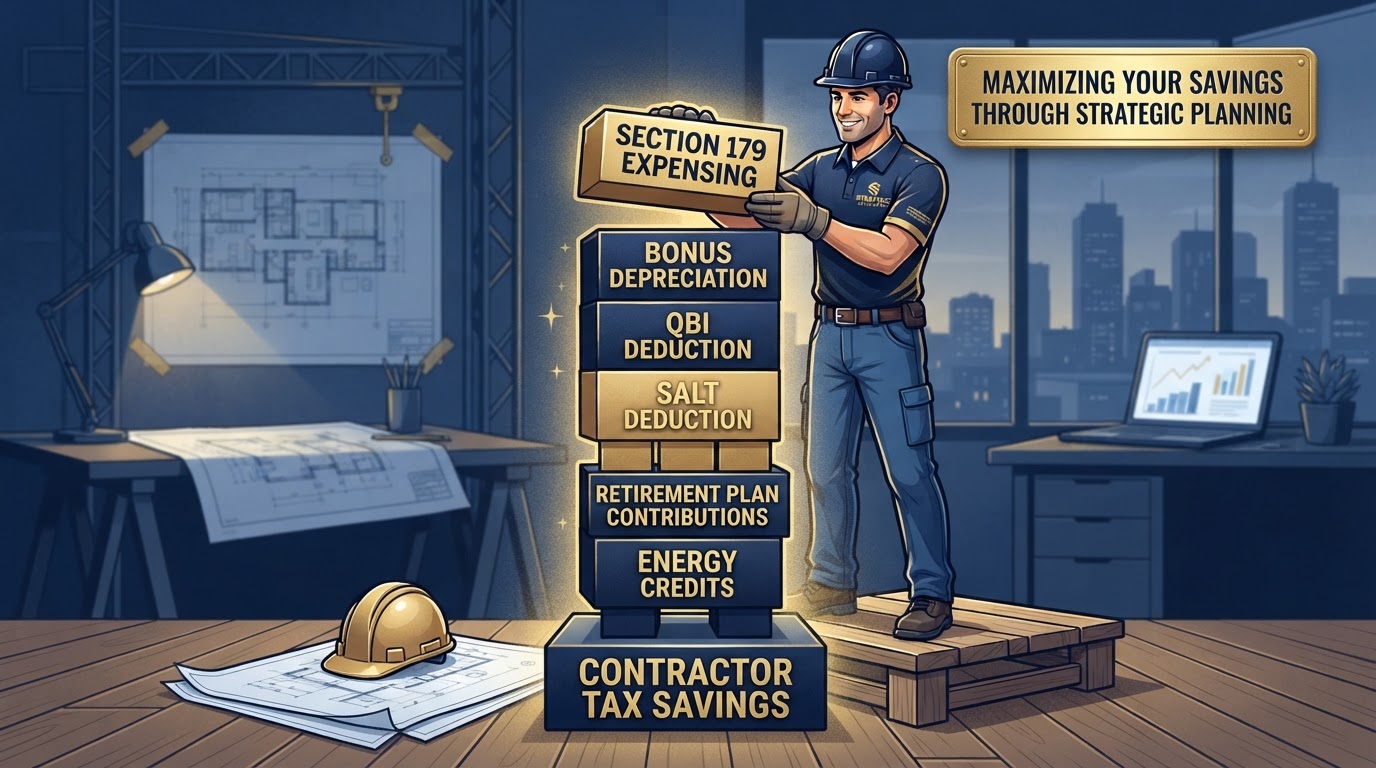
This is why we model scenarios rather than apply rules one at a time. For a client considering an equipment purchase, we run the numbers with and without bonus depreciation, with and without Section 179, at different reasonable salary levels, and with the PTET election on and off. The output is not a single number — it is a matrix that shows which combination produces the best after-tax result. That kind of modeling is only possible when the books are clean, current, and structured to support it.
FIG Case Study: Stacking the OBBBA Provisions for a Southern California Contractor
A general contracting client in Los Angeles County came to Fiscal Integrity Group in the fall of 2025 with a common problem: a strong revenue year, a large equipment purchase planned, and no strategy for how the new OBBBA provisions fit together. The owner operated as an S-Corporation, had two employees who regularly worked overtime, and was preparing to acquire two service trucks and a piece of heavy equipment before year-end.
We rebuilt the plan around the new law. First, we confirmed the business qualified for the full 20% QBI deduction under the expanded thresholds, since the owner's taxable income fell below the new phase-in limits. Second, we modeled the equipment purchase against both Section 179 and 100% bonus depreciation and elected Section 179 on the specific assets that kept the deduction within taxable income, then applied bonus depreciation to the remainder. Third, we updated the payroll workflow so that the two employees' overtime was tracked and reported in the format required for the new overtime deduction, protecting their benefit and the employer's reporting compliance.
Fourth, we reviewed the California PTET election. Because the owner's state tax liability exceeded the new $40,000 SALT cap, we confirmed the entity-level election was still the right move for the portion of state tax above the cap, while the owner could now deduct up to $40,000 of personal state and property taxes directly. Fifth, we confirmed the owner's reasonable salary was still defensible given the new QBI thresholds — a salary that is too low relative to distributions invites IRS scrutiny, and one that is too high reduces QBI unnecessarily.
The combined result: the owner captured the full QBI deduction, expensed the equipment in the year of purchase instead of spreading it over five to seven years, and put the employees in a position to claim the overtime deduction on their personal returns. The books were structured so that each provision was documented independently — QBI-eligible income separated, Section 179 elections filed, overtime coded to the correct payroll category — so that nothing was lost to a reporting error. The estimated combined federal tax benefit across all provisions was in the range of $45,000 to $60,000 for the year, depending on final income figures.
The point of this case study is not the dollar figure — every business is different — but the process. None of these provisions were claimed in isolation. Each one was modeled against the others, and the elections were coordinated so that capturing one benefit did not undermine another. That coordination is the work, and it is work that has to happen before the year closes. After December 31, most of these decisions are locked.
What This Means for Your Bookkeeping and Tax Planning
The OBBBA creates opportunity, but only for businesses whose books can actually support the claims. Bonus depreciation requires correctly identifying and placing assets in service with the right date. The QBI deduction requires clean separation of qualified business income from non-qualified income, SSTB classification, and W-2 wage tracking. The tips and overtime deductions require payroll systems that capture and report the right fields. None of this works if the underlying bookkeeping is sloppy, miscategorized, or months behind.
This is where most of the value of the OBBBA is actually won or lost. The law gives you the deduction; your books determine whether you can prove you qualify. A business with clean, current, properly categorized books can layer these provisions together and capture the full benefit. A business with messy books often discovers the opportunity too late — after the year has closed, after the assets have been placed in service without the right documentation, after the payroll was reported in the wrong format.
Consider the documentation chain for a single equipment purchase. To claim bonus depreciation, you need the purchase date, the in-service date, the cost basis, the asset classification, and the election itself. To claim Section 179 instead, you need all of that plus an asset-by-asset election. To know which one is better, you need to know the business's taxable income before the deduction, which requires current books. To know whether the deduction reduces QBI in a way that matters, you need to know the owner's total income picture. Each link in that chain depends on the one before it, and a break anywhere — a missing invoice, a miscategorized asset, a bookkeeping lag — can cost the entire benefit.
The same is true for payroll. The tip and overtime deductions require payroll systems that separately track and report qualified tip income and FLSA overtime. If your payroll provider lumps these into general wages, or if your books do not separate them, the deductions cannot be substantiated. Updating payroll workflows is not a year-end task — it has to be set up before the first pay period of the year, because the reporting is cumulative.
How Different Industries Are Affected
The OBBBA does not affect every business the same way. The mix of provisions that matters depends on the industry, the entity structure, and the owner's income level. Below is a quick guide to which provisions matter most for the industries we serve most often.
- Construction and contracting — bonus depreciation and Section 179 are the headline provisions, given the constant equipment purchases. QBI and the SALT/PTET interaction matter for profitable owners. Overtime reporting matters for crews.
- Real estate investors — the restoration of 100% bonus depreciation supercharges cost segregation studies. The higher estate exemption helps with succession planning for portfolios. The SALT cap increase helps owners with significant property tax exposure.
- Restaurants and hospitality — the no-tax-on-tips deduction is the biggest change, and it requires payroll system updates. Bonus depreciation applies to build-outs and fixtures. QBI applies to profitable operators.
- Trucking and logistics — equipment purchases (trucks, trailers) are the main bonus depreciation and Section 179 targets. Per diem and overtime rules interact with the new deductions.
- Medical and healthcare practices — SSTB classification means QBI phase-outs are the central concern. The raised thresholds help, but high-earning practitioners still need to plan around the phase-out. The SALT cap and PTET election are especially valuable here.
- Manufacturing — large equipment purchases make Section 179 and bonus depreciation the dominant provisions. The raised Section 179 limit to $2.5 million is particularly relevant.
How Fiscal Integrity Group Helps You Capture the Full Benefit
We help Southern California businesses structure their books and their timing around the OBBBA provisions so that every deduction the law allows is actually captured. That means clean monthly bookkeeping, properly categorized asset purchases, payroll workflows that report tips and overtime correctly, and year-end planning that models QBI, Section 179, and bonus depreciation together before decisions are finalized.
Our process is built around the idea that tax benefits are won through bookkeeping, not just tax filing. We maintain books that are current enough to support mid-year planning, structured so that QBI-eligible income is separable, asset purchases are documented to the date, and payroll categories match what the new reporting requires. When year-end arrives, the decisions are already modeled — we are not reconstructing nine months of transactions in December to figure out whether an equipment purchase makes sense.
If you want a clear picture of how the One Big Beautiful Bill Act changes your tax position for 2025 and beyond, we will review your books, identify which provisions apply to your business, and build a plan to capture them — before the year closes and the opportunities harden into missed deadlines.
The Law Passed. Your Books Decide Whether You Benefit.
The One Big Beautiful Bill Act is the most significant tax change most businesses will see this decade. It made the QBI deduction permanent, restored 100% bonus depreciation, doubled Section 179, raised the SALT cap, added deductions for tips and overtime, and lifted the estate exemption to $15 million. Each of these is a real, measurable benefit — but each one depends on books that are clean, current, and structured to support the claim. The businesses that capture the full benefit will be the ones whose bookkeeping was ready for it.
The provisions are permanent where it matters most, but several are temporary and several phase out at income levels that many successful business owners will reach. The window to act is now — while the benefits are available, while the year is still open, and while the decisions that determine your tax outcome can still be changed. The businesses that plan ahead will capture the full stack. The ones that wait will read about what they missed.
Quick Tax Savings Estimator
See how much you could potentially save with proactive tax strategy and clean bookkeeping. Most LA businesses overpay by 15-20% simply due to missed deductions.
Free IRS Audit Risk Assessment
Do you mix personal and business expenses in the same bank account?
Frequently Asked Questions
How far back can you catch errors?
I perform a deep forensic review of your history to catch errors and fix them. Whether it's one year or five, my goal is to ensure your historical data is pristine before we move forward.
Will you educate me on how to manage my books?
Yes! My approach is highly educational. I want you to understand the "why" behind the numbers so you can make better business decisions with confidence.

About the Author
Wiyao Awesso
Wiyao Awesso is a leading financial advisor in Los Angeles. With extensive experience in tax strategy, accounting, and fractional CFO services, he helps business owners optimize their finances, minimize tax liabilities, and scale with confidence.