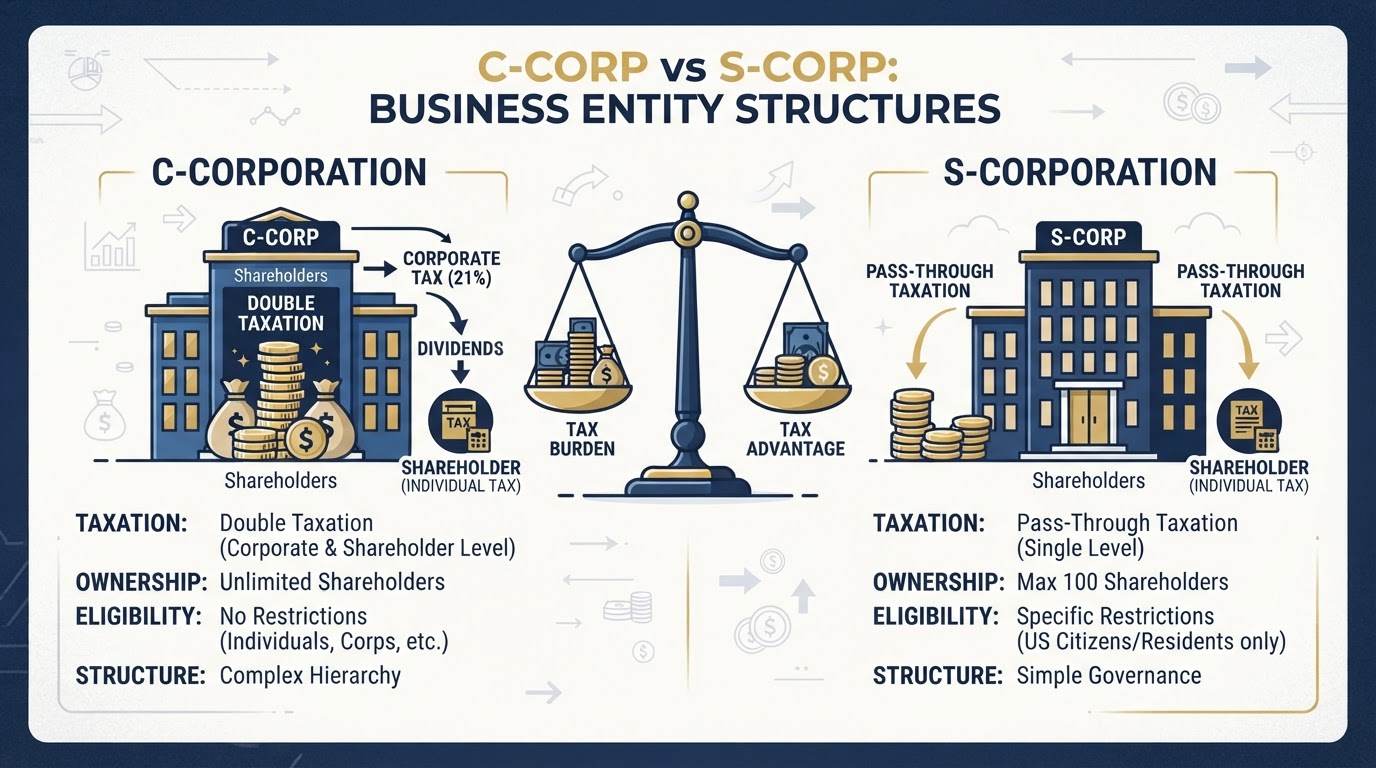
Estate planning is not just for the ultra-wealthy. It is a critical component of any comprehensive financial plan, ensuring that your assets are distributed according to your wishes while minimizing the tax burden on your beneficiaries. Without proper planning, your estate could be subject to lengthy probate processes and significant federal and state estate taxes.

This guide covers the fundamental tools of estate planning, including wills, living trusts, irrevocable trusts, and powers of attorney. We also explore advanced strategies for high-net-worth individuals, such as Family Limited Partnerships (FLPs), Grantor Retained Annuity Trusts (GRATs), and Charitable Remainder Trusts (CRTs). By taking proactive steps today, you can protect your legacy and provide for your loved ones efficiently.
Understanding the Federal Estate Tax Exemption
The federal estate tax applies to the transfer of your estate at death, but only the portion above the exemption amount is taxed. For 2025, the exemption is approximately $13.99 million per individual, or roughly $27.98 million per married couple. Estates below these thresholds owe no federal estate tax. However, the exemption is scheduled to revert to roughly $7 million per individual at the end of 2025 unless Congress acts — which makes proactive planning urgent for anyone whose estate approaches either threshold.
Married couples can use portability to transfer any unused exemption to the surviving spouse, effectively doubling the shield. But portability requires a timely filed estate tax return, and it does not protect against growth in asset value or state-level estate taxes. We model whether your estate is exposed and which strategies close the gap.

- 2025 exemption: ~$13.99M per individual, ~$27.98M per couple
- Scheduled to revert to ~$7M per individual after 2025
- Portability lets a surviving spouse use the deceased spouse's unused exemption
Revocable vs. Irrevocable Trusts
A revocable living trust lets you retain control of your assets during your lifetime, change the terms at any time, and avoid probate at death. It does not, however, remove assets from your taxable estate — they are still subject to estate tax. An irrevocable trust, by contrast, removes assets from your estate entirely, which can provide estate tax savings and asset protection, but you give up control and the ability to change the terms.
The choice depends on your goals: probate avoidance and flexibility favor a revocable trust; estate tax reduction and creditor protection favor an irrevocable trust. Many plans use both — a revocable trust for day-to-day management and probate avoidance, and one or more irrevocable trusts for tax and protection strategies.
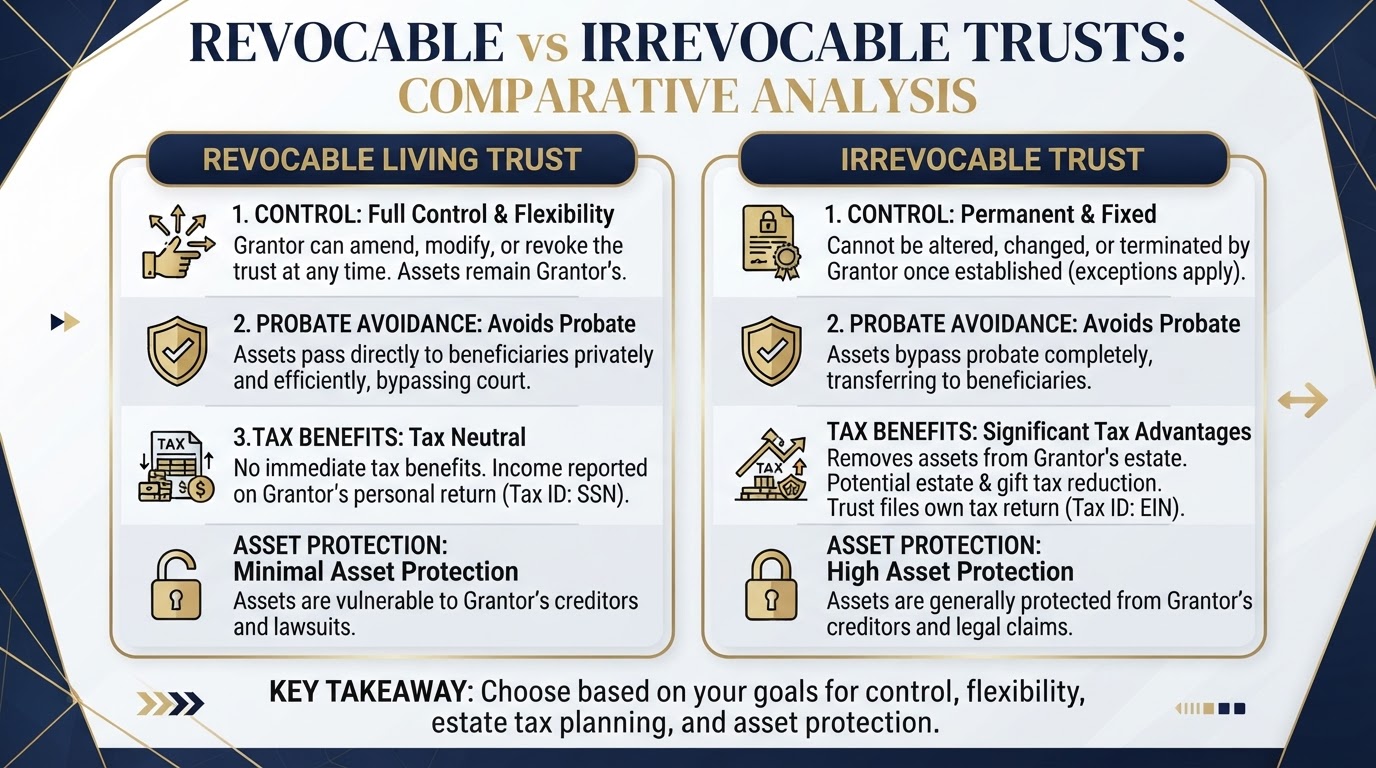
- Revocable trust: control retained, avoids probate, still in taxable estate
- Irrevocable trust: removes assets from estate, provides asset protection
- Many plans use both for different goals
Gifting Strategies to Reduce Estate Size
The annual gift exclusion lets you give up to $19,000 per recipient per year (2025) without using any of your lifetime exemption. A married couple can jointly gift $38,000 per recipient. Over a decade, a couple with three children and their spouses can transfer over $1 million out of their estate through annual exclusion gifts alone — plus any future appreciation on those assets.
Beyond the annual exclusion, you can pay unlimited amounts directly to educational institutions and medical providers on behalf of anyone without using your exemption. Strategic gifting of appreciating assets early multiplies the estate tax savings, because the growth occurs outside your estate.

- Annual gift exclusion: $19,000 per recipient (2025), $38,000 per couple
- Unlimited direct payments for education and medical expenses
- Gift appreciating assets early to remove growth from the estate
Family Limited Partnerships (FLPs)
A Family Limited Partnership lets you transfer interests in a family business or investment assets to the next generation at a discounted valuation. Because limited partnership interests lack marketability and control, they qualify for valuation discounts — often 25% to 40% below pro-rata value. This means you can transfer more wealth using less of your lifetime exemption.
The FLP also centralizes management with the general partner (you), provides creditor protection, and allows for orderly succession. The IRS scrutinizes FLPs closely, so the structure must have a legitimate business purpose and be properly funded and operated. We work with your attorney to ensure the FLP is defensible.
- Transfer interests at discounted valuations (often 25-40% below pro-rata)
- Centralize management with the general partner and protect from creditors
- Requires a legitimate business purpose and proper operation
Charitable Giving & Tax Benefits
Charitable giving strategies serve dual purposes: they support causes you care about and they reduce your taxable estate. A Charitable Remainder Trust (CRT) lets you transfer appreciated assets to a trust, receive an income stream for life, take an immediate partial deduction, and remove the asset from your estate — all while avoiding capital gains tax on the appreciated asset. A Donor-Advised Fund offers a simpler vehicle for bunching charitable deductions.
The right vehicle depends on your income, the assets you hold, and your charitable intent. We model the deduction, the income stream, and the estate tax impact so you can see exactly what each strategy delivers.
- Charitable Remainder Trust: income stream, deduction, removes asset from estate
- Donor-Advised Fund: simpler vehicle for bunching charitable deductions
- Avoid capital gains tax on appreciated assets transferred to charity
Business Succession Planning
For business owners, the business is often the largest asset in the estate — and the hardest to transfer. Succession planning addresses who takes over, how the transition is funded, and how the value is transferred with minimal tax. Tools include buy-sell agreements funded with life insurance, gifting of ownership interests over time, and installment sales to intentionally defective grantor trusts.
Without a succession plan, a business can be tied up in probate, valued by the IRS, or forced into a distressed sale. With a plan, the transition is orderly, the value is frozen or transferred efficiently, and the family's financial security is protected. We coordinate with your attorney and financial advisor to build the plan.
- Buy-sell agreements funded with life insurance to ensure liquidity
- Gift ownership interests over time to freeze or transfer value
- Without a plan, the business may be tied up in probate or distressed sale
Conclusion
Estate planning is the difference between a legacy that is preserved and one that is eroded by taxes, probate, and forced sales. The exemption is scheduled to drop, which makes the window to act now. Contact us to review your estate exposure and build a plan that protects what you have built.
Quick Tax Savings Estimator
See how much you could potentially save with proactive tax strategy and clean bookkeeping. Most LA businesses overpay by 15-20% simply due to missed deductions.
Free IRS Audit Risk Assessment
Do you mix personal and business expenses in the same bank account?
Frequently Asked Questions
How far back can you catch errors?
I perform a deep forensic review of your history to catch errors and fix them. Whether it's one year or five, my goal is to ensure your historical data is pristine before we move forward.
Will you educate me on how to manage my books?
Yes! My approach is highly educational. I want you to understand the "why" behind the numbers so you can make better business decisions with confidence.

About the Author
Wiyao Awesso
Wiyao Awesso is a leading financial advisor in Los Angeles. With extensive experience in tax strategy, accounting, and fractional CFO services, he helps business owners optimize their finances, minimize tax liabilities, and scale with confidence.