Selling a business is often the defining financial event of an entrepreneur's life. However, without careful tax planning, up to half of your hard-earned value could be lost to federal, state, and local taxes. A successful exit requires more than just finding a buyer; it requires structuring the transaction to maximize your after-tax proceeds.
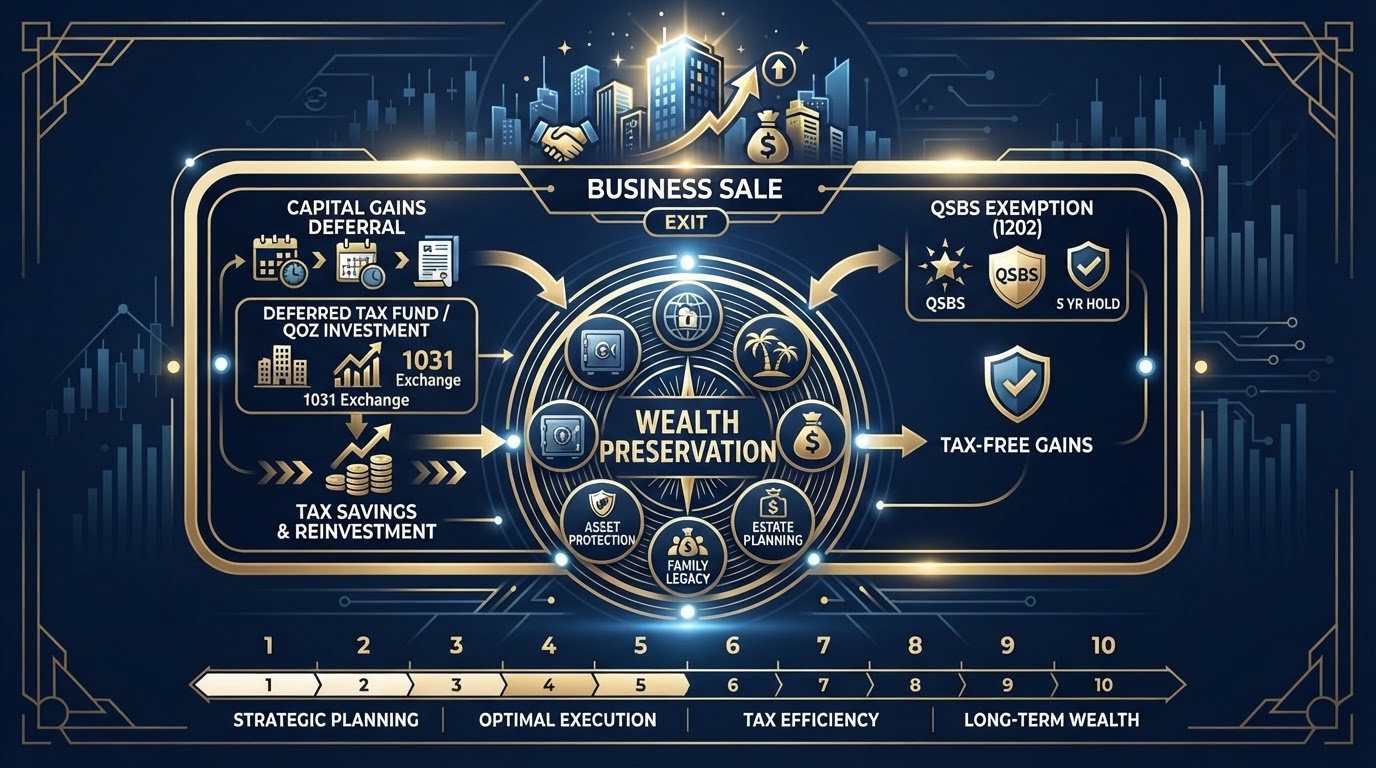
This guide explores the tax implications of different types of business sales, including asset sales vs. stock sales. We dive into advanced strategies for deferring or reducing capital gains taxes, such as Section 1202 Qualified Small Business Stock (QSBS), installment sales, and Charitable Remainder Trusts. Whether you plan to sell in two years or ten years, the strategies in this playbook will help you keep more of what you have built.
Asset Sale vs. Stock Sale: Tax Implications
The structure of the sale is the single largest determinant of your tax bill. In an asset sale, the buyer purchases the individual assets of the business, and the seller recognizes gain on each asset — often a mix of ordinary income (on inventory and depreciation recapture) and capital gains (on goodwill and equipment). In a stock sale, the buyer purchases the ownership interest, and the seller recognizes a single capital gain on the sale of the stock.
Buyers generally prefer asset sales because they get a step-up in basis and avoid inheriting liabilities. Sellers generally prefer stock sales for the single, lower-taxed capital gain. The negotiation over structure is often the most consequential part of the deal. We model the after-tax proceeds under each structure so you negotiate from a position of clarity.
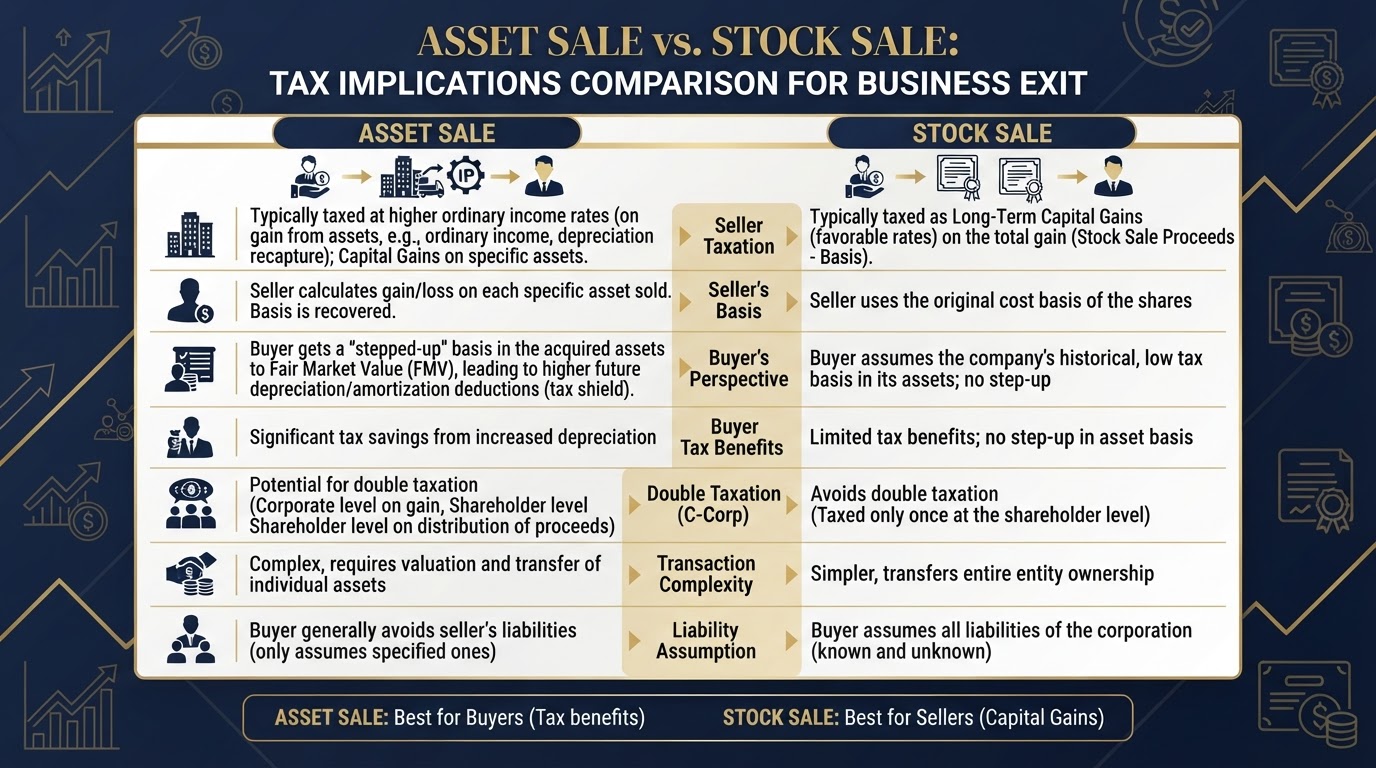
- Asset sale: gain on each asset, often a mix of ordinary and capital rates
- Stock sale: single capital gain on the sale of ownership
- Buyers prefer asset sales; sellers prefer stock sales — model both
Section 1202 (QSBS) Exemption
Section 1202 is the most powerful capital gains exclusion in the tax code for qualifying small business stock. If you hold C-Corporation stock acquired at original issuance from a qualifying small business (generally under $50 million gross assets) for more than five years, you can exclude up to $10 million or 10x your basis, whichever is greater, from federal capital gains tax on the sale. For many founders, this means the entire gain is tax-free.
The catch is that the business must be a C-Corp and must meet the active business requirement — a holding company or passive investment vehicle does not qualify. Planning for QSBS often begins years before a sale, sometimes with an entity restructuring. We assess whether your business can qualify and time the holding period to capture the exclusion.
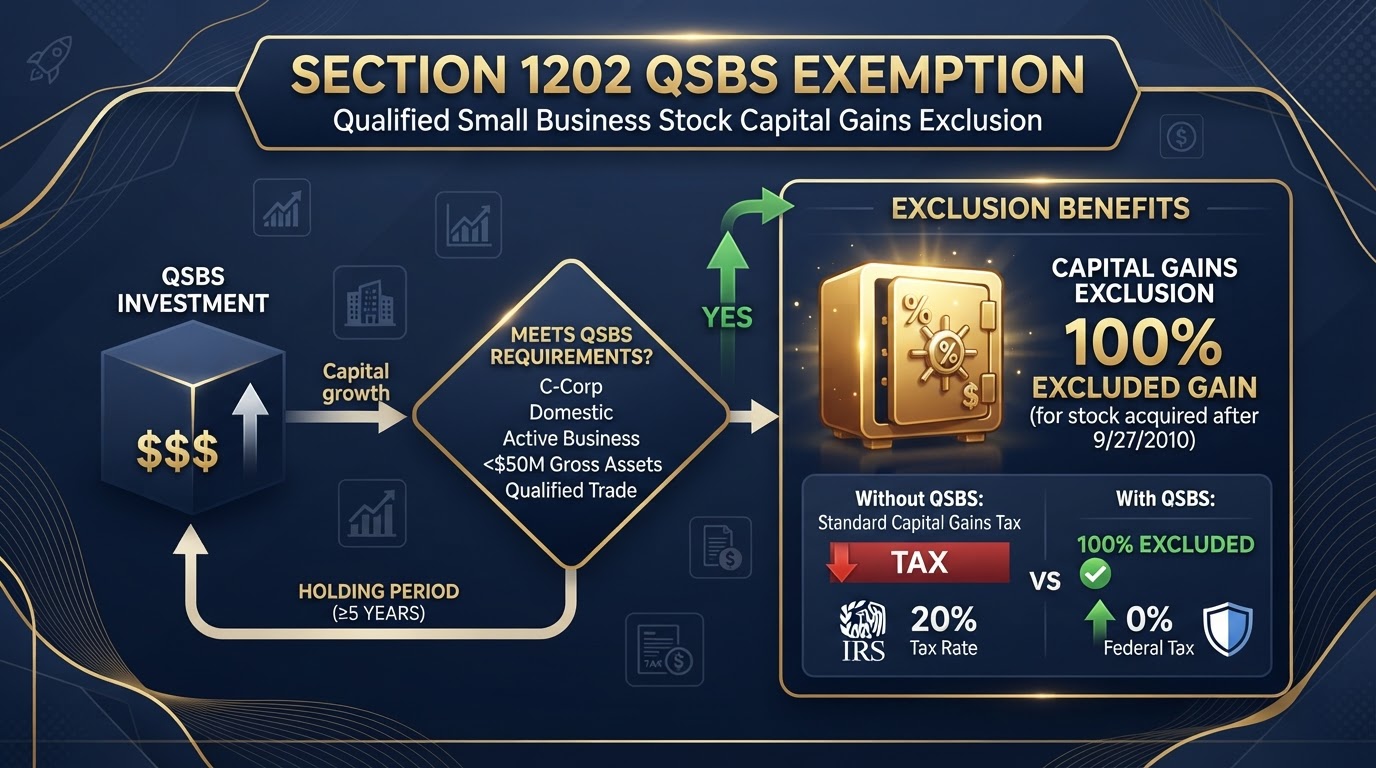
- Exclude up to $10M or 10x basis on qualifying C-Corp stock held 5+ years
- Must be acquired at original issuance from a qualifying small business
- Planning often begins years before the sale
Installment Sales and Tax Deferral
An installment sale spreads the recognition of gain over the years in which you receive payments, rather than recognizing the entire gain in the year of sale. This can keep you out of the top bracket in any single year and smooth the tax burden across multiple years. It is especially useful when the buyer cannot pay the full price upfront and when you want a stream of payments rather than a lump sum.
The risk is buyer default — if the buyer fails to make payments, you may have already recognized some gain without receiving the cash. We help structure the installment terms with adequate security, interest at the applicable federal rate, and protections that align with your risk tolerance.
- Spread gain recognition over the years you receive payments
- Avoid the top bracket in any single year
- Structure with security and adequate interest to manage default risk
Using Charitable Remainder Trusts (CRTs) in an Exit
A Charitable Remainder Trust can be a powerful exit-planning tool for highly appreciated businesses. You contribute the business interest to the CRT before the sale, the CRT sells the interest (paying no tax because it is a tax-exempt entity), and you receive an income stream for life. You also take an immediate charitable deduction for the present value of the remainder that will eventually go to charity.
The CRT defers the capital gains tax, provides income, and fulfills charitable intent — but it is irrevocable, and the principal ultimately passes to charity. It is best suited for owners with charitable intent who want to defer tax and create an income stream. We model the economics and coordinate with your attorney on the trust creation.
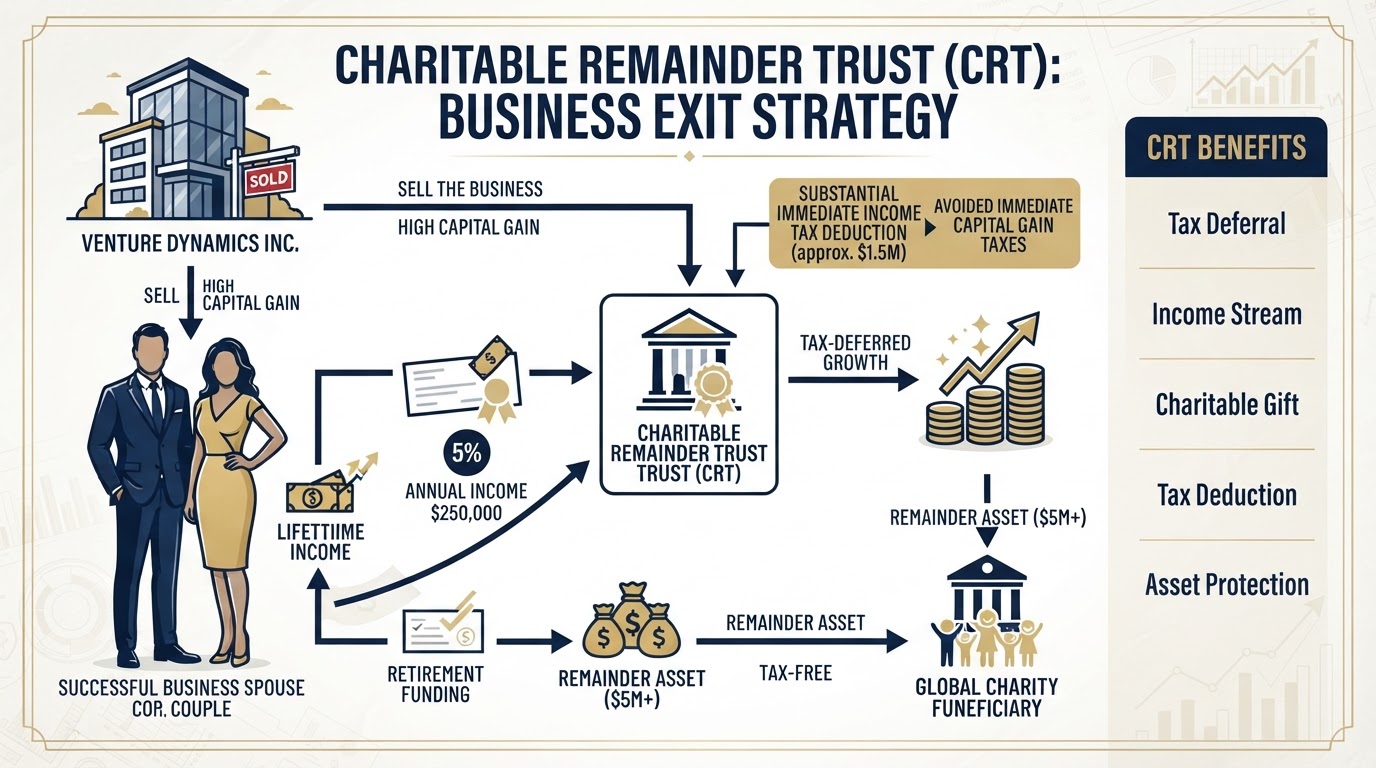
- Contribute the interest pre-sale; the CRT sells tax-free
- Receive an income stream for life plus an immediate charitable deduction
- Irrevocable — the remainder ultimately passes to charity
Allocating the Purchase Price
In an asset sale, the allocation of the purchase price among the various assets drives the tax outcome for both buyer and seller — and their interests are opposed. The buyer wants more value allocated to assets that produce faster deductions (inventory, equipment with depreciation). The seller wants more value allocated to capital-gain assets (goodwill, intangibles). The allocation must reflect the fair market value of each asset, but within that constraint there is room to negotiate.
We prepare the allocation analysis, model the after-tax result under different allocations, and help you negotiate a structure that is both defensible and tax-efficient. The allocation is reported on Form 8594 and must be consistent between buyer and seller.
- Allocation drives the tax outcome — buyer and seller interests are opposed
- Buyer wants faster-deducting assets; seller wants capital-gain assets
- Must reflect fair market value; reported consistently on Form 8594
Conclusion
A business sale without tax planning can surrender a large share of your life's work to taxes. The right structure — QSBS, installment sale, CRT, or a negotiated allocation — can preserve far more of the proceeds. The earlier you plan, the more options remain available. Contact us to model your after-tax proceeds under each strategy before you sign.
Quick Tax Savings Estimator
See how much you could potentially save with proactive tax strategy and clean bookkeeping. Most LA businesses overpay by 15-20% simply due to missed deductions.
Free IRS Audit Risk Assessment
Do you mix personal and business expenses in the same bank account?
Frequently Asked Questions
How far back can you catch errors?
I perform a deep forensic review of your history to catch errors and fix them. Whether it's one year or five, my goal is to ensure your historical data is pristine before we move forward.
Will you educate me on how to manage my books?
Yes! My approach is highly educational. I want you to understand the "why" behind the numbers so you can make better business decisions with confidence.

About the Author
Wiyao Awesso
Wiyao Awesso is a leading financial advisor in Los Angeles. With extensive experience in tax strategy, accounting, and fractional CFO services, he helps business owners optimize their finances, minimize tax liabilities, and scale with confidence.