When you first start a business, wearing every hat is a necessity. You are the CEO, the marketer, the janitor, and the bookkeeper.
But as your business grows, holding onto the bookkeeping reins becomes one of the most expensive mistakes you can make. While you might think you are saving money by not hiring a professional, the hidden costs of DIY bookkeeping are quietly draining your time, your profits, and your peace of mind.
Most business owners never sit down and calculate what DIY bookkeeping actually costs them. They see the monthly fee from a bookkeeping firm and compare it to zero — the cost of doing it themselves. But zero is an illusion. The real cost is buried in hours lost, deductions missed, errors compounded, and opportunities forfeited. By the time most owners realize it, the damage far exceeds what a professional would have charged.
In this article, I am going to walk through every hidden cost — the ones I have seen first-hand working with hundreds of business owners across Los Angeles and Southern California. Some of these costs are measurable in dollars. Others are measured in stress, sleepless nights, and stalled growth. All of them are avoidable.

1. The Time Trap
Let us start with the most obvious cost, because it is the one most people acknowledge but still underestimate.
Calculate your hourly rate as a CEO. If you generate $200,000 in annual revenue and you work 2,000 hours a year, your time is worth $100 per hour. Now multiply that by the 10 to 15 hours a month you spend wrestling with QuickBooks, chasing down receipts, and trying to reconcile accounts that never seem to balance. That is $1,000 to $1,500 per month — $12,000 to $18,000 per year — spent on bookkeeping that a professional could handle for a fraction of the cost.
But the real cost is not just the dollar value of your time. It is the opportunity cost. Every hour you spend categorizing expenses is an hour you are not spending on sales calls, client relationships, product development, or strategic planning. It is an hour you are not growing your business.
I have worked with owners who spent entire Saturdays — eight, ten, twelve hours — trying to get their books in order for tax season. Saturdays that could have been spent with family, or on the golf course, or simply resting. The cost of that lost weekend is impossible to measure in dollars, but every business owner I have spoken to feels it.
A professional bookkeeper can do in two hours what takes you fifteen. Not because they are smarter, but because they have the training, the systems, and the daily practice that makes reconciliation second nature. They are not learning on your dime. They are executing on day one.
There is also the ramp-up cost. Every time you sit down to do your books, you have to remember where you left off, re-orient yourself to the software, and figure out what still needs to be done. A professional picks up exactly where they left off because they were there yesterday. You are starting cold every time. That context switching alone can double the time it takes.
2. Costly Categorization Errors
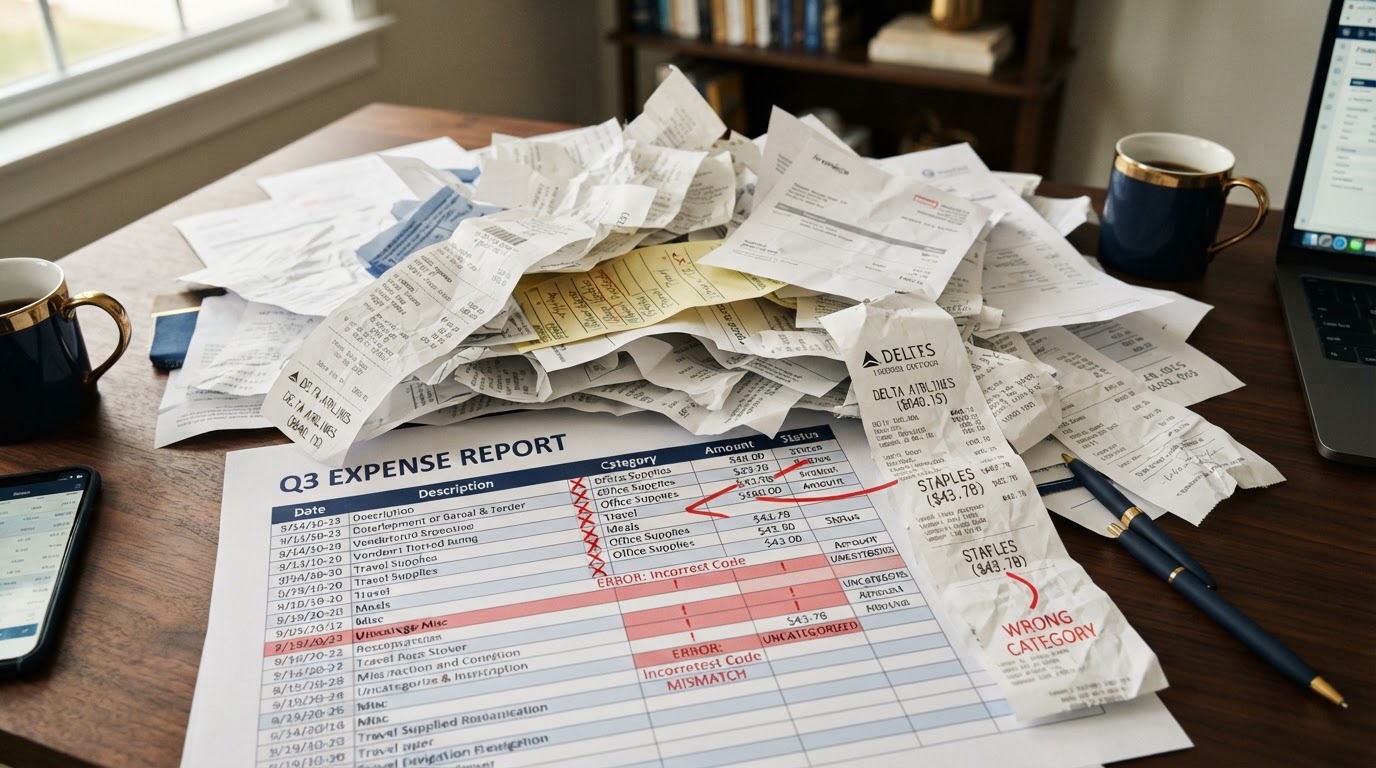
Putting expenses in the wrong category does not just make your reports look messy. It distorts your financial reality and can trigger IRS red flags.
Here is a scenario I see constantly: an owner buys a $5,000 piece of equipment and categorizes it as an office expense instead of a fixed asset. On the surface, it looks like a minor bookkeeping mistake. But the consequences cascade. The expense inflates the current year's deductions artificially (which the IRS can flag as an irregularity), the asset never gets depreciated properly, and when it is eventually sold, there is no accurate cost basis to calculate gain or loss. What started as a five-second mistake becomes a multi-thousand-dollar cleanup project.
Misclassifying an asset as an expense, or commingling personal and business funds, creates a tangled web that will eventually cost thousands to clean up. And the longer it goes on, the worse it gets. A single misclassification in January that goes uncorrected all year means twelve months of built-up errors that all have to be untangled at once — usually in March, when your CPA is already drowning in tax returns and charging premium rates for the privilege.
Then there is the issue of consistency. If you categorize advertising one way in March and another way in July, your year-end reports are meaningless. You cannot compare quarter to quarter. You cannot identify trends. You cannot make decisions based on data that is inconsistent. And if you ever need to produce financials for a lender, an investor, or a buyer, inconsistent categorization is the first thing they will flag.
I have seen cleanups that took forty, sixty, even eighty hours to untangle — all because the owner spent a year making small categorization errors that compounded month after month. At a CPA's hourly rate, that cleanup alone cost more than a full year of professional bookkeeping would have.
3. Missed Tax Deductions
If you are not a tax professional, you are almost certainly leaving money on the table.
The tax code is not a single document — it is an interconnected web of rules, exceptions, phase-outs, and timing requirements. A deduction that is perfectly valid one year may be useless the next because your income crossed a threshold. A credit that could save you thousands requires documentation that must be maintained throughout the year, not gathered retroactively in April.
Here are just a few deductions that DIY bookkeepers routinely miss:
- Home office deduction: Many owners are afraid to claim it because they heard it is a red flag. It is not, when done correctly. The simplified method alone can save $1,500 or more per year.
- Vehicle expenses: If you are tracking mileage manually and inconsistently, you are almost certainly undercounting. The difference between actual expenses and the standard mileage rate can be thousands of dollars, and the wrong choice costs you every year.
- Section 179 and bonus depreciation: Timing matters. Buying equipment in December versus January can shift an entire deduction from one tax year to the next. Without proactive planning, you miss the window.
- Startup costs: Many first-year deductions for organizational costs, startup expenses, and pre-opening costs go unclaimed because owners do not know they exist.
- Retirement contributions: A SEP-IRA or solo 401(k) can shelter tens of thousands of dollars from taxes while building retirement security. But it requires setting up the account and making the contribution before the deadline — not something you figure out at 11 PM on tax day.
A professional bookkeeper ensures every deductible expense is properly tracked and categorized throughout the year, so when tax season arrives, you maximize your savings without scrambling for receipts. They also flag purchases that have tax implications — a new vehicle, an equipment purchase, a real estate transaction — so you can make informed decisions about timing before the window closes.
I have never met a DIY bookkeeper who was capturing all of these. Not because they are not smart, but because the tax code rewards specialization. The person who does this every day, for hundreds of clients, sees patterns and opportunities that a once-a-month dabbler simply cannot.

4. Late Fees and Cash Flow Crises
When your books are not current, you are flying blind. You do not know exactly how much cash you have. You do not know which invoices are outstanding. You do not know which bills are due this week versus next week.
This creates a predictable cascade of problems. You miss a vendor payment and get hit with a late fee. You forget to follow up on an overdue invoice and a client takes sixty extra days to pay. You do not realize a supplier raised prices until three months later when you finally reconcile. Each of these is a small leak — but together, they add up to real money.
The cash flow crisis is worse. Without current books, you cannot forecast. You cannot see that a gap is coming in two months when your big client's payment arrives late. You cannot plan for the quarterly tax payment that is always larger than you expected. So you end up scrambling — drawing on a line of credit, delaying payments, or worse, missing payroll.
A professional bookkeeper keeps your books current every month. They flag overdue invoices. They project cash flow. They give you a dashboard so you always know exactly where you stand. The difference between flying blind and flying with instruments is the difference between a business that survives a downturn and one that does not.
5. The Audit Risk Nobody Talks About
Here is something most business owners do not realize: the IRS does not audit you just because they suspect fraud. They audit you because something on your return looks irregular — and DIY bookkeeping is a factory for irregularities.
Round numbers on your Schedule C. Expenses that jump 40% from one year to the next with no explanation. A home office deduction that does not match your business address. Meals and entertainment that look like personal spending. Any of these can trigger a correspondence audit — a letter from the IRS asking you to prove specific deductions.
When that letter arrives, what do you have? If you did your own books, you probably have a shoebox of receipts, a few screenshots of bank transactions, and a vague memory of what you spent money on. The IRS does not accept vague memory. They want documentation — receipts, mileage logs, invoices, and contemporaneous records.
A professional bookkeeper builds that documentation every month. Every transaction is categorized with a clear audit trail. Every receipt is attached. Every mileage entry is logged. If the IRS comes knocking, you hand them a binder and they go away. If you did it yourself, you spend weeks reconstructing what happened two years ago, pay a CPA to represent you, and hope for the best.
The cost of an audit — even one that finds nothing wrong — can easily exceed $5,000 in CPA fees, plus dozens of hours of your time. Clean, professional bookkeeping is the cheapest audit defense money can buy.
6. Financial Blind Spots
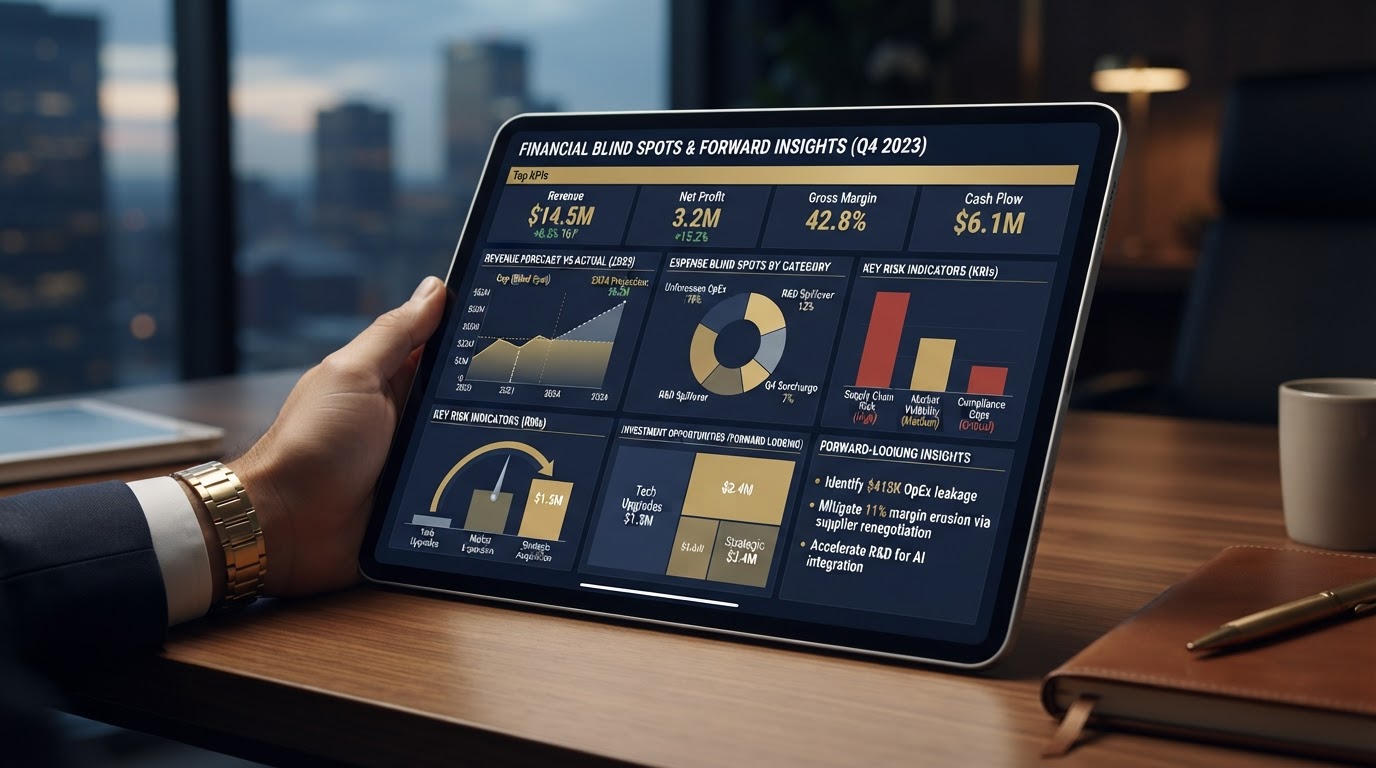
DIY bookkeeping usually means you are only looking backward — recording what already happened. You miss the forward-looking insights.
A professional does not just reconcile accounts. They provide dashboards, cash flow forecasts, and strategic advice to help you navigate the future. They notice when your gross margin is slipping before it becomes a problem. They flag when a particular product line is losing money. They identify when your customer acquisition cost is rising so you can adjust before it eats your profit.
Without those insights, you are driving with the rearview mirror as your only guide. You know what happened last month, but you have no idea what is about to happen next month. You react instead of plan. You scramble instead of strategize.
I worked with a contractor who had been doing his own books for three years. His revenue was growing, but his profit was flat. When we cleaned up his books and built a proper P&L by job, the problem was immediately visible: two of his project types were losing money on every single job. He had been subsidizing them with profits from the other jobs and never knew it. Three years of working harder and not getting further — all because his books did not show him the truth.
That is what financial blind spots cost you. Not just money — years of effort in the wrong direction.
7. The Mental Toll
There is one cost that does not show up on any invoice, but every business owner feels it: the mental weight of knowing your books are not right.
It is the nagging feeling when a vendor asks for financials and you are not sure they will hold up. It is the anxiety when tax season approaches and you know you have not reconciled since August. It is the dread of opening QuickBooks because you know you will find something you do not understand.
That stress accumulates. It affects your sleep. It affects your decision-making. It makes you tentative about investments and growth because you do not have confidence in your numbers. And here is the thing — confident numbers are the foundation of every bold business decision. Without them, you play small.
When you hand your books to a professional, that weight lifts. You stop worrying about whether the numbers are right. You start using them — to plan, to invest, to grow. The relief is immediate and transformative. I have had clients tell me they slept better the first week after we took over their books than they had in years.
You cannot put a price on peace of mind. But if you could, it would be less than what you are paying in stress and lost opportunity to do your own books.
8. What It Actually Costs You
Let us add it up. Here is what a typical DIY bookkeeping situation costs a small business owner over the course of a year:
- Time value: 12-15 hours per month at your effective rate of $100/hr = $14,400-$18,000
- Missed deductions: $2,000-$5,000 conservatively, often more
- Year-end cleanup by CPA: $1,500-$4,000 for untangling a year of mess
- Late fees and lost discounts: $500-$2,000
- Opportunity cost of no forecasting: immeasurable, but easily the largest line item
That is $18,000 to $29,000 or more — every single year. And that is before you factor in the cost of an audit, a denied loan because your financials were a mess, or the growth you did not pursue because you did not trust your numbers.
A professional bookkeeper costs a fraction of that. The Starter plan for new businesses and sole proprietors is $149 per month — $1,788 per year. Even the most comprehensive plans come in well under the cost of doing it yourself.
The math is not complicated. The question is not whether you can afford professional bookkeeping. The question is whether you can afford not to.

9. The Professional Solution
Outsourcing your bookkeeping is an investment, not an expense. It provides audit-ready accuracy, actionable financial intelligence, and most importantly, it gives you your time back.
Here is what a professional bookkeeping engagement actually looks like. You get a dedicated team — not a rotating cast of interns, but the same people who learn your business and your numbers. Every transaction is categorized correctly the first time, with supporting documentation attached. Every account is reconciled monthly. You receive clean financial statements by the 15th of every month, so you are never more than two weeks behind reality.
You get dashboards that show your key metrics at a glance. You get cash flow projections that tell you what is coming. You get a team that flags problems before they become crises and opportunities before they pass you by.
And when tax season comes — or when a lender asks for financials, or when you decide to sell — your books are ready. No scramble. No cleanup. No surprises.
The transition is simpler than most owners fear. A good bookkeeper handles the cleanup, the migration, and the setup. You do not have to do anything except provide access and answer a few questions. In most cases, the first clean set of books is delivered within thirty days of engagement.
The Bottom Line
The hidden costs of DIY bookkeeping are not hypothetical. They are real, they are measurable, and they are almost always larger than the cost of hiring a professional. Every month you wait is another month of compounding errors, missed deductions, and lost time.
It is time to step out of the back office and back into the CEO role. Let us handle the numbers so you can handle the growth.
Get Clean, Accurate, Done-For-You Bookkeeping
Schedule a free consultation today to see how affordable and liberating professional bookkeeping can be. Your time, your profit, and your peace of mind are worth it.
Quick Tax Savings Estimator
See how much you could potentially save with proactive tax strategy and clean bookkeeping. Most LA businesses overpay by 15-20% simply due to missed deductions.
Free IRS Audit Risk Assessment
Do you mix personal and business expenses in the same bank account?
Frequently Asked Questions
How far back can you catch errors?
I perform a deep forensic review of your history to catch errors and fix them. Whether it's one year or five, my goal is to ensure your historical data is pristine before we move forward.
Will you educate me on how to manage my books?
Yes! My approach is highly educational. I want you to understand the "why" behind the numbers so you can make better business decisions with confidence.

About the Author
Fiscal Integrity Group
Fiscal Integrity Group is a leading financial advisory firm in Los Angeles. With extensive experience in tax strategy, accounting, and fractional CFO services, we help business owners optimize their finances, minimize tax liabilities, and scale with confidence.