Introduction
There is a moment of cold dread that every business owner experiences when they realize they have been categorizing a major expense incorrectly for the past three years. Or when they discover that their "contractor" payments should have been processed as W-2 payroll. The immediate thought is always the same: "Is the IRS going to find out?"
I am Wiyao Awesso, and I specialize in intercepting these exact scenarios. The truth is, the IRS does not expect perfection, but they do expect compliance. When mistakes are made, the difference between a simple correction and a devastating audit lies entirely in who finds the mistake first. If you find it and fix it, it is a correction. If the IRS finds it, it is an audit.
In this guide, I will show you how to identify the bookkeeping errors that act as massive red flags to IRS algorithms, and exactly how to fix them proactively so you never have to deal with the fallout of an audit. We will cover the IRS scoring system that decides who gets audited, the specific errors that trigger it, how to catch those errors before you file, how to correct them the right way, and how to build a system that prevents them from happening again.
Why Bookkeeping Errors Trigger Audits
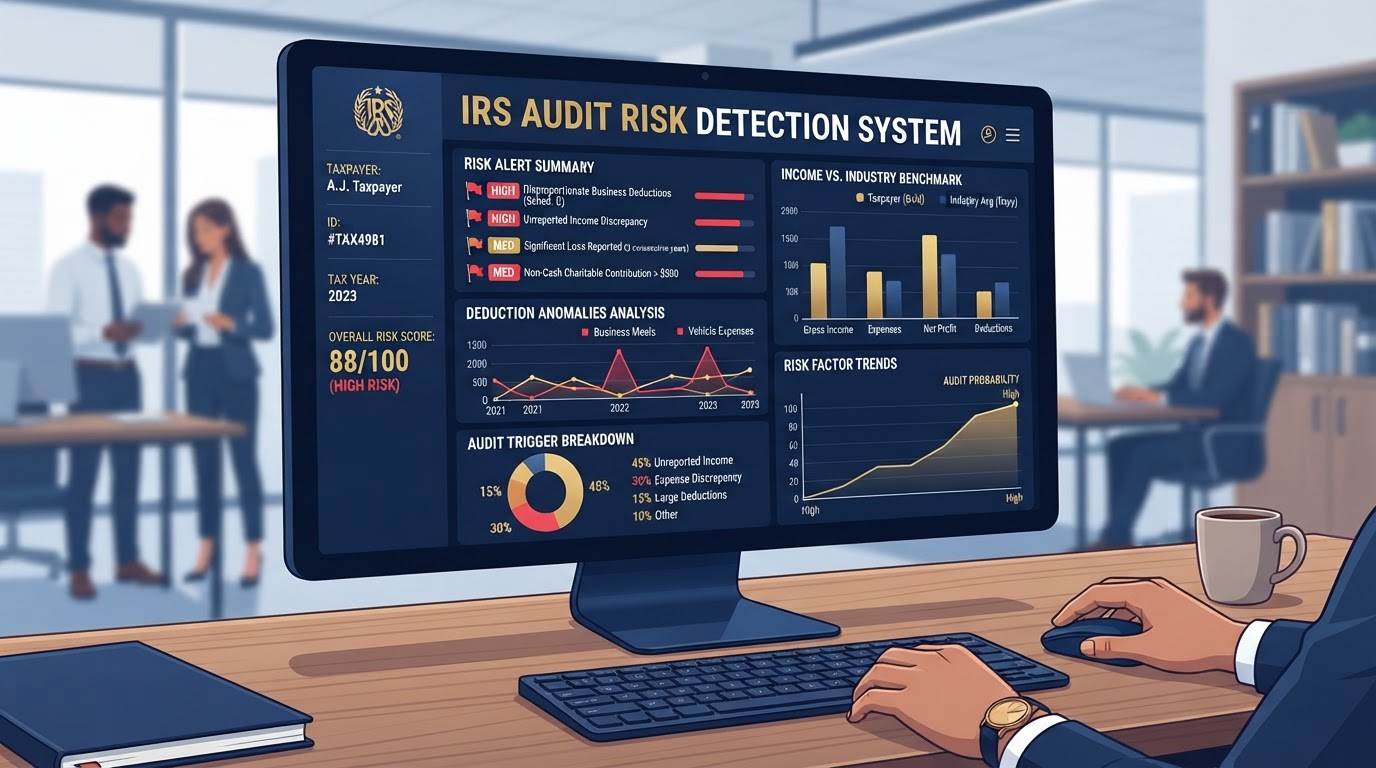
The IRS processes millions of returns every year. They do not have the manpower to review them all manually. Instead, they use a sophisticated statistical algorithm to decide which returns deserve a human's attention. Bookkeeping errors do not just cost you money in penalties and missed deductions — they act as a beacon, drawing IRS attention to your business.
When your numbers deviate significantly from what the IRS expects for a business of your size, in your industry, in your zip code, the system flags your return. A human auditor is then assigned to figure out why your numbers look so strange. The irony is that most flagged returns are not the result of intentional fraud — they are the result of careless bookkeeping by an overwhelmed owner who never meant to do anything wrong. The IRS does not care about your intent when the algorithm hands them a flagged return. They care about the numbers.
This is why the timing of when you find an error matters so much. An error caught in November, before the return is filed, is a quiet correction. An error caught in July, after the return is filed, is a notice in the mail. The same mistake, the same dollar amount, two completely different outcomes — all determined by when you discovered it.
Inside the IRS DIF Scoring System
The IRS uses a system called the Discriminant Inventory Function, or DIF. Every tax return that is filed is scored by this system. The score is not based on whether your return is right or wrong — it is based on how different your return looks from the statistical average of other businesses in your industry and geographic area.
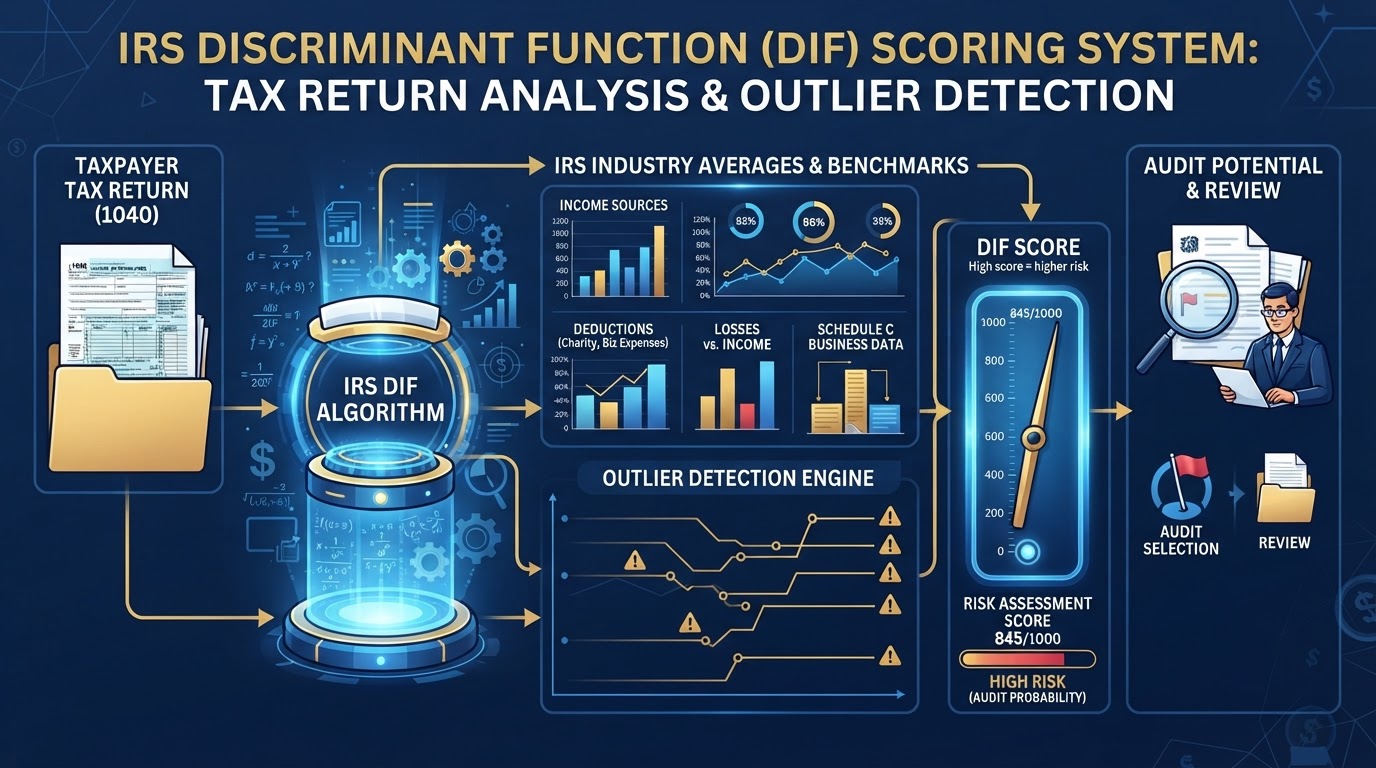
Here is how it works in practice. The IRS has decades of data on what a typical roofing contractor in Southern California reports for meals and entertainment, for advertising, for vehicle expenses, for cost of goods sold as a percentage of revenue. When your return is filed, the DIF system compares your ratios to those benchmarks. If your meals and entertainment expense is seven times the industry average, your DIF score spikes. If your cost of goods sold is suspiciously low relative to your revenue, your DIF score spikes.
A high DIF score does not mean you are being audited — it means your return is being pulled into a pool of returns that a human will review. From that pool, the IRS selects returns for audit based on what they believe will yield the highest return on their audit investment. So even if your high DIF score is the result of a legitimate but unusual business situation, you are now in the pool, and you may be selected.
The key insight is this: most DIF score spikes are caused by bookkeeping errors, not by unusual but legitimate business activity. A $50,000 equipment purchase categorized as office supplies looks like an outlier because it is an error, not because you genuinely spent $50,000 on paper clips. Fixing the categorization before you file brings your ratios back in line with the benchmarks and keeps your DIF score low.
The 'Big Three' Audit Triggers
While any error can cause problems, these three bookkeeping mistakes are the most likely to trigger an IRS inquiry. I see all three constantly in the books of new clients who come to me after years of DIY bookkeeping.
1099 Discrepancies
If the income you report on your tax return is less than the total of the 1099s issued to your business by your clients, the IRS's automated matching system will flag you immediately. This is a pure computer match — no human judgment involved.
Commingled Funds
Paying personal expenses out of your business account and deducting them as business expenses is the fastest way to lose an audit and face severe negligence penalties. It also pierces the corporate veil that protects your personal assets.
Misclassified Workers
Treating employees as independent contractors to avoid payroll taxes is a massive red flag. The IRS actively hunts for businesses making this error, and reclassification can trigger retroactive payroll taxes, penalties, and interest.
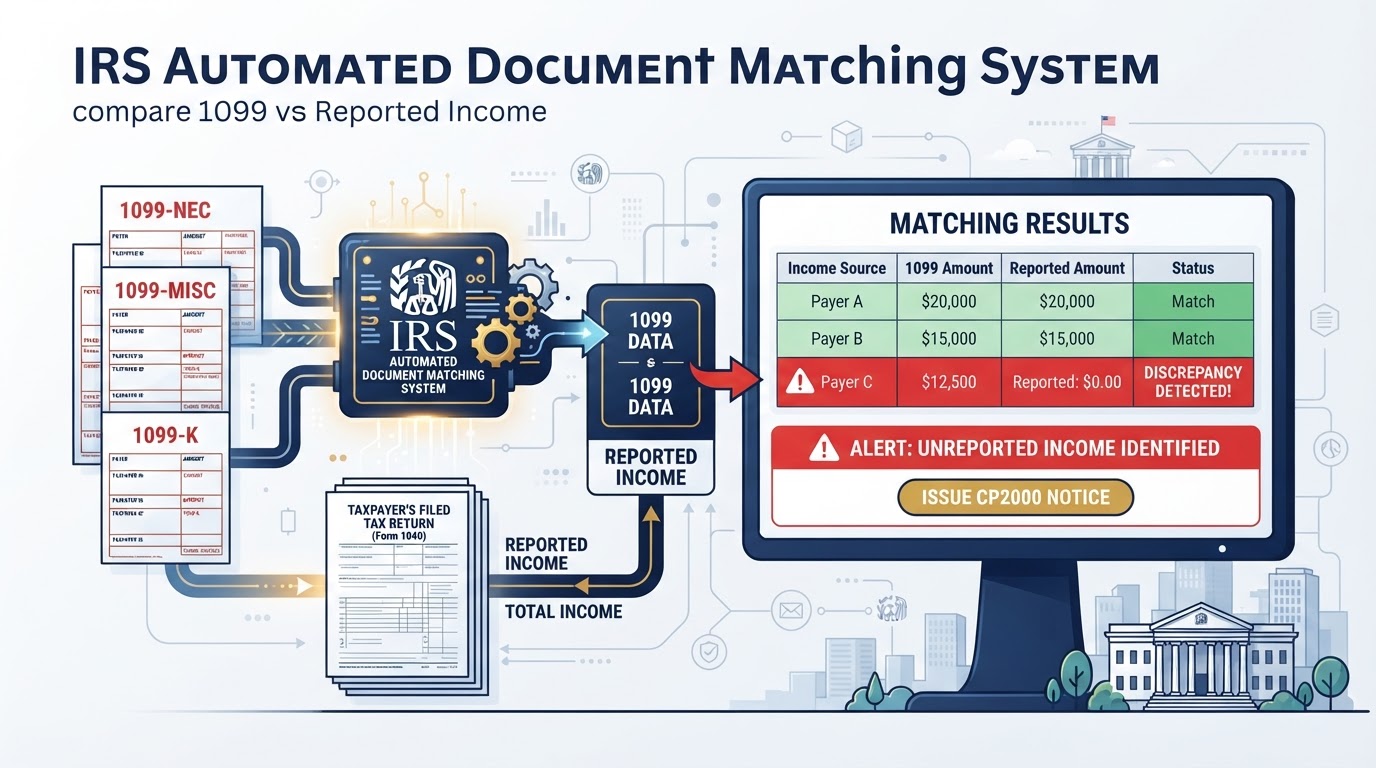
Let me explain why the 1099 discrepancy is so dangerous. When a client pays your business $600 or more in a year for services, they are generally required to issue you a Form 1099-NEC. They send one copy to you and one copy to the IRS. The IRS then has a record of exactly how much that client paid you. When you file your tax return, the IRS computer automatically compares the total of all 1099s issued to your business against the income you reported. If you reported less, you are flagged — instantly, automatically, and without any human discretion.
This happens most often when a business owner deposits a 1099 payment into their personal account instead of their business account, and then forgets to record it in their bookkeeping software. The income never makes it onto the books, never makes it onto the tax return, and the IRS computer catches the gap. The fix is simple — record every deposit, every time, in the right account — but only if you have a system that makes it impossible to forget.
Beyond the Big Three: Other Red Flags
The Big Three are the most common triggers, but they are not the only ones. Here are additional errors I frequently find that can raise your audit risk or cost you money even without a full audit:
- Round-Number Reporting
Reporting expenses in suspiciously round numbers — $5,000 exactly for advertising, $10,000 exactly for travel — signals estimates rather than actual records. The IRS knows real expenses are rarely round. Rounded numbers suggest you are guessing, which undermines the credibility of every number on your return.
- Consistently Reporting a Loss
If your business reports a net loss three years out of five, the IRS may classify it as a hobby rather than a business. Once classified as a hobby, you lose the ability to deduct business losses against other income. The IRS expects a legitimate business to turn a profit in at least three of five consecutive years.
- Inconsistent Categorization Year to Year
If you categorize advertising one way in March and another way in July, or change your chart of accounts mid-year without restating prior periods, your year-end reports are meaningless and your ratios look erratic. Inconsistency is itself a flag.
- Large Uncategorized Balances
Accounts labeled "Ask My Accountant," "Miscellaneous Expenses," or "Uncategorized" are dumping grounds for transactions the bookkeeper did not understand. A large balance in these accounts means a large portion of your expenses are undocumented — exactly what an auditor wants to see.
How to Spot Errors Before Filing
The best time to catch an error is before the tax return is filed. This is why month-end and year-end reconciliations are non-negotiable. I perform a series of diagnostic reviews for my clients throughout the year, not just at tax time, because the earlier you catch an error, the cheaper it is to fix.
The single most important habit is monthly bank reconciliation. Every month, without exception, your bookkeeping software balance must match your actual bank statement balance to the penny. If it does not, you have a problem — duplicate transactions, missing transactions, or unrecorded fees. Reconciliation is the foundation. If the foundation is cracked, everything built on top of it is unreliable.
Beyond reconciliation, I run a mock tax return projection in November. This allows us to see exactly what the IRS will see, giving us time to correct glaring anomalies before the December 31st deadline passes. A November projection also lets us make strategic decisions — like whether to accelerate a major equipment purchase into the current year for Section 179 depreciation, or defer income into the next year. None of that planning is possible if your books are not clean by November.
The Power of Variance Analysis
One of the most effective tools for catching errors before they reach the IRS is variance analysis. This is a comparison of this year's expenses to last year's expenses, line by line. The goal is not to check whether the numbers are correct in isolation — it is to check whether they make sense relative to each other and to history.
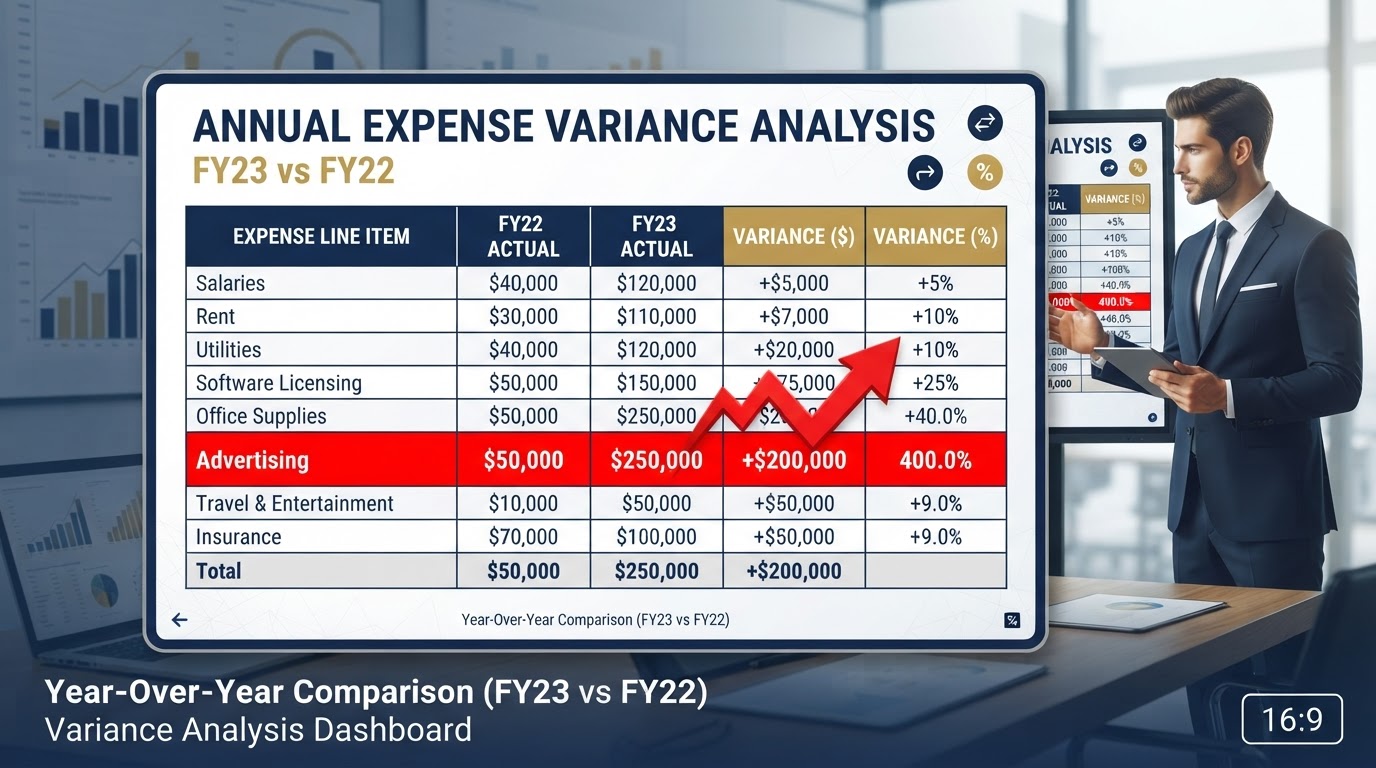
Here is a real example. I had a client whose "Office Supplies" expense jumped from $200 per month to $14,000 in April. On its own, the number was in the books and reconciled — the bank feed matched the statement. But variance analysis immediately flagged it as an outlier. When I drilled down, I discovered the owner had purchased a $13,800 piece of manufacturing equipment and categorized it as office supplies because that was the first expense category he saw in the dropdown menu. That single miscategorization would have inflated his current-year deductions, prevented proper depreciation, and created a cost basis problem when he eventually sold the equipment. We caught it in May, reclassified it to fixed assets, and set up a depreciation schedule — all before the tax return was ever filed.
Variance analysis works because errors are almost always outliers. A legitimate business does not see its advertising expense quadruple while revenue stays flat — unless something is wrong. A legitimate business does not see its meals expense suddenly equal its entire payroll. When a number deviates significantly from its historical pattern or from industry benchmarks, that deviation is the signal. Either something unusual but legitimate happened, or an error was made. Either way, it deserves investigation before it reaches the IRS.
I also compare the client's expense ratios to industry benchmarks. If a construction client's cost of goods sold is 30% of revenue when the industry average is 55%, that is a flag — not necessarily an error, but a question that needs an answer before the return is filed. Sometimes the answer is legitimate and defensible. Sometimes the answer is that subcontractor costs were miscategorized as something else. You want to find out which it is before the IRS asks.
Fixing the Damage: The Right Way
If you find an error, do not simply delete the transaction in QuickBooks. Deleting transactions destroys the audit trail and makes your books look suspicious. If an auditor ever compares your current books to prior bank statements and finds that transactions have vanished, it looks like you are hiding something — even if your intent was simply to correct a mistake.
Instead, we use journal entries to reclassify the funds. A journal entry moves the value from one account to another while leaving the original transaction intact. This leaves a clear, documented trail showing exactly what the error was, why it occurred, and how it was corrected. Every journal entry includes a memo explaining the reason for the reclassification. If an auditor ever asks, the trail proves your intent was compliance, not evasion.
Here is the step-by-step process I follow when correcting a misclassification:
- 1Identify the Error
Confirm exactly what was misclassified, when, and for how much. Pull the original receipt or invoice to verify the true nature of the transaction.
- 2Determine the Correct Treatment
Decide whether the transaction is an expense, a fixed asset, a cost of goods sold, or a personal expenditure that needs to be reclassified as an owner distribution.
- 3Post a Journal Entry
Credit the incorrect account and debit the correct account for the full amount. Include a detailed memo: "Reclassification of equipment purchase incorrectly coded to office supplies on [date]. See invoice #[number]."
- 4Set Up Depreciation if Applicable
If the corrected transaction is a fixed asset, establish a depreciation schedule and decide on Section 179, bonus depreciation, or straight-line treatment based on your tax strategy.
- 5Lock the Period
Once the correction is made and verified, lock the accounting period so no one can accidentally alter the corrected data. This preserves the integrity of the audit trail.
When to File an Amended Return
If the error occurred in a year where the tax return has already been filed, fixing QuickBooks is not enough. We have to correct the record with the IRS by filing an amended return — Form 1040-X for individuals or Form 1120-X for corporations.
Many business owners are terrified that filing an amended return will trigger an audit. In reality, proactively fixing your own mistake demonstrates good faith. It shows the IRS that you are monitoring your own compliance, which often reduces the likelihood of a deeper investigation. The IRS would far rather you correct an error voluntarily than wait for their matching program to catch it and send you a CP2000 notice demanding an explanation.
There is a time limit. You generally have three years from the date you filed the original return, or two years from the date you paid the tax, to file an amended return and claim a refund. If the error resulted in underpayment of tax, you should amend as soon as possible to stop the clock on accumulating interest and penalties. The longer you wait, the more expensive the correction becomes.
When we file an amended return, we attach a clear explanation of what changed and why. We do not just submit corrected numbers — we tell the story. "The taxpayer purchased manufacturing equipment in April that was incorrectly coded to office supplies. The attached journal entry reclassifies the purchase to fixed assets and establishes a depreciation schedule under Section 179." A clear, documented explanation makes it easy for the IRS to process the amendment without questions.
Building an Audit-Proof System
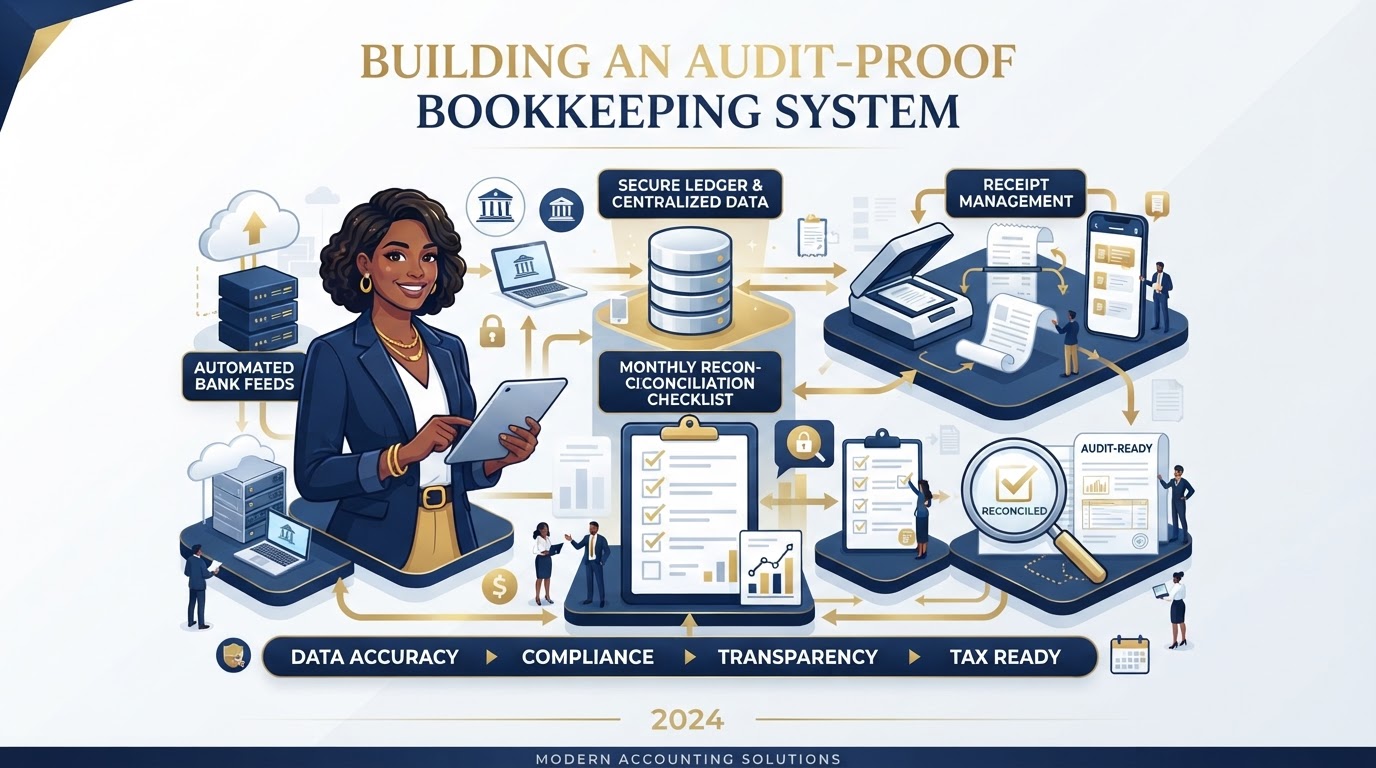
The ultimate goal is to stop making the errors in the first place. This requires moving away from DIY bookkeeping and establishing a professional financial ecosystem. We implement strict receipt management protocols, automate bank feeds with daily reconciliations, and establish clear guidelines for what constitutes a deductible expense.
An audit-proof system has four pillars. The first is separation of accounts — dedicated business checking and credit card accounts with zero personal transactions running through them. The second is daily or weekly transaction review, so errors are caught within days rather than months. The third is monthly reconciliation, locked and signed off, so each month's books are finalized before the next month begins. The fourth is documentation — every transaction over $75 has a receipt with the business purpose noted, stored digitally and linked to the transaction in the software.
When all four pillars are in place, an audit becomes a non-event. The auditor asks for support for a transaction, and you produce the receipt, the bank statement, and the business purpose in under a minute. There is no scrambling, no reconstruction, no explanation of why the books look different from the bank statements. The system speaks for itself.
A Glimpse Into Your Financial Command Center
Stop sending sensitive documents over unencrypted email. My secure client portal provides a 256-bit encrypted environment where you can access your financial reports, upload tax documents, and track project status in real-time.

Interactive Portal Walkthrough
See how I organize your financial life in one secure place.
Your Pre-Filing Error Checklist
Before any tax return is filed, I run through a checklist with every client. This is the same checklist you should run through yourself if you are managing your own books. It takes an hour, and it has saved clients from audits, penalties, and thousands in unnecessary tax.
Reconcile Every Account
Bank, credit card, loan, and merchant accounts must all match statements to the penny.
Review Uncategorized Accounts
Zero out "Ask My Accountant" and "Miscellaneous" — every transaction needs a real category.
Match 1099 Income
Total all 1099s received and confirm the income on your books matches or exceeds that total.
Verify Worker Classifications
Confirm every 1099 contractor meets the independent contractor tests. Flag any that look like employees.
Lock Prior Periods
Once reviewed, lock the books so no transactions can be altered after the return is filed.
Conclusion: Proactive Protection
Finding a bookkeeping mistake is stressful, but it is an opportunity. By finding it before the IRS does, you retain control of the narrative. You have the power to fix the math, document the correction, and file an amended return on your own terms. The difference between a correction and an audit is not the mistake itself — it is who finds it first.
The system I have described — monthly reconciliation, variance analysis, a November tax projection, journal-entry corrections, and a pre-filing checklist — is not complicated. But it requires consistency, discipline, and a professional who knows what the IRS is looking for before the IRS looks. That is what we do at Fiscal Integrity Group, every month, for every client.
Do not wait for a notice in the mail to force your hand. Let us review your books, find the hidden errors, and secure your business against the threat of an audit.
Quick Tax Savings Estimator
See how much you could potentially save with proactive tax strategy and clean bookkeeping. Most LA businesses overpay by 15-20% simply due to missed deductions.
Free IRS Audit Risk Assessment
Do you mix personal and business expenses in the same bank account?
Frequently Asked Questions
How far back can you catch errors?
I perform a deep forensic review of your history to catch errors and fix them. Whether it's one year or five, my goal is to ensure your historical data is pristine before we move forward.
Will you educate me on how to manage my books?
Yes! My approach is highly educational. I want you to understand the "why" behind the numbers so you can make better business decisions with confidence.

About the Author
Fiscal Integrity Group
Fiscal Integrity Group is a leading financial advisory firm in Los Angeles. With extensive experience in tax strategy, accounting, and fractional CFO services, we help business owners optimize their finances, minimize tax liabilities, and scale with confidence.