A 1031 exchange, named after Section 1031 of the U.S. Internal Revenue Code, allows you to avoid paying capital gains taxes when you sell an investment property and reinvest the proceeds from the sale within certain time limits in a property or properties of like kind and equal or greater value. For real estate investors, this is one of the most powerful tax deferral tools available — it lets you compound wealth without the drag of capital gains tax at every sale.
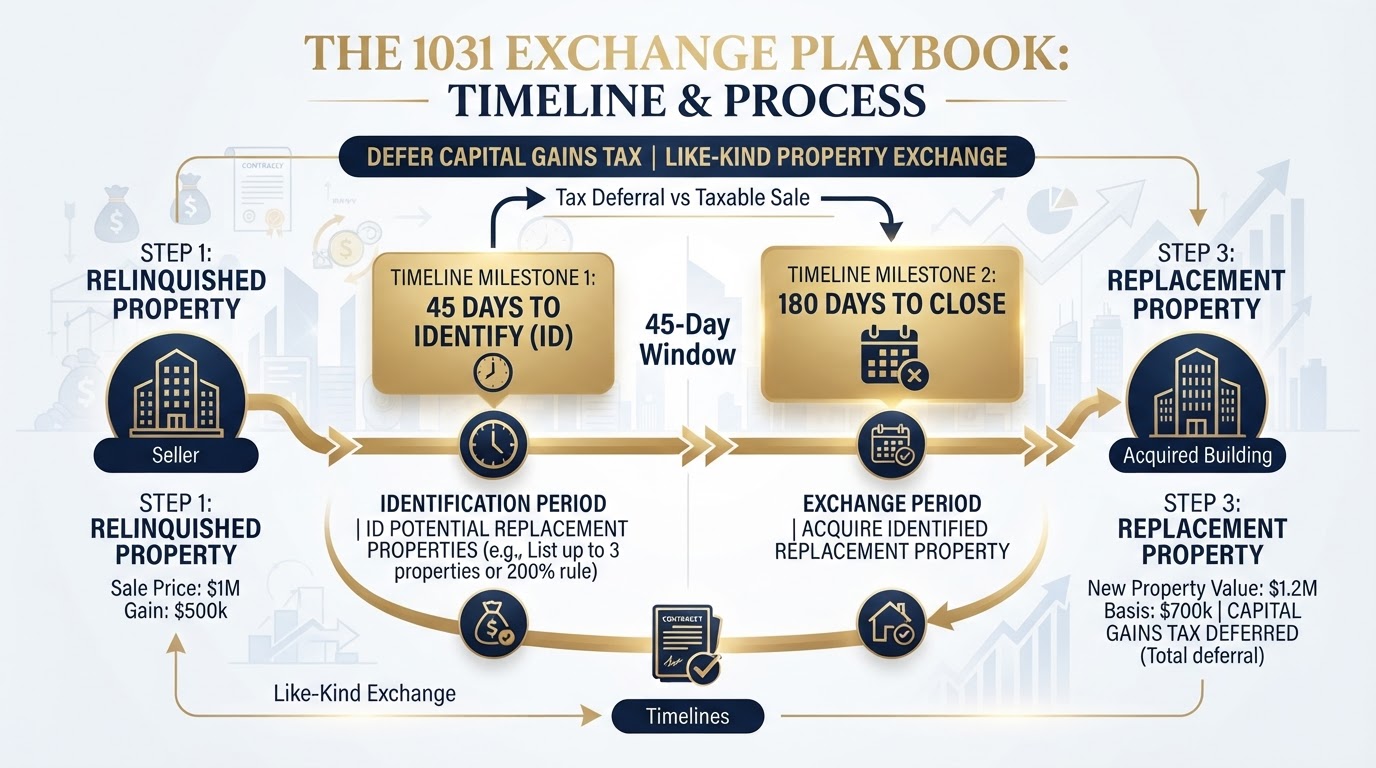
This guide walks through the rules that govern a valid 1031 exchange — like-kind property, the strict identification and closing timelines, the role of the qualified intermediary, and the concept of boot. We also cover advanced structures like reverse exchanges and how 1031 interacts with estate planning. The rules are strict, and a single missed deadline can collapse the entire exchange.
Identifying Like-Kind Properties
The term "like-kind" is broader than most investors assume. For real estate, any investment property can be exchanged for any other investment property — an apartment building for raw land, a retail strip for an office building, a single-family rental for a multi-family complex. The key is that both properties must be held for investment or for productive use in a trade or business. Personal residences do not qualify.
Note that after the 2017 tax law changes, real property is the only category that still qualifies for like-kind exchange treatment — personal property (equipment, art, collectibles) no longer does. We confirm the like-kind status of both the relinquished and replacement properties before the exchange begins.
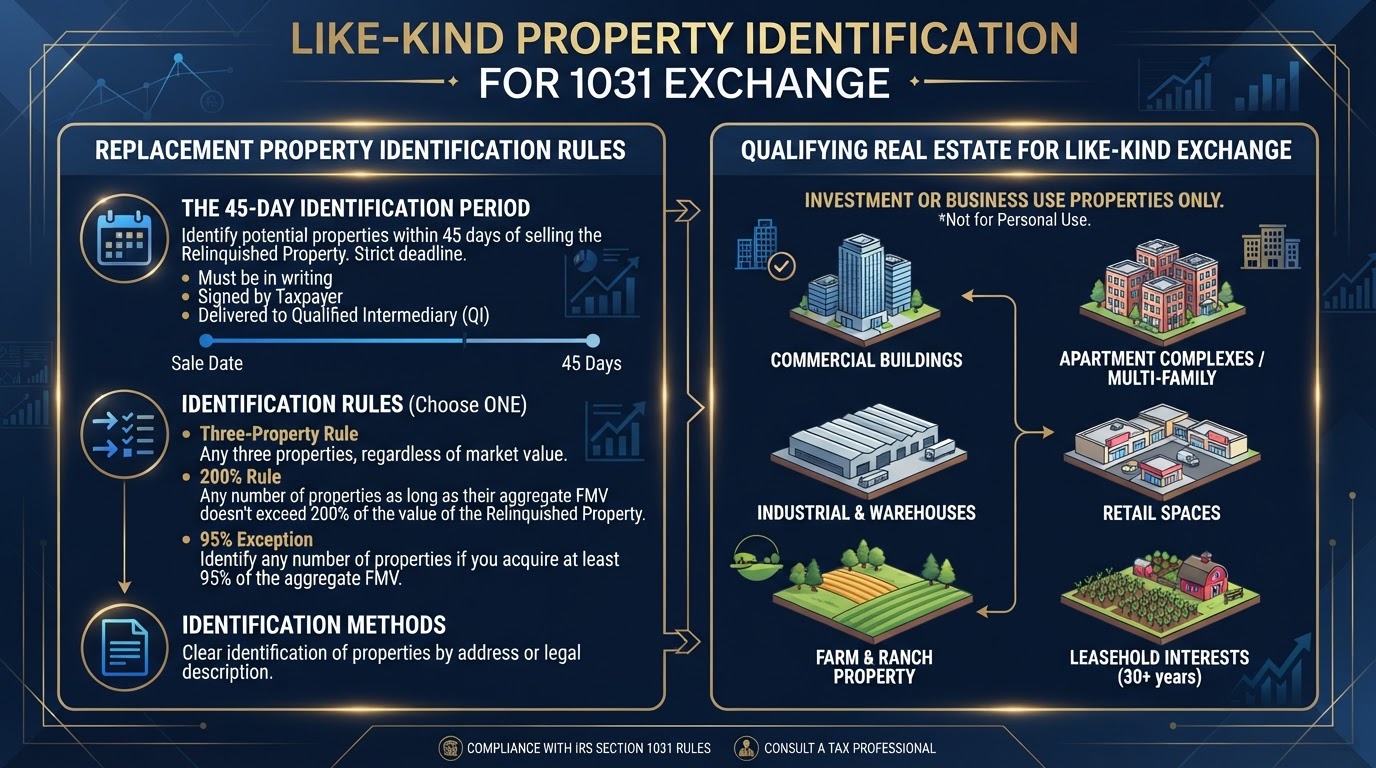
- Any investment real property can exchange for any other investment real property
- Both properties must be held for investment or business use
- Personal residences and personal property do not qualify
The 45-Day Identification Rule
Within 45 calendar days of closing the sale of the relinquished property, you must identify the replacement property or properties in writing. The identification must be signed, dated, and delivered to the qualified intermediary (or another party to the exchange). The IRS provides three identification rules, and you must satisfy one: the three-property rule (identify up to three properties of any value), the 200% rule (identify any number of properties as long as their total value does not exceed 200% of the relinquished property's value), or the 95% rule (identify any number of properties as long as you acquire 95% of their total value).
The 45-day clock is unforgiving — it includes weekends and holidays, and there are no extensions. Missing the deadline disqualifies the exchange and triggers the full capital gains tax. We help clients identify candidate properties before the relinquished property even closes, so the 45-day window is used for confirmation rather than a frantic search.
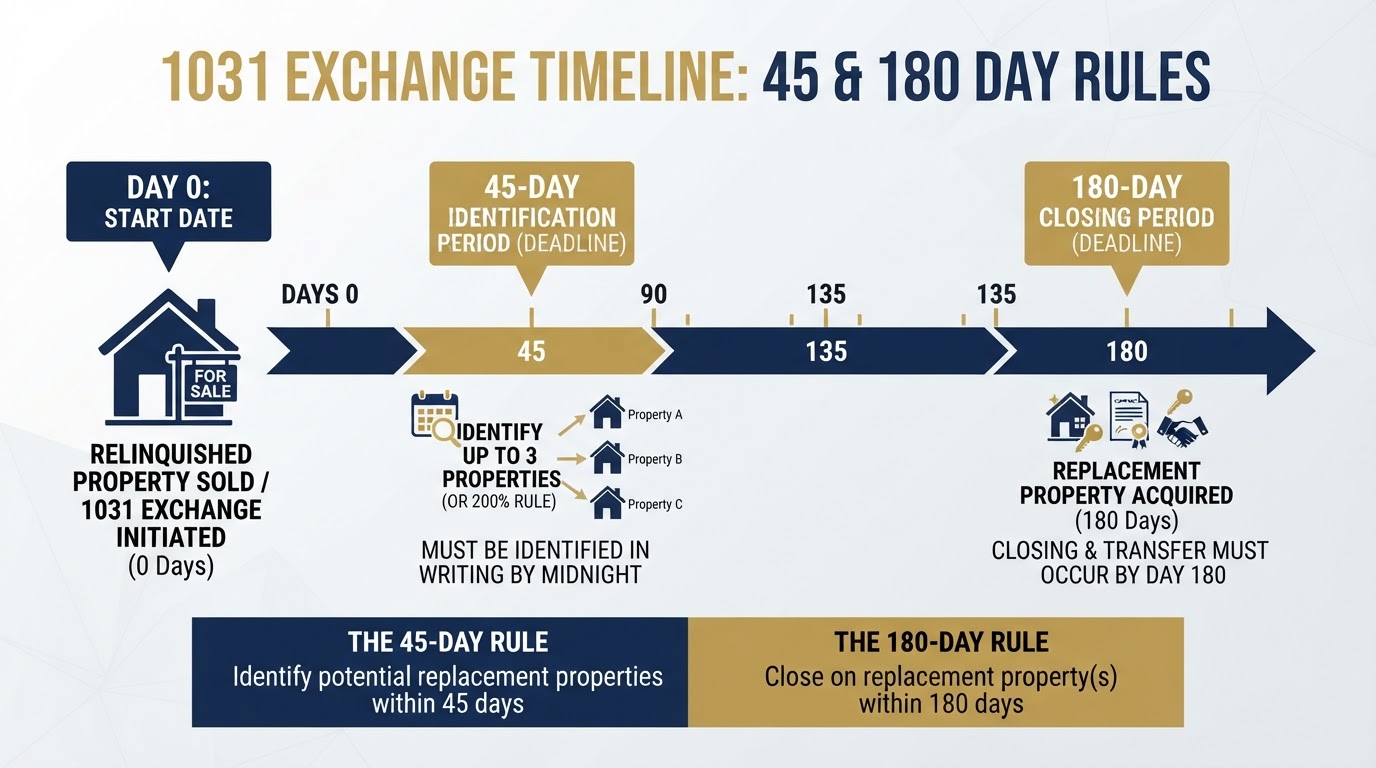
- Identify replacement properties in writing within 45 days of closing
- Three-property rule, 200% rule, or 95% rule — satisfy one
- The 45-day clock includes weekends and holidays with no extensions
The 180-Day Closing Rule
You must close on the replacement property (or properties) within 180 calendar days of closing the relinquished property — or by the due date of your tax return for the year of the sale, including extensions, whichever is earlier. The 180-day period runs concurrently with the 45-day identification period, so the identification deadline is the first milestone and the closing deadline is the second.
The interaction with the tax return due date is critical. If your tax return is due before 180 days have passed, you must file an extension to preserve the full 180-day window. We coordinate with your tax preparer to ensure the extension is filed so the exchange timeline is not cut short by the return deadline.
- Close on replacement property within 180 days of the relinquished sale
- Or by the tax return due date (with extensions), whichever is earlier
- File a tax extension to preserve the full 180-day window
Qualified Intermediaries (QIs)
To qualify for a 1031 exchange, you cannot receive the proceeds from the sale of the relinquished property — if you touch the money, the exchange is disqualified. A Qualified Intermediary (QI) holds the proceeds in escrow and disburses them to the seller of the replacement property. The QI also prepares the exchange agreement and the identification paperwork.
The QI must be independent — it cannot be your attorney, accountant, real estate agent, or anyone who has acted as your agent in the past two years. We help select a reputable QI, confirm their bonding and escrow practices, and ensure the exchange agreement is structured correctly before the relinquished property closes.
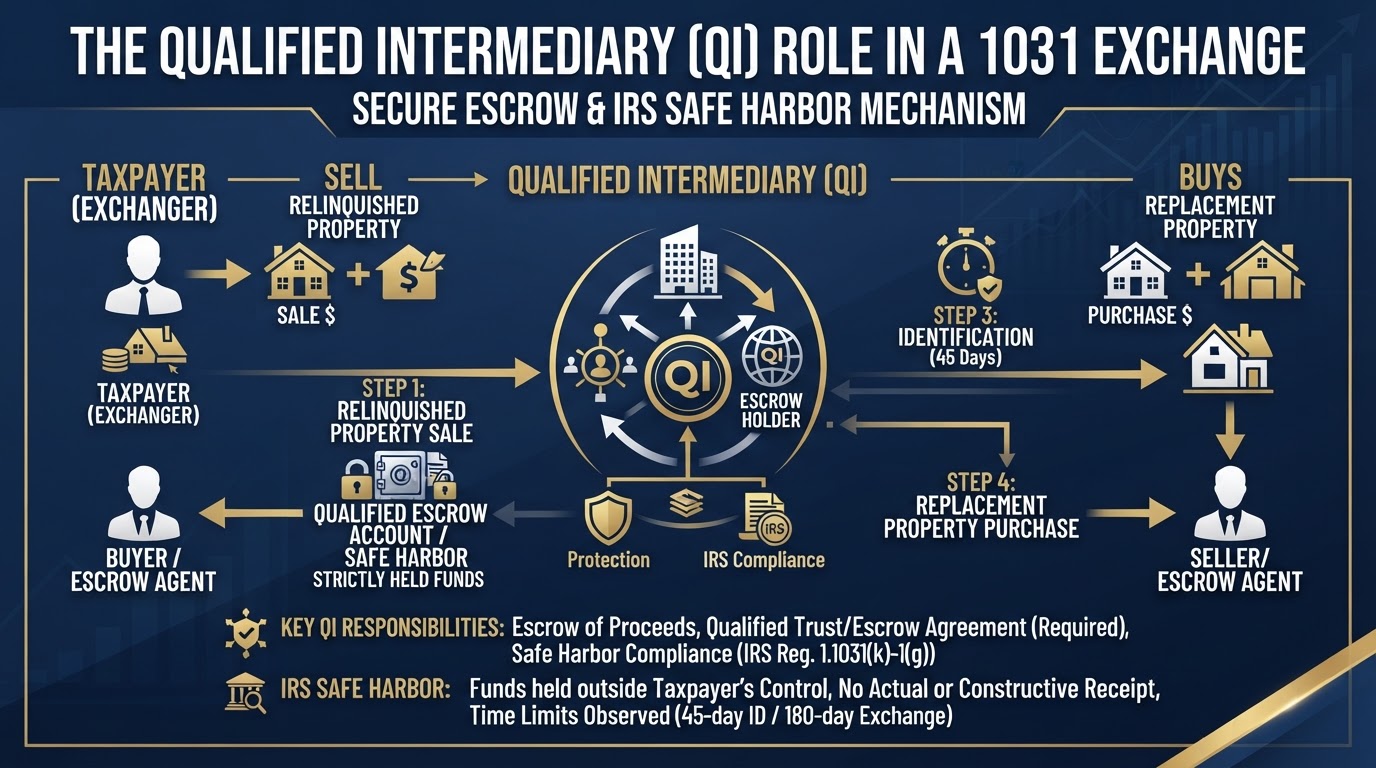
- The QI holds the sale proceeds in escrow — you cannot touch the money
- The QI must be independent — not your attorney, accountant, or agent
- Confirm bonding and escrow practices before the relinquished property closes
Boot and Taxable Gains
"Boot" is any value received in the exchange that is not like-kind real property — cash left over, debt relief, or personal property included in the deal. Boot is taxable to the extent of the realized gain. For example, if you have a $300,000 gain and receive $50,000 in cash boot, you defer $250,000 and pay tax on $50,000. To achieve full deferral, you must reinvest all net proceeds and acquire property of equal or greater value with equal or greater debt.
We model the exchange economics before closing to identify any boot and structure the transaction to minimize or eliminate it. Sometimes a small amount of boot is acceptable if the deferral of the larger gain still produces a strong outcome — but that is a decision made with full information, not by accident.
- Boot is cash, debt relief, or non-like-kind property received in the exchange
- Boot is taxable to the extent of the realized gain
- Full deferral requires reinvesting all proceeds at equal or greater value and debt
Estate Planning with 1031 Exchanges
One of the most powerful aspects of the 1031 exchange is its interaction with estate planning. When you die holding property that has been exchanged multiple times, the deferred capital gains tax is eliminated entirely — your heirs receive the property with a stepped-up basis to its fair market value at the date of your death. All the deferred gain from a lifetime of exchanges disappears.
This makes the 1031 exchange not just a deferral strategy but a potential elimination strategy when combined with a long-term hold and estate transfer. We coordinate with your estate planning attorney to ensure the property is titled correctly and the basis step-up is preserved for your heirs.
- At death, heirs receive a stepped-up basis to fair market value
- All deferred gain from prior exchanges is eliminated
- Coordinate property titling with your estate planning attorney
Conclusion
A 1031 exchange is one of the most powerful wealth-building tools in the tax code — but only when the rules are followed precisely. The timelines are strict, the intermediary is mandatory, and the boot calculations determine how much gain is actually deferred. Contact us before you sell an investment property to structure the exchange correctly from the start.
Quick Tax Savings Estimator
See how much you could potentially save with proactive tax strategy and clean bookkeeping. Most LA businesses overpay by 15-20% simply due to missed deductions.
Free IRS Audit Risk Assessment
Do you mix personal and business expenses in the same bank account?
Frequently Asked Questions
How far back can you catch errors?
I perform a deep forensic review of your history to catch errors and fix them. Whether it's one year or five, my goal is to ensure your historical data is pristine before we move forward.
Will you educate me on how to manage my books?
Yes! My approach is highly educational. I want you to understand the "why" behind the numbers so you can make better business decisions with confidence.

About the Author
Wiyao Awesso
Wiyao Awesso is a leading financial advisor in Los Angeles. With extensive experience in tax strategy, accounting, and fractional CFO services, he helps business owners optimize their finances, minimize tax liabilities, and scale with confidence.