Being an independent contractor or freelancer comes with significant financial freedom — but also significant tax responsibility. Unlike W-2 employees, where the employer withholds taxes automatically, self-employed individuals are responsible for paying both the employee and employer portions of Social Security and Medicare taxes, totaling 15.3% on top of federal and state income taxes. Without proper planning, this can result in a tax bill that catches you completely off guard.
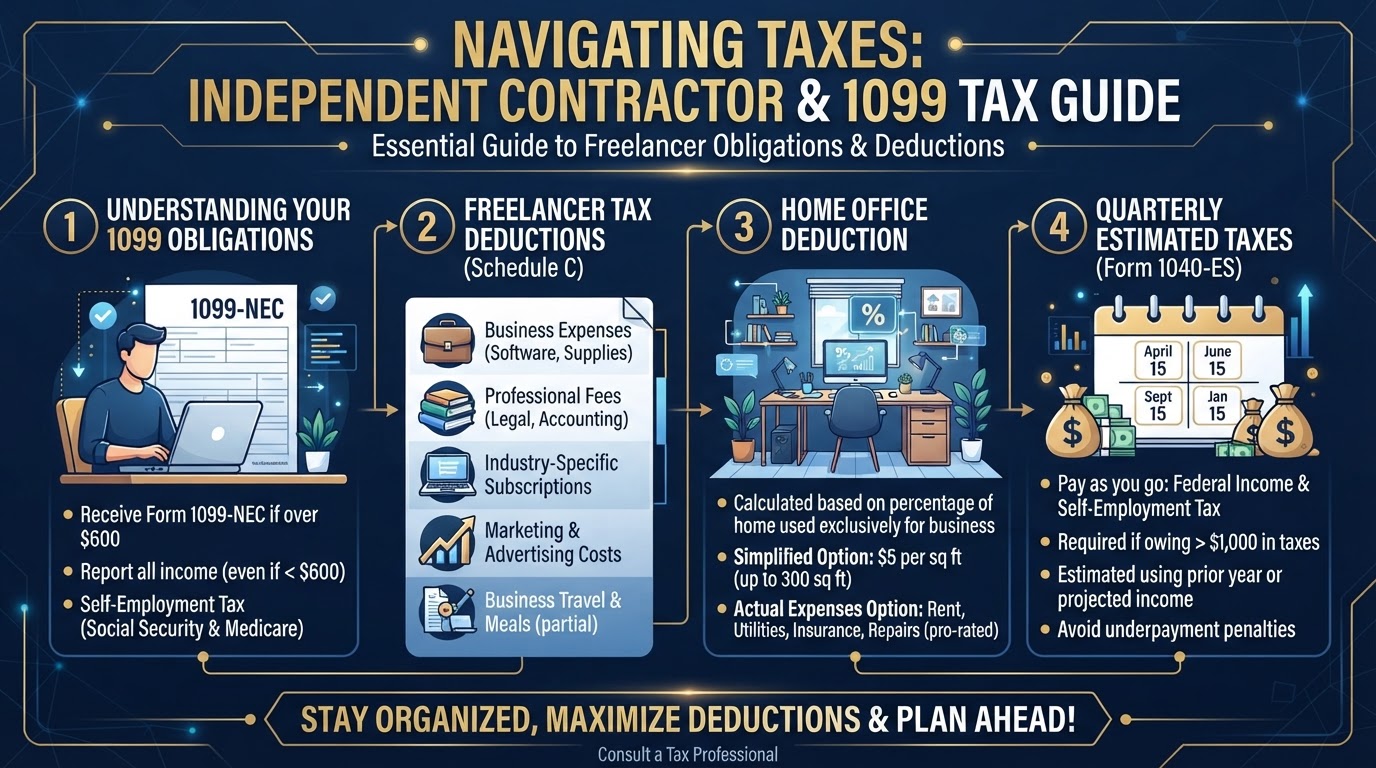
This guide walks through every deduction, strategy, and compliance requirement available to 1099 workers and independent contractors. From the home office deduction to the Section 199A QBI deduction, from quarterly estimated taxes to retirement account strategies, these are the tools that legally and dramatically reduce what you owe the IRS — while staying fully compliant and audit-proof.
Quarterly Estimated Tax Payments
As a 1099 contractor, no one is withholding taxes from your pay. The IRS requires you to pay your tax liability throughout the year via quarterly estimated payments — due in April, June, September, and January. If you wait until April 15 to pay your full annual tax bill, you may owe underpayment penalties on top of the tax itself.
The safe harbor is to pay either 90% of your current-year tax liability or 100% of your prior-year liability (110% if your AGI was over $150,000) through quarterly estimates. We calculate the right quarterly amount based on your projected income, set up the payment schedule, and track your year-to-date liability so there are no surprises in April.
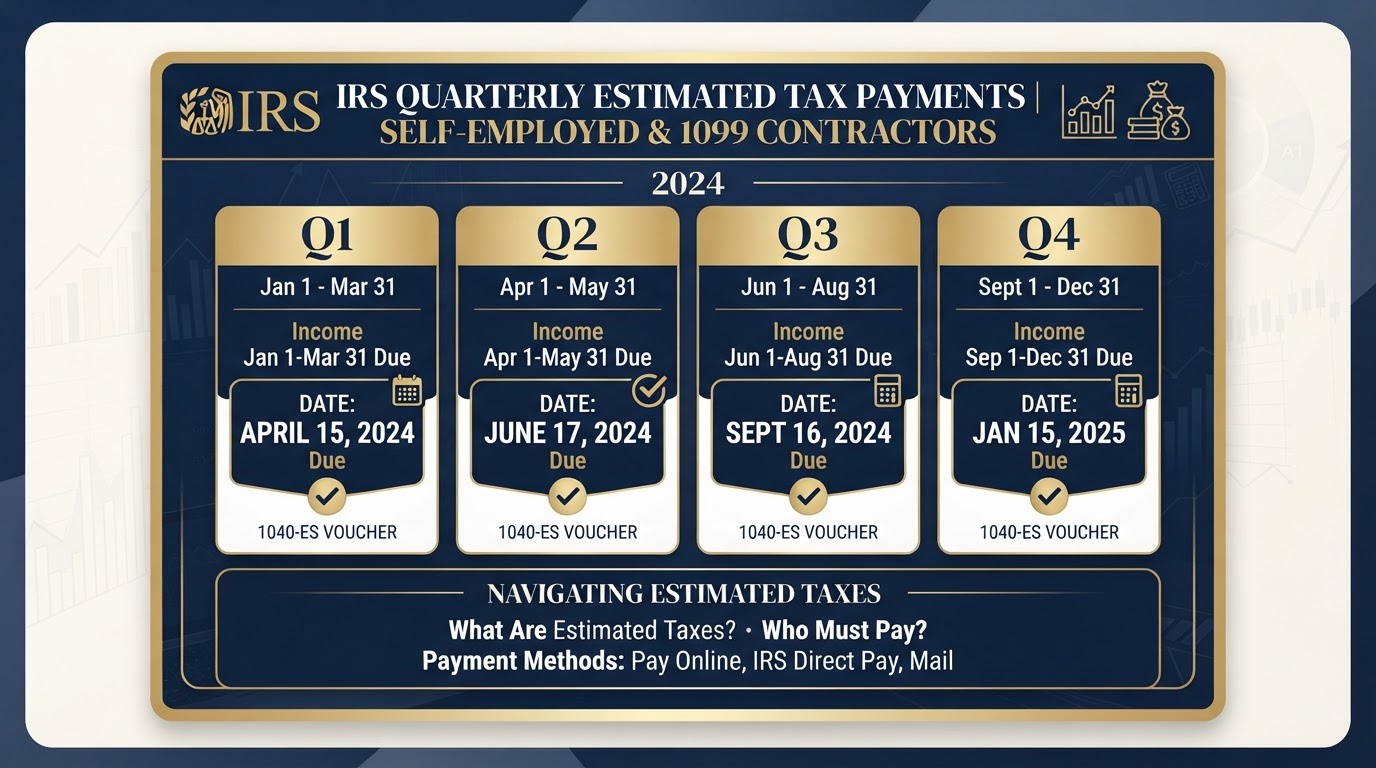
- Pay quarterly estimates in April, June, September, and January
- Safe harbor: 90% of current year or 100% of prior year (110% if AGI over $150k)
- Underpaying triggers penalties on top of the tax you owe
Home Office Deduction (Simplified vs. Regular Method)
The home office deduction allows self-employed individuals to deduct the cost of a home workspace used regularly and exclusively for business. There are two methods: the simplified method ($5 per square foot, up to 300 square feet, for a maximum of $1,500) and the regular method (actual expenses allocated based on the percentage of your home used for business — rent, utilities, insurance, depreciation).
The regular method is almost always larger for contractors with a dedicated office, but it requires more documentation. The space must be used regularly and exclusively for business — a guest bedroom that doubles as an office does not qualify. We help determine which method yields the larger deduction and document the exclusive-use requirement so the deduction survives an audit.
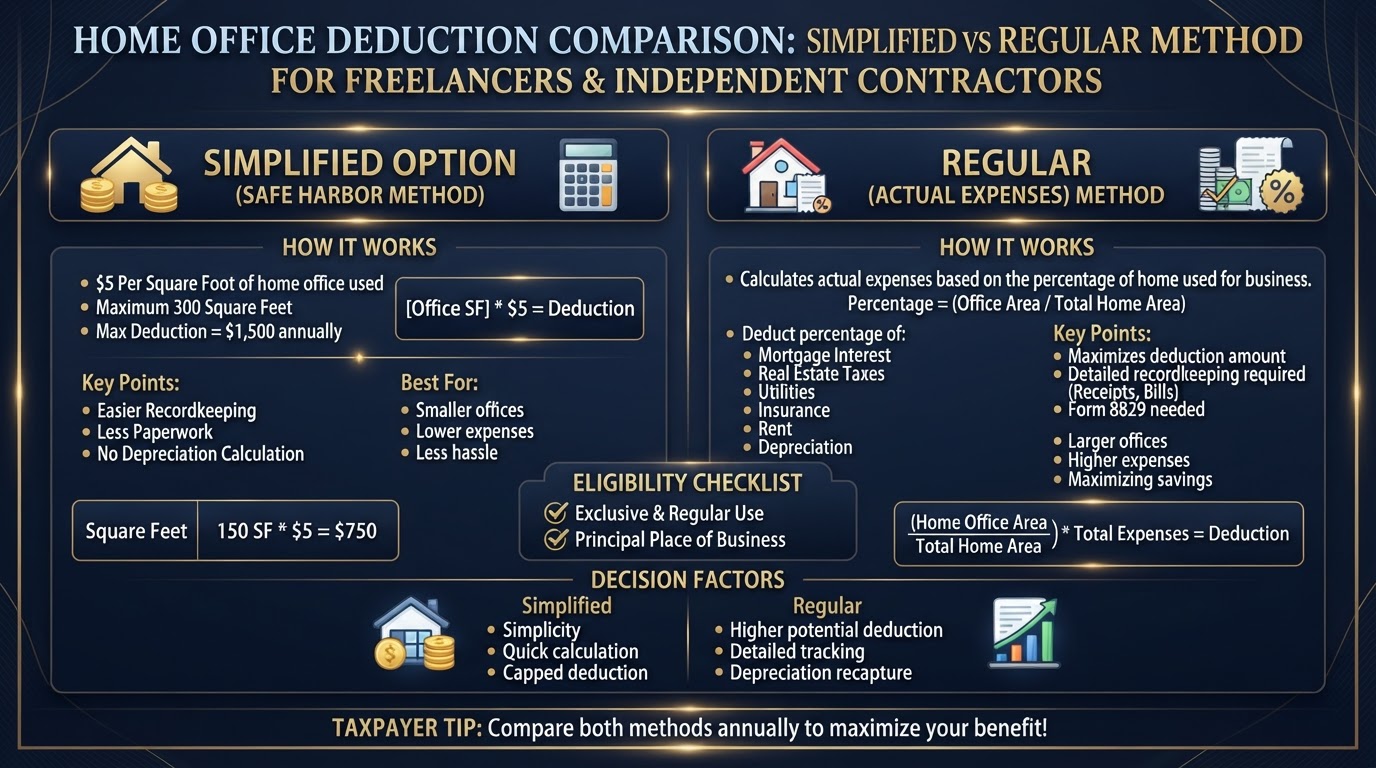
- Simplified: $5/sq ft up to 300 sq ft ($1,500 max)
- Regular: actual expenses allocated by business-use percentage
- Space must be used regularly and exclusively for business
Vehicle Expenses & Mileage Logs
If you drive for business, you can deduct vehicle expenses using either the standard mileage rate (70 cents per mile in 2025) or the actual expense method (gas, maintenance, depreciation, insurance, allocated by business-use percentage). The standard mileage rate is simpler, but the actual expense method can yield a larger deduction for high-cost vehicles or heavy business use.
Either way, you need a contemporaneous mileage log — a record of the date, business purpose, starting and ending odometer, and miles driven for each trip. A log reconstructed at year-end from memory does not survive an audit. We provide a mileage tracking workflow (or app recommendation) and show you how to keep a log that holds up under IRS scrutiny.
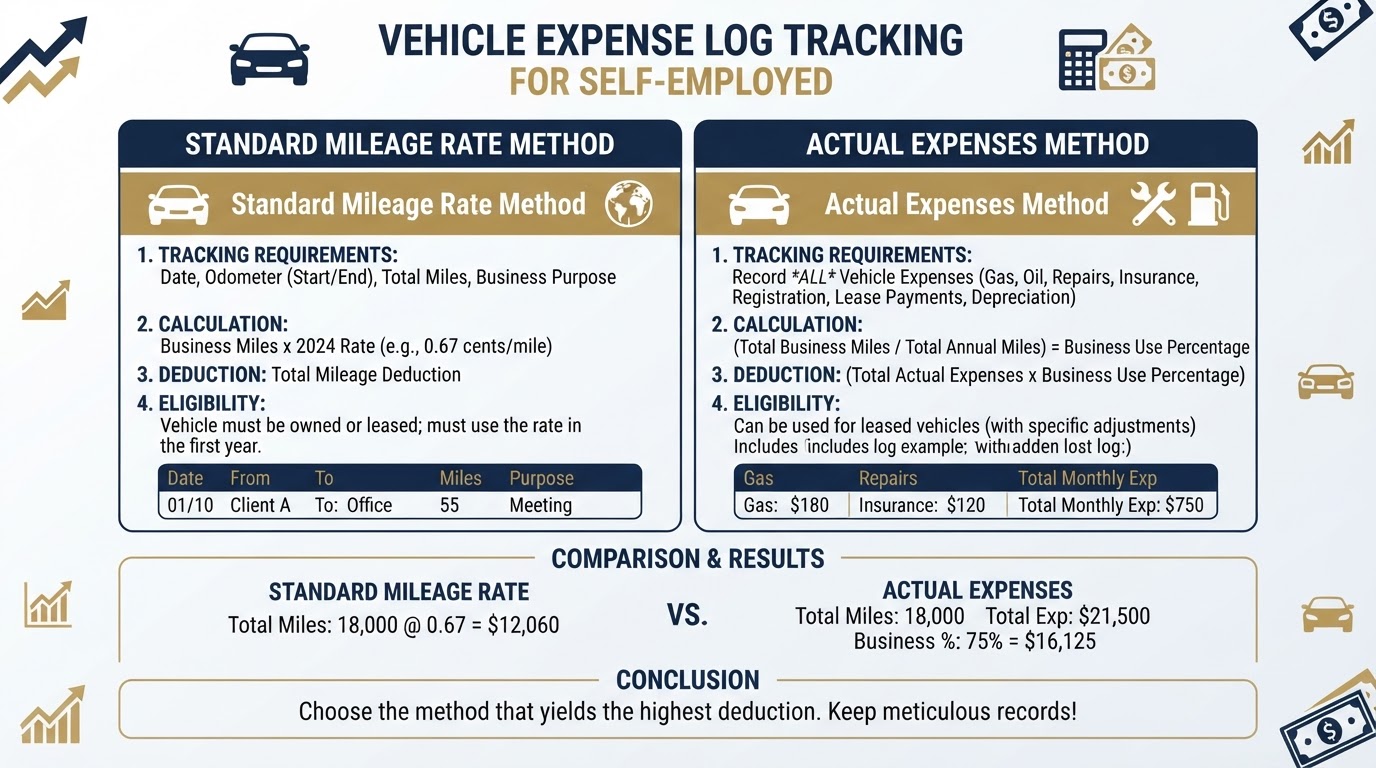
- Standard mileage rate: 70 cents/mile (2025) — simple, no depreciation calc
- Actual expense method: gas, maintenance, insurance, depreciation by business %
- Contemporaneous mileage log required — date, purpose, start/end odometer
The QBI (Section 199A) 20% Deduction
The Qualified Business Income deduction allows eligible self-employed individuals to deduct up to 20% of their net business income from their taxable income — above the line, before adjusted gross income. For a contractor earning $150,000 in net profit, that is a $30,000 deduction that directly reduces taxable income. The deduction is available regardless of whether you itemize.
Eligibility depends on your taxable income, your industry (certain service businesses face a phase-out above an income threshold), and the wage and property limitations. We calculate whether you qualify, model the wage and property factors, and position your income to maximize the deduction. For many 1099 contractors, this single deduction is worth thousands of dollars per year.
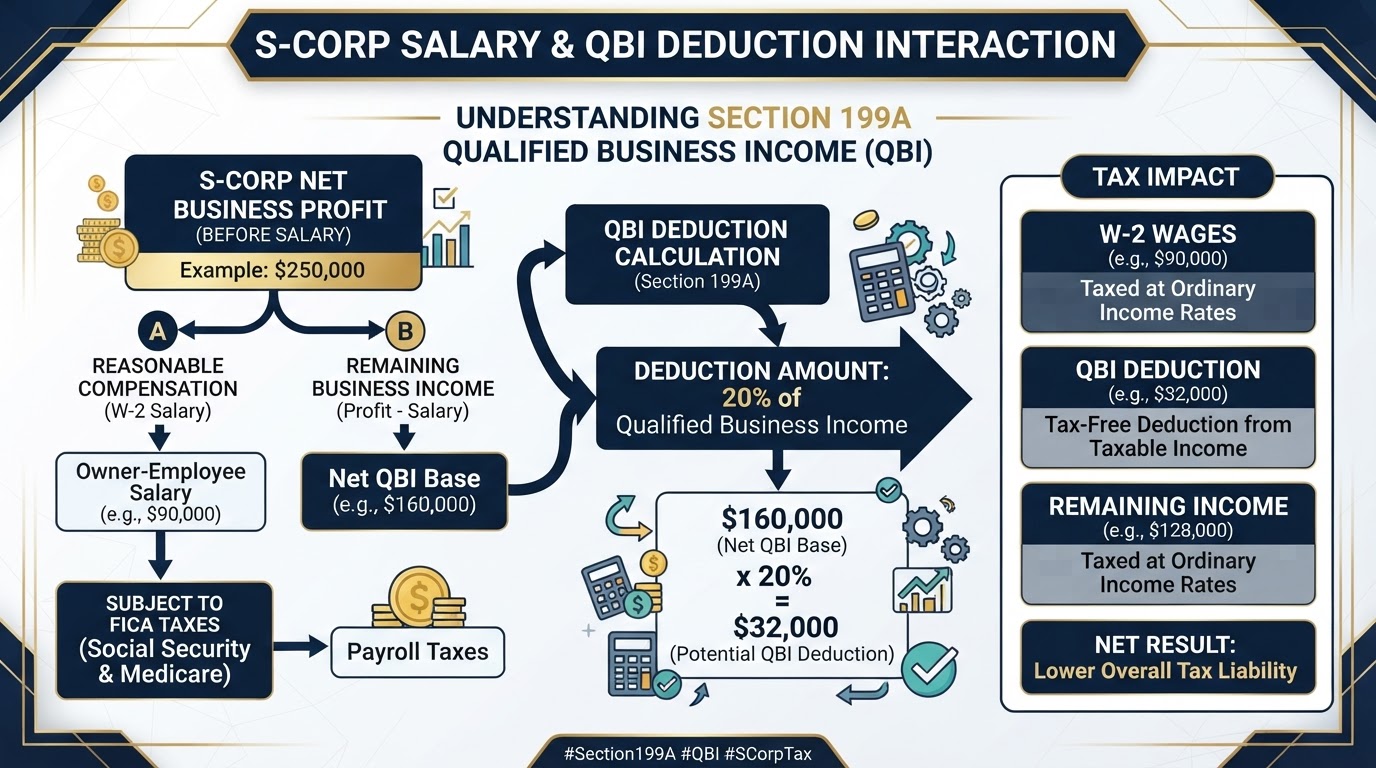
- Deduct up to 20% of net business income — above the line
- Available whether or not you itemize deductions
- Subject to taxable income limits and SSTB phase-outs
Retirement Plans: Solo 401(k) vs SEP-IRA
For 1099 contractors with no full-time employees (other than a spouse), the Solo 401(k) and the SEP-IRA are the two primary retirement vehicles. Both allow tax-deferred contributions that reduce your current-year taxable income, but they differ in contribution limits and flexibility.
The Solo 401(k) typically allows a larger total contribution because it combines an employee salary deferral ($23,500 in 2025) with an employer profit-sharing contribution (up to 25% of compensation), for a total ceiling of $70,000 (or $77,500 with catch-up). The SEP-IRA allows up to 25% of compensation but does not include the employee deferral. For most self-employed contractors, the Solo 401(k) is the stronger vehicle — and it also allows Roth contributions and loans in some plans.
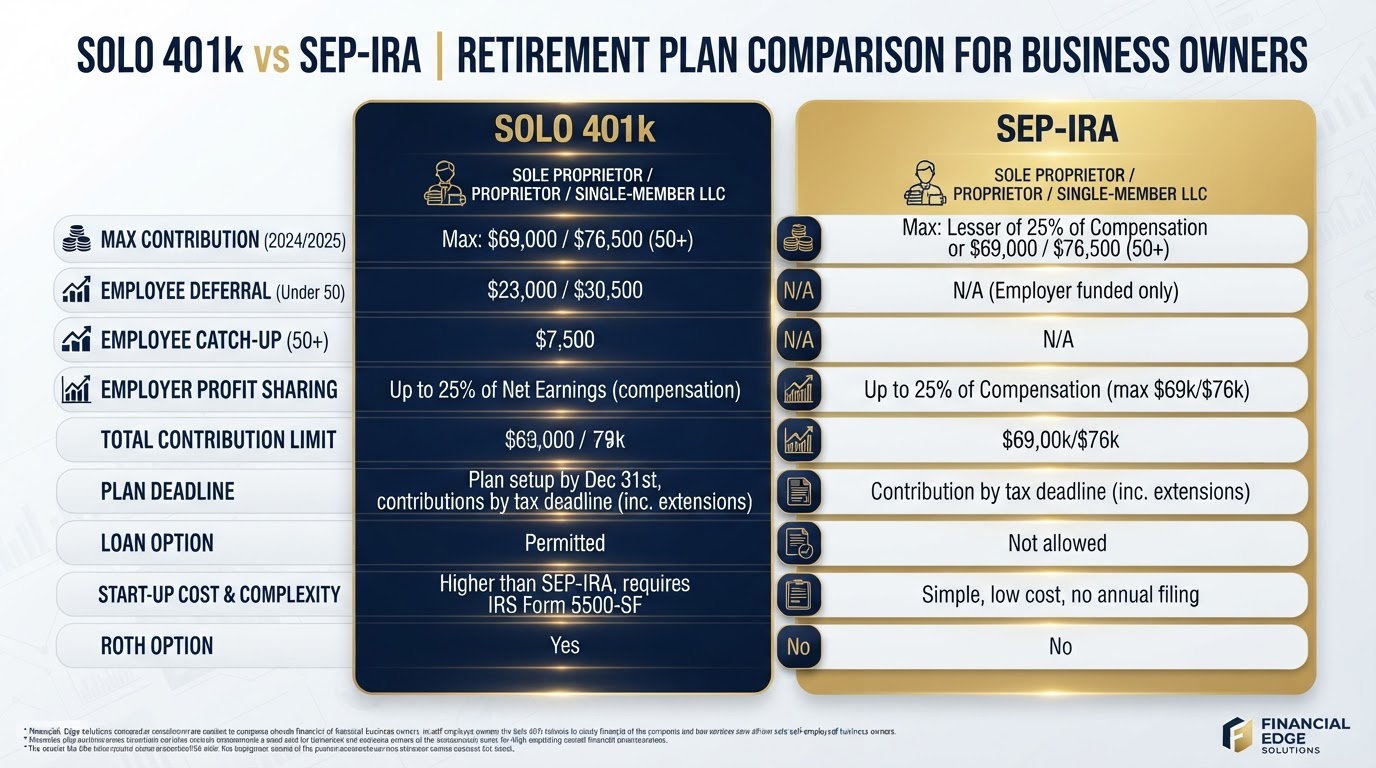
- Solo 401(k): up to $70,000 (2025) combining employee + employer contributions
- SEP-IRA: up to 25% of compensation, no employee deferral component
- Solo 401(k) usually allows the larger total contribution
Business Equipment & Section 179
Section 179 allows you to expense the full purchase price of qualifying business equipment in the year you buy it, rather than depreciating it over several years. For 2025, the deduction limit is $1,220,000, with a spending cap of $3,050,000 before the deduction begins to phase out. This applies to computers, software, office furniture, tools, and most tangible business property.
Combined with bonus depreciation, Section 179 lets you front-load the deduction in the year of purchase — a powerful tool when you have a high-income year and want to reduce the taxable hit. We model whether immediate expensing or multi-year depreciation produces the better long-term outcome, considering your projected income in future years.
- Expense up to $1,220,000 of equipment in the year of purchase (2025)
- Applies to computers, software, furniture, tools, and most tangible property
- Front-loads the deduction in high-income years
Conclusion
Being a 1099 contractor means you are your own employer — and your own tax department. The deductions and strategies in this guide can reduce your tax bill by tens of thousands per year, but only if they are documented, timed correctly, and structured around your actual income pattern. Contact us to build a personalized contractor tax plan before the next quarterly estimated payment is due.
Quick Tax Savings Estimator
See how much you could potentially save with proactive tax strategy and clean bookkeeping. Most LA businesses overpay by 15-20% simply due to missed deductions.
Free IRS Audit Risk Assessment
Do you mix personal and business expenses in the same bank account?
Frequently Asked Questions
How far back can you catch errors?
I perform a deep forensic review of your history to catch errors and fix them. Whether it's one year or five, my goal is to ensure your historical data is pristine before we move forward.
Will you educate me on how to manage my books?
Yes! My approach is highly educational. I want you to understand the "why" behind the numbers so you can make better business decisions with confidence.

About the Author
Wiyao Awesso
Wiyao Awesso is a leading financial advisor in Los Angeles. With extensive experience in tax strategy, accounting, and fractional CFO services, he helps business owners optimize their finances, minimize tax liabilities, and scale with confidence.