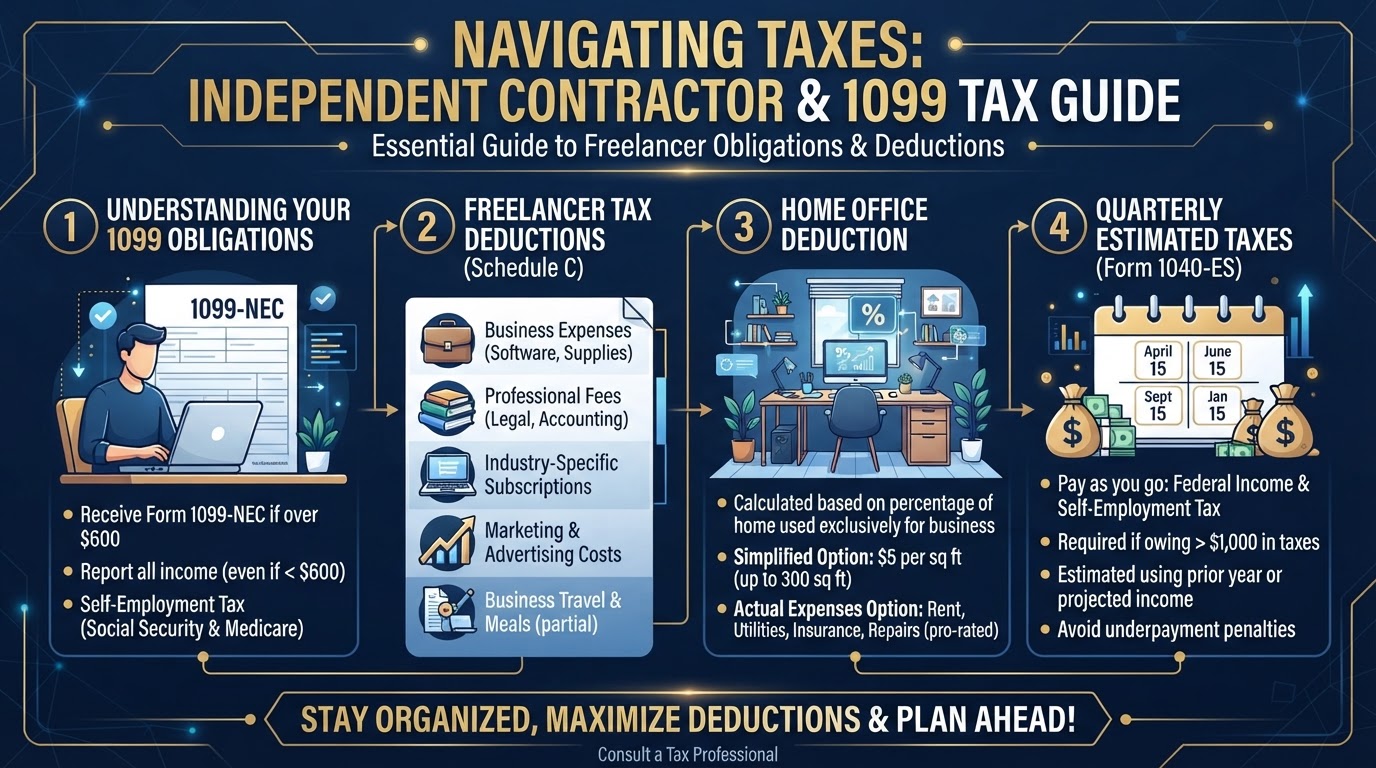
This comprehensive checklist is designed to be your daily companion for tax optimization. By systematically reviewing these categories, you can ensure that no legitimate business expense goes unrecorded. We will dive deep into the most commonly missed deductions across various business operations — from office and administrative expenses to vehicle, marketing, employee benefits, and depreciation.
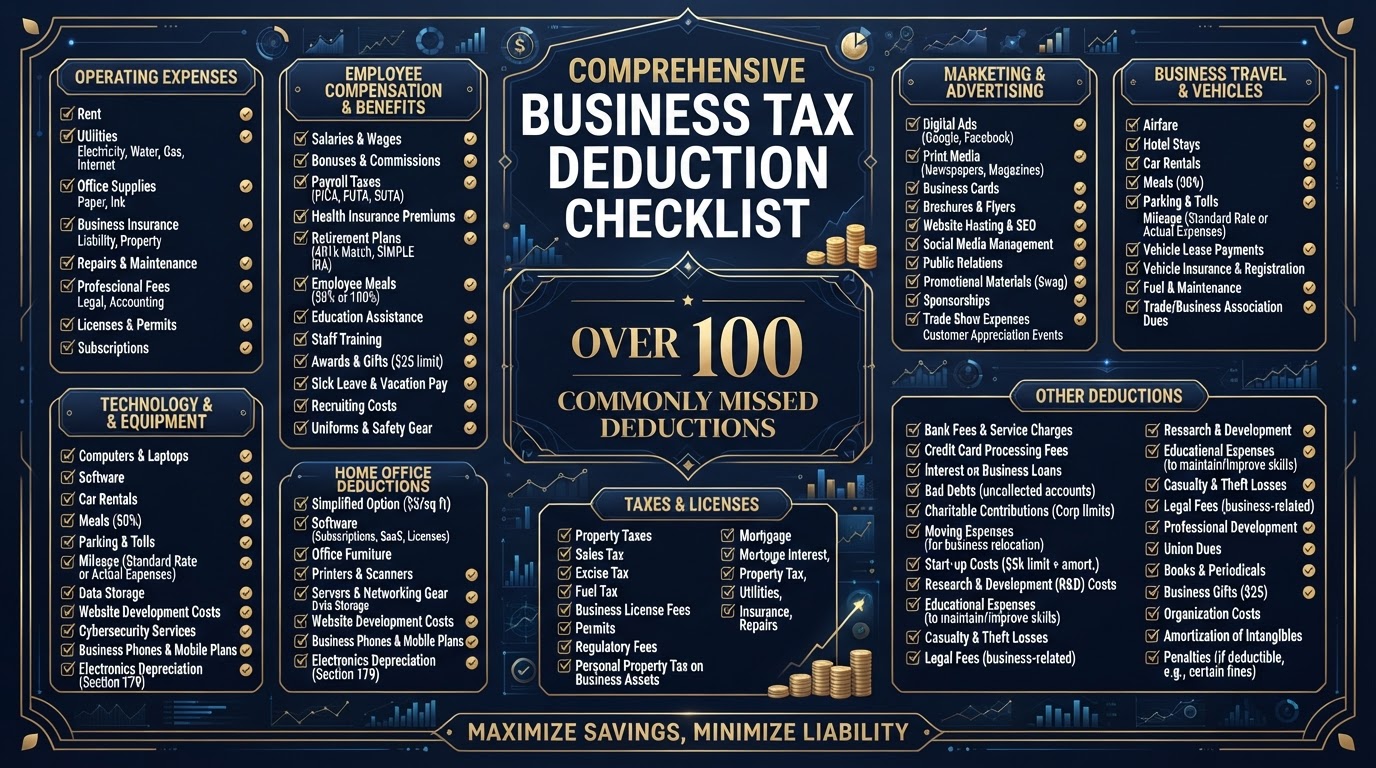
The principle behind every deduction is the same: the expense must be ordinary and necessary for your trade or business, and it must be documented. The categories below cover the vast majority of deductions most businesses are entitled to — but too often miss because the bookkeeping did not capture them cleanly.
General Office & Administrative Expenses
Office expenses are the most common and most frequently under-captured deductions. These include rent, utilities, office supplies, software subscriptions, internet, phone, postage, and small equipment. The problem is not that these are not deductible — it is that they are often paid on a personal card or buried in a commingled account and never make it into the books.
We set up a dedicated business account and card so every administrative expense is captured automatically. Software subscriptions in particular are missed constantly — the monthly SaaS charges that quietly drain a card are legitimate deductions that disappear if they are not in the books.
- Rent, utilities, internet, phone, and postage
- Office supplies and small equipment under the capitalization threshold
- Software subscriptions and SaaS tools — capture every monthly charge
Vehicle & Travel Deductions
Vehicle expenses are deductible using either the standard mileage rate (70 cents per mile in 2025) or the actual expense method. The choice is made in the first year the vehicle is placed in service, and contemporaneous mileage logs are required either way. Travel expenses — airfare, lodging, ground transportation, and 50% of meals — are deductible when the trip has a primary business purpose.
The most common mistake is failing to document the business purpose of each trip and mile. A mileage app that records date, purpose, and distance at the time of the trip solves this. We recommend the right tool and show you how to keep a log that survives an audit.
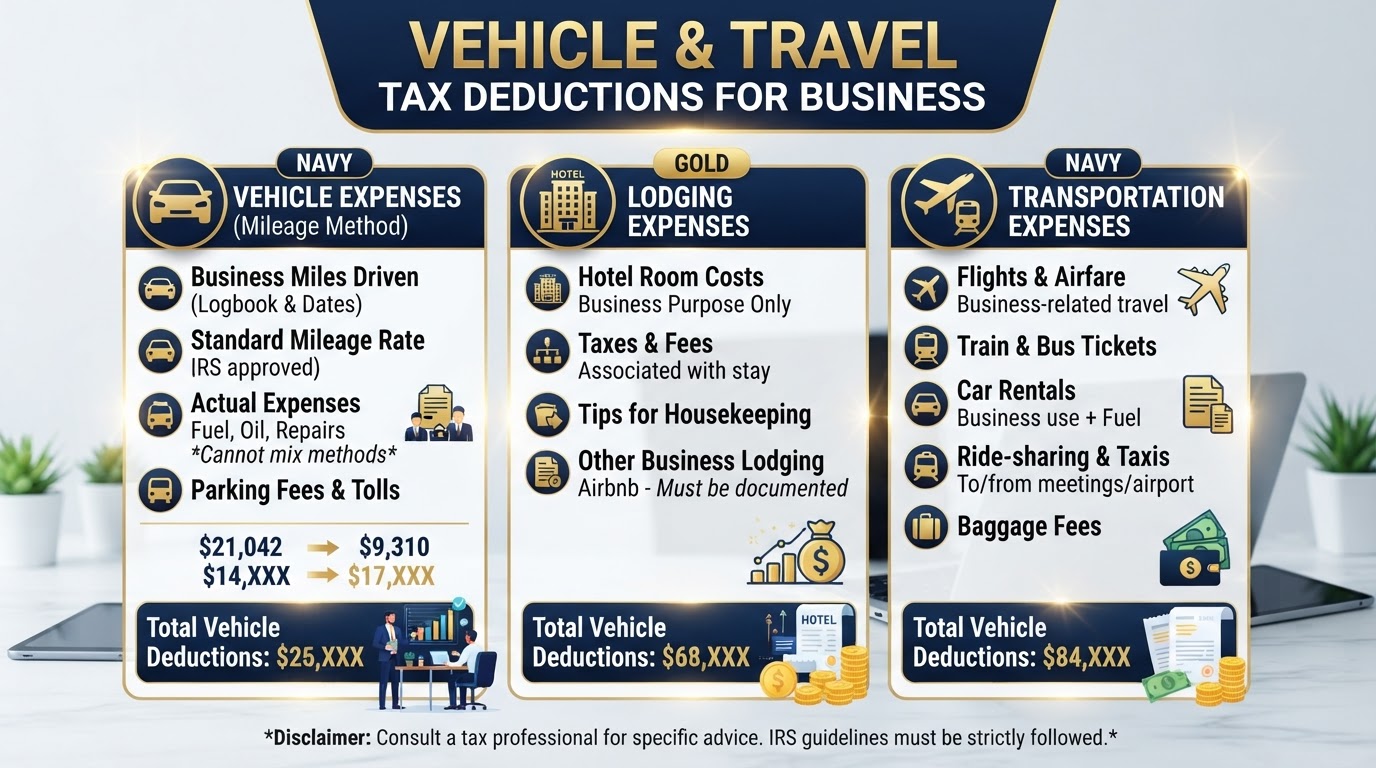
- Standard mileage rate (70 cents/mile, 2025) or actual expenses
- Travel: airfare, lodging, ground transport, 50% of meals — primary business purpose
- Contemporaneous mileage log required: date, purpose, distance
Marketing & Advertising Costs
Marketing and advertising are fully deductible as ordinary and necessary business expenses. This includes digital advertising (Google, Meta, LinkedIn ads), website design and hosting, print materials, business cards, signage, sponsorships, and promotional items. Many businesses miss the smaller, recurring charges — domain renewals, email marketing platform fees, and design tool subscriptions.
We categorize every marketing expense so the deduction is captured and the spend is visible for ROI analysis. Knowing what you spend on marketing — and what it produces — is as valuable as the deduction itself.
- Digital ads, website, print, signage, sponsorships, promotional items
- Capture recurring charges: domains, email platforms, design tools
- Fully deductible as ordinary and necessary expenses
Meals & Entertainment Current Rules
Business meals are generally 50% deductible when the meal is with a business associate, the expense is not lavish, and you (or an employee) are present. The documentation must include the date, location, amount, attendees, and business purpose. Entertainment expenses — like tickets to sporting events or concerts — are no longer deductible under the current rules, though the food and beverage portion at such an event may still qualify for the 50% meals deduction if separately stated.
The key is separating meals from entertainment and documenting the business purpose on the receipt at the time of the expense. We show clients how to capture this without creating administrative burden.

- Business meals: 50% deductible with date, attendees, purpose, amount
- Entertainment expenses are no longer deductible
- Food at entertainment events may qualify if separately stated
Home Office Deduction Strategies
The home office deduction is available to self-employed individuals and business owners who use a portion of their home regularly and exclusively for business. The simplified method allows $5 per square foot up to 300 square feet ($1,500 max). The regular method allocates actual home expenses (rent, utilities, insurance, depreciation) by the business-use percentage — which is almost always larger for a dedicated office.
The exclusive-use requirement is strict: the space must be used only for business. A guest room that doubles as an office does not qualify. We help determine which method yields the larger deduction and document the exclusive use so the deduction holds up.
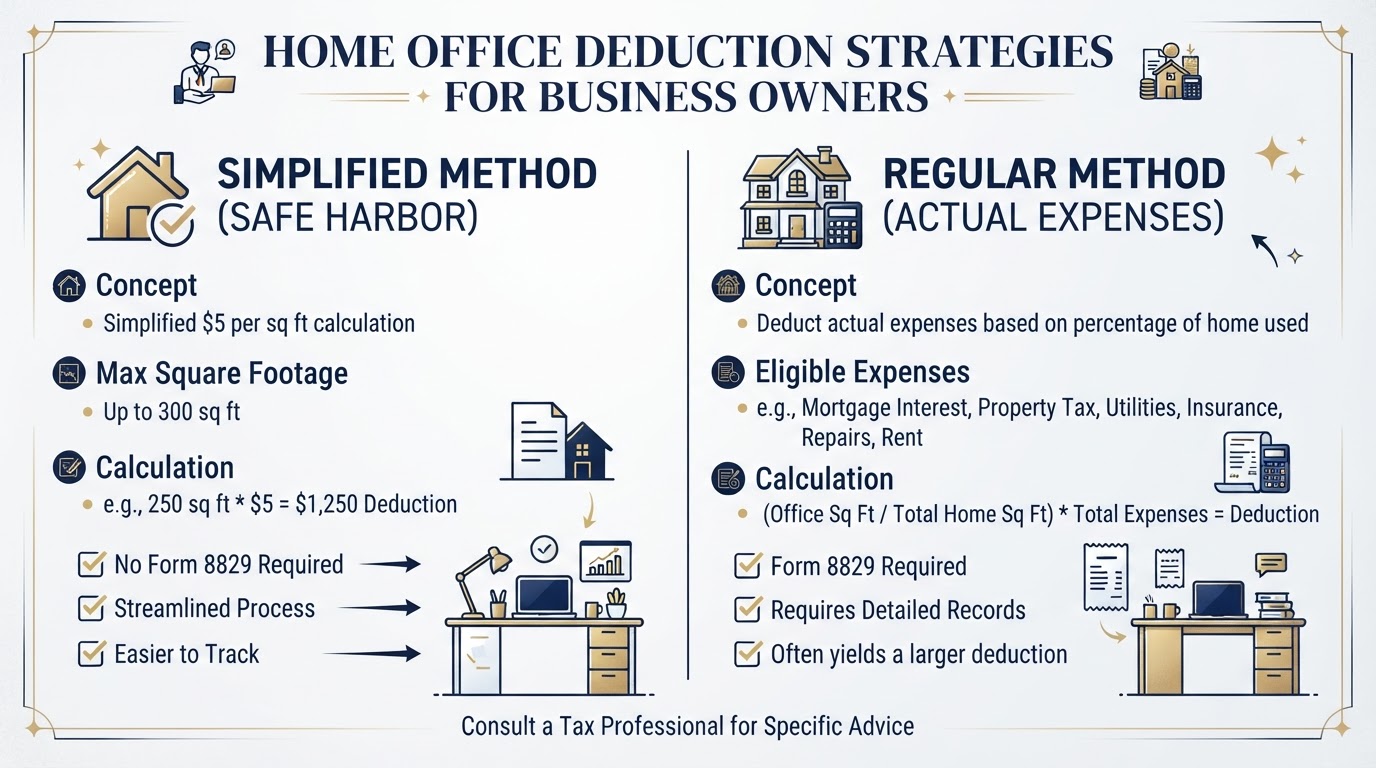
- Simplified: $5/sq ft up to 300 sq ft ($1,500 max)
- Regular: actual expenses allocated by business-use percentage
- Space must be used regularly and exclusively for business
Equipment & Depreciation
Equipment purchases can be expensed immediately under Section 179 (up to $1,220,000 in 2025) or through bonus depreciation, or depreciated over the asset's useful life. The choice depends on your current and projected income — front-loading the deduction makes sense in a high-income year, while spreading it may be better if you expect higher income in future years.
We model the after-tax outcome of each method and recommend the one that minimizes your lifetime tax burden, not just the current-year hit. The wrong choice can lock you into a depreciation schedule that no longer fits your business.
- Section 179: expense up to $1,220,000 of equipment in 2025
- Bonus depreciation: front-load the deduction in high-income years
- Model lifetime tax burden, not just the current-year deduction
Conclusion
Every legitimate expense you fail to capture is money left on the table. The deductions in this checklist are not exotic — they are the everyday expenses most businesses incur but fail to document properly. Contact us to review your books and ensure every deduction you are entitled to is captured before the next filing deadline.
Quick Tax Savings Estimator
See how much you could potentially save with proactive tax strategy and clean bookkeeping. Most LA businesses overpay by 15-20% simply due to missed deductions.
Free IRS Audit Risk Assessment
Do you mix personal and business expenses in the same bank account?
Frequently Asked Questions
How far back can you catch errors?
I perform a deep forensic review of your history to catch errors and fix them. Whether it's one year or five, my goal is to ensure your historical data is pristine before we move forward.
Will you educate me on how to manage my books?
Yes! My approach is highly educational. I want you to understand the "why" behind the numbers so you can make better business decisions with confidence.

About the Author
Wiyao Awesso
Wiyao Awesso is a leading financial advisor in Los Angeles. With extensive experience in tax strategy, accounting, and fractional CFO services, he helps business owners optimize their finances, minimize tax liabilities, and scale with confidence.