Why Your Accounting Method Matters More Than You Think
Most business owners pick an accounting method once, early on, and never think about it again. They choose cash basis because it sounds simpler, or they accept whatever default their software suggested during setup, and then they run their business for years without questioning whether that choice still fits. The truth is that your accounting method shapes every number you rely on. It determines when income shows up on your books, when expenses hit your profit and loss, what your tax liability looks like in any given year, and whether your financial statements tell a true story or a distorted one.
The difference between cash basis and accrual basis accounting is not just a technical detail. It changes how you see your business, how lenders and investors evaluate you, and how much tax you owe in a given year. Choosing the wrong method can make a profitable business look unhealthy, or it can create a tax bill that does not match the cash you actually have on hand. This guide breaks down how each method works, when each one makes sense, how to know when it is time to switch, and what the conversion actually involves so you can make the decision with confidence.

How Cash Basis Accounting Actually Works
Cash basis accounting is exactly what it sounds like. You record income when money hits your bank account, and you record expenses when money leaves your bank account. If a client signs a contract in November but does not pay until January, the income shows up in January. If you receive a vendor invoice in December but pay it in February, the expense shows up in February. The books follow the cash, nothing more.
This simplicity is the reason so many small businesses start here. Cash basis is easy to understand, easy to maintain, and easy to explain to a spouse, a partner, or a business coach. You always know exactly how much cash you have because the books reflect the bank balance. For a sole proprietor with a handful of transactions and no inventory, cash basis can work well for years. The problem is that simplicity becomes a limitation as the business grows.
Cash basis hides the timing gap between earning revenue and collecting it. You can have a record month of sales and a bank account that looks empty because none of the invoices have been paid yet. You can also look profitable on paper while sitting on a pile of unpaid bills that will wipe out that profit the moment they come due. Cash basis tells you where the cash is, but it does not tell you whether the business is actually healthy.

How Accrual Basis Accounting Actually Works
Accrual basis accounting recognizes income when it is earned, not when it is collected. It recognizes expenses when they are incurred, not when they are paid. If you complete a project and send an invoice in December, the revenue shows up in December even if the client does not pay until March. If you receive a vendor bill in October, the expense hits your books in October even if you do not pay it until the following year. The books follow the economic activity, not the cash movement.
This approach matches revenue to the expenses that generated it, which is the foundation of accurate profitability reporting. If you run a construction company and you complete a job in November, accrual accounting shows the revenue and the costs of that job together in November. Cash basis might show the revenue in November and the material costs in September, October, and December, making it nearly impossible to see whether that specific job was profitable.
Accrual basis is what lenders, investors, bonding companies, and sophisticated buyers expect to see. It is also required for businesses that carry inventory, and for businesses whose gross receipts exceed the IRS thresholds for mandatory accrual. If you are pursuing a loan, seeking investment, preparing to sell, or simply growing past the point where cash basis gives you a clear picture, accrual is the method that tells the real story.
The Key Differences That Actually Affect Your Business
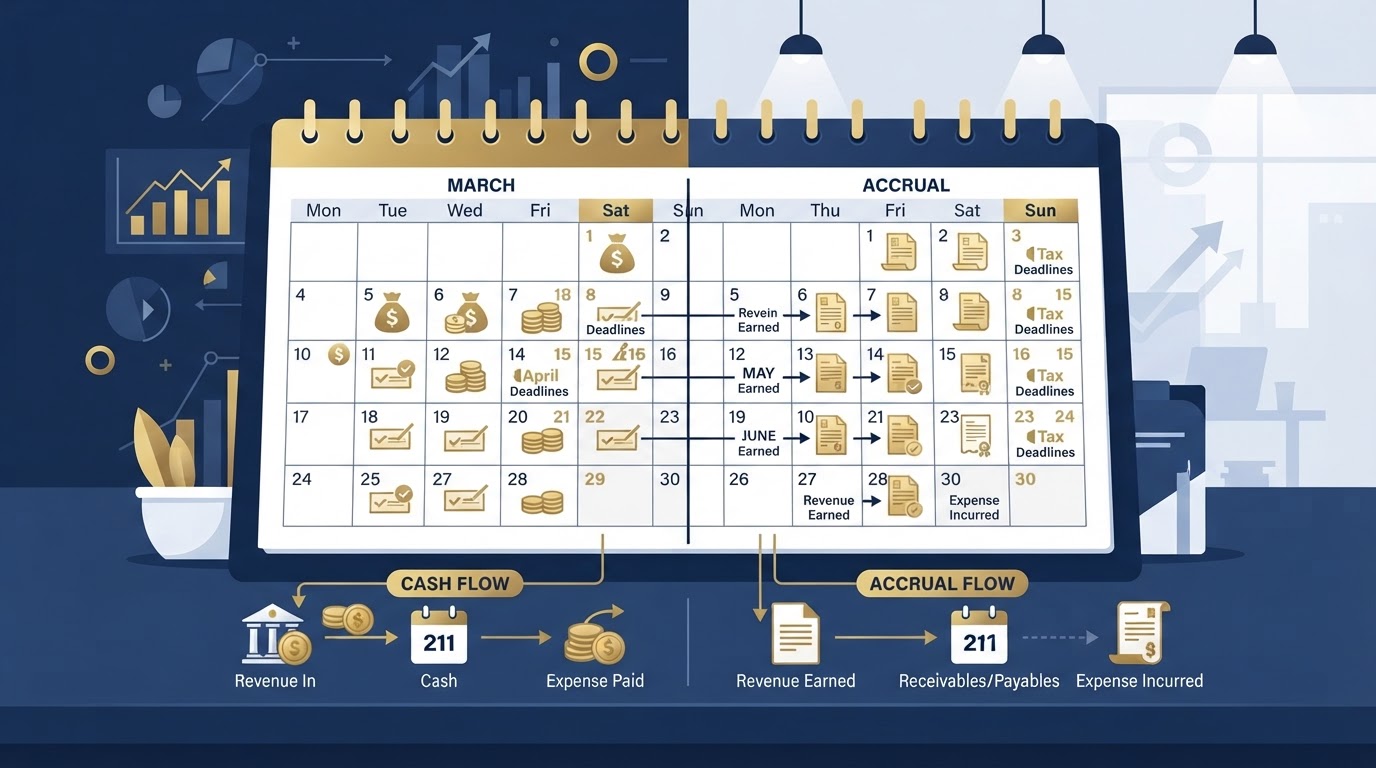
The simplest way to understand the difference is to think about timing. Cash basis asks when the money moved. Accrual basis asks when the economic event happened. That single distinction ripples through every part of your financial reporting.
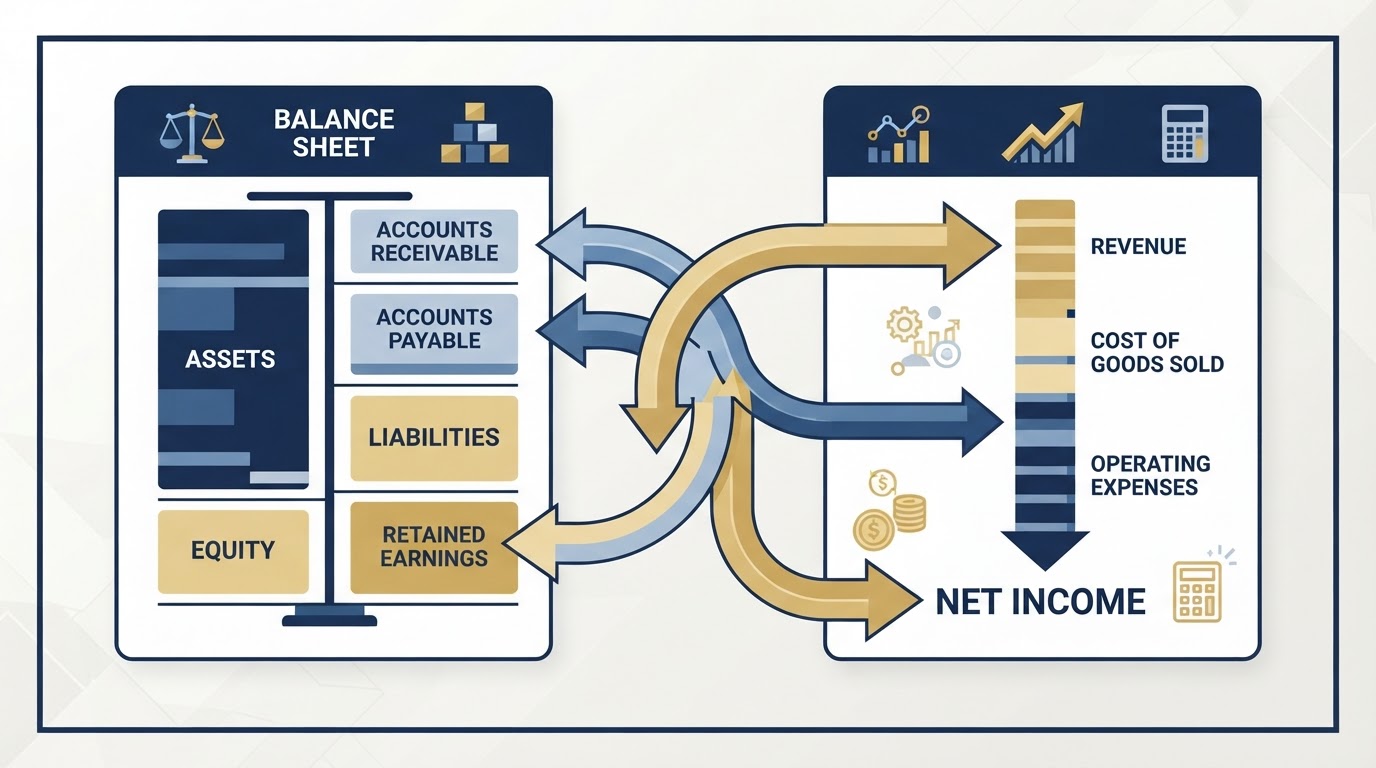
Under cash basis, accounts receivable and accounts payable do not exist on your books. You only record the transaction when cash changes hands. Under accrual basis, you track receivables and payables as real balance sheet accounts, which means you can see who owes you money, who you owe money to, and how those obligations are aging over time.
Inventory is another dividing line. Cash basis does not properly handle inventory because it records the purchase of goods as an expense when paid, regardless of whether those goods have been sold. Accrual basis capitalizes inventory as an asset on the balance sheet and only moves it to cost of goods sold when the product is actually sold, which matches the revenue to the cost and produces an accurate gross margin.
Tax timing is where most owners feel the difference directly. Cash basis lets you defer income by waiting to send invoices until after year end, and accelerate deductions by paying bills before year end. Accrual basis locks the income into the year it was earned, which means you may owe tax on revenue you have not collected yet. This is why some profitable accrual basis businesses face tax bills that strain their cash flow, and why tax planning has to account for the method you use.
When Cash Basis Makes Sense
Cash basis is a legitimate and appropriate choice for many small businesses. If you are a sole proprietor or a single member LLC with no inventory, simple transactions, and gross receipts below the IRS thresholds, cash basis can serve you well. Service businesses that collect payment at the time of service, such as consultants, tutors, or independent contractors, often find that cash basis matches how they already think about their money.
Cash basis also works when you want maximum flexibility for tax timing. Because you control when income and expenses hit the books by controlling when cash moves, you can shift taxable income between years in a way that accrual basis does not allow. For a small business whose owner is trying to manage their personal tax bracket, that flexibility can be valuable.
The limitation is that cash basis stops being useful the moment your business starts carrying accounts receivable, accounts payable, or inventory. At that point, the books no longer reflect reality, and the numbers you are making decisions on are incomplete. If you are invoicing clients and waiting 30 or 60 days for payment, cash basis is hiding your true revenue. If you are holding inventory, cash basis is distorting your cost of goods sold and your gross margin.
When Accrual Basis Makes Sense
Accrual basis becomes the right choice when your business has grown past the point where cash basis tells the full story. If you carry inventory, accrual is not optional, it is required. If you invoice clients and carry accounts receivable, accrual gives you the visibility to manage collections and understand your true revenue. If you carry accounts payable, accrual lets you see your real obligations instead of pretending they do not exist until you pay them.
Accrual is also the method that external parties trust. Banks underwriting loans, investors evaluating opportunities, bonding companies assessing contractors, and buyers conducting due diligence all expect to see accrual basis financials. Cash basis statements raise questions because they omit receivables, payables, and inventory, which are often the largest moving parts of a growing business. If you anticipate needing financing, seeking investment, or selling the business, accrual basis positions you for those conversations.
Businesses with complex revenue recognition also benefit from accrual. If you collect customer deposits, bill in milestones, have retainage held on construction contracts, or recognize revenue over time as work progresses, accrual basis is the only method that captures those realities accurately. Cash basis would record the deposit as income when received, even though the work has not been performed, creating a distorted and misleading picture.
What the IRS Requires
The IRS does not leave the choice entirely up to you. Businesses that carry inventory are generally required to use the accrual method, and businesses that meet certain gross receipts thresholds must also use accrual. There are exceptions and safe harbors, and the rules have shifted in recent years to allow more small businesses to use cash basis, but the thresholds and requirements are specific and must be evaluated carefully.
The gross receipts test is the most common threshold. If your average annual gross receipts for the prior three years exceed a specified amount, you are generally required to use the accrual method. Certain types of businesses, including C corporations with average gross receipts above the threshold and partnerships with a C corporation partner, face additional restrictions. Tax shelters are always required to use accrual regardless of size.
This is not an area to guess on. Choosing the wrong method, or continuing to use cash basis after you have crossed a threshold, can create compliance issues and require a formal accounting method change with the IRS. The method you use on your tax return also needs to be consistent with the method reflected in your books, which is why the decision should be made with professional input, not by accepting a software default.
The Hybrid Approach and Why It Confuses Owners
Some businesses use a hybrid method, recording inventory on accrual and everything else on cash. This is permitted in certain situations, and it can be a practical middle ground for businesses that carry inventory but are still small enough to benefit from cash basis for their service revenue. The problem is that hybrid accounting is easy to set up incorrectly and hard to maintain consistently, especially when multiple people are doing the bookkeeping.
If your books are on a hybrid method and you are not sure whether it is set up correctly, that uncertainty is itself a sign that it needs to be reviewed. A misconfigured hybrid can produce financials that are neither accurate under cash rules nor accurate under accrual rules, which means the numbers you are reading do not comply with either standard. Reviewing the setup and documenting the method clearly is the only way to know your financials are trustworthy.
Switching From Cash to Accrual: What Actually Happens
Switching accounting methods is not as simple as changing a setting in your software. It is a formal process that involves the IRS, because changing methods changes when income and expenses are recognized, which can create a one time tax adjustment. The IRS requires Form 3115, Application for Change in Accounting Method, to be filed to request approval for the change and to calculate the adjustment.
The adjustment is called the Section 481 adjustment, and it exists to prevent income or expense from being double counted or permanently missed during the transition. When you switch from cash to accrual, any accounts receivable that were not previously recorded become income in the year of the change, and any accounts payable that were not previously recorded become expenses. The net difference is the adjustment, and it can be spread over multiple years to soften the tax impact.
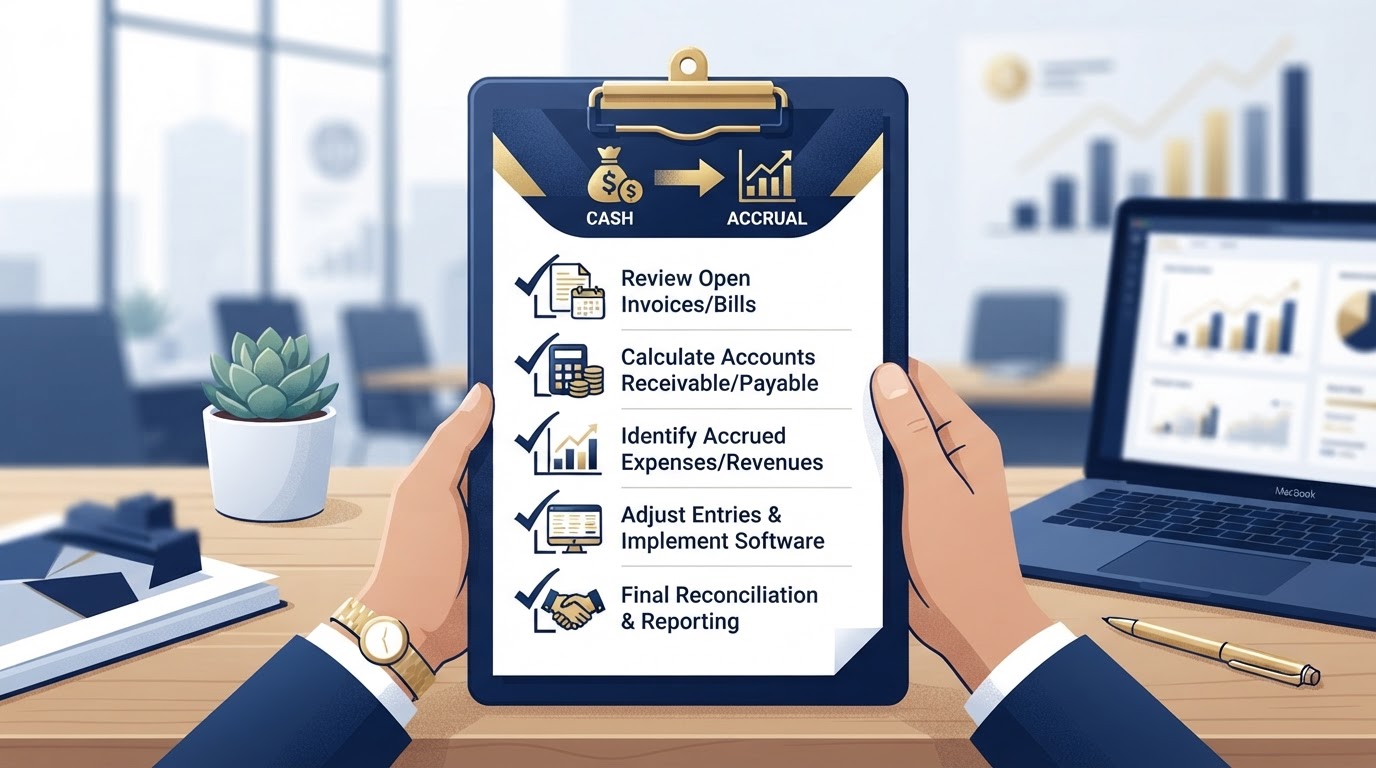
On the bookkeeping side, the conversion involves setting up opening balances for accounts receivable, accounts payable, and inventory if applicable. Every unpaid invoice and every unpaid bill needs to be entered as of the transition date. The chart of accounts needs to be reviewed to ensure it supports accrual reporting, and the recurring workflow needs to be updated so that future transactions are recorded on the accrual basis going forward. This is a project, not a quick fix, and it should be scoped and planned before it is started.
Common Mistakes We See With Accounting Methods
The most common mistake is simply not knowing which method your books are on. Many owners assume their books are cash basis because that is what they intended, but their software was set to accrual by default, or a previous bookkeeper changed it without explaining the implications. The result is books that do not match the tax return, which creates confusion at year end and can require costly cleanup.
Another common mistake is mixing personal and business cash flows in a way that distorts the method. Recording owner contributions and distributions as income and expenses, or recording loan proceeds as revenue, breaks the logic of both cash and accrual basis accounting and produces financials that do not reflect the business at all.
A third mistake is using cash basis for management decisions when the business has clearly outgrown it. If you are carrying significant receivables, payables, or inventory, and you are still making pricing, hiring, and expansion decisions based on cash basis financials, you are making those decisions on incomplete information. The cash number may look fine while the accrual picture tells a different story, or vice versa, and the gap between them is where surprises happen.
How to Decide Which Method Is Right for You
The decision comes down to three questions. First, what does the IRS require for your business type and size? If you are above the gross receipts threshold or you carry inventory, the answer may be made for you. Second, who needs to see your financials? If lenders, investors, or buyers are in your future, accrual basis is what they will expect. Third, what do you need your numbers to tell you? If you need to see true profitability, manage receivables and payables, and understand gross margin on inventory, accrual is the method that delivers that clarity.
For many growing businesses, the answer is to run accrual basis books for management and reporting, and let your tax professional determine whether cash basis is still available and beneficial for tax purposes. This gives you accurate financials for decision making while preserving tax flexibility where the law allows it. The two are not in conflict when the setup is done correctly, and the reconciliation between book and tax is a normal part of year end.
The worst approach is to leave the decision unmade. If you do not know which method your books are on, or if the method was chosen years ago and never revisited, that uncertainty is costing you. Every decision you make on unclear numbers carries that risk forward, and the longer it goes unaddressed, the more expensive the cleanup becomes.

A FIG Engagement: Converting From Cash to Accrual
A wholesale distribution client came to Fiscal Integrity Group with books that had been on cash basis since the business started. As the company grew, the owner noticed that their gross margin numbers did not make sense. Material costs were hitting the books when paid, which was often weeks after the goods were received and sometimes in a different month than the sales those goods generated. The result was a profit and loss statement that swung wildly from month to month for no reason other than the timing of cash movement.
FIG scoped the conversion as a project. We reviewed the chart of accounts and confirmed it needed to support inventory as an asset account, cost of goods sold, and accounts payable. We gathered every unpaid vendor invoice and every unpaid customer invoice as of the transition date and entered them as opening balances. We set up the inventory valuation and reconciled it to a physical count. We filed Form 3115 to request the accounting method change and calculated the Section 481 adjustment so the transition did not create a one time tax surprise.
After the conversion, the client received monthly accrual basis financials that showed true gross margin, accurate accounts receivable and accounts payable aging, and a balance sheet that reflected inventory as a real asset. The owner could finally see which product lines were profitable and which were not, and the financials were ready to hand to a lender when the client pursued a line of credit later that year. The conversion was a project, but it gave the owner numbers they could finally trust.
How Fiscal Integrity Group Helps You Get It Right
If you are not sure which accounting method your books are on, or if you know it is time to switch, Fiscal Integrity Group can help. We review your current setup, confirm what method your books and tax return are actually using, and recommend the method that fits your business size, industry, and goals. If a conversion is needed, we scope it as a project, handle the bookkeeping work, and coordinate the tax filing so the transition is clean and compliant.
We do not just change a setting and hope for the best. We rebuild the chart of accounts, set up opening balances, document the method clearly, and update your recurring workflow so future transactions are recorded correctly. The result is books that match your tax return, financials that tell the true story of your business, and a system you can rely on for the decisions that matter.
Quick Tax Savings Estimator
See how much you could potentially save with proactive tax strategy and clean bookkeeping. Most LA businesses overpay by 15-20% simply due to missed deductions.
Free IRS Audit Risk Assessment
Do you mix personal and business expenses in the same bank account?
Frequently Asked Questions
How far back can you catch errors?
I perform a deep forensic review of your history to catch errors and fix them. Whether it's one year or five, my goal is to ensure your historical data is pristine before we move forward.
Will you educate me on how to manage my books?
Yes! My approach is highly educational. I want you to understand the "why" behind the numbers so you can make better business decisions with confidence.

About the Author
Wiyao Awesso
Wiyao Awesso is a leading financial advisor in Los Angeles. With extensive experience in tax strategy, accounting, and fractional CFO services, he helps business owners optimize their finances, minimize tax liabilities, and scale with confidence.