While most business owners obsess over their Profit & Loss statement, the balance sheet often holds the true secrets to a company's financial health. A balance sheet provides a snapshot of what your business owns (assets) and what it owes (liabilities) at a specific point in time. Understanding this document is critical for securing loans, attracting investors, and managing liquidity.
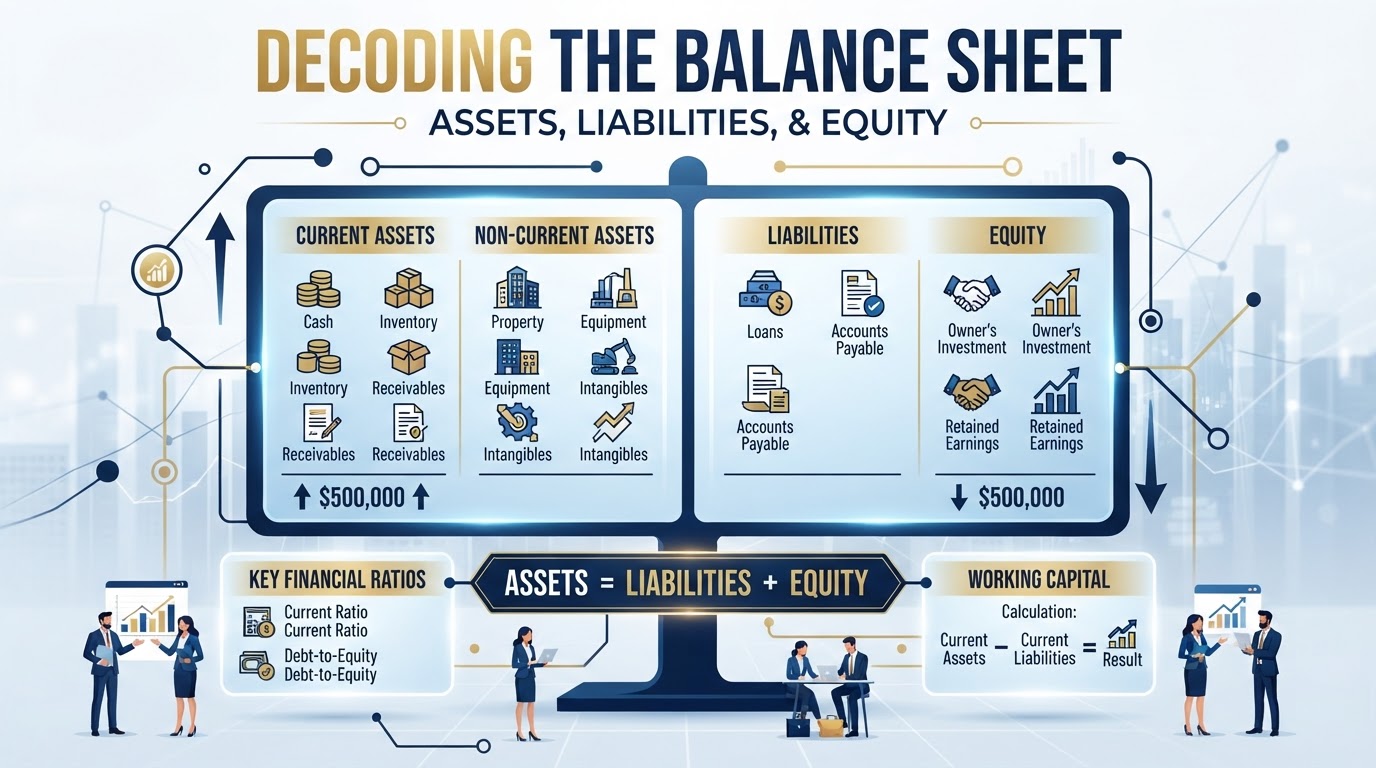
This guide breaks down the components of the balance sheet in plain language — assets, liabilities, and equity — and explains the ratios and metrics that reveal whether your business is genuinely healthy or just profitable on paper. The balance sheet and the income statement tell different stories, and you need both to understand the full picture.
Current vs. Non-Current Assets
Assets are split into current (expected to be converted to cash within one year) and non-current (held for longer than a year). Current assets include cash, accounts receivable, inventory, and short-term investments — they are the resources you can deploy quickly. Non-current assets include property, equipment, and intangible assets — the long-term productive capacity of the business.
The ratio of current assets to current liabilities (the current ratio) is a quick measure of liquidity. A business with plenty of current assets relative to current liabilities can meet its short-term obligations; one with a thin current ratio is at risk of a cash crunch even if it is profitable on the income statement.
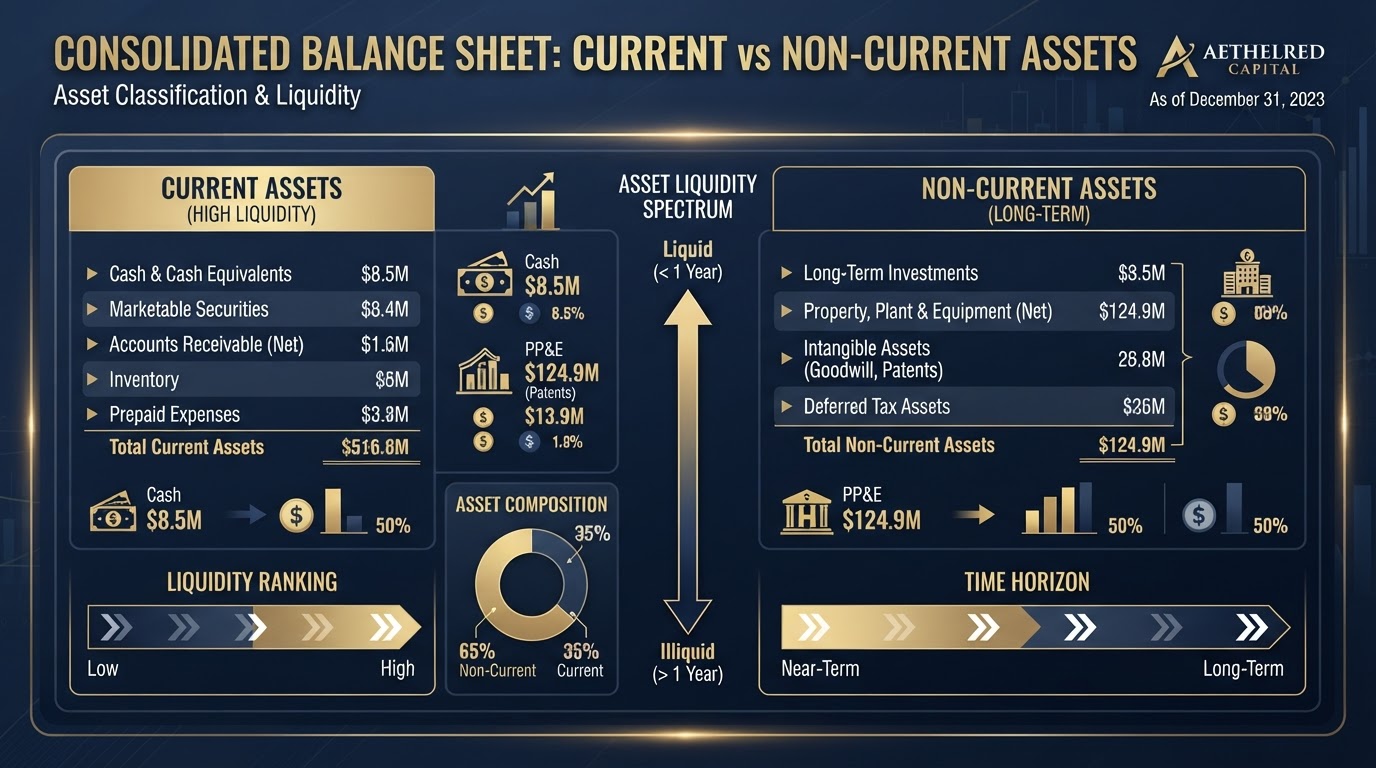
- Current assets: cash, receivables, inventory — convertible within a year
- Non-current assets: property, equipment, intangibles — long-term capacity
- Current ratio (current assets ÷ current liabilities) measures liquidity
Understanding Accounts Receivable Aging
Accounts receivable is only an asset if it is actually collectible. The receivables aging report breaks down what customers owe you by how long the invoice has been outstanding — current, 1-30 days, 31-60 days, 61-90 days, and over 90 days. The older a receivable gets, the less likely it is to be collected, and at some point it must be written off as bad debt.
A healthy balance sheet shows receivables concentrated in the current and 1-30 day buckets. A balance sheet with receivables piling up in the 60+ day buckets is a warning sign — the business may be profitable on paper but starved for cash because customers are not paying. We review the aging report monthly and flag accounts that need collection action.
- Aging report breaks receivables by how long they have been outstanding
- Older receivables are less collectible and may become bad debt
- Receivables piling up in 60+ day buckets signal a cash flow problem
Current Liabilities and Working Capital
Current liabilities are obligations due within one year — accounts payable, accrued expenses, short-term debt, and the current portion of long-term debt. Working capital is current assets minus current liabilities; it is the cushion available to fund day-to-day operations. Positive working capital means you can cover your short-term obligations; negative working capital means you cannot — regardless of what the income statement says.
A business with negative working capital is living on borrowed time, financing operations with money it owes. We track working capital monthly and identify the levers — accelerating receivables, managing payables, or arranging a line of credit — that keep the cushion positive.
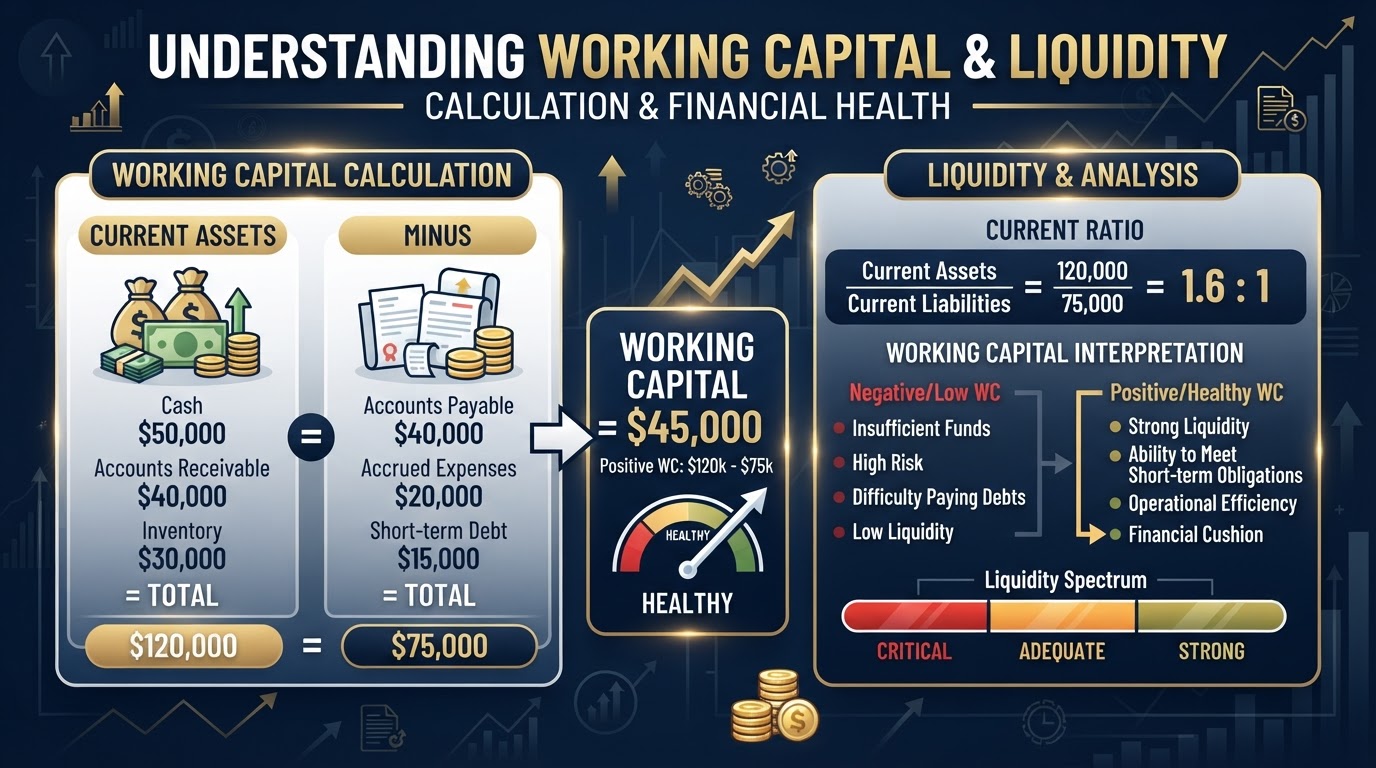
- Current liabilities: payables, accruals, short-term debt due within a year
- Working capital = current assets minus current liabilities
- Negative working capital signals a cash crunch even if profitable
Long-Term Debt and Equity
The right side of the balance sheet shows how the business is funded — long-term debt and owner equity. Long-term debt is obligations due beyond one year: mortgages, equipment loans, and long-term notes. Equity is the owner's stake — contributed capital plus retained earnings (the accumulated profits the business has kept). The mix of debt and equity is the capital structure, and it determines both the cost of capital and the financial risk.
A business heavily reliant on debt has higher fixed obligations and greater risk in a downturn; a business funded mostly by equity is more resilient but may be giving up the leverage that debt provides. We help owners understand their capital structure and whether it is appropriate for their stage and risk tolerance.
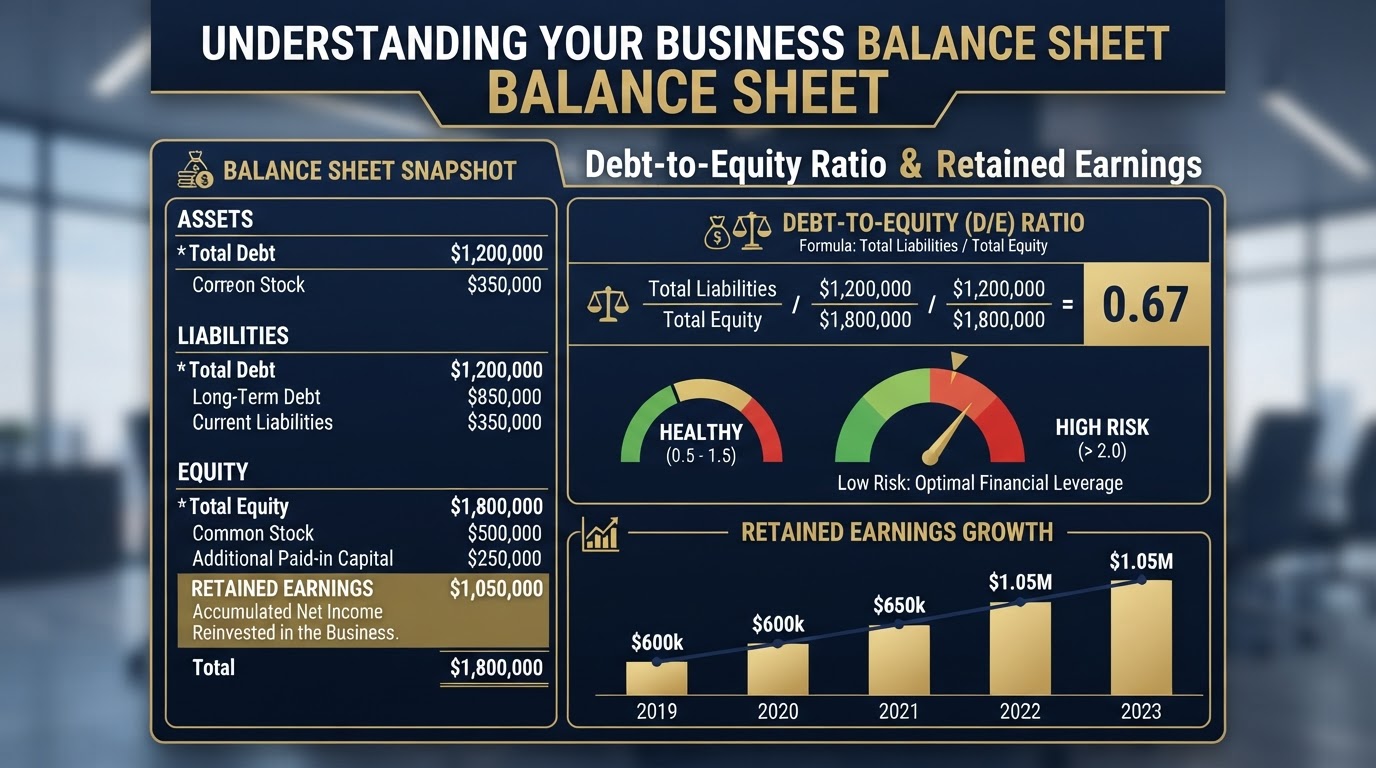
- Long-term debt: mortgages, equipment loans, notes due beyond a year
- Equity: contributed capital plus retained earnings
- The debt-to-equity ratio measures financial leverage and risk
Retained Earnings Explained
Retained earnings is the cumulative profit the business has earned and kept rather than distributed to owners. It is the bridge between the income statement and the balance sheet — each year's net profit flows into retained earnings, and each distribution to owners flows out. A growing retained earnings balance signals a business that is generating and reinvesting profit; a shrinking or negative balance signals a business that is losing money or distributing more than it earns.
Negative retained earnings (an accumulated deficit) is a red flag that the business has historically lost money. Lenders and investors scrutinize this line closely. We ensure retained earnings is calculated correctly each year and explain what the trend means for your business.
- Retained earnings = cumulative profit kept in the business
- Each year's net profit flows in; distributions flow out
- Negative retained earnings signals historical losses — a red flag
Conclusion
The balance sheet tells you whether your business is solvent, liquid, and appropriately capitalized — things the income statement cannot. A profitable business with a weak balance sheet is still at risk. Contact us to review your balance sheet, identify the warning signs, and build the financial strength that sustains growth.
Quick Tax Savings Estimator
See how much you could potentially save with proactive tax strategy and clean bookkeeping. Most LA businesses overpay by 15-20% simply due to missed deductions.
Free IRS Audit Risk Assessment
Do you mix personal and business expenses in the same bank account?
Frequently Asked Questions
How far back can you catch errors?
I perform a deep forensic review of your history to catch errors and fix them. Whether it's one year or five, my goal is to ensure your historical data is pristine before we move forward.
Will you educate me on how to manage my books?
Yes! My approach is highly educational. I want you to understand the "why" behind the numbers so you can make better business decisions with confidence.

About the Author
Wiyao Awesso
Wiyao Awesso is a leading financial advisor in Los Angeles. With extensive experience in tax strategy, accounting, and fractional CFO services, he helps business owners optimize their finances, minimize tax liabilities, and scale with confidence.