Receiving an IRS audit notice is one of the most stressful events any business owner or individual taxpayer can face. However, being audited does not mean you did something wrong — the IRS audits returns for a variety of reasons, many of them statistical. What matters most is how you respond. This guide is your definitive resource for understanding the audit process from start to finish, from the moment you receive that notice to the final resolution.
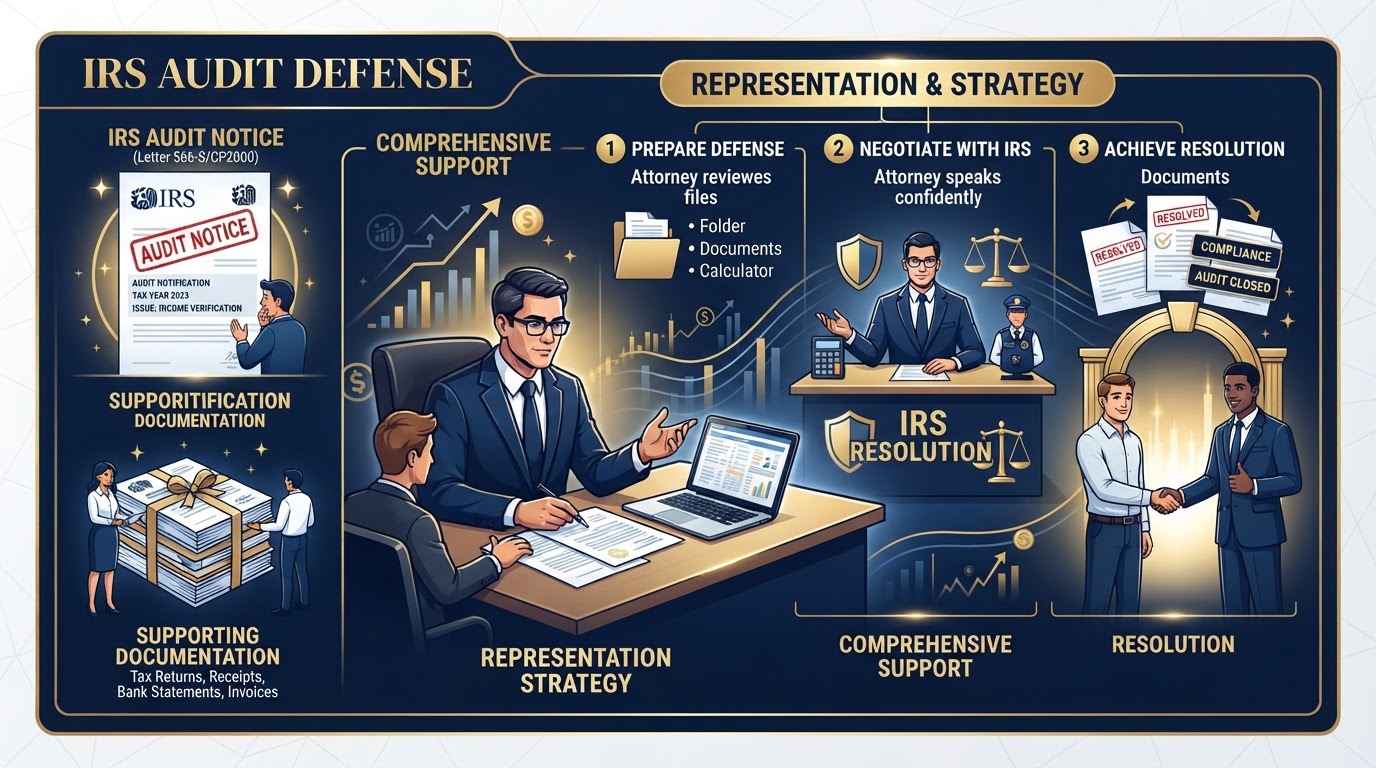
We cover the three types of IRS audits, the most common triggers that increase your audit risk, and the documentation standards the IRS expects to see. More importantly, we outline the exact steps to take from the moment you receive that notice — including whether to handle it yourself, hire a CPA, or engage an Enrolled Agent or Tax Attorney. With proper documentation practices in place before an audit, most examinations can be resolved quickly and in your favor.
The 3 Types of IRS Audits Explained
The IRS conducts three distinct types of audits, each with a different level of severity. The correspondence audit is conducted entirely by mail and typically addresses a single, specific issue — a missing form, a mismatched income document, or a single deduction. The office audit requires you to bring your records to an IRS office, usually covering a broader range of items. The field audit is the most comprehensive: an IRS agent comes to your home or place of business and examines your entire return.
The type of audit you receive dictates the response strategy. Correspondence audits can often be resolved by mailing in the requested documentation. Office and field audits require preparation, and in most cases, professional representation. The sooner you identify the audit type, the sooner you can prepare the right response.
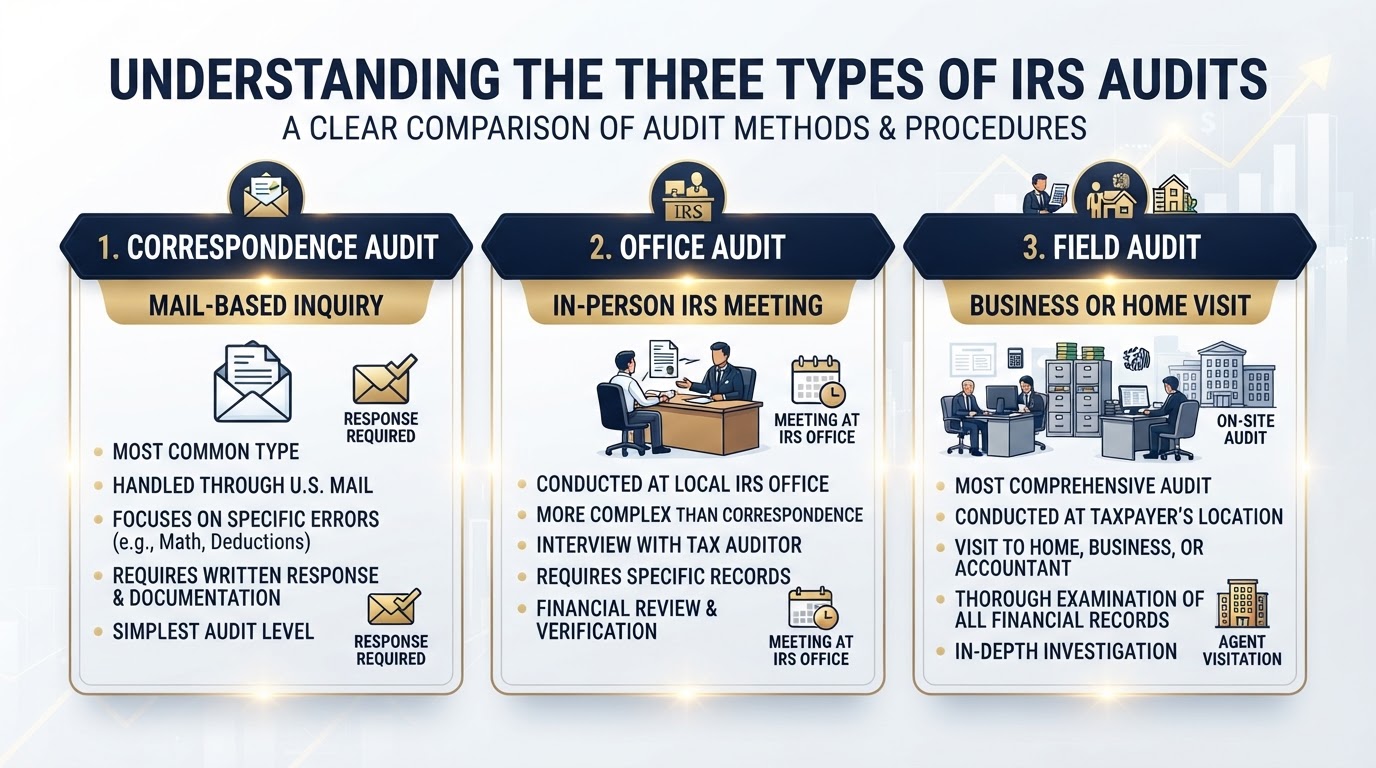
- Correspondence audit: by mail, single issue, simplest to resolve
- Office audit: bring records to an IRS office, broader scope
- Field audit: agent visits your business, most comprehensive
Top 10 Audit Triggers for Business Owners
The IRS uses a combination of statistical scoring and document matching to select returns for audit. The Discriminant Income Function (DIF) system scores every return based on how far it deviates from similar returns. Returns with unusually high deductions relative to income, large cash transactions, or significant home office and vehicle deductions tend to score higher. Document matching catches unreported income when a 1099 or W-2 on file with the IRS does not appear on your return.
Common triggers include a high income relative to deductions claimed, large charitable contributions relative to income, claiming losses from a hobby-like activity year after year, significant cash transactions, and round-number entries that suggest estimates rather than actual records. Understanding these triggers lets you proactively document the items most likely to be questioned.
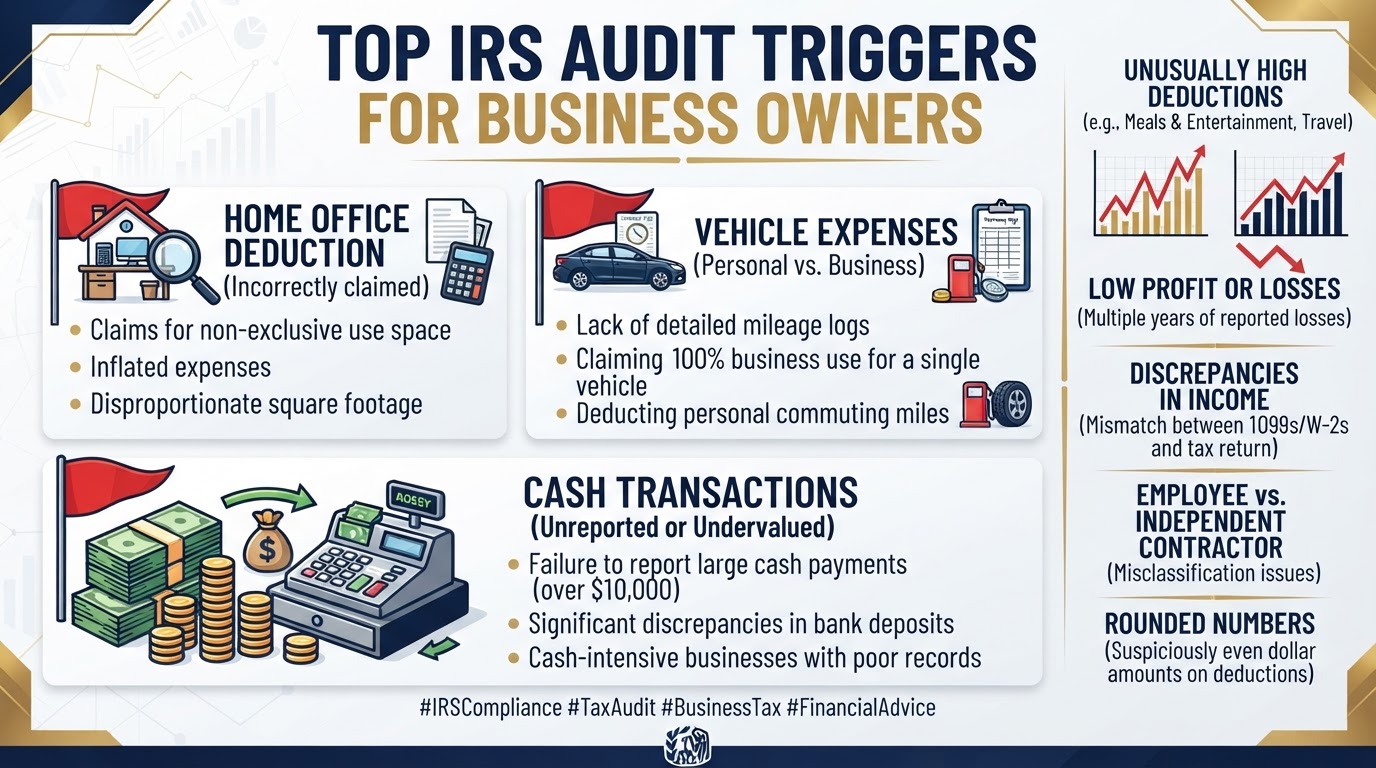
- Deductions unusually high relative to income (DIF score)
- Unreported income caught by document matching
- Large cash transactions and round-number estimates
- Recurring losses in a hobby-like activity
Documentation Standards the IRS Requires
The IRS requires "contemporaneous" documentation — records created at or near the time of the transaction, not reconstructed after the fact. A mileage log written in January for the prior year does not hold up. A receipt with the business purpose noted at the time of the expense does. The standard is not just that you spent the money; it is that you can prove the business purpose, the amount, the date, and the place.
For each category of deduction, the IRS expects specific evidence. Travel requires receipts and a business purpose for each trip. Meals require the date, attendees, business purpose, and amount. Vehicle expenses require a mileage log. Charitable contributions require written acknowledgments for gifts of $250 or more. We help establish the documentation systems that produce this evidence automatically, so the records exist before an audit ever begins.
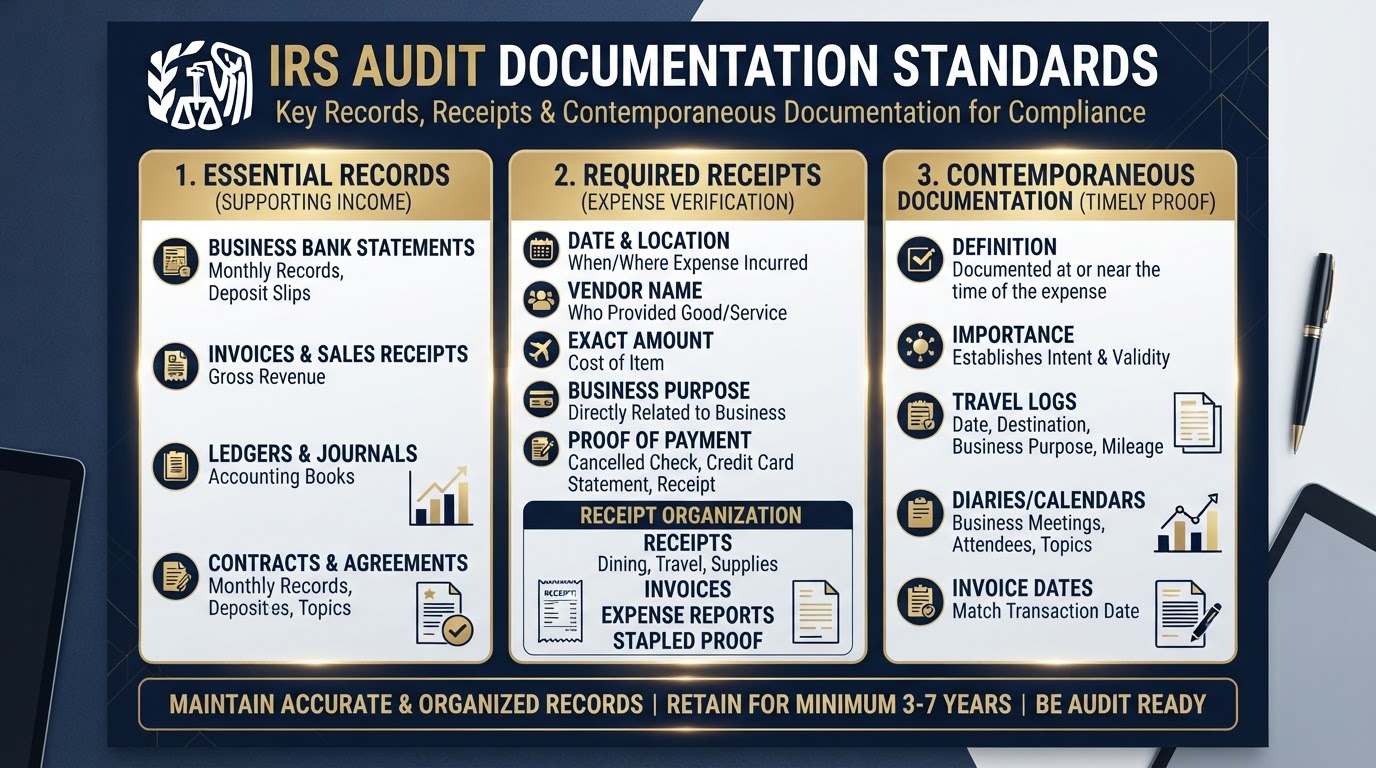
- Contemporaneous records — created at the time of the transaction
- Business purpose, amount, date, and place for every expense
- Written acknowledgments for charitable gifts of $250 or more
- Reconstructed logs after the fact do not survive an audit
Should You Hire Representation?
For a simple correspondence audit on a single issue, you may be able to respond yourself by mailing in the requested documents. For office and field audits — or any audit that touches business income, deductions, or entity structure — professional representation is almost always the right call. A CPA, Enrolled Agent, or Tax Attorney can communicate with the IRS on your behalf, prepare the documentation package, and ensure you do not inadvertently expand the scope of the audit.
Representation also protects you from saying something that could be used against you. The IRS examiner is trained to ask questions that elicit information; a representative ensures only the relevant, documented information is provided. The cost of representation is often far less than the cost of an expanded audit or an unfavorable outcome.
- Correspondence audits on a single issue may be handled directly
- Office and field audits almost always warrant representation
- A representative limits the scope and speaks to the IRS for you
Penalties, Interest, and the Appeals Process
If the audit results in a deficiency, the IRS assesses the additional tax plus penalties and interest. Common penalties include the accuracy-related penalty (20% of the underpayment) for negligence or substantial understatement, and the failure-to-pay penalty. Interest accrues on both the tax and the penalties from the original due date of the return. The total can grow quickly, which is why early resolution matters.
You have the right to appeal an audit outcome through the IRS Office of Appeals, and ultimately to the U.S. Tax Court without first paying the deficiency. Penalty abatement may be available for first-time noncompliant taxpayers with a clean history. We evaluate whether appeal, abatement, or a negotiated settlement is the right path for your situation.
- Accuracy-related penalty: 20% of the underpayment for negligence
- Interest accrues on tax and penalties from the original due date
- Appeals and Tax Court available; first-time penalty abatement possible
Conclusion
An audit is a process, not a verdict. The taxpayers who fare worst are those who ignore the notice, fail to maintain contemporaneous records, or try to handle a complex audit without representation. The taxpayers who fare best have documentation systems in place before the audit begins and engage representation early. Contact us to review your documentation practices — or to represent you if a notice has already arrived.
Quick Tax Savings Estimator
See how much you could potentially save with proactive tax strategy and clean bookkeeping. Most LA businesses overpay by 15-20% simply due to missed deductions.
Free IRS Audit Risk Assessment
Do you mix personal and business expenses in the same bank account?
Frequently Asked Questions
How far back can you catch errors?
I perform a deep forensic review of your history to catch errors and fix them. Whether it's one year or five, my goal is to ensure your historical data is pristine before we move forward.
Will you educate me on how to manage my books?
Yes! My approach is highly educational. I want you to understand the "why" behind the numbers so you can make better business decisions with confidence.

About the Author
Wiyao Awesso
Wiyao Awesso is a leading financial advisor in Los Angeles. With extensive experience in tax strategy, accounting, and fractional CFO services, he helps business owners optimize their finances, minimize tax liabilities, and scale with confidence.