Why High-Net-Worth Filers Draw IRS Attention
If you live in Malibu, Hollywood, or anywhere along the coastal corridors of Southern California, your tax return carries a target that most filers never have to think about. The IRS does not audit everyone equally. It concentrates its examination resources on returns that combine high income, complex structures, large deductions, and significant pass-through activity — the exact profile of a successful entrepreneur, entertainment professional, real estate investor, or private-equity principal. The agency's own data confirms that audit rates climb sharply once adjusted gross income crosses certain thresholds, and the scrutiny intensifies further when a return includes the kinds of items that high-net-worth households routinely claim.
This guide is not about fear. It is about preparation. Understanding what draws IRS attention lets you file with confidence, document the positions you take, and avoid the patterns that turn a routine return into a multi-year examination. At Fiscal Integrity Group, we work with high-income filers across Los Angeles County every tax season, and the same triggers appear again and again. Below we break down each one, explain why the IRS cares, and describe what clean documentation looks like before a notice ever arrives.

How the IRS Actually Selects Returns for Audit
Before diving into specific triggers, it helps to understand the machinery behind selection. The IRS does not read every return by hand. It runs returns through automated systems that score them for audit potential. The most well-known is the Discriminant Function (DIF) system, which assigns a numerical score to each return based on how far its deductions, credits, and ratios deviate from what the IRS expects for a filer in that income bracket. A high DIF score does not guarantee an audit, but it puts a return in the pool from which examiners pull.
The IRS also relies heavily on document matching. Every W-2, 1099, K-1, and 1098 that gets filed against your Social Security number or EIN is matched against the income and deductions you report. A mismatch — income reported on a 1099 that does not appear on your return, or a mortgage interest deduction that does not match the lender's 1098 — generates an automated notice, often before a human ever looks at the return. For high-net-worth filers with dozens of information returns flowing in each year, the matching process alone is a significant source of exposure.
Beyond automation, the IRS has dedicated compliance programs aimed at high-income individuals. These include examinations of large partnerships, pass-through entities, and returns with international activity. The agency has publicly stated its intent to increase enforcement on high earners and complex pass-through structures, which means the patterns described in this guide are becoming more relevant, not less.

Trigger One: Income That Does Not Match Information Returns
This is the most common and the most avoidable trigger. A high-net-worth filer often receives income from many sources — consulting fees, board director compensation, royalty payments, investment distributions, partnership guaranteed payments, and 1099-K amounts from payment processors. Each of these generates an information return filed with the IRS. If any amount on those forms does not reconcile to what appears on your 1040 or your entity return, the IRS matching program flags it automatically.
The fix is procedural. Before filing, we reconcile every information return against the books. A 1099-NEC for consulting should tie to the consulting income reported. A K-1 from a partnership should match the ordinary business income, rental income, interest, dividends, and capital gains passed through. A 1099-K from Stripe or PayPal should be accounted for in gross receipts, with any fees and refunds properly netted. When a payer issues a corrected 1099 after you have already filed, that correction needs to be addressed on an amended return rather than ignored, because the IRS will see both versions.
Trigger Two: Large Charitable Contributions and Non-Cash Donations
Charitable giving is a hallmark of high-income tax planning, and the IRS knows it. Contributions of cash to qualified organizations are generally straightforward, but non-cash donations — artwork, real estate, privately held business interests, and conservation easements — draw immediate scrutiny. The larger the deduction relative to your income, the more likely the return is to be scored for examination.
For non-cash gifts above $5,000, a qualified appraisal is required, and Form 8283 must be attached to the return with the appraiser's signature and a description of the property. For conservation easement donations, the rules are even more demanding — a qualified appraisal, a baseline documentation report, and a deed of conservation easement that meets specific requirements under Section 170(h). The IRS has made conservation easements a dedicated compliance focus, and deductions that lack the required substantiation are routinely disallowed in full, with penalties added.
The documentation standard is not optional. A cancelled check is not enough for non-cash gifts. A market opinion from a broker is not a qualified appraisal. And a donation made to a non-qualified organization — a private foundation that has not received its 501(c)(3) determination, or a foreign charity without an equivalency ruling — produces no deduction at all. We review every charitable position before filing to confirm the recipient qualifies, the valuation is defensible, and the required forms are attached.

Trigger Three: Home Office and Mixed-Use Property Deductions
A Malibu or Hollywood residence is often a substantial asset, and claiming a home office deduction against a property with a high fair market value and large mortgage interest creates a multiplier effect that draws attention. The home office deduction under Section 280A requires that the space be used regularly and exclusively as the principal place of business. "Exclusive" is the word that ends most audits. A guest bedroom that doubles as an office does not qualify. A dining table used for business during the day does not qualify. The space must be devoted to business use and nothing else.
The deduction is calculated as a percentage of the home's total square footage, and that percentage is applied to mortgage interest, property taxes, insurance, utilities, repairs, and depreciation. On a high-value property, even a modest percentage produces a large deduction. The IRS knows this, and it looks for returns where the home office percentage seems aggressive relative to the claimed business activity. A 400-square-foot office in a 3,000-square-foot home is defensible. A claim that half the residence is used for business is not, unless there is a genuine, exclusive, and documented business use.
Mixed-use property extends beyond the home office. A vacation property that is rented out part of the year and used personally the rest must be allocated between rental and personal use under the Section 280A vacation-home rules. Personal use days — including days used by family members or anyone under a shared-ownership arrangement — reduce the deductible rental expenses and can recharacterize the property entirely. We track use days carefully for every client with a short-term rental or second home, because the allocation is one of the first things an examiner reconstructs.

Trigger Four: Pass-Through Entities and Reasonable Compensation
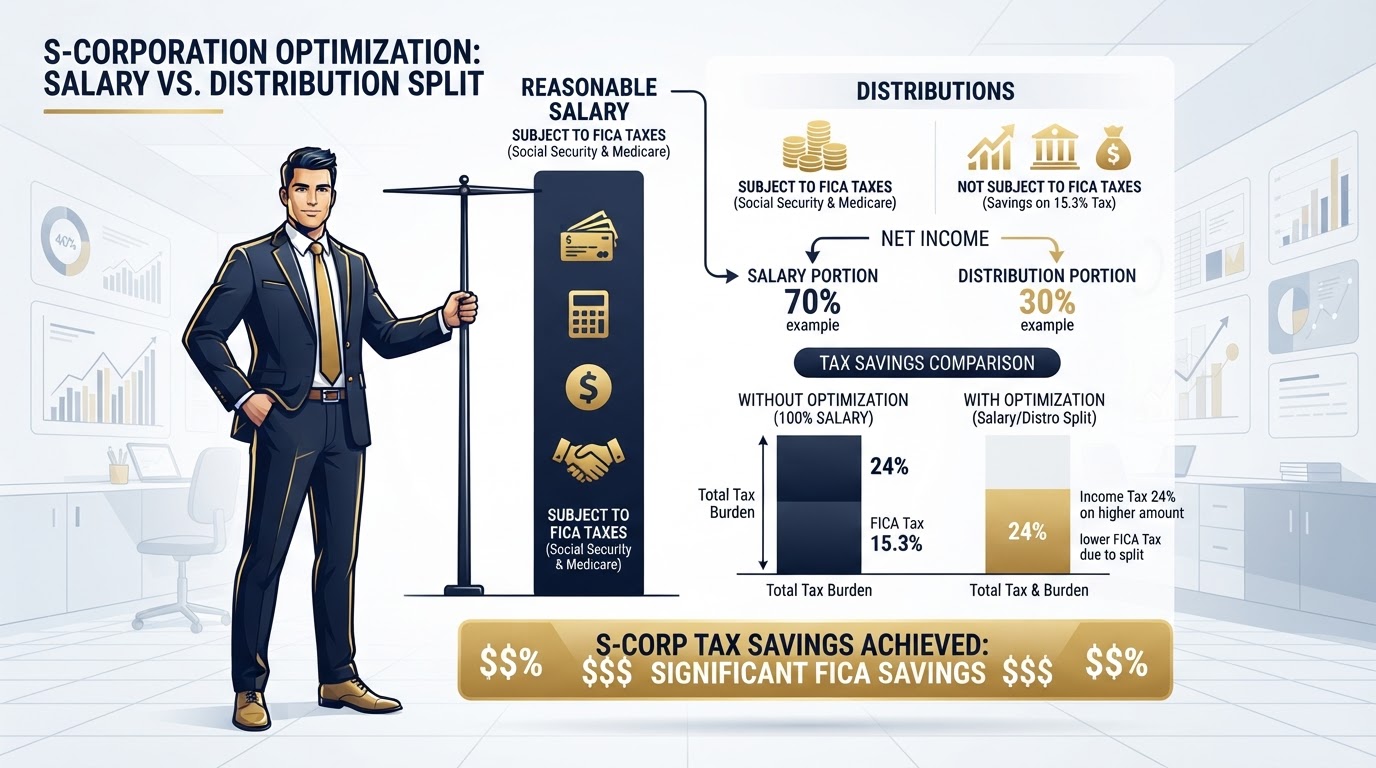
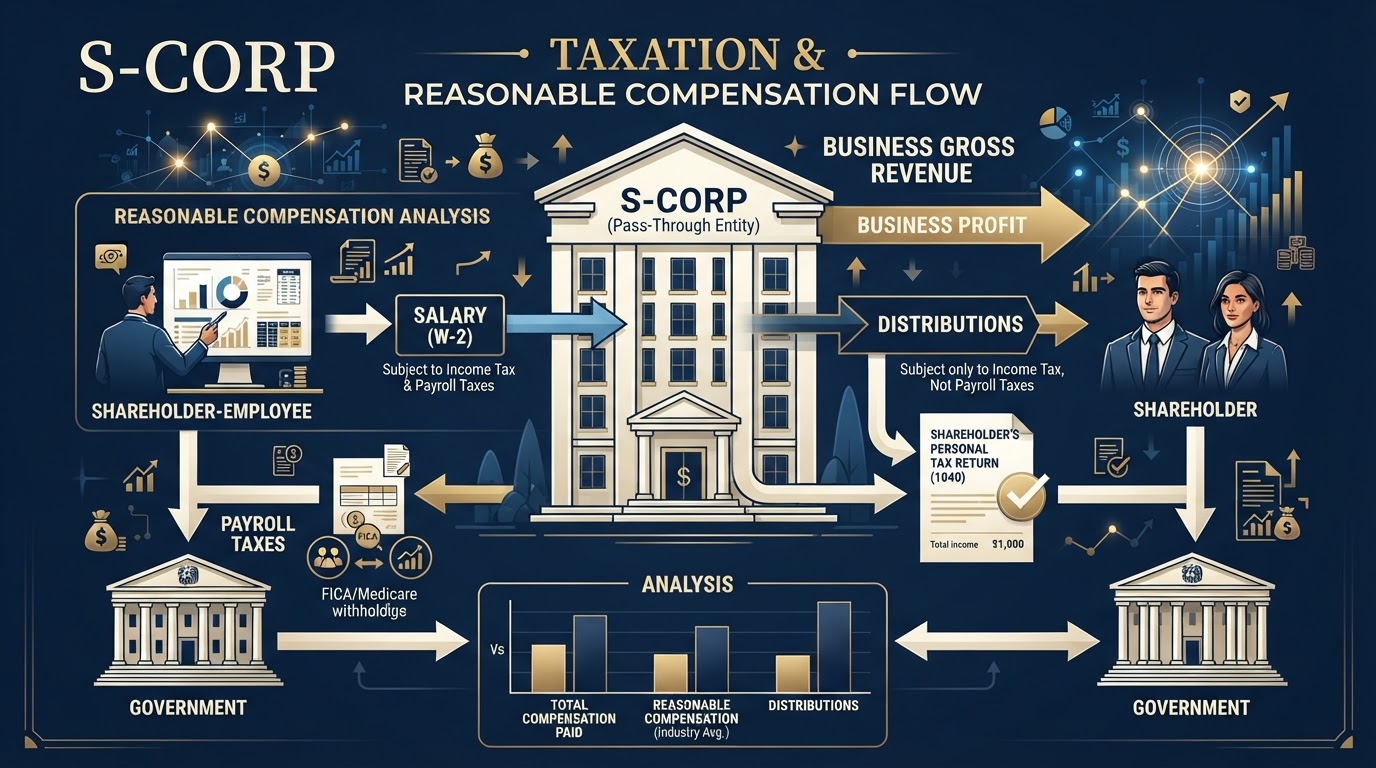
Many high-net-worth filers operate through S-corporations, LLCs taxed as partnerships, or a combination of entities. Pass-through structures are effective, but they create their own audit surface. The single most examined issue for an S-corporation owner who provides services is reasonable compensation. The IRS position is that an officer who provides significant services to the corporation must be paid a wage that reflects what similar services would command in an arm's-length arrangement, before any pass-through income is taken as a distribution.
The temptation, of course, is to set the salary low and take the remainder as distributions to avoid payroll tax. The IRS treats unreasonably low compensation as a reclassification issue, and the result is back payroll taxes, interest, and penalties. What constitutes "reasonable" depends on the services performed, the individual's qualifications, the revenue and profit of the business, and comparable compensation data. There is no fixed percentage, but a salary that is a token fraction of distributions is a red flag.
Beyond compensation, the IRS examines distributions, loans to and from shareholders, and basis. A distribution that exceeds a shareholder's stock and debt basis is a taxable gain, not a tax-free return of capital. Shareholder loans that lack formal notes, interest, or repayment terms are routinely recharacterized as contributions or distributions. We maintain basis schedules for every pass-through client and document every loan with a formal promissory note and at least annual interest accrual, because these are the records an examiner asks for first.
Trigger Five: Foreign Accounts and International Activity
High-net-worth individuals are more likely to hold foreign accounts, foreign investments, or interests in foreign entities. Each of these carries disclosure obligations that are separate from the tax computation itself, and the penalties for missing them are severe. The FBAR (FinCEN Form 114) is required for any U.S. person with a financial interest in or signature authority over foreign financial accounts whose aggregate value exceeded $10,000 at any point during the year. FATCA adds Form 8938 for specified foreign financial assets above higher thresholds.
The IRS does not need to prove willfulness to assert a non-willful FBAR penalty, and willful penalties can reach the greater of $100,000 or 50 percent of the account balance per violation. Foreign trusts, foreign partnerships, and passive foreign investment companies (PFICs) each carry their own reporting and computation regimes. A high-income filer with an undisclosed foreign account is one of the highest-priority examination targets the agency pursues, and the voluntary disclosure programs that once offered a clean path back are narrower than they used to be.
The practical takeaway is that any foreign connection must be identified before filing, not after a notice arrives. We screen every high-income client for foreign accounts, signature authority, foreign gifts or inheritances, and interests in foreign entities, and we file the required forms even when no tax is owed, because the failure to file is itself the violation.
Trigger Six: Cryptocurrency and Digital Asset Reporting
The digital asset question now appears at the top of Form 1040, and it must be answered by every filer. For high-net-worth individuals who have traded, staked, mined, or received cryptocurrency, the reporting obligations are substantial. Each disposal of a digital asset is a taxable event, and the cost basis must be tracked per lot. Exchanges issue 1099-DA forms, and the IRS receives them. A return that answers "no" to the digital asset question while exchange records show significant activity is an automatic mismatch.
The complexity compounds when digital assets move between wallets, are used to purchase other property, or are received as staking or mining income. We reconstruct transaction histories from exchange exports and on-chain data, match disposals to specific lots using the chosen cost-basis method, and report gains and losses on Form 8949 with the same rigor as securities transactions. The IRS has made digital asset compliance a standing enforcement priority, and the treatment of crypto as an audit trigger will only grow as reporting from exchanges matures.
Trigger Seven: Loss Deductions and Hobby Loss Arguments
A high-income filer who also operates a venture that consistently loses money — a horse breeding operation, a vineyard, a small production company, a consulting practice that never turns a profit — invites the hobby loss analysis under Section 183. The IRS applies a nine-factor test to determine whether an activity is engaged in for profit. Factors include whether the activity is carried on in a businesslike manner, whether the taxpayer has expertise, the time and effort expended, the history of income or losses, and whether the activity has ever been profitable.
If the activity is deemed a hobby, losses are not deductible beyond income, and expenses are limited to the activity's gross income. For a high earner using a loss-making venture to offset W-2 or investment income, the hobby loss reclassification can produce a significant tax increase plus interest. The defense is contemporaneous: separate books and records, a written business plan, documented efforts to improve profitability, and a genuine expectation that the activity will become profitable. We help clients maintain the record that demonstrates profit motive before the question is ever asked.
Trigger Eight: Estimated Tax Underpayment and Large Balances Due
High-income filers with variable income — entertainment professionals, real estate developers, founders with liquidity events — often struggle to match estimated payments to the actual tax liability. A return that shows a large balance due, or a pattern of underpayment across years, signals to the IRS that the filer may be unable to pay and that the return deserves a closer look. The underpayment penalty under Section 6654 is itself a flag, because it indicates the safe harbors were not met.
The safe harbors are straightforward but must be planned for in advance. Paying 90 percent of the current year's liability or 100 percent of the prior year's liability (110 percent for AGI above $150,000) avoids the penalty. For a filer whose income swings significantly year to year, the annualized income installment method can align payments to income as it is earned. We project tax liability quarterly for variable-income clients and adjust estimated payments so the return does not arrive with a surprise balance due that invites scrutiny.
What Clean Documentation Looks Like Before a Notice Arrives
Every trigger described above has the same underlying theme: the IRS is looking for the gap between what a return claims and what the records support. The defense is not a clever argument made after a notice arrives. It is a contemporaneous documentation file built during the year, while the transactions are happening, that an examiner can review and find consistent with the return.
- Income reconciliation. A worksheet that ties every information return to the corresponding line on the 1040 and entity returns, with any differences explained.
- Charitable substantiation. Written acknowledgments for gifts of $250 or more, qualified appraisals and Form 8283 for non-cash gifts above $5,000, and confirmation that each recipient is a qualified organization.
- Home office and mixed-use records. Square footage calculations, photos of the exclusive-use space, a log of personal versus rental use days for any mixed-use property, and allocations applied consistently.
- Entity and basis records. Formation documents, operating agreements, formal promissory notes for shareholder loans, annual interest accruals, and a running basis schedule for each pass-through interest.
- Foreign account disclosures. FBAR and Form 8938 filed for every reportable account, with maximum account values documented from year-end statements.
- Digital asset records. Exchange exports, lot-level cost basis, and a reconciliation of disposals to the 8949 attached to the return.
- Profit-motive evidence. For any loss-making activity, a written business plan, separate books, and a documented history of efforts to achieve profitability.

What to Do If You Are Already Under Examination
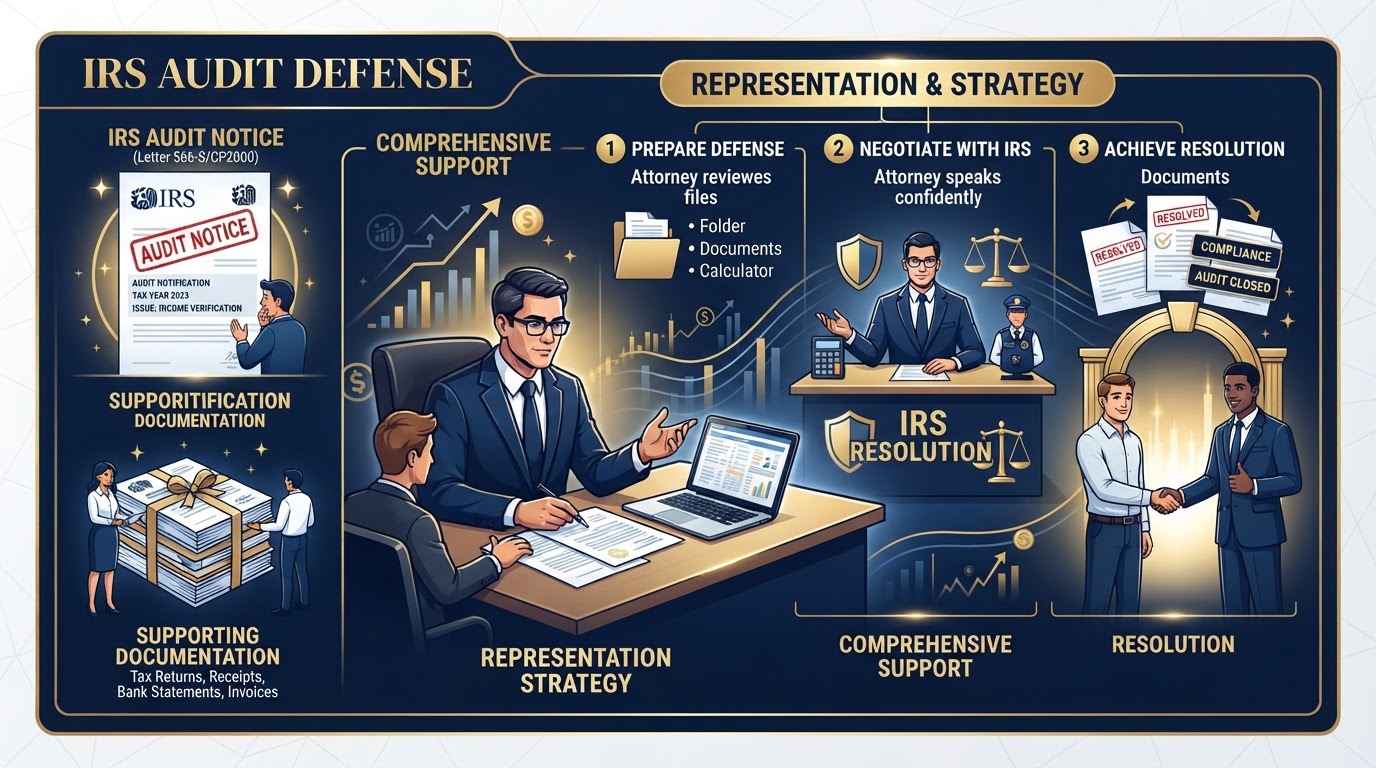
If a notice has already arrived, the first rule is to respond through representation, not directly. Anything you say to an examiner can be used to expand the scope of the audit, and the instinct to explain often creates more exposure than it resolves. A representative can manage the information flow, narrow the issues under examination, and negotiate the scope so that a single questioned item does not become a full-return review.
The second rule is to reconstruct the documentation file before responding, not during the audit. Examiners work on timelines, and a response that arrives piecemeal signals disorganization. A complete, organized response that addresses every item in the initial document request, with supporting records attached and indexed, often shortens the examination and limits its scope.
The third rule is to understand the examination type. A correspondence audit handled by mail is different from an office audit conducted at an IRS office, which is different from a field audit at your business or home. Each has different procedures, different expectations, and different strategies. We assess the examination type and the specific issues before any response is prepared.
How Fiscal Integrity Group Helps High-Net-Worth Filers Stay Audit-Ready
Audit readiness is not a project that begins when a notice arrives. It is a year-round discipline built into how we maintain your books, document your positions, and prepare your return. For our high-net-worth clients across Malibu, Hollywood, and the broader Los Angeles area, we build the documentation file as we go — reconciling every information return, substantiating every deduction, tracking basis on every pass-through interest, and filing every required disclosure — so that the return we file is the same return we could defend.
If you have a complex return and you are not certain it would survive a review, the time to address that is now, not after a letter from the IRS. We can review your most recent return, identify the positions most likely to draw attention, and help you build the documentation that supports them. And if a notice has already arrived, we can step in to manage the response, represent you before the examiner, and work to resolve the examination on the narrowest possible terms.
Quick Tax Savings Estimator
See how much you could potentially save with proactive tax strategy and clean bookkeeping. Most LA businesses overpay by 15-20% simply due to missed deductions.
Free IRS Audit Risk Assessment
Do you mix personal and business expenses in the same bank account?
Frequently Asked Questions
How far back can you catch errors?
I perform a deep forensic review of your history to catch errors and fix them. Whether it's one year or five, my goal is to ensure your historical data is pristine before we move forward.
Will you educate me on how to manage my books?
Yes! My approach is highly educational. I want you to understand the "why" behind the numbers so you can make better business decisions with confidence.

About the Author
Wiyao Awesso
Wiyao Awesso is a leading financial advisor in Los Angeles. With extensive experience in tax strategy, accounting, and fractional CFO services, he helps business owners optimize their finances, minimize tax liabilities, and scale with confidence.