When You Realize You Are Months Behind on Your Books
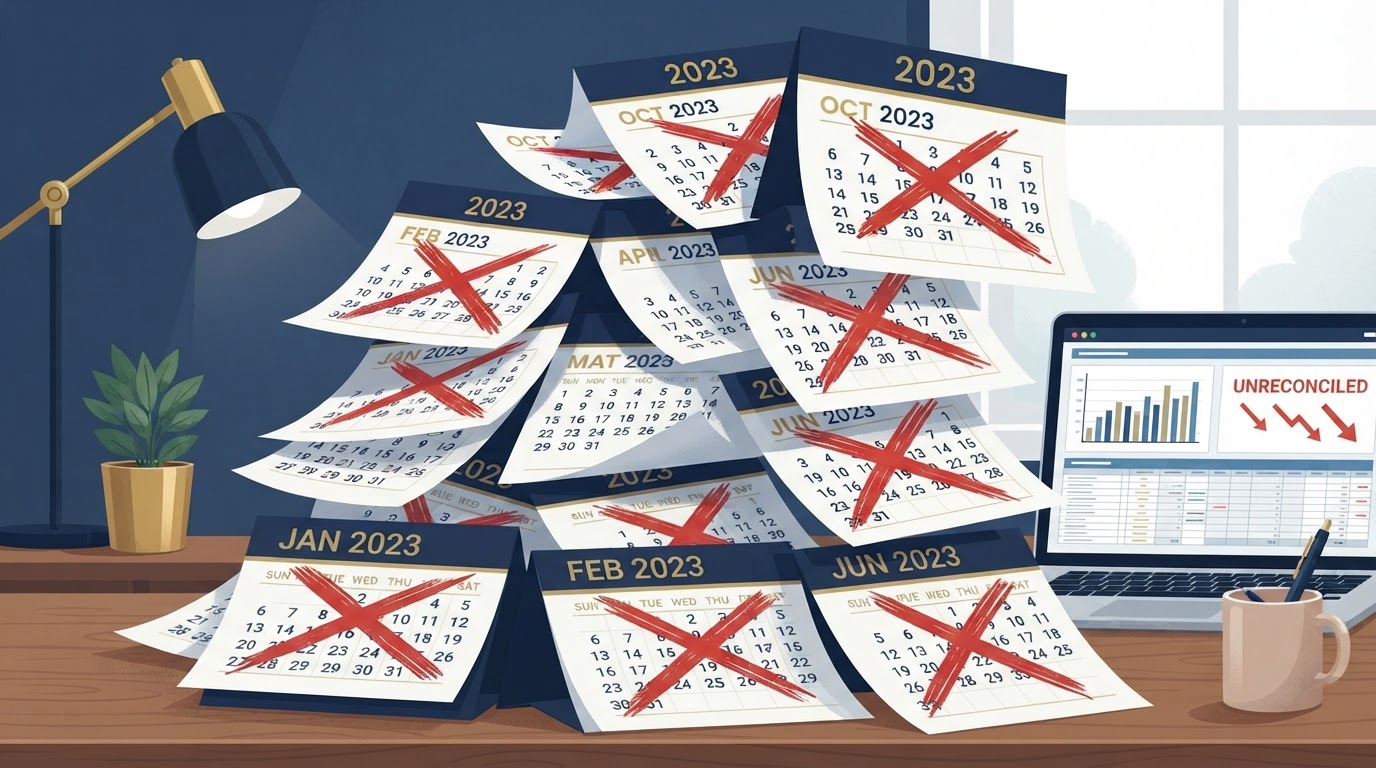
It usually starts with a feeling, not a fact. You open your accounting software to look something up, and you notice the last reconciled month was March. It is now September. Somewhere between spring and fall, life happened. You got busy with customers, employees, vendors, and the hundred daily decisions that keep a business running. Bookkeeping slid down the priority list, and now it has compounded into something that feels impossible to face.
You are not lazy, and you are not careless. You are a business owner doing the work of three people, and bookkeeping is the task that quietly waits while everything else demands immediate attention. The problem is that books do not stay still while they wait. Every month you fall behind, the cleanup gets harder, the deductions get harder to reconstruct, and the gap between what you know and what your numbers say gets wider. This guide walks you through exactly how to catch up when you are months behind, how to rebuild from the balance sheet up, and how to make sure you never land in this position again.
How Far Behind Are You, Really?
Before you can fix the problem, you have to measure it. Falling behind is not a binary state. There are degrees, and the degree determines the approach. A business that is two months behind needs a focused sprint. A business that is a year or more behind needs a full cleanup engagement with a defined scope, a diagnostic phase, and a project plan. Knowing where you stand tells you what you are actually dealing with.
Here is a simple framework for assessing the damage:
- One to two months behind. This is a catch up sprint. The transactions are recent enough that you still remember what most of them were. Receipts are probably still in a folder or an email inbox. A focused week of work can close the gap.
- Three to six months behind. This is the danger zone. Memory is fading. Receipts are scattered. Vendor names are starting to blur-sm together. You likely have uncategorized transactions piling up in an Ask My Accountant bucket that nobody wants to touch. This requires a structured cleanup, not just a weekend.
- Six to twelve months behind. At this point you are reconstructing history. Bank statements need to be pulled individually. Loan balances have drifted. Payroll may have been run but not recorded properly. Estimated tax payments may have been missed. This is a full engagement that should be scoped and priced before anyone starts.
- More than a year behind. You are in cleanup territory that borders on reconstruction. Prior year tax returns may need to be amended. The balance sheet is likely unreliable. This requires a diagnostic first, then a phased recovery plan.
Be honest with yourself about where you fall on this scale. The worst thing you can do is underestimate the problem, promise yourself you will catch up this weekend, and then feel the same dread next month when nothing has changed.
Why Falling Behind Compounds So Quickly
Bookkeeping is sequential. Every month builds on the month before it. When you reconcile January, you establish the starting balance for February. When you reconcile February, you carry that forward into March. If January is wrong, everything after it is wrong, and you will not know how wrong until you go back and fix the source. This is why you cannot skip months and reconcile the current month first. It feels faster, but it creates a false sense of progress because the numbers are built on an unverified foundation.
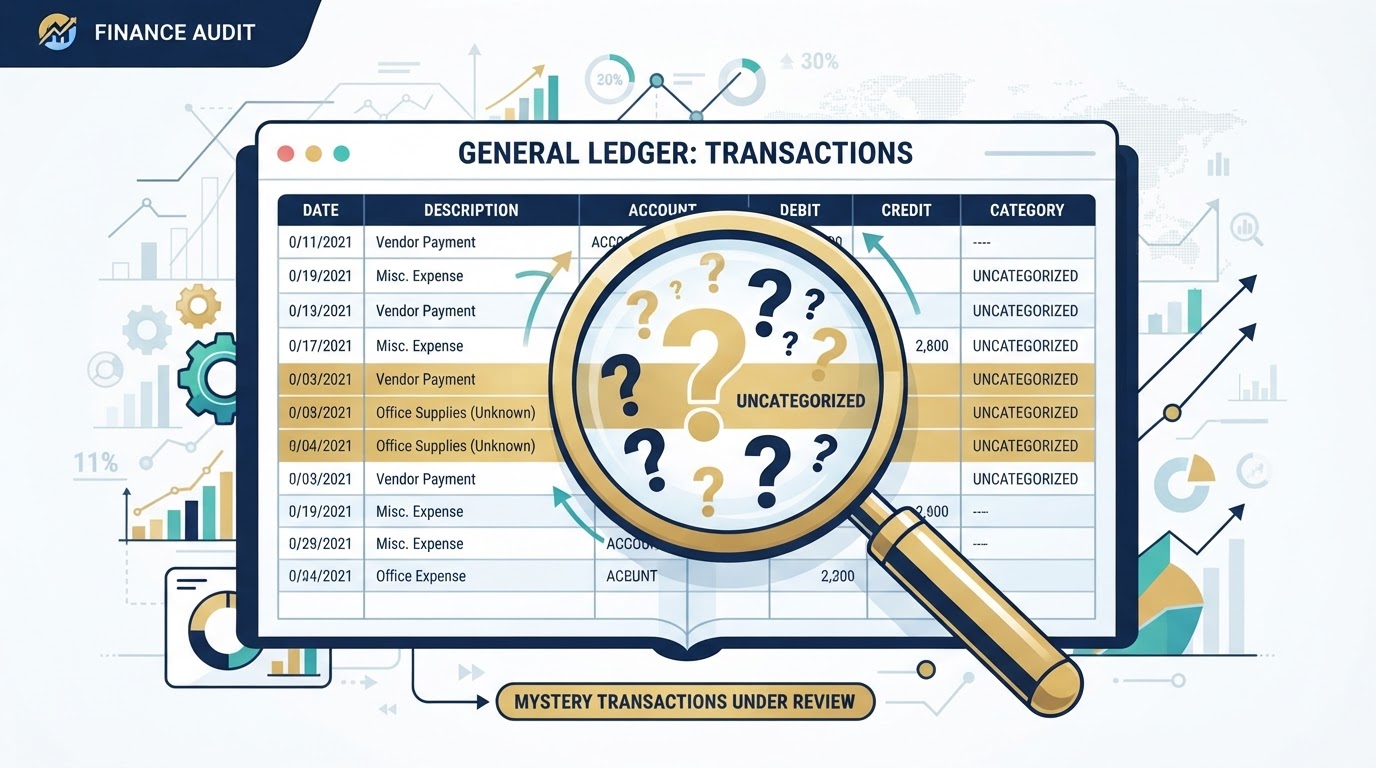
The compounding effect shows up in other ways too. Uncategorized transactions accumulate in a holding account, and the longer they sit there, the harder it is to remember what they were. A charge from a vendor in April is easy to identify in May. In October, it is a mystery. Receipts get lost. Bank statements become harder to download the older they get. Memory degrades, and with it, your ability to defend every deduction if the IRS ever asks.
There is also a psychological compounding effect. The longer you avoid the books, the more anxiety builds around them. The task grows in your mind until it feels insurmountable. Owners who are six months behind often describe the same feeling: a weight in the back of their mind every time they see the accounting software icon. That anxiety leads to more avoidance, which leads to more months behind. Breaking the cycle starts with understanding that the task is finite, measurable, and entirely solvable with the right approach.
The Right Way to Catch Up: From the Balance Sheet Up
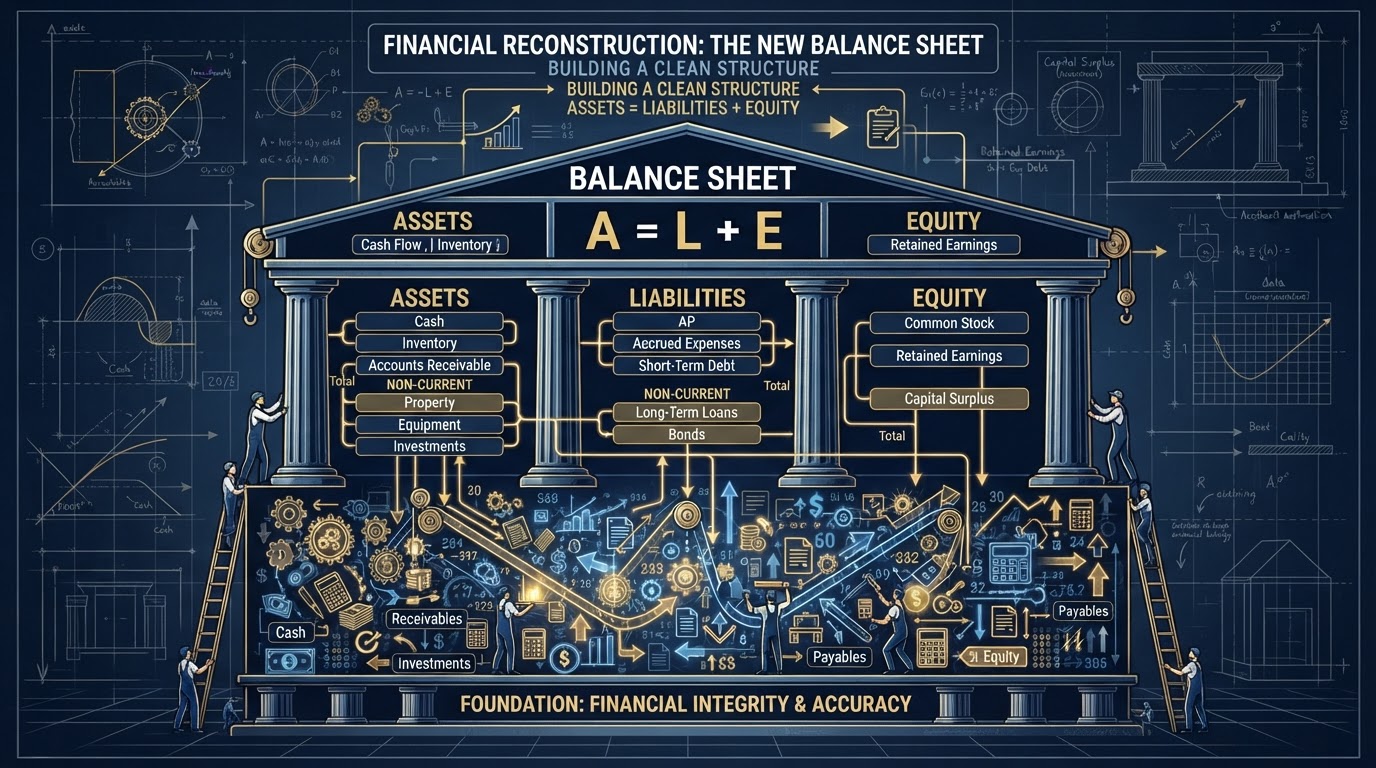
Most owners try to catch up by starting with the profit and loss statement. They go to the current month, start categorizing transactions, and work backward. This is the natural instinct, and it is exactly wrong. The profit and loss statement is a downstream report. It depends on the balance sheet being correct. If your bank balances, loan balances, credit card balances, and equity accounts are wrong, your profit and loss is wrong no matter how carefully you categorize every transaction.
The correct approach is to rebuild from the balance sheet up. This means you start with the oldest unreconciled month and work forward, one month at a time, never skipping. You reconcile every bank account, every credit card, every loan, and every payment processor to the exact ending balance on the statement. You clear the uncategorized account to zero. You verify that opening balances tie to the last filed tax return. Only when the balance sheet is solid do you trust the profit and loss numbers that flow from it.
This is the method we use at Fiscal Integrity Group for every cleanup engagement. It is slower than slapping categories on transactions and hoping for the best, but it is the only approach that produces books you can actually rely on. Books that a tax preparer can use without questioning every number. Books that a lender will accept without a footnote. Books that hold up under scrutiny.
The Step by Step Catch Up Process
Whether you are two months behind or twelve, the process follows the same sequence. The difference is how long each step takes.
Step 1: Gather Every Statement
Download or request every bank statement, credit card statement, loan statement, and merchant processor statement for every month you are behind. Do not rely on the accounting software feed alone. Feeds break, drop transactions, and duplicate entries. The statement is your source of truth. If you cannot download statements older than a certain date from your bank portal, call the bank and request them. Most banks will provide up to 18 months of history through online banking and older statements by request.
Step 2: Establish the Starting Point
Identify the last month that was fully reconciled and locked. That ending balance is your starting point. If no month was ever properly reconciled, you need to go back to the last filed tax return and use the balance sheet from that return as your opening balances. This is non negotiable. Without a verified starting point, every number after it is a guess.
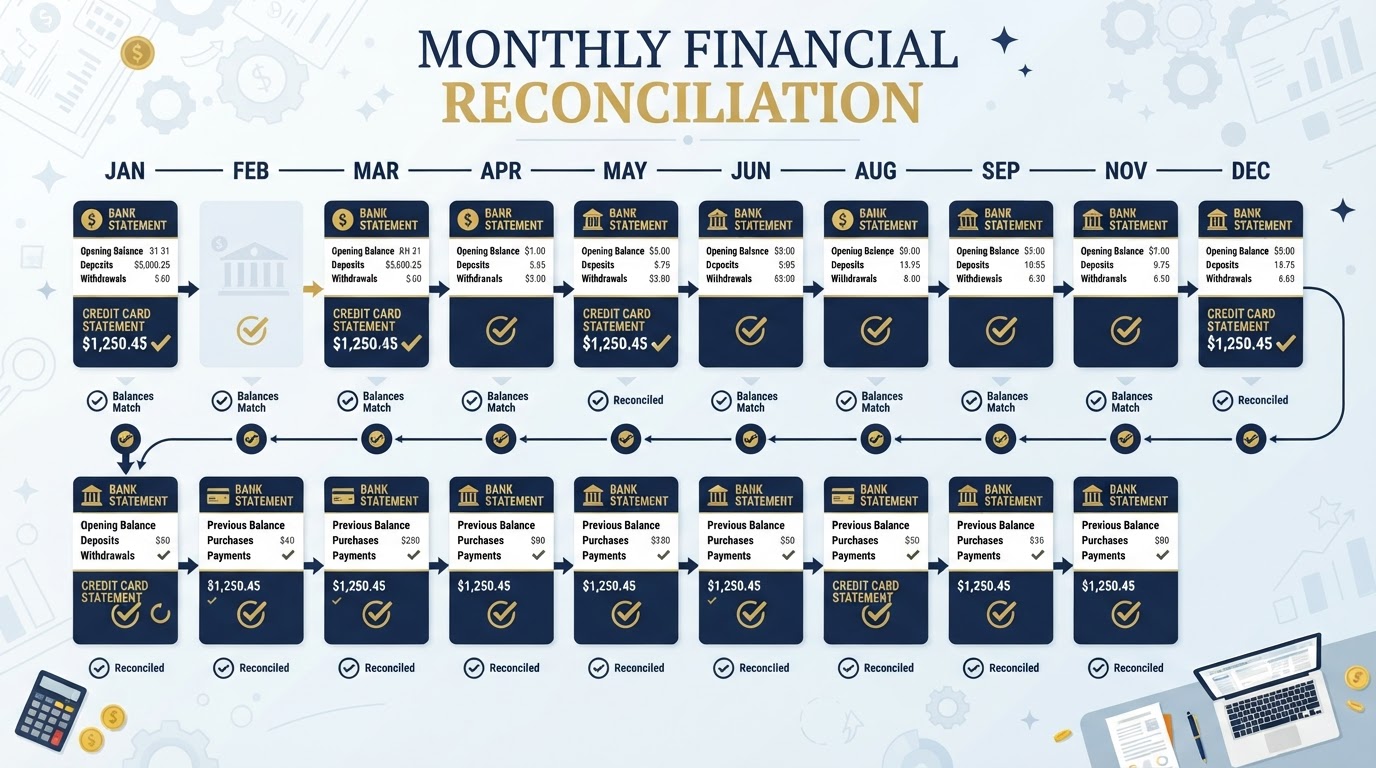
Step 3: Reconcile Oldest to Newest, Never Skip
Start with the oldest unreconciled month. Reconcile every account to the exact statement ending balance. Investigate every difference. Do not force a balance by plugging a number into a reconciliation discrepancy account. If something does not match, find out why. It could be a missing transaction, a duplicate, a bank error, or a transaction recorded in the wrong month. Once the oldest month reconciles cleanly, move to the next one. Repeat until you reach the current month.
Step 4: Clear the Uncategorized Account
As you reconcile each month, you will encounter transactions that were dumped into an Ask My Accountant or uncategorized bucket. Now is the time to deal with them. For each one, identify the vendor, determine the business purpose, and categorize it correctly. If you cannot determine what a transaction was, document your best effort and flag it for review. Do not leave anything in the uncategorized account when you close a month. A zero balance in that account is a sign that the month is truly closed.
Step 5: Review the Balance Sheet Account by Account
Once all months are reconciled, review every balance sheet account for reasonableness. Are there negative balances in asset accounts? That usually means a transaction was recorded in the wrong direction. Is the loan balance declining in a way that matches the amortization schedule? Is retained earnings rolling forward correctly? Are there balances in clearing accounts like undeposited funds or opening balance equity that should be zero? Every account should have a logical explanation for its balance.
Step 6: Lock and Report
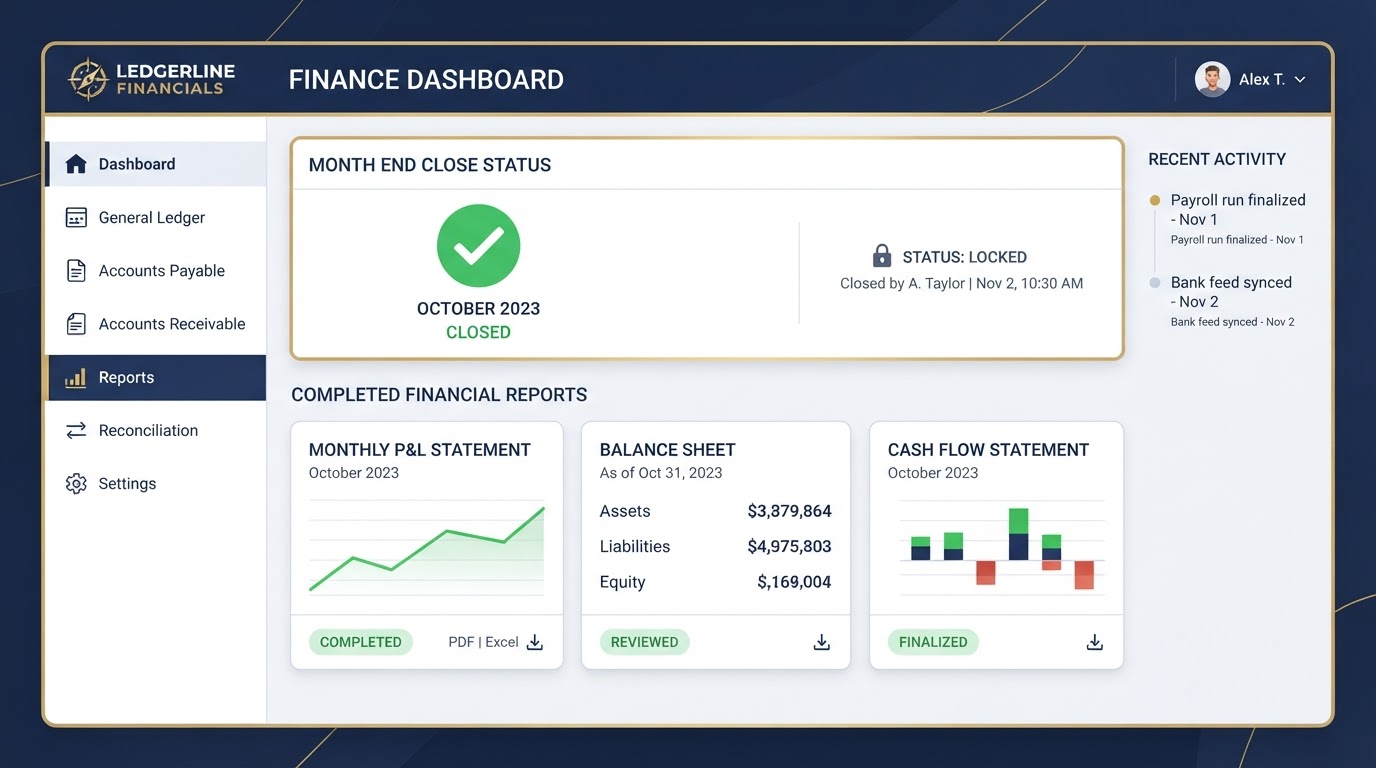
After the balance sheet is clean and the profit and loss reflects accurate categorization, lock the period. Closing the period prevents future changes to historical months, which protects the integrity of the work you just completed. Then generate your financial reports: profit and loss, balance sheet, and statement of cash flows. These are now numbers you can trust.
Common Traps That Make Cleanup Harder Than It Needs to Be
In every cleanup engagement, we see the same mistakes repeated. These traps turn a manageable catch up into a drawn out ordeal.
- Plugging reconciliation differences. When the bank reconciliation does not balance, the temptation is to enter an adjustment to force it. This hides the real problem and makes every future reconciliation harder. Always find the actual cause.
- Deleting transactions instead of correcting them.When you find a duplicate or a wrongly categorized transaction, the instinct is to delete it. But deleting transactions destroys your audit trail. Instead, void or correct them so the history is preserved.
- Starting with the current month. Reconciling the current month first gives you a false sense of progress. The balance is built on unreconciled prior months, so it is unreliable. Always start with the oldest month.
- Ignoring the balance sheet. Owners focus on the profit and loss because that is where the action feels like it is. But a wrong balance sheet makes the profit and loss wrong. Fix the balance sheet first.
- Not documenting decisions. When you make a judgment call about how to categorize a transaction or handle a discrepancy, write it down. Six months from now, you will not remember why you made that choice, and neither will anyone else.
Protecting the Deductions That Are Slipping Away
Every month you are behind, deductions are at risk. Not because they are invalid, but because the documentation is degrading. A receipt that was in your email in April may be buried under thousands of messages by October. A vendor invoice that was on your desk in May may be in a landfill by November. The deduction is still legally yours, but without documentation, you cannot prove it if questioned.
During the catch up process, pay special attention to reconstructing documentation for expenses that lack receipts. Bank and credit card statements prove that a payment was made, but they do not prove the business purpose. For each significant expense, try to obtain a vendor invoice or receipt. If the vendor can reissue a receipt, request it. If you have an email confirmation, save it. For cash expenses with no paper trail, document what you can remember about the transaction: the date, the amount, the vendor, and the business purpose. This is not as strong as a receipt, but it is far better than nothing.
Pay particular attention to meals, travel, vehicle expenses, and home office deductions. These are the categories the IRS scrutinizes most closely, and they are also the categories where documentation tends to be weakest. If you have been using your personal vehicle for business but have no mileage log, reconstruct one using your calendar, delivery records, and appointment history. An after the fact log is not ideal, but a reasonable reconstruction is better than claiming nothing.
A FIG Cleanup Engagement: Eight Months Behind to Current
A Southern California service business came to Fiscal Integrity Group eight months behind on their books. The owner had been managing operations personally and had let bookkeeping slide after a key employee left. When they opened QuickBooks, the uncategorized account held over 400 transactions. The bank had not been reconciled since the prior year. The owner had no idea whether they were profitable month to month and was anxious about an upcoming tax filing deadline.
We started with a diagnostic. We pulled every bank, credit card, and loan statement for the eight month gap. We identified the last reconciled month and verified that its ending balances tied to the prior year tax return. Then we reconciled oldest to newest, one month at a time. Each reconciliation surfaced missing transactions, duplicate entries, and misclassified expenses that we corrected on the spot. The 400 uncategorized transactions were reviewed individually, categorized, and documented.
The engagement took three weeks. By the end, every account was reconciled through the current month. The balance sheet was clean. The profit and loss showed accurate monthly results for the first time in nearly a year. The owner could see which months had been strong and which had been weak, and they had reliable numbers to hand to their tax preparer ahead of the deadline. We then set up a recurring monthly close process so the books would never fall behind again.
How to Never Fall This Far Behind Again
Catching up is only half the battle. If you do not change the system that got you behind, you will end up behind again. The goal is not just to fix the past but to build a process that keeps the present current.
- Set a monthly close date. Pick a specific day each month, ideally within ten business days of month end, and commit to closing the books by that date. Treat it like a payroll deadline. It is non negotiable.
- Reconcile every account every month. Reconciliation is not optional. It is the control that verifies your numbers. If you do nothing else, reconcile.
- Categorize transactions weekly. Do not let the bank feed accumulate. Spend thirty minutes a week clearing transactions so the uncategorized account never grows beyond a handful of items.
- Capture receipts immediately. Use a receipt capture tool or snap a photo the moment you receive a receipt. The longer you wait, the more likely it is to disappear.
- Hand it to someone who will not let it slide. If bookkeeping keeps falling to the bottom of your list, that is a sign it needs to be someone else's responsibility. A dedicated bookkeeper or firm with a recurring close schedule will keep your books current whether or not you have time that month.
How Fiscal Integrity Group Helps You Catch Up
If you are months behind, you do not have to face it alone. Fiscal Integrity Group specializes in cleanup and catch up engagements for businesses across Los Angeles and Southern California. We start with a diagnostic to assess exactly how far behind you are and what it will take to get you current. We give you a clear scope and a clear price before any work begins, so there are no surprises.
We rebuild your books from the balance sheet up, reconciling every account oldest to newest, clearing every uncategorized transaction, and documenting every correction. When we are done, you have books you can trust, reports you can read, and numbers you can hand to your tax preparer with confidence. Then we set up a recurring monthly process so you never fall this far behind again.
The longer you wait, the harder the cleanup gets. The best time to start was last month. The second best time is today.
Quick Tax Savings Estimator
See how much you could potentially save with proactive tax strategy and clean bookkeeping. Most LA businesses overpay by 15-20% simply due to missed deductions.
Free IRS Audit Risk Assessment
Do you mix personal and business expenses in the same bank account?
Frequently Asked Questions
How far back can you catch errors?
I perform a deep forensic review of your history to catch errors and fix them. Whether it's one year or five, my goal is to ensure your historical data is pristine before we move forward.
Will you educate me on how to manage my books?
Yes! My approach is highly educational. I want you to understand the "why" behind the numbers so you can make better business decisions with confidence.

About the Author
Wiyao Awesso
Wiyao Awesso is a leading financial advisor in Los Angeles. With extensive experience in tax strategy, accounting, and fractional CFO services, he helps business owners optimize their finances, minimize tax liabilities, and scale with confidence.