The Research and Development (R&D) Tax Credit is one of the most lucrative tax incentives available to businesses in the United States. Despite its name, you don't need to be a tech startup or have a laboratory to qualify. If your business invests time, money, and resources toward developing new or improved products, processes, or software, you may be eligible for significant tax savings.
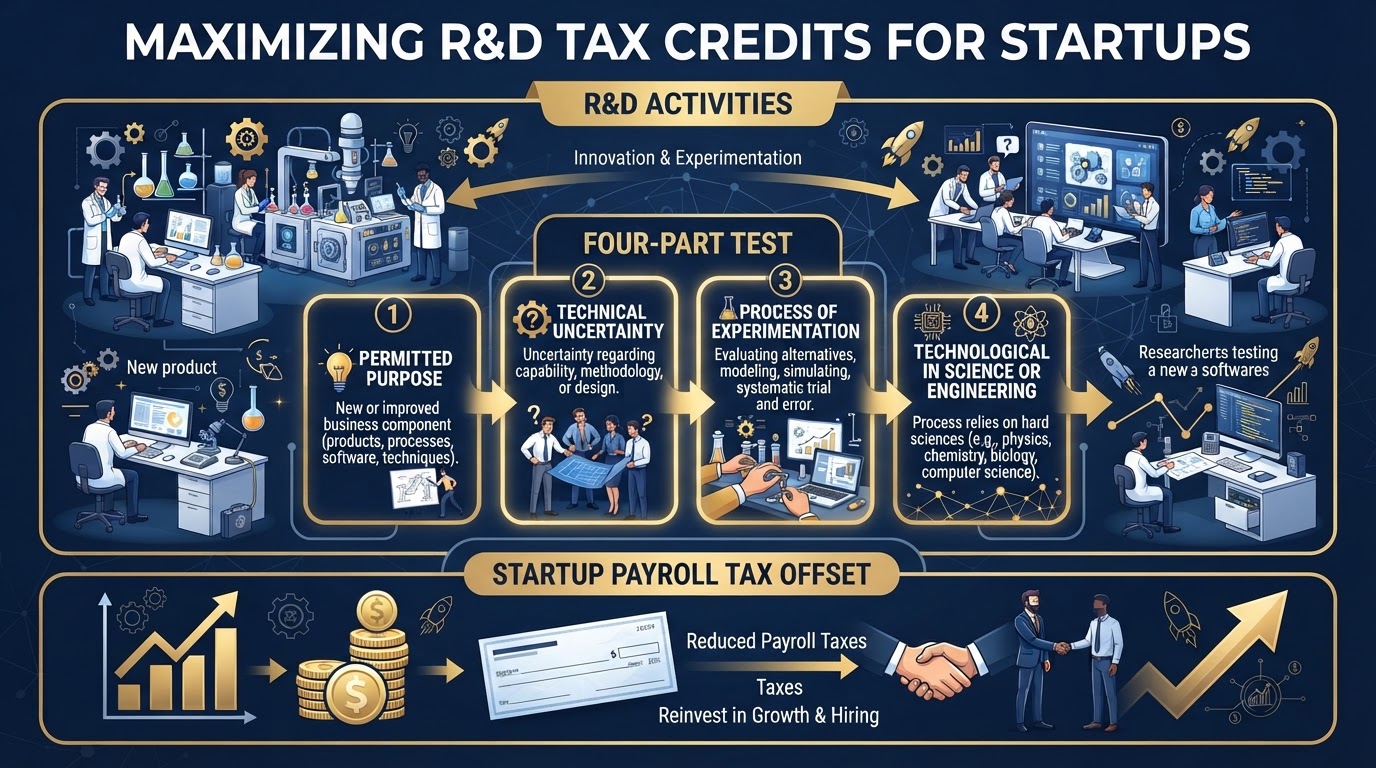
This playbook demystifies the R&D tax credit, explaining the four-part test the IRS uses to determine eligibility. We walk through the types of expenses that qualify, including employee wages, supplies, and contract research. Furthermore, we discuss how startups can use the credit to offset payroll taxes even before they become profitable. Don't leave money on the table — learn how to document and claim the R&D credit for your business.
The IRS Four-Part Test Explained
To qualify for the R&D credit, an activity must satisfy all four parts of the IRS test. First, the activity must be intended to create a new or improved product or process (the "section 174 test"). Second, it must be technological in nature — relying on principles of engineering, computer science, or the hard sciences, not marketing or social science. Third, there must be a process of experimentation — testing alternatives, prototyping, trial and error. Fourth, the purpose must be to eliminate uncertainty about the capability or method of developing the product.
Many businesses that never thought of themselves as "doing R&D" actually qualify — manufacturers improving a process, software developers building custom applications, food producers formulating new products, and engineering firms solving technical problems. The key is documenting the uncertainty and the experimentation.
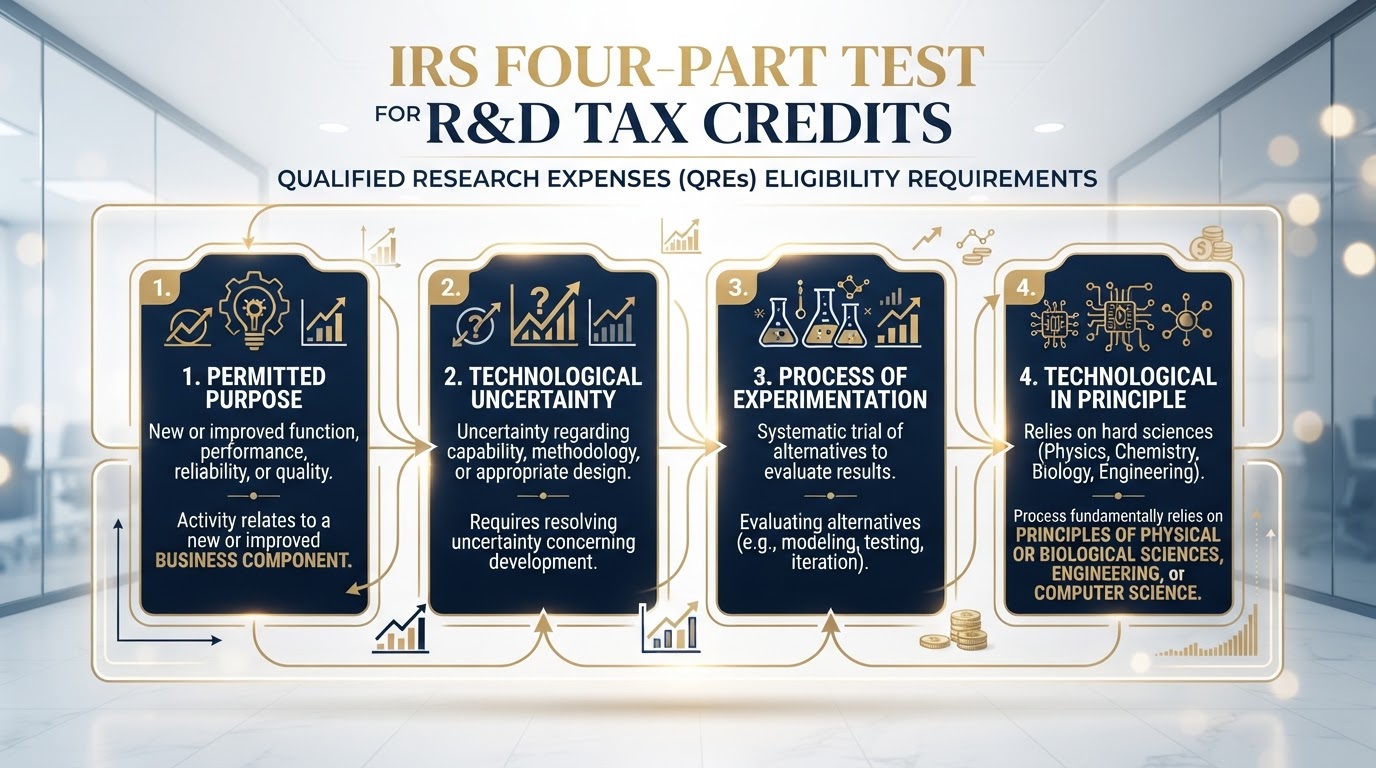
- Section 174 test: intended to create a new or improved product/process
- Technological in nature: engineering, computer science, hard sciences
- Process of experimentation: testing alternatives and prototypes
- Purpose of eliminating technical uncertainty
Qualifying Expenses: Wages, Supplies, and Contractors
The credit is calculated based on qualified research expenses (QREs). The three main categories are wages paid to employees who performed qualified services, supplies consumed in the research (tangible materials, not capital equipment), and 65% of amounts paid to contractors for qualified research performed on your behalf. Time tracking is essential — only the portion of an employee's time spent on qualified activities counts.
We help identify which employees and activities qualify, establish the time-tracking that supports the claim, and calculate the QREs using the method that produces the largest credit. The documentation must be contemporaneous where possible and detailed enough to survive an IRS examination.
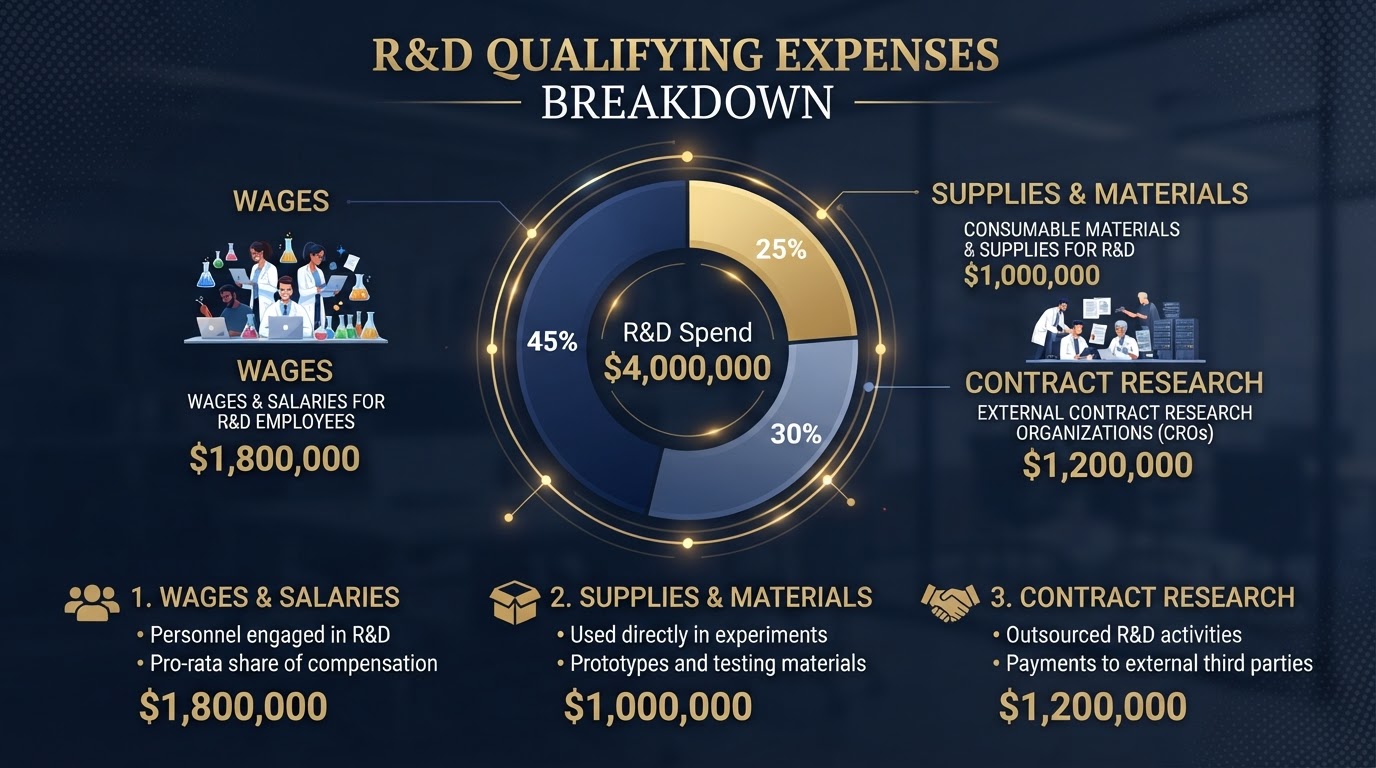
- Wages for employees performing qualified services (time-tracked)
- Supplies consumed in research (tangible materials, not equipment)
- 65% of contractor payments for qualified research on your behalf
The Payroll Tax Offset for Startups
For years, the R&D credit was only useful to profitable businesses that owed income tax. That changed. Eligible small businesses (less than five years old and less than $5 million in gross receipts) can now elect to apply up to $500,000 of the R&D credit against the employer portion of FICA payroll tax — even if they have no income tax liability. This is a powerful tool for pre-profit startups burning cash on development.
The payroll tax offset is claimed on Form 8974 and applied against the quarterly payroll tax deposits. For a startup spending heavily on engineering or software development, this can eliminate the employer payroll tax burden entirely for several quarters — real cash returned to the business.
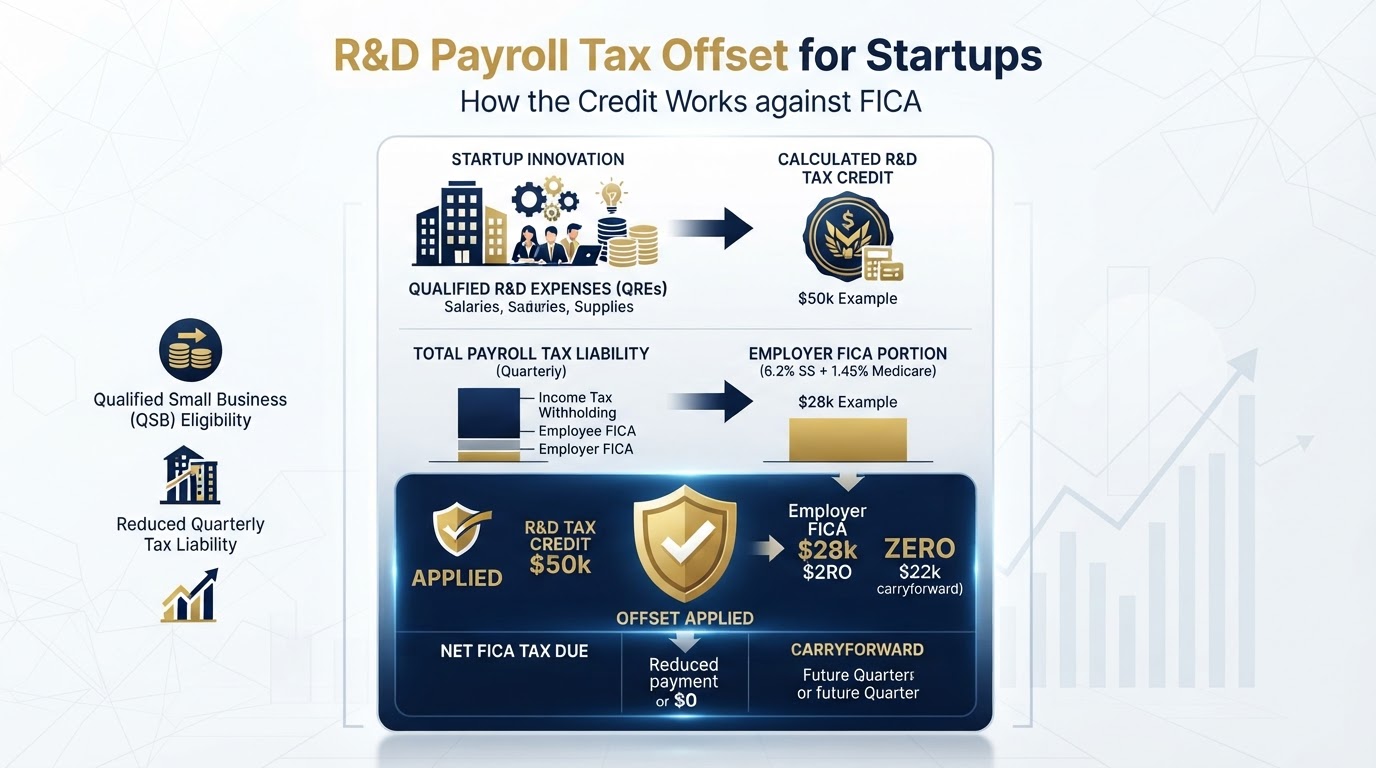
- Eligible startups: under 5 years old, under $5M gross receipts
- Apply up to $500,000 of R&D credit against employer FICA payroll tax
- Claimed on Form 8974 against quarterly payroll deposits
Software Development and the R&D Credit
Software development is one of the most common qualifying activities. Developing new or significantly improved software, internal-use software that meets elevated standards, and resolving technical uncertainties in architecture, algorithms, or integration can all qualify. The IRS applies a stricter test to internal-use software, but commercial software development for sale or license generally qualifies under the standard four-part test.
We work with development teams to identify the qualifying projects, capture the developer time spent on them, and document the technical uncertainties being resolved. For many software businesses, the R&D credit recovers a meaningful percentage of engineering payroll.
- Commercial software development generally qualifies under the four-part test
- Internal-use software must meet a stricter elevated standard
- Document the technical uncertainties in architecture and algorithms
Calculating the Credit: Regular vs. Alternative Simplified Method
There are two methods to calculate the credit. The Regular Method compares current-year QREs to a base-period average (the average of the four years preceding the start of the credit period), with a 20% credit on the excess above that base. The Alternative Simplified Credit (ASC) method uses 14% of QREs above 50% of the prior three years' average, with no fixed-base requirement. The ASC is simpler and is often the better choice for businesses without clean historical records.
We calculate both methods and select the one that produces the larger credit. The choice can be made year by year, so the optimal method can change as your business grows.
- Regular Method: 20% of QREs above a fixed-base period average
- Alternative Simplified Credit: 14% of QREs above 50% of prior 3-year average
- Calculate both and select the larger credit each year
Conclusion
The R&D credit is real money that many businesses never claim simply because they did not realize they qualified. If you develop products, processes, or software and resolve technical uncertainties along the way, you may be eligible. Contact us to assess your qualifying activities and document a defensible credit claim.
Quick Tax Savings Estimator
See how much you could potentially save with proactive tax strategy and clean bookkeeping. Most LA businesses overpay by 15-20% simply due to missed deductions.
Free IRS Audit Risk Assessment
Do you mix personal and business expenses in the same bank account?
Frequently Asked Questions
How far back can you catch errors?
I perform a deep forensic review of your history to catch errors and fix them. Whether it's one year or five, my goal is to ensure your historical data is pristine before we move forward.
Will you educate me on how to manage my books?
Yes! My approach is highly educational. I want you to understand the "why" behind the numbers so you can make better business decisions with confidence.

About the Author
Wiyao Awesso
Wiyao Awesso is a leading financial advisor in Los Angeles. With extensive experience in tax strategy, accounting, and fractional CFO services, he helps business owners optimize their finances, minimize tax liabilities, and scale with confidence.