The Biggest Tax Break the Self-Employed Keep Leaving on the Table
Of all the deductions and credits we model for self-employed clients across Los Angeles and Southern California, few move the needle as decisively as a properly funded Solo 401(k). A single-owner S-Corp consultant earning $300,000 can legally shelter tens of thousands of dollars of income from federal and state tax in a single year — and simultaneously build a retirement account that compounds tax-free or tax-deferred for decades. Yet most independent professionals we meet are either contributing nothing, or are funneling money into a SEP IRA without realizing they are leaving a meaningful portion of their contribution capacity unused.
This playbook breaks down exactly how the Solo 401(k) works, why it almost always beats a SEP IRA for an owner-only business, how the Mega Backdoor Roth feature can multiply your Roth balance, and the deadlines and documentation rules that determine whether the strategy holds up under scrutiny. The goal is not to turn you into your own retirement planner. It is to make clear how much tax savings is realistically available — and what it takes to claim it correctly.

What a Solo 401(k) Actually Is
A Solo 401(k) — sometimes called an individual or self-employed 401(k) — is a qualified retirement plan designed specifically for business owners with no full-time W-2 employees other than themselves and a spouse. It is a true 401(k), meaning it carries the same contribution structure, Roth option, and loan provisions as the plans offered by large employers. The defining feature is that you wear two hats inside the same plan: you are both the employee and the employer.
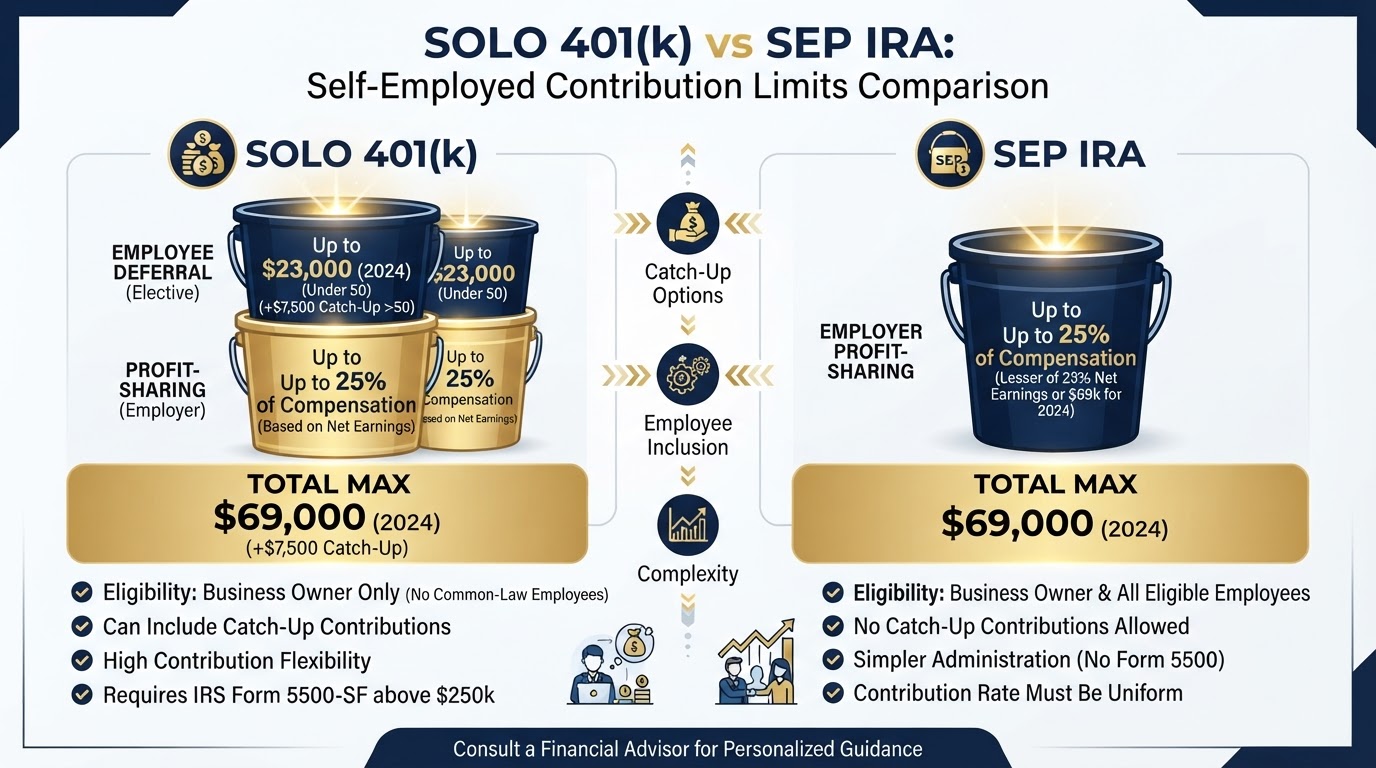
That dual role is the entire reason the Solo 401(k) out-contributes a SEP IRA for most owner-only businesses. In a SEP IRA, you can only contribute as the employer — up to 25% of your compensation, capped at the annual limit. A Solo 401(k) lets you make the employer profit-sharing contribution AND an employee salary deferral on top of it, which roughly doubles the usable contribution at most income levels.
Eligibility is straightforward but strict. You must have self-employment income, and you cannot have any full-time employees working more than 1,000 hours per year outside of yourself, your spouse, or certain partners. A single ineligible employee who crosses that threshold disqualifies the plan, which is why we verify staffing carefully before recommending it.
The Two Contribution Buckets: Employee Deferral Plus Profit-Sharing
The Solo 401(k) contribution is built from two independent buckets that stack on top of each other. Understanding each bucket is the key to maximizing the deduction.
Employee Salary Deferral
As the employee, you can defer a fixed dollar amount of your compensation into the plan, regardless of how much you earn. For 2026, the employee deferral limit is $24,500, plus a $7,500 catch-up contribution if you are 50 or older — for a total of $32,000. This bucket is available even if your net self-employment income is modest, which is precisely the scenario where a SEP IRA leaves the most money on the table.
Employer Profit-Sharing
As the employer, you can contribute up to 25% of your compensation (adjusted for self-employment tax) as a profit-sharing contribution. This bucket scales with income, so higher-earning owners lean more heavily on it. The two buckets combined are capped at a total annual limit of $73,000 for 2026 — or $80,500 with the catch-up — which is the ceiling that matters most for a high-earning solo practitioner.
The practical takeaway: at almost every income level a self-employed owner can reach, the Solo 401(k) allows a larger deductible contribution than a SEP IRA. The gap is widest at lower and mid-range incomes, where the flat employee deferral does the heavy lifting, and narrows only at the very top of the cap.
Solo 401(k) vs SEP IRA: Where the Numbers Diverge
Consider a self-employed consultant with $150,000 of net self-employment income. With a SEP IRA, the maximum deductible contribution is roughly 20% of net income after the self-employment tax adjustment — about $28,000. A Solo 401(k) in the same scenario allows the full $24,500 employee deferral plus a profit-sharing contribution on top, pushing the deductible total well past the SEP limit. That difference is a direct, dollar-for-dollar reduction of taxable income at the owner's marginal federal and state rate.
The Solo 401(k) also offers two structural advantages the SEP IRA cannot match. First, it permits a Roth (after-tax) bucket, so owners who expect higher future tax rates can lock in tax-free growth. Second, it permits participant loans of up to 50% of the account balance, capped at $50,000 — a liquidity backstop that a SEP IRA simply does not allow. For an owner who wants both a tax deduction and access to capital in a pinch, that combination is meaningful.
The Deadlines That Catch Owners Off Guard
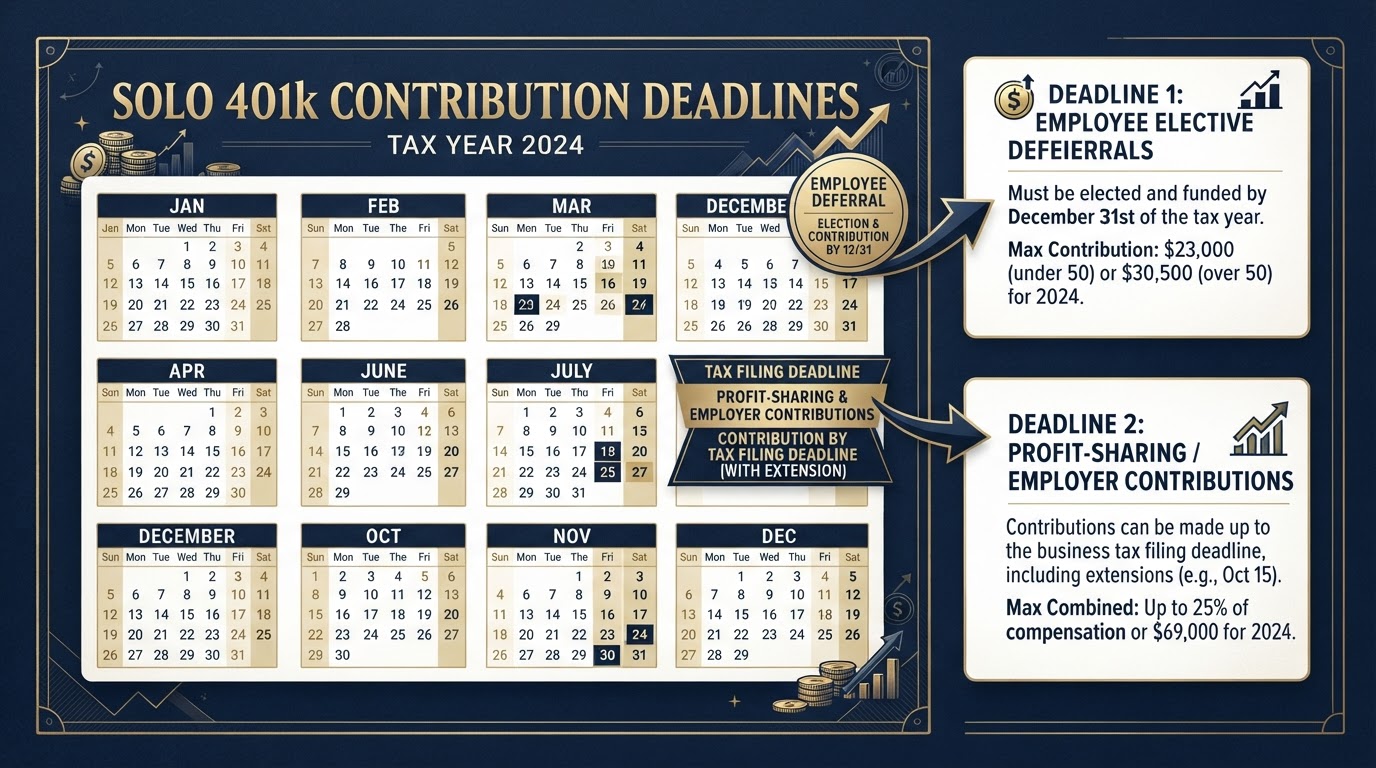
Deadlines are where well-intentioned Solo 401(k) plans fall apart. The employee salary deferral bucket is the stricter of the two. To make a deferral for a given tax year, the plan must be established and the deferral elected by December 31 of that year — even though the actual contribution can be funded up to the tax filing deadline. If you wait until January to open the plan, you forfeit the employee deferral bucket entirely for the prior year.
The employer profit-sharing contribution is more forgiving. It can be made up to the tax filing deadline, including extensions, for the prior year. This is the same window a SEP IRA enjoys, which is why the SEP remains a fallback for owners who missed the year-end plan setup deadline.
There is one additional filing obligation owners routinely miss. Once the plan's total assets cross $250,000 at the end of a year, Form 5500-EZ must be filed with the Department of Labor. The form is straightforward, but the penalty for skipping it is not. We track this threshold for every Solo 401(k) client and prepare the filing automatically once it applies.
The Roth Option and the Mega Backdoor Strategy
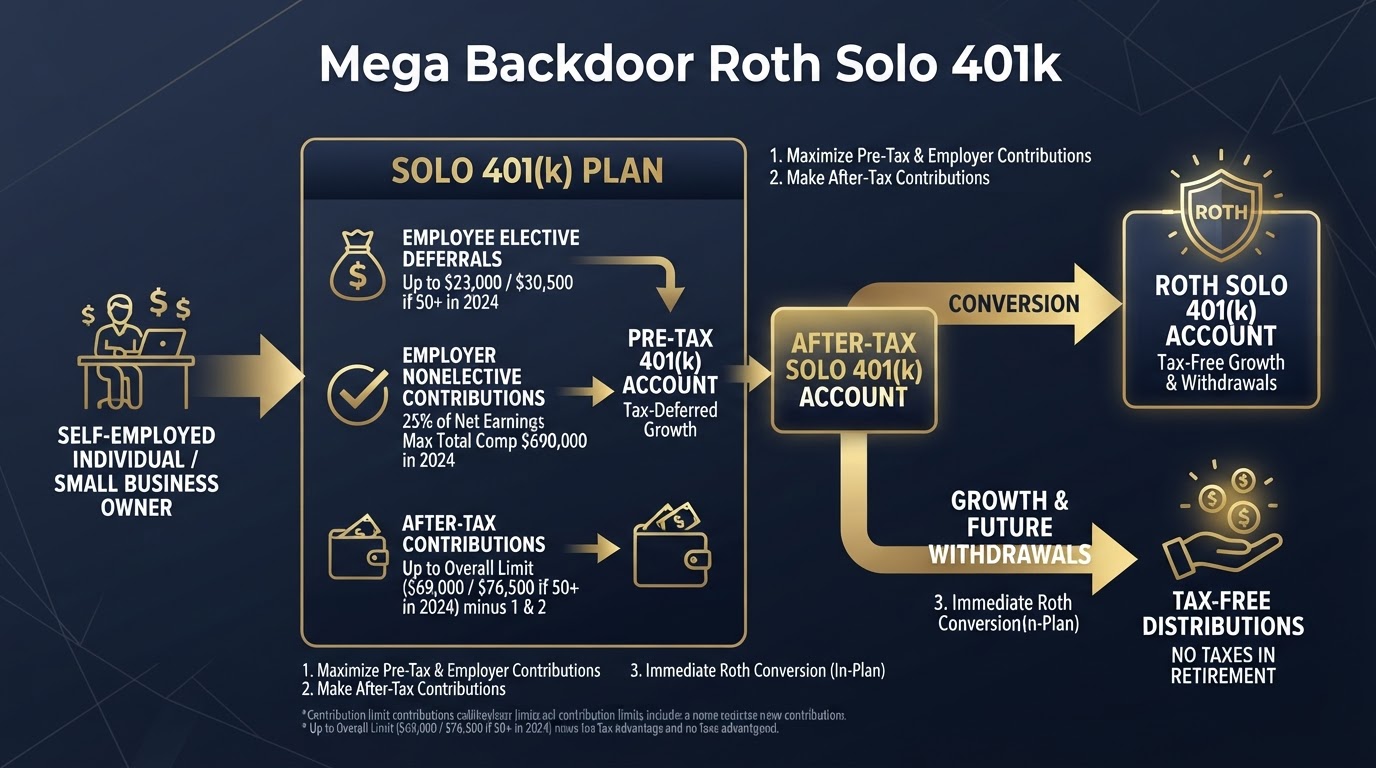
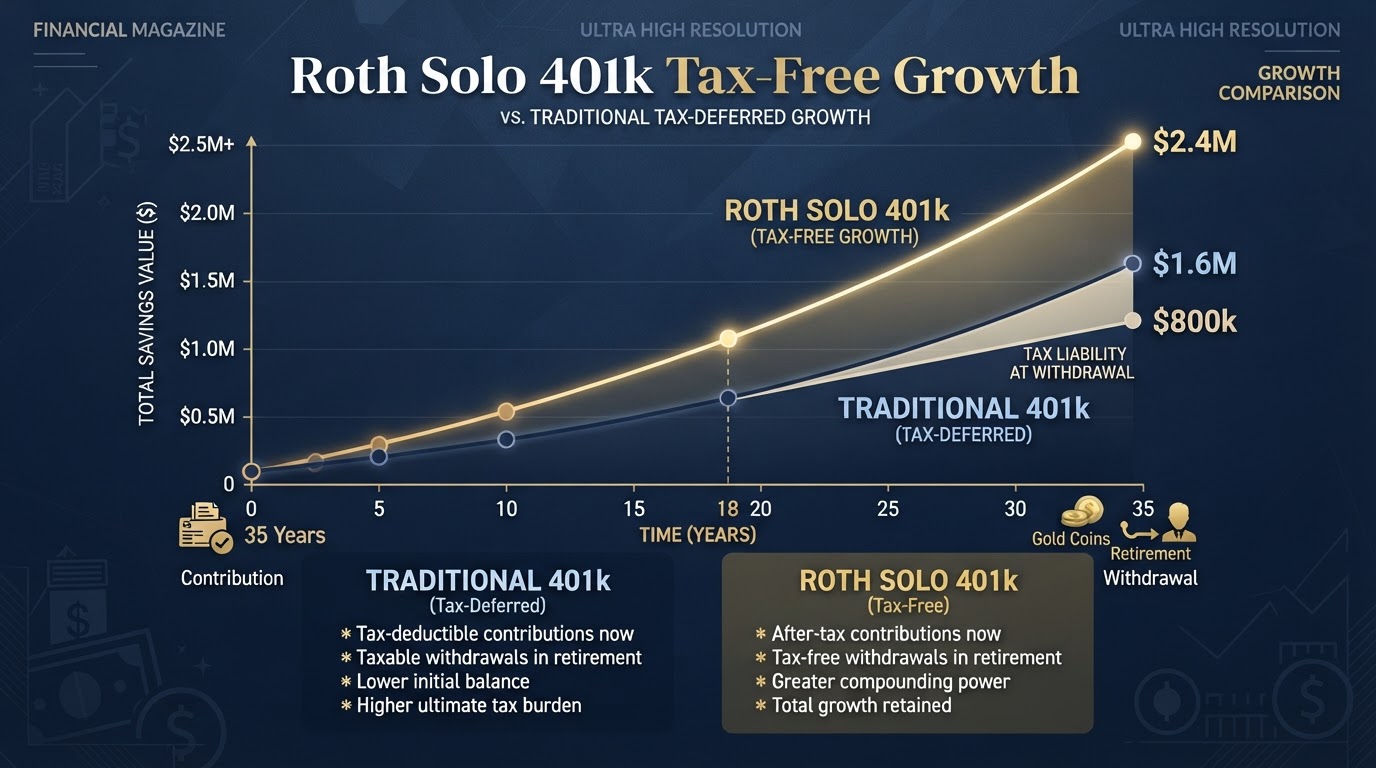
A Solo 401(k) can be structured to accept Roth (after-tax) employee contributions. Roth contributions do not reduce current taxable income, but all growth — and eventually all qualified withdrawals — are completely tax-free. For a high-earning owner who expects tax rates to rise, or who wants a tax-free bucket in retirement to manage Medicare premiums and Social-Security taxation, the Roth feature is a compelling long-term lever.
The more advanced feature is the Mega Backdoor Roth. A properly drafted plan can accept after-tax, non-Roth contributions above the standard employee deferral limit, up to the overall annual contribution cap. Those after-tax dollars can then be converted to Roth either inside the plan or through a rollover. The converted principal is tax-free going in and tax-free coming out, and every dollar of growth after conversion compounds tax-free permanently. This is the mechanism that lets an owner dramatically expand their Roth balance in a single year — far beyond what a standard Backdoor Roth IRA permits.
The catch is plan design. Not every Solo 401(k) provider offers after-tax contributions and in-plan Roth conversions. Adopting a prototype plan that lacks these features locks you out of the strategy until you amend or restate the document. We review the provider's plan document before adoption to confirm the Mega Backdoor features are enabled, because retrofitting them later is disruptive and sometimes impossible mid-year.
How Your Entity Type Changes the Math
The contribution calculation depends on how your business is taxed. For a sole proprietor or single-member LLC, profit-sharing is based on net self-employment income after the self-employment tax deduction, and the math runs through an adjustment that most owners find counterintuitive on the first pass. For an S-Corp owner, profit-sharing is based on the W-2 wages the owner pays themselves — which means reasonable compensation directly drives the contribution ceiling.
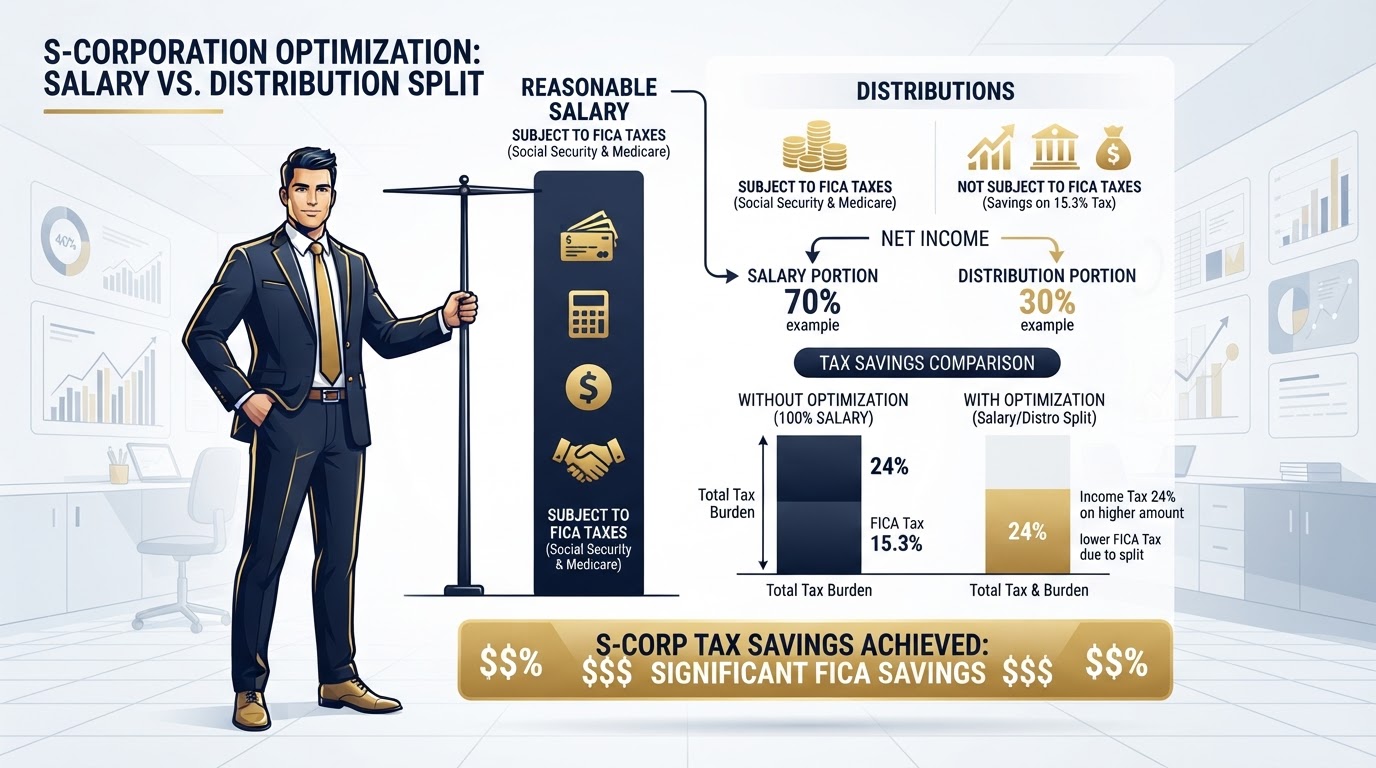
That interaction matters. An S-Corp owner who sets a deliberately low salary to minimize payroll tax also caps the profit-sharing bucket, which can backfire if the goal is maximizing the retirement deduction. We model both levers together — reasonable salary and profit-sharing percentage — so the owner sees the combined tax outcome rather than optimizing one in isolation and losing ground on the other.
For a partner in a partnership, the rules differ again: a partner cannot defer partnership income directly, so the plan must be established and the deferral coordinated with the partnership's guaranteed payments structure. This is a common point of confusion for multi-member LLCs that elect partnership taxation, and it is one of the first things we confirm during onboarding.
A FIG Client Case Study: The Solo Consultant Who Doubled His Deduction
A self-employed marketing consultant in Los Angeles came to us contributing to a SEP IRA each year. His net self-employment income was approximately $180,000, and his SEP contribution was capped near $33,000. His effective combined federal and California marginal rate was roughly 43%, meaning each dollar of deductible contribution saved about $0.43 in tax.
We reviewed his eligibility, confirmed he had no full-time employees, and recommended adopting a Solo 401(k) with a Roth feature before December 31. For the same income, the plan allowed the full employee deferral plus a profit-sharing contribution that brought his total deductible contribution to roughly $48,000 — an increase of about $15,000 over his SEP limit. At his marginal rate, the additional deduction reduced his tax bill by approximately $6,500 in a single year, while the Roth bucket began building a tax-free growth stream he did not previously have.
We also flagged that his prior SEP contributions, while legitimate, were made without any documentation linking them to a written contribution formula. We formalized the Solo 401(k) adoption, drafted the written resolution, set up the trust account, and built a recurring year-end review so the deferral election is never missed. The outcome: a larger current-year deduction, a Roth growth bucket, and a documented plan file that will hold up if the return is ever examined.

The Mistakes That Cost Owners the Deduction
The most expensive mistake is timing. Owners routinely wait until after January 1 to begin thinking about retirement contributions, and by then the employee deferral bucket for the prior year is closed. The second is adopting a plan that lacks Roth and Mega Backdoor features, locking the owner out of the most powerful long-term growth lever. The third is crossing the 1,000-hour employee threshold without realizing it, which can retroactively disqualify the plan and trigger excise taxes on excess contributions.
We also see owners commingle personal and plan funds, fail to open a separate trust account, or miss the Form 5500-EZ filing once assets cross $250,000. Each of these is a solvable problem, but only if it is caught before the IRS does. A clean plan file — adoption resolution, contribution formula, separate trust account, and timely filings — is the documentation that converts a good idea into a defensible tax position.
How Fiscal Integrity Group Helps Self-Employed Owners Maximize the Plan
For our self-employed clients, the Solo 401(k) is rarely a set-it-and-forget-it document. It is a living tax strategy that interacts with entity structure, reasonable compensation, estimated payments, and the year-end close. We manage all of it together. We confirm eligibility before adoption, select a plan provider whose document supports Roth and Mega Backdoor features, draft the adoption resolution, and model the optimal split between employee deferral and profit-sharing each year.
We track the December 31 deferral deadline and the tax-filing profit-sharing deadline on every client's calendar, monitor the $250,000 Form 5500-EZ threshold, and reconcile plan contributions against the books so the deduction on the return ties exactly to the cash that moved. If you are self-employed and not sure whether a Solo 401(k) beats your current arrangement — or whether you are even using the plan you already have to its full capacity — that is the question we are built to answer.
Quick Tax Savings Estimator
See how much you could potentially save with proactive tax strategy and clean bookkeeping. Most LA businesses overpay by 15-20% simply due to missed deductions.
Free IRS Audit Risk Assessment
Do you mix personal and business expenses in the same bank account?
Frequently Asked Questions
How far back can you catch errors?
I perform a deep forensic review of your history to catch errors and fix them. Whether it's one year or five, my goal is to ensure your historical data is pristine before we move forward.
Will you educate me on how to manage my books?
Yes! My approach is highly educational. I want you to understand the "why" behind the numbers so you can make better business decisions with confidence.

About the Author
Wiyao Awesso
Wiyao Awesso is a leading financial advisor in Los Angeles. With extensive experience in tax strategy, accounting, and fractional CFO services, he helps business owners optimize their finances, minimize tax liabilities, and scale with confidence.